Malamute or Dachshund: Both Will Excavate Your Garden
Quick answer
Malamute vs Dachshund: which should I choose?
The Dachshund if you live in a flat, someone is usually home and you will commit to lifelong back protection. The Malamute if you are athletic, have space and a properly secured garden, and want a large sociable dog.
One of these breeds was built to go underground after badgers and the other digs because it is bored and strong. Either way, a lawn is optional in both households. Beyond the shared enthusiasm for earthworks, they have almost nothing in common — and the Dachshund's short legs come with a spine that shapes everything else.
This page is for someone comparing a small characterful hound with a large working breed. It covers spinal disease and the household rules it produces, digging and containment, noise, time alone, and cost.
Quick verdict
The Dachshund is cheap, long-lived and suited to a flat, and it comes with a lifelong physical management plan; the Malamute needs a house, a fence and three times the budget.
Choose alaskan malamute if...
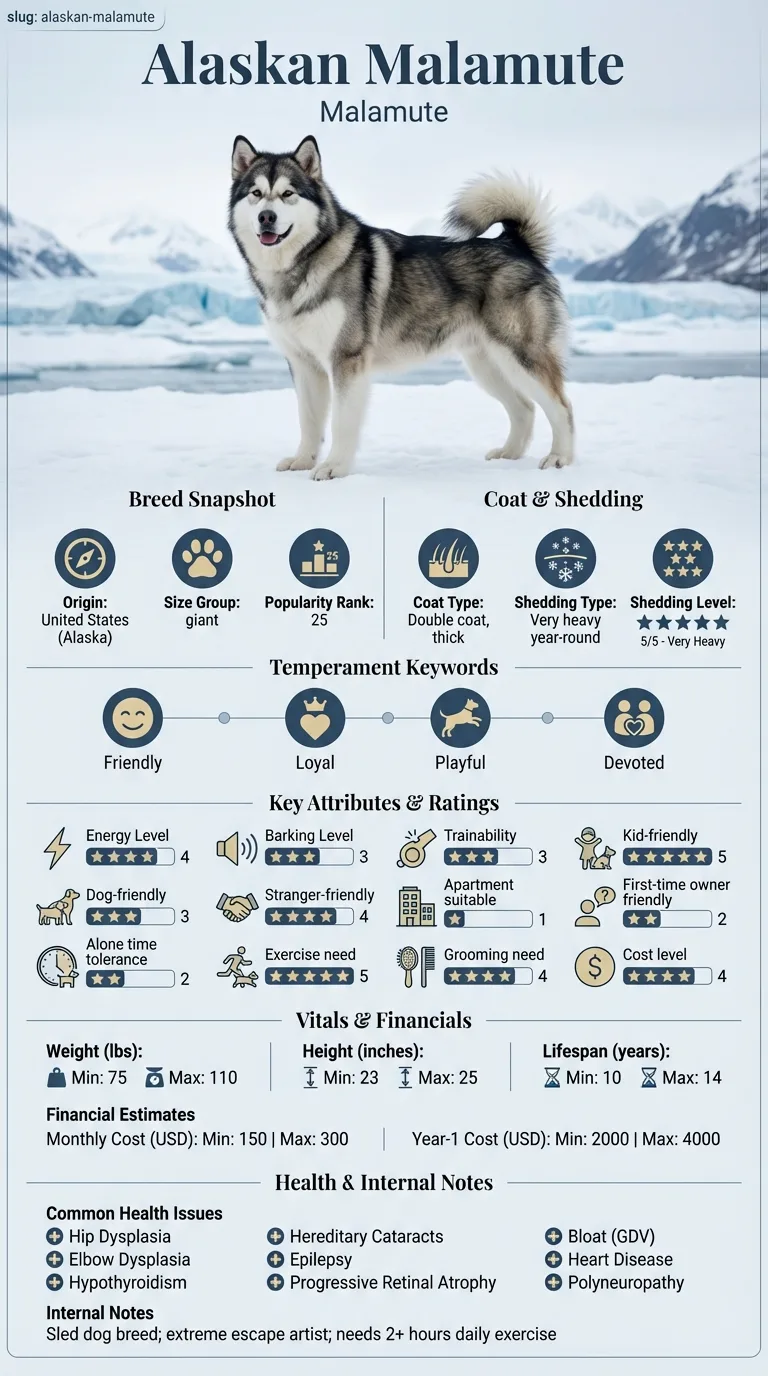
Choose the Alaskan Malamute if you are athletic, have space and want a large sociable dog. It rates 5/5 with children against the Dachshund's 3/5, 4/5 with strangers against 2/5, and barks at 3/5 against 4/5. You are accepting $150–$300 a month against $80–$150, 5/5 exercise and 5/5 shedding.
Choose dachshund if...
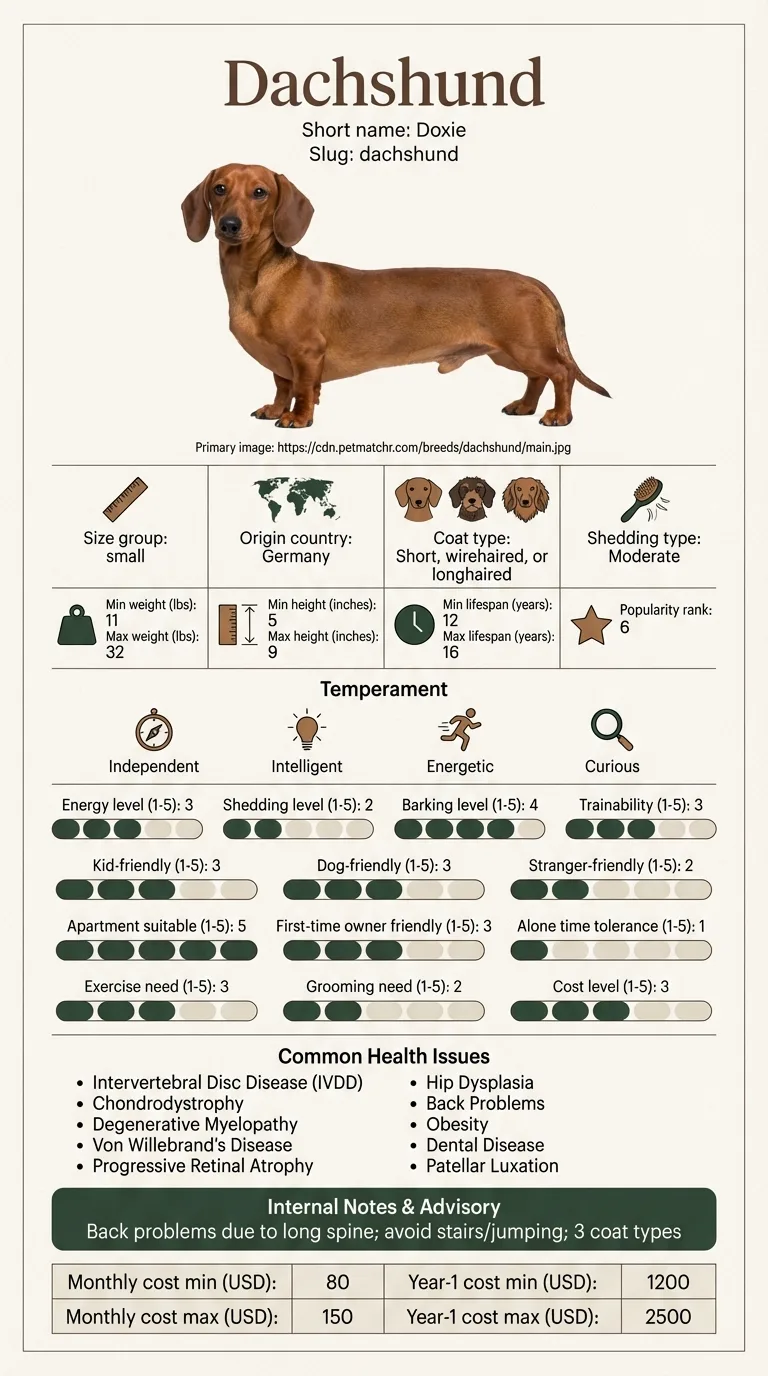
Choose the Dachshund if you live in a flat and someone is usually home. It rates 5/5 for apartments against 1/5, needs only 3/5 exercise, sheds at 2/5 and lives 12 to 16 years at $80–$150 a month. You are accepting 4/5 barking, a 1/5 tolerance for solitude and a back that has to be protected.
Head-to-head comparison
Feature
alaskan malamute
dachshund
Winner
Weight
75–110 lbs
11–32 lbs
Equal
Height
23–25 in
5–9 in
Equal
Lifespan
10–14 years
12–16 years
dachshund
Coat
Thick double coat
Short, wire or long
Equal
Grooming need
High (4/5)
Low (2/5)
dachshund
Shedding
Very high (5/5)
Low (2/5)
dachshund
Energy level
High (4/5)
Moderate (3/5)
Equal
Exercise need
Very high (5/5)
Moderate (3/5)
dachshund
Trainability
Moderate (3/5)
Moderate (3/5)
Equal
Barking
Moderate (3/5)
High (4/5)
alaskan malamute
Good with kids
Very high (5/5)
Moderate (3/5)
alaskan malamute
Good with other dogs
Moderate (3/5)
Moderate (3/5)
Equal
Friendly to strangers
High (4/5)
Low (2/5)
alaskan malamute
Apartment suitability
Very low (1/5)
Very high (5/5)
dachshund
Good for first-time owners
Low (2/5)
Moderate (3/5)
dachshund
Tolerates being alone
Low (2/5)
Very low (1/5)
alaskan malamute
Typical monthly cost
$150–$300
$80–$150
dachshund
Typical first-year cost
$2,000–$4,000
$1,200–$2,500
dachshund
Deep dive
Alaskan Malamute vs Dachshund: two breeds that move earth
This is the one genuine similarity and it is worth taking seriously before you turf a garden.
A Dachshund digs because that is the job. It was built to follow quarry underground, and the instinct arrives with the dog rather than developing from boredom. Flower beds, molehills, the base of a fence — anything that smells like something is under it.
A Malamute digs for two reasons: to make a cool hollow to lie in, which is normal northern-breed behaviour, and because it is under-exercised, which is when the excavation becomes structural. Its own breed notes call it an extreme escape artist, and the fence line is where a bored Malamute concentrates.
The containment consequence differs by scale. A Dachshund needs a fence with no gaps at ground level and no soft edges; a Malamute needs one dug in at the base, with secured gates, and its recall treated as a bonus rather than a safety measure.
Both households do better with a designated digging area than with a prohibition.
The Dachshund's spine and the rules it creates
Intervertebral disc disease heads the Dachshund's condition list, and chondrodystrophy — the genetic condition producing the short legs — is the cause. The same gene that shortens the limbs makes the spinal discs degenerate and calcify early, sometimes within the first year.
A degenerated disc that herniates presses on the spinal cord. Signs range from a reluctance to jump and a hunched back through to sudden hind limb weakness or paralysis, and severe cases are surgical emergencies where hours matter.
The management is lifelong and unglamorous. Keep the dog lean, because obesity is the largest modifiable risk and appears separately on the breed's list. Ramp the furniture the dog actually uses every day rather than only worrying about the stairs. Support the chest and hindquarters together when lifting, never under the front legs alone. Use a harness rather than a collar.
None of this makes a Dachshund a fragile or joyless dog — it runs, digs and hunts with enthusiasm. But the household has to be arranged around a spine for twelve to sixteen years.
The Malamute has hip and elbow dysplasia on its list and no comparable structural liability.
4/5 barking and a 1/5 tolerance for being left
The Dachshund's 4/5 barking is a hound's voice in a small body, and it is loud out of all proportion. It was bred to bark underground so a handler could locate it, and the instinct did not disappear when the breed moved indoors.
It announces the door, the corridor, the post and anything visible from a window. Blocking sightlines and training a settled alternative reduces it; the baseline stays high.
The 1/5 for solitude is the harder problem and the lowest rating on the scale. Dachshunds bond intensely and have no independent mode — left for a full day they vocalise, dig at doors and soil the house.
The Malamute at 2/5 and 3/5 is marginally better on both and fails differently. It howls rather than barks, which carries further, and a bored Malamute rearranges the garden rather than panicking indoors.
For a household out five days a week, neither is a fair choice without cover — but the Dachshund's version of that failure is distress and the Malamute's is landscaping.
Two hours of hauling against an hour on the flat
The Malamute rates 5/5 and is tired by resistance: carting, scootering, canicross, loaded hikes. Heat limits it, so summer sessions move to the cool ends of the day, and walking beside you does very little.
The Dachshund rates 3/5, which surprises people — around an hour a day, ideally with scent work, which tires a hound far more than distance. It is not a sedentary lap dog.
The constraint is what the exercise looks like. Repeated jumping on and off furniture, long flights of stairs and high-impact landings are hard on a chondrodystrophic spine, so mileage should be flat and steady rather than acrobatic.
The apartment ratings follow: 5/5 against 1/5. A Dachshund is a genuinely workable flat dog provided the noise and the solitude are managed; a Malamute is not, on size and output together.
On coat the Dachshund is far easier at 2/5 grooming and 2/5 shedding, with the wirehaired variety needing stripping and the longhaired needing brushing through its feathering. The Malamute needs an undercoat rake and several long sessions twice a year and should never be clipped.
Cheap to feed, expensive to insure
The Dachshund runs $80–$150 a month against the Malamute's $150–$300, and $1,200–$2,500 against $2,000–$4,000 in the first year.
The number that matters is insurance. Spinal surgery for a herniated disc runs into four figures and a meaningful share of the breed needs it, so Dachshunds are priced high relative to their size and some policies limit or exclude spinal cover. Read that section specifically before buying a policy rather than after.
Dental disease is the other recurring small-breed cost, and daily brushing genuinely reduces it.
The Malamute's expensive risks are orthopaedic surgery and a bloat emergency, both four-figure events at this size, and its list also carries inherited polyneuropathy, which has a DNA test and shows in young dogs as exercise intolerance and a wobbly gait.
On lifespan the Dachshund is well ahead at 12 to 16 years against 10 to 14 — which also means the back-protection routine has to hold for longer.
Alaskan Malamute vs Dachshund at a glance
One of these breeds was built to go underground after badgers and the other digs because it is bored and strong — either way, a tidy lawn is optional in both households. Beyond that shared enthusiasm for earthworks, they have almost nothing in common, and the Dachshund's short legs come with a long spine that shapes everything else about owning one.
The Dachshund is cheap, long-lived at 12 to 16 years and suited to a flat at 5/5 for apartments, but it comes with a lifelong management plan to protect its back — no stairs, no jumping on and off furniture — and a 1/5 tolerance for being left alone. The Malamute needs a house, secure fencing and roughly three times the monthly budget, but carries no comparable structural fragility.
Choose the Malamute if you are athletic, have space and want a large sociable dog. Choose the Dachshund if you live in a flat and someone is usually home to manage its back and its solitude.
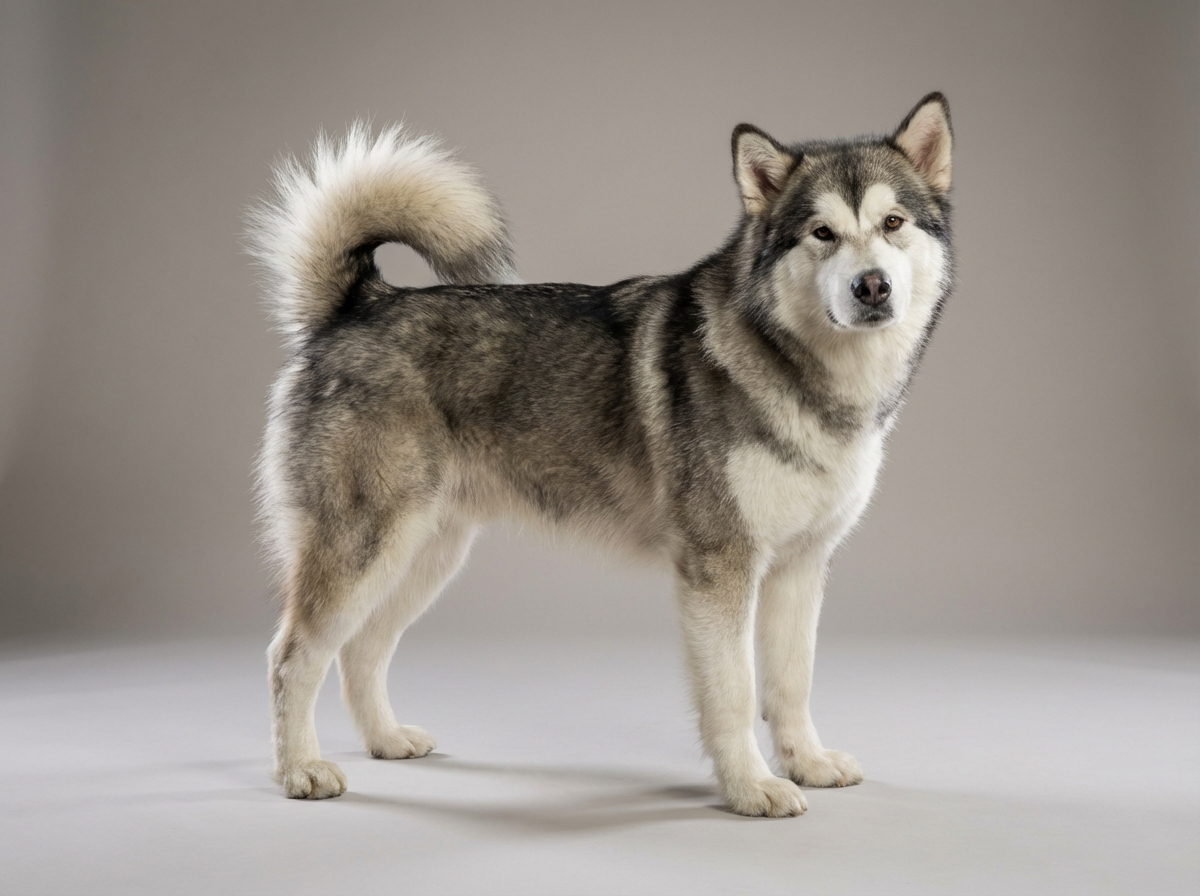
Malamute or Dachshund: Both Will Excavate Your Garden - Alaskan Malamute vs Dachshund at a glance
Frequently asked questions
Do both breeds really dig?
Yes, for different reasons. A Dachshund digs because it was built to follow quarry underground and the instinct arrives with the dog. A Malamute digs to make a cool hollow, and excavates seriously when under-exercised. Both households do better with a designated digging area than with a prohibition.
How likely is back trouble in a Dachshund?
Common enough that the whole household should be arranged around it. Intervertebral disc disease heads the breed's condition list, caused by chondrodystrophy — the same genetic condition that shortens the legs also makes the spinal discs degenerate and calcify early, sometimes within the first year.
What are the rules for protecting a Dachshund's back?
Keep the dog lean, since obesity is the largest modifiable risk. Ramp the furniture it uses every day rather than only worrying about stairs. Support the chest and hindquarters together when lifting, never under the front legs alone. Use a harness rather than a collar.
Which is noisier?
The Dachshund at 4/5 against the Malamute's 3/5, and it is loud out of proportion to its size — the breed was selected to bark underground so a handler could locate it. The Malamute howls rather than barks, which carries further but happens far less often in a well-exercised dog.
Can either be left during a working day?
Neither comfortably. The Dachshund rates 1/5, the lowest on the scale, and has no independent mode. The Malamute rates 2/5 and gets bored rather than distressed. Both need absence training from week one and cover for a full day — one to prevent panic, the other to prevent landscaping.
How much exercise does a Dachshund need?
3/5 — around an hour a day, ideally with scent work, which tires a hound far more than distance. It is not a sedentary lap dog. The constraint is that the exercise should be flat and steady rather than acrobatic, because jumping and high-impact landings load a vulnerable spine.
Which is cheaper to keep?
The Dachshund, at $80–$150 a month against the Malamute's $150–$300, and $1,200–$2,500 against $2,000–$4,000 in the first year. Check the insurance carefully though — spinal surgery runs into four figures and some policies limit or exclude spinal cover for the breed.
The Dachshund if you live in a flat, someone is usually home and you will commit to lifelong back protection. The Malamute if you are athletic, have space and a properly secured garden, and want a large sociable dog.
Costs
How much does each cost per month?
The Malamute runs $150–$300 a month and the Dachshund $80–$150, with first-year totals of $2,000–$4,000 and $1,200–$2,500. Check whether a Dachshund policy limits spinal cover before buying it.
Behavior
Which is better with strangers and children?
The Malamute — 4/5 with strangers against 2/5 and 5/5 with children against 3/5. It is demonstrative and hopeless as a guard. The Dachshund is a wary hound with a strong opinion about visitors.
Health
Which lives longer?
The Dachshund at 12 to 16 years against the Malamute's 10 to 14. That also means the ramps, the weight control and the lifting technique have to hold for a decade and a half.
Health information here is general and is not veterinary advice. If your dog shows pain, sudden behaviour change, or worsening symptoms, consult a licensed veterinarian.
Some links on this site are affiliate links. We may earn a commission at no extra cost to you, and we only suggest products we believe are helpful for dog owners.
We research and check what we publish, but we do not warrant that any figure, date, price, or statement is accurate, complete, or current, and we accept no liability for any loss, cost, injury, or other harm arising from the use of this site. Use it as one reference among several. You remain responsible for your own decisions and for your dog's care - confirm anything that matters with a licensed veterinarian or another qualified professional before you act on it. Full disclaimer.