Akita or Cavalier: The Dog That Watches, or the One That Follows
Quick answer
Akita vs Cavalier King Charles Spaniel: which should I choose?
The Cavalier if someone is home most of the day and you want a gentle, universally friendly companion. The Akita if the house is empty during the day and you want a self-contained guardian with space to keep it.
The Cavalier rates 5/5 with children, 5/5 with other dogs, 4/5 with strangers and 5/5 for first-time owners. The Akita rates 3/5, 2/5, 2/5 and 1/5. On temperament these two sit at opposite ends of the site, and the gap is not something training closes.
This page is for someone weighing a genuine lap dog against a genuine guardian. It covers the sociability gap, the Cavalier's mitral valve disease — the single most important fact about the breed — its 1/5 tolerance for being left alone, size and cost, and what each asks of a week.
Quick verdict
The Cavalier is the easier dog in every way that concerns behaviour and the harder one in every way that concerns health, and its heart disease is close to a certainty rather than a risk.
Choose akita if...
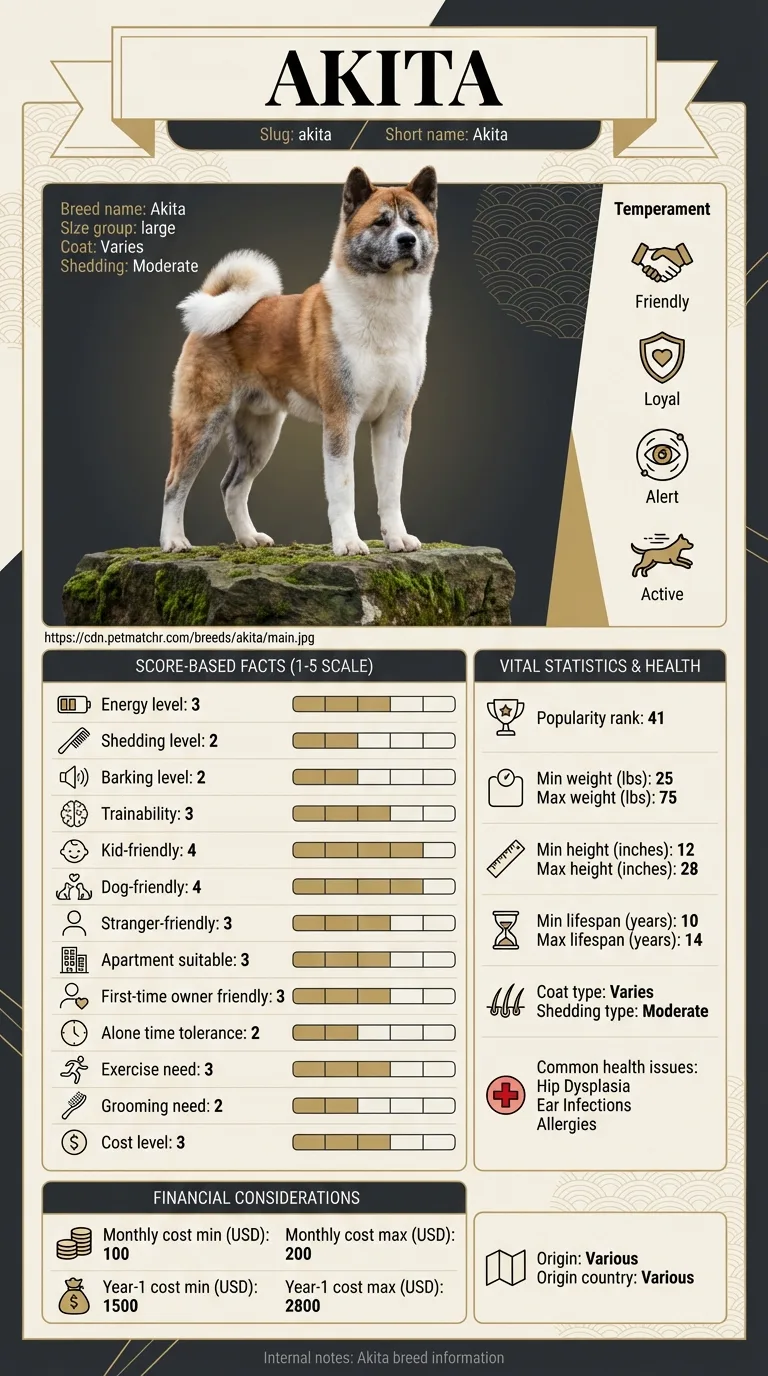
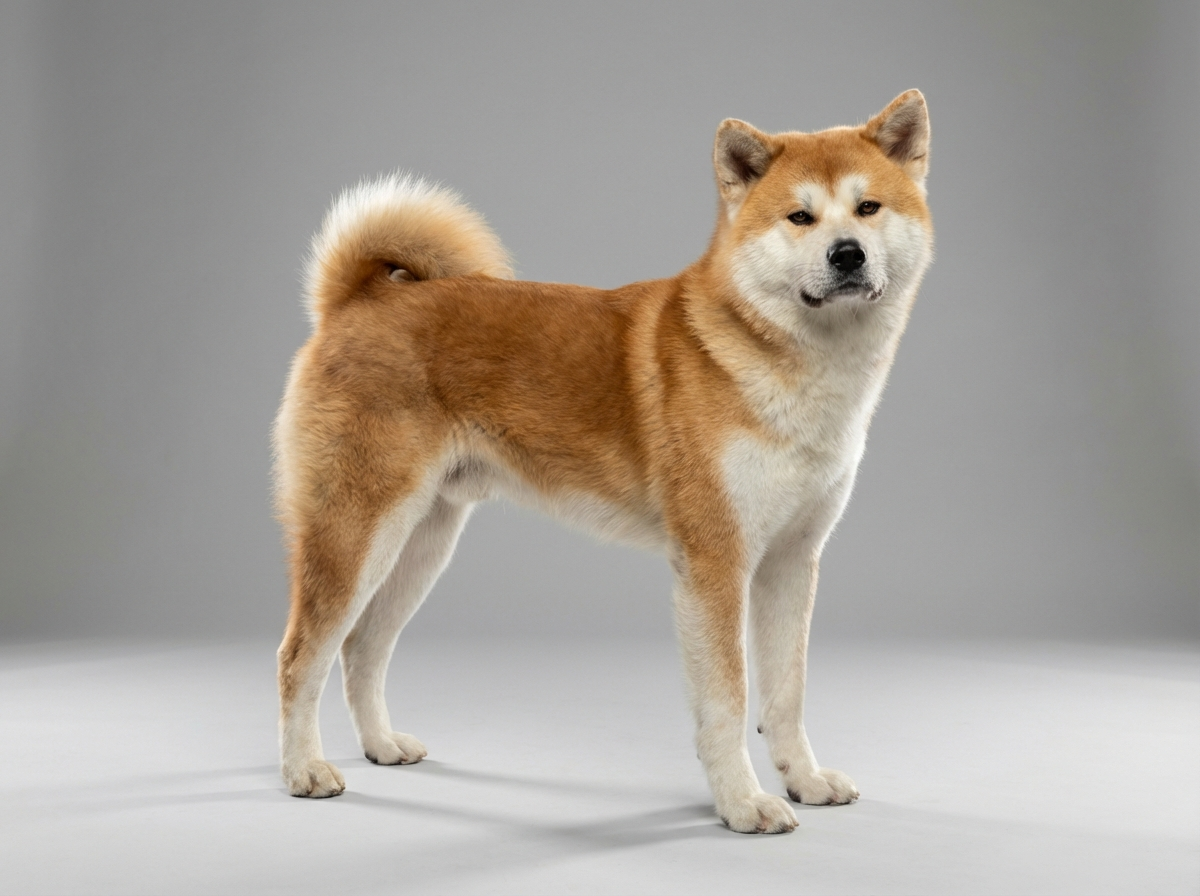
Choose the Akita if the house is empty during the day, you have space and a fenced garden, and you want a guardian. It tolerates being alone at 3/5 against the Cavalier's 1/5 and has a far sounder heart. You are accepting 1/5 for first-time owners, 2/5 with other dogs and strangers, 5/5 shedding and up to 130 pounds of dog.
Choose cavalier king charles spaniel if...
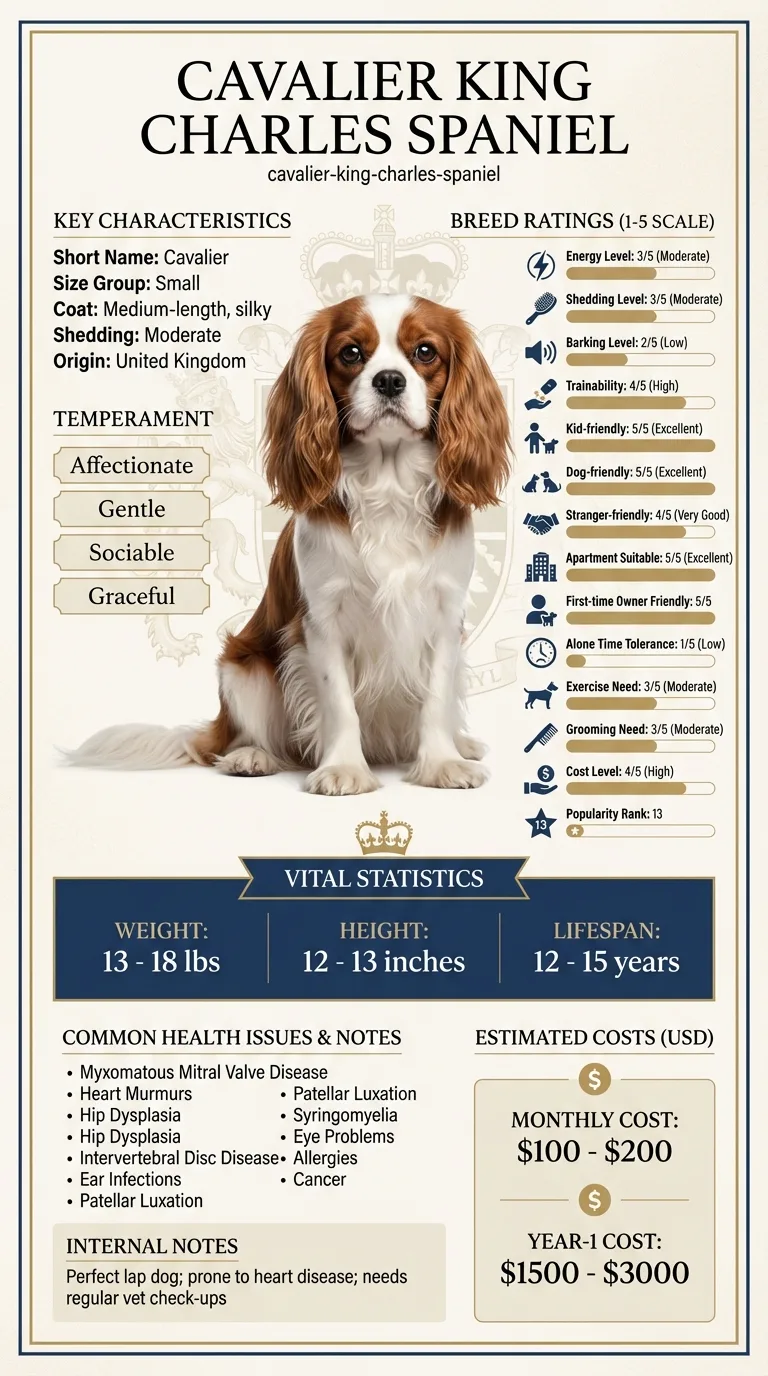
Choose the Cavalier if someone is home most of the day and you want a small, gentle, universally friendly companion. It rates 5/5 for apartments, first-time owners, children and other dogs, and lives 12 to 15 years. You are accepting a breed in which mitral valve disease is close to inevitable with age, plus a 1/5 tolerance for solitude.
Head-to-head comparison
Feature
akita
cavalier king charles spaniel
Winner
Weight
70–130 lbs
13–18 lbs
Equal
Height
24–28 in
12–13 in
Equal
Lifespan
10–13 years
12–15 years
cavalier king charles spaniel
Coat
Dense double coat
Medium-length, silky
Equal
Grooming need
Moderate (3/5)
Moderate (3/5)
Equal
Shedding
Very high (5/5)
Moderate (3/5)
cavalier king charles spaniel
Energy level
Moderate (3/5)
Moderate (3/5)
Equal
Exercise need
Moderate (3/5)
Moderate (3/5)
Equal
Trainability
Moderate (3/5)
High (4/5)
cavalier king charles spaniel
Barking
Low (2/5)
Low (2/5)
Equal
Good with kids
Moderate (3/5)
Very high (5/5)
cavalier king charles spaniel
Good with other dogs
Low (2/5)
Very high (5/5)
cavalier king charles spaniel
Friendly to strangers
Low (2/5)
High (4/5)
cavalier king charles spaniel
Apartment suitability
Low (2/5)
Very high (5/5)
cavalier king charles spaniel
Good for first-time owners
Very low (1/5)
Very high (5/5)
cavalier king charles spaniel
Tolerates being alone
Moderate (3/5)
Very low (1/5)
akita
Typical monthly cost
$110–$240
$100–$200
cavalier king charles spaniel
Typical first-year cost
$1,700–$3,200
$1,500–$3,000
cavalier king charles spaniel
Deep dive
Mitral valve disease is the fact about this breed
Myxomatous mitral valve disease heads the Cavalier's condition list, and no honest comparison of this breed can treat it as one item among ten.
It is a degenerative disease of the heart's mitral valve. The valve thickens, stops sealing properly, and blood leaks backward — first as a murmur, eventually as heart failure. In Cavaliers it appears far earlier and far more frequently than in any other breed, and a large majority of Cavaliers have a murmur by their tenth year. Many have one well before that.
What this means practically: annual cardiac auscultation from around three years old, echocardiography once a murmur appears, and medication that often becomes lifelong. The condition is manageable for years with modern treatment, and treatment costs money every month.
When buying, ask specifically about heart-scheme results for the parents and grandparents, and about the age at which murmurs appeared in that line. A breeder following an established cardiac scheme is the single most useful filter available to you.
Syringomyelia — fluid-filled cavities in the spinal cord, often caused by a skull too small for the brain — is the second condition to name out loud.
A 1/5 tolerance for being left
The Cavalier's 1/5 for time alone is the lowest rating on the scale, and it is the reason this breed does not suit a household that is out all day.
A dog bred for centuries with no function other than human company does not have a fallback. Left for long stretches, Cavaliers vocalise, become destructive at doors, and in many cases simply stop eating until someone returns. This is not stubbornness or spite; it is a breed with no independent mode.
It is manageable if the household allows it. Someone working from home, a retired owner, a family with staggered hours, or a reliable midday walker all make it fine. Full-time absence with no cover does not.
The Akita at 3/5 is genuinely self-contained. It sleeps. It does not need entertaining, and it does not experience an empty house as a loss.
If your working pattern is fixed and nobody is home, this row alone decides the comparison, regardless of everything else on the page.
Children, dogs and daily handling
The Cavalier rates 5/5 with children and 5/5 with other dogs. The caveat is fragility rather than temperament: at 13 to 18 pounds it is easily hurt by a toddler, and intervertebral disc disease and patellar luxation both appear on its list, so jumping off furniture is worth discouraging early.
It is also easy to handle — 4/5 trainability, no strength to speak of, and a strong desire to please. Recall is the one weak point, because the breed retains enough spaniel to follow a scent across a road without hesitation.
The Akita's 3/5 with children reflects the opposite risk profile: a hundred-pound dog, limited patience for rough handling, and a guarding temperament that needs supervision around visiting children. Nothing about that is hostility toward its own family.
Grooming is 3/5 for both. The Cavalier's silky coat and feathered ears mat behind the ears and on the legs and need brushing several times a week, plus ear checks, since ear infections are common. The Akita's work is seasonal: an undercoat rake through the two periods a year when it blows a dense double coat at 5/5 shedding.
What each costs, and where the money goes
On paper the two are close: $100–$200 a month for the Cavalier against $110–$240 for the Akita, and $1,500–$3,000 against $1,700–$3,200 in the first year.
The composition is different. The Akita's monthly figure is mostly food and weight-dosed products, with veterinary spend that is episodic — autoimmune disease, thyroid management, or a bloat emergency, none of which are certainties.
The Cavalier's figure is small on food and heavier on medicine, and the trajectory rises with age in a way the Akita's does not. Once cardiac medication starts, it does not stop, and echocardiograms are not cheap. Insurers know this: Cavaliers are frequently quoted above what their size suggests, and heart conditions are the most common breed-related exclusion applied to them.
Buying insurance before the first murmur is heard is the whole game with this breed. A Cavalier insured from eight weeks is a very different financial proposition from one insured at five years with a note on its record.
Lifespan runs 12 to 15 years against the Akita's 10 to 13.
Akita vs Cavalier King Charles Spaniel: the sociability gap
Four rows on this table separate by three points or more, and all four are about people and other animals.
The Cavalier is one of the few breeds on this site that rates 4/5 or above on every social measure. It genuinely likes everyone — visitors, children, other dogs, cats in many cases — and it does not have a suspicious mode to switch into.
The Akita has almost nothing else. Its reserve with strangers at 2/5 and its intolerance of other dogs at 2/5 are not failures of socialisation; they are what the breed was selected for, and good socialisation makes them manageable rather than absent.
The rows that tie are the quiet ones. Both bark at 2/5. Both rate 3/5 for energy and 3/5 for exercise — which surprises people, because the Cavalier is not a hyperactive small dog and the Akita is not a driven large one. Both are, in their own way, calm indoors.
Akita or Cavalier: The Dog That Watches, or the One That Follows - Akita vs Cavalier King Charles Spaniel: the sociability gap
Frequently asked questions
Is a Cavalier or an Akita better for a first-time owner?
The Cavalier, at 5/5 against the Akita's 1/5. It is small, gentle, trains at 4/5 and has no suspicious mode to manage. The one condition is that someone needs to be home most of the day — it rates 1/5 for tolerating solitude, the lowest rating on the scale, and full-time absence does not suit the breed.
Do all Cavaliers get heart disease?
Not all, but a large majority develop a mitral valve murmur by ten years old, and many considerably earlier. Myxomatous mitral valve disease is the defining health issue of the breed. Plan for annual cardiac checks from around three, echocardiography once a murmur appears, and medication that often becomes lifelong.
Which is better with other dogs?
The Cavalier, overwhelmingly — 5/5 against the Akita's 2/5. Akita dog-intolerance is frequently same-sex and usually surfaces at social maturity around two years old rather than in puppyhood. If you already have a dog or want off-lead park life, this row decides the comparison on its own.
How long can a Cavalier be left alone?
Not a full working day without cover. At 1/5 it is the least solitude-tolerant profile on this site. Expect vocalising, destruction at doors and refusal to eat. It works well for someone at home, a retired owner, or a household with a reliable midday walker. The Akita at 3/5 is genuinely self-contained.
Which needs more exercise?
Neither — both rate 3/5, which surprises most people. The Cavalier wants around an hour split over the day and is happy on the sofa the rest of the time. The Akita wants forty-five to sixty minutes of walking. The difference is where it happens: the Akita needs a securely fenced space, the Cavalier does not.
What should I ask a Cavalier breeder?
Cardiac scheme results for the parents and grandparents, and the age at which murmurs first appeared in the line. Then ask about syringomyelia, which is diagnosed by MRI, and about patella and eye testing. A breeder following an established heart scheme is the most useful filter you have.
Which is cheaper to keep?
The Cavalier slightly, at $100–$200 a month against $110–$240, but the shape matters more than the number. The Akita's cost is mostly food and stays flat; the Cavalier's is mostly medicine and rises with age. Insure a Cavalier from eight weeks, before any murmur is on its record.
Akita vs Cavalier King Charles Spaniel: which should I choose?
The Cavalier if someone is home most of the day and you want a gentle, universally friendly companion. The Akita if the house is empty during the day and you want a self-contained guardian with space to keep it.
Costs
How much does each cost per month?
The Cavalier runs $100–$200 a month and the Akita $110–$240, with first-year totals of $1,500–$3,000 and $1,700–$3,200. The Cavalier's costs rise with age as cardiac medication begins.
Health
What is the main health risk in a Cavalier?
Myxomatous mitral valve disease. Most Cavaliers develop a heart murmur by ten and many far earlier. Annual cardiac checks from around three years old and insurance taken out in puppyhood are the two things that matter.
Behavior
Which is quieter?
Both rate 2/5 for barking, which is a genuine tie. Neither is a nuisance barker — unusual for a small companion breed, and one of the Cavalier's underrated advantages for flat living.
Related DogBreedCompass guides
Akita breed guide – The Akita profile covers guardian temperament and the long socialisation window the breed needs.
Health information here is general and is not veterinary advice. If your dog shows pain, sudden behaviour change, or worsening symptoms, consult a licensed veterinarian.
Some links on this site are affiliate links. We may earn a commission at no extra cost to you, and we only suggest products we believe are helpful for dog owners.
We research and check what we publish, but we do not warrant that any figure, date, price, or statement is accurate, complete, or current, and we accept no liability for any loss, cost, injury, or other harm arising from the use of this site. Use it as one reference among several. You remain responsible for your own decisions and for your dog's care - confirm anything that matters with a licensed veterinarian or another qualified professional before you act on it. Full disclaimer.