Malamute vs Cavalier: which should I choose?
The Cavalier if someone is home most of the day and you want a gentle, friendly companion in a flat. The Malamute if you are athletic, have space and a secured garden, and want a structurally sound dog.
The Cavalier rates 1/5 for tolerating time alone and the Malamute 2/5. Both are among the worst breeds on this site for an empty house, and they arrive there from opposite directions — one was bred purely for human company, the other to work in a team. Neither inherited an off switch for solitude.


This page is for someone weighing a small gentle companion against a large working breed. It covers the solitude problem in both, the exercise gap, the Cavalier's heart disease and why insurance timing matters, coat work and cost.
The Cavalier is the easier dog in every behavioural respect and carries a near-certain heart disease; the Malamute is physically sound and asks for two hours a day.
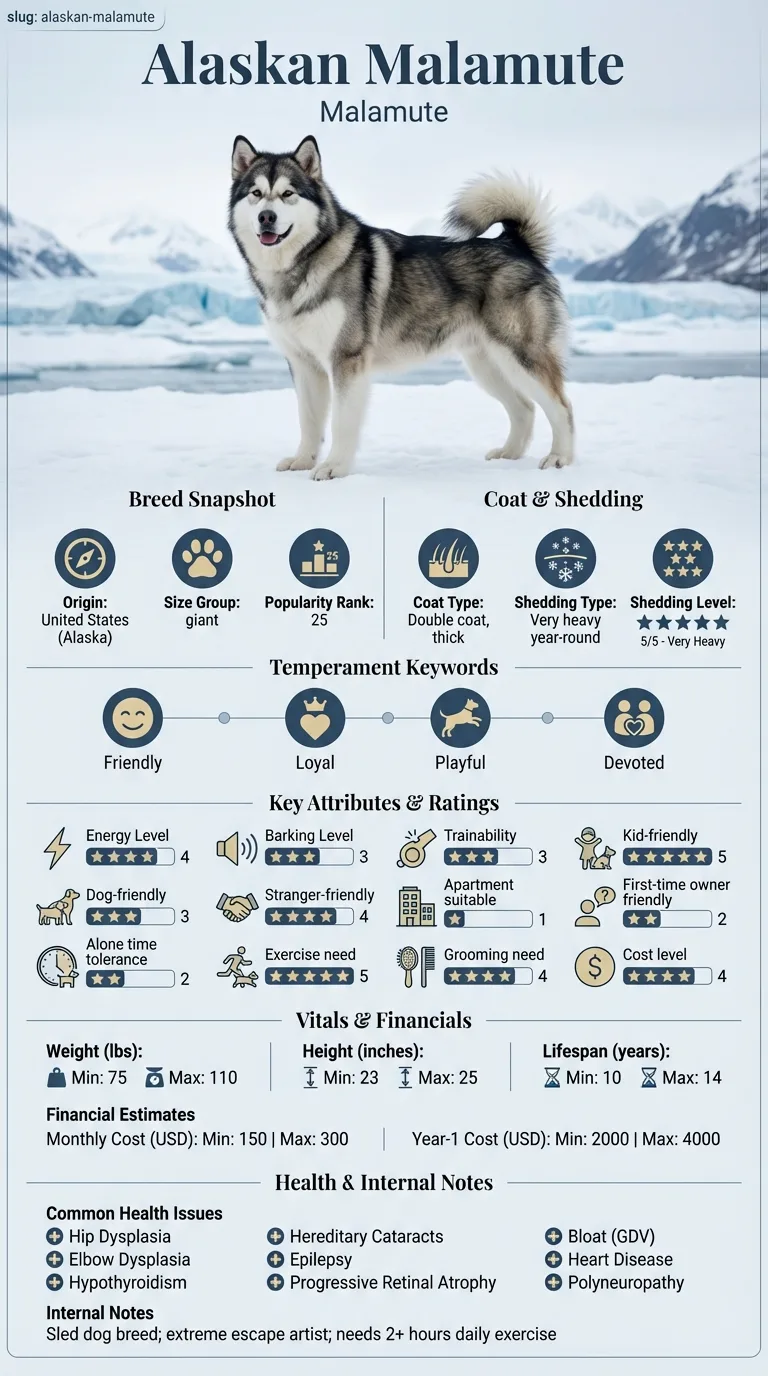
Choose the Alaskan Malamute if you are athletic, have space and want a structurally robust dog. It has no comparable cardiac risk and rates 5/5 with children like the Cavalier. You are accepting $150–$300 a month against $100–$200, 5/5 exercise against 3/5, 5/5 shedding, 4/5 grooming and a 1/5 apartment rating.
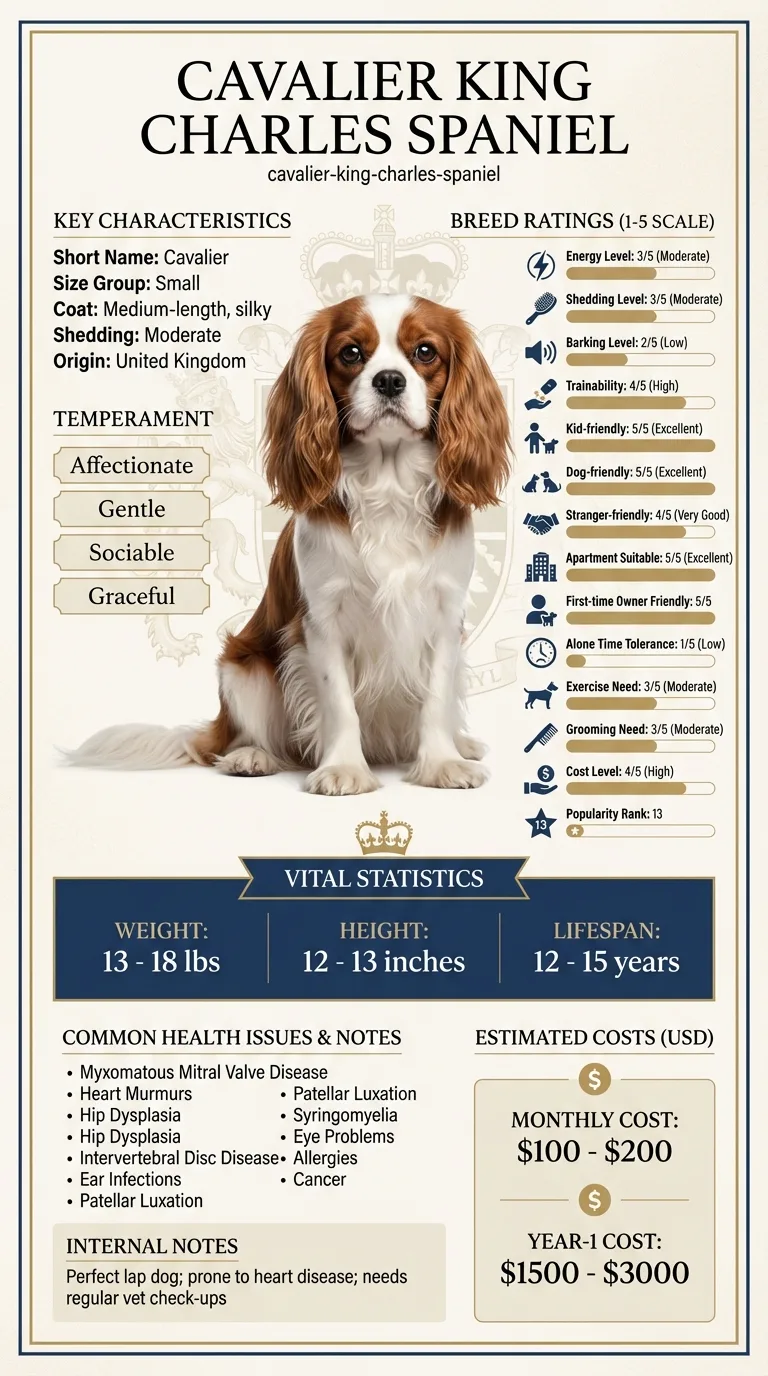
Choose the Cavalier if someone is home most of the day and you want a gentle, universally friendly companion. It rates 5/5 for apartments, first-time owners, children and other dogs, needs only 3/5 exercise and lives 12 to 15 years. You are accepting mitral valve disease as close to inevitable with age.
| Feature | alaskan malamute | cavalier king charles spaniel | Winner |
|---|---|---|---|
| Weight | 75–110 lbs | 13–18 lbs | Equal |
| Height | 23–25 in | 12–13 in | Equal |
| Lifespan | 10–14 years | 12–15 years | cavalier king charles spaniel |
| Coat | Thick double coat | Medium-length, silky | Equal |
| Grooming need | High (4/5) | Moderate (3/5) | cavalier king charles spaniel |
| Shedding | Very high (5/5) | Moderate (3/5) | cavalier king charles spaniel |
| Energy level | High (4/5) | Moderate (3/5) | Equal |
| Exercise need | Very high (5/5) | Moderate (3/5) | cavalier king charles spaniel |
| Trainability | Moderate (3/5) | High (4/5) | cavalier king charles spaniel |
| Barking | Moderate (3/5) | Low (2/5) | cavalier king charles spaniel |
| Good with kids | Very high (5/5) | Very high (5/5) | Equal |
| Good with other dogs | Moderate (3/5) | Very high (5/5) | cavalier king charles spaniel |
| Friendly to strangers | High (4/5) | High (4/5) | Equal |
| Apartment suitability | Very low (1/5) | Very high (5/5) | cavalier king charles spaniel |
| Good for first-time owners | Low (2/5) | Very high (5/5) | cavalier king charles spaniel |
| Tolerates being alone | Low (2/5) | Very low (1/5) | alaskan malamute |
| Typical monthly cost | $150–$300 | $100–$200 | cavalier king charles spaniel |
| Typical first-year cost | $2,000–$4,000 | $1,500–$3,000 | cavalier king charles spaniel |
1/5 and 2/5 are the two worst solitude ratings a household can pick between, and it is worth understanding that they fail differently.
The Cavalier has no independent mode at all. Bred for centuries with no function other than human company, it vocalises, becomes destructive at doors, and in many cases simply stops eating until someone comes home. It is distress rather than boredom.
The Malamute is bored rather than frightened, and a bored Malamute is an engineering problem. It digs, works the fence line, and its own breed notes call it an extreme escape artist.
The management differs accordingly. The Cavalier needs graduated absence training from week one, never pushed to the point of panic, and a walker or day care for a full working day. The Malamute needs a longer morning haul, something to dismantle that you do not mind losing, and concrete along the fence.
If nobody is home five days a week, neither of these breeds is a fair choice without cover.
Myxomatous mitral valve disease heads the Cavalier's condition list and it is not one item among ten. It is the defining fact about the breed.
The valve thickens, stops sealing, and blood leaks backward — first as a murmur, eventually as heart failure. In Cavaliers it appears earlier and more often than in any other breed, and a large majority have a murmur by their tenth year. Many have one well before that.
The practical consequence most owners learn too late is about insurance rather than medicine. A murmur heard at four years old goes on the dog's record, and every policy taken out afterwards will exclude cardiac conditions — which is precisely the cover this breed needs. Insure from eight weeks and never let the policy lapse.
On the medical side: annual cardiac auscultation from around three, echocardiography once a murmur appears, and medication that often becomes lifelong and grows over the years.
When buying, ask for heart-scheme results on the parents and grandparents and the age at which murmurs appeared in that line.
The Malamute carries heart disease on its list too, but nothing of this scale or predictability.

The Malamute rates 5/5 for exercise and the Cavalier 3/5, which is a smaller gap than most people expect — the Cavalier is not a cushion ornament and wants around an hour split across the day.
What differs is the kind. A Malamute is tired by resistance: carting, scootering, canicross, loaded hikes. Walking beside you does very little, and two hours is realistic. Heat limits it, so summer sessions move to the cool ends of the day.
A Cavalier walks. It also retains enough spaniel to follow a scent across a road without hesitation, so its recall needs proofing and its lead is not optional near traffic.
The housing consequence is stark: 1/5 for apartments against 5/5. The Malamute's problem is size and output together, and the Cavalier has neither.
Both need care in warm weather — the Malamute because of its coat, the Cavalier because a heart condition and heat are a poor combination in an older dog.
Children ties at 5/5 and strangers ties at 4/5. Both are demonstrative, friendly breeds and neither guards anything.
The Cavalier is better with other dogs at 5/5 against 3/5 — Malamute same-sex intolerance is common and usually appears at social maturity around two years old — and easier to train at 4/5 against 3/5.
Its caveat is fragility rather than temperament. At 13 to 18 pounds it is easily hurt by a toddler, and intervertebral disc disease and patellar luxation are both on its list, so jumping off furniture is worth discouraging early.
The Malamute's caveat is the opposite: a hundred-pound dog that is entirely well-meaning still knocks things over, and its containment problem is permanent rather than developmental.
On noise the Cavalier is quieter at 2/5 against 3/5, which is unusual for a small companion breed and one of its underrated advantages in a flat.
Syringomyelia is the second Cavalier condition worth naming — fluid-filled cavities in the spinal cord, often signalled by scratching at the neck without touching the skin.
The Cavalier runs $100–$200 a month against the Malamute's $150–$300, and $1,500–$3,000 against $2,000–$4,000 in the first year.
Grooming is 3/5 against 4/5. The Cavalier's silky coat and feathered ears mat behind the ears and on the legs and need brushing several times a week, plus ear checks. The Malamute's work is seasonal: an undercoat rake and several long sessions during two heavy blows a year, on top of shedding constantly at 5/5. Its coat never mats, never needs a groomer, and should never be clipped.
The shape of the veterinary spending is the real difference. The Malamute's is episodic — orthopaedic surgery or a bloat emergency, expensive and uncertain. The Cavalier's rises steadily with age as cardiac medication starts and grows, and that trajectory is close to predictable.
Which is why the insurance point matters more here than anywhere else on this page: a Cavalier insured from eight weeks and kept insured is a very different financial proposition from one insured at five.
On lifespan the Cavalier is ahead at 12 to 15 years against 10 to 14.
The Cavalier rates 1/5 for tolerating time alone and the Malamute 2/5 — both among the worst breeds on this site for an empty house, arrived at from opposite directions. One was bred purely for human company; the other to work in a team. Neither inherited an off switch for solitude.
The Cavalier is the easier dog in almost every other respect: 5/5 for apartments, first-time owners, children and other dogs, and only 3/5 exercise against the Malamute's 5/5. What it carries instead is a heart condition, myxomatous mitral valve disease, that becomes close to inevitable with age and shapes both the breeder search and the dog's later years. The Malamute has no comparable cardiac risk but needs two hours of exercise a day and a securely fenced home.
Choose the Malamute if you are athletic, have space, and want a structurally robust dog. Choose the Cavalier if someone is home most of the day and you want a gentle, universally friendly companion.
The Malamute marginally, at 2/5 against the Cavalier's 1/5, though neither is good. The Cavalier has no independent mode and experiences real distress; the Malamute gets bored and turns into an engineering problem, digging and working the fence line. Both need cover for a full working day.
Not all, but a large majority develop a mitral valve murmur by ten and many far earlier. It is the defining health issue of the breed. Plan for annual cardiac checks from around three, echocardiography once a murmur appears, and medication that often becomes lifelong and grows over time.
Because a murmur heard at four goes on the record, and every policy taken out afterwards excludes cardiac conditions — which is exactly the cover the breed needs. Insure from eight weeks and never let the policy lapse. It is the single most consequential financial decision in owning one.
3/5 — around an hour split across the day, which surprises people who expect a lap dog. The Malamute needs two hours at 5/5 and is tired by resistance rather than distance. The Cavalier also retains enough spaniel to follow a scent across a road, so its recall needs proofing.
The Cavalier at 5/5 against the Malamute's 3/5. Malamute same-sex intolerance is common and usually appears at social maturity around two years old rather than in puppyhood. Both are excellent with people, and neither is any use as a guard dog.
A condition in which fluid-filled cavities form in the spinal cord, often because the skull is too small for the brain behind it. It appears on the Cavalier's list. The classic sign is scratching toward the neck or shoulder without touching the skin. It is diagnosed by MRI and managed rather than cured.
The Cavalier, at $100–$200 a month against the Malamute's $150–$300, and $1,500–$3,000 against $2,000–$4,000 in the first year. The shape differs though: the Malamute's spending is episodic while the Cavalier's rises steadily with age as cardiac treatment begins.
The Cavalier if someone is home most of the day and you want a gentle, friendly companion in a flat. The Malamute if you are athletic, have space and a secured garden, and want a structurally sound dog.
The Malamute runs $150–$300 a month and the Cavalier $100–$200, with first-year totals of $2,000–$4,000 and $1,500–$3,000. The Cavalier's costs rise with age as cardiac medication starts.
Continuous insurance from puppyhood. Once a murmur is documented, cardiac cover is effectively unavailable — and cardiac cover is the cover this breed needs above all others.
The Malamute at 5/5 against the Cavalier's 3/5, with grooming at 4/5 against 3/5. It sheds year-round and blows its undercoat in sheets twice a year. Its coat never mats and should never be clipped.


Health information here is general and is not veterinary advice. If your dog shows pain, sudden behaviour change, or worsening symptoms, consult a licensed veterinarian.
Some links on this site are affiliate links. We may earn a commission at no extra cost to you, and we only suggest products we believe are helpful for dog owners.
Match your lifestyle to the right dog.
Take quizNot sure which breed is right for you? Take our 2-minute quiz to find out.
Take the quiz