Akita or Great Dane: Two Quiet Giants, One Much Shorter Life
Quick answer
Akita vs Great Dane: which should I choose?
The Great Dane if you want a genuinely gentle giant and can absorb $200–$400 a month and a 7 to 10 year lifespan. The Akita if cost and longevity matter — it lives around three years longer and costs roughly half as much.
Energy ties at 3/5. Exercise ties at 3/5. Barking ties at 2/5. These are two large, calm, undemanding dogs, and if the comparison stopped there it would be a coin toss. It does not stop there: the Great Dane lives 7 to 10 years and costs $200 to $400 a month.
This page is for someone who wants a very large, calm dog and needs the practical consequences spelled out. It covers bloat, which is the single greatest risk in a Dane, how a giant puppy must be grown, lifespan and cost, and the temperament differences that matter.
Quick verdict
The Great Dane is the friendlier dog with the shorter life and the far larger bill; the Akita is the more guarded dog that costs half as much to keep and lives several years longer.
Choose akita if...
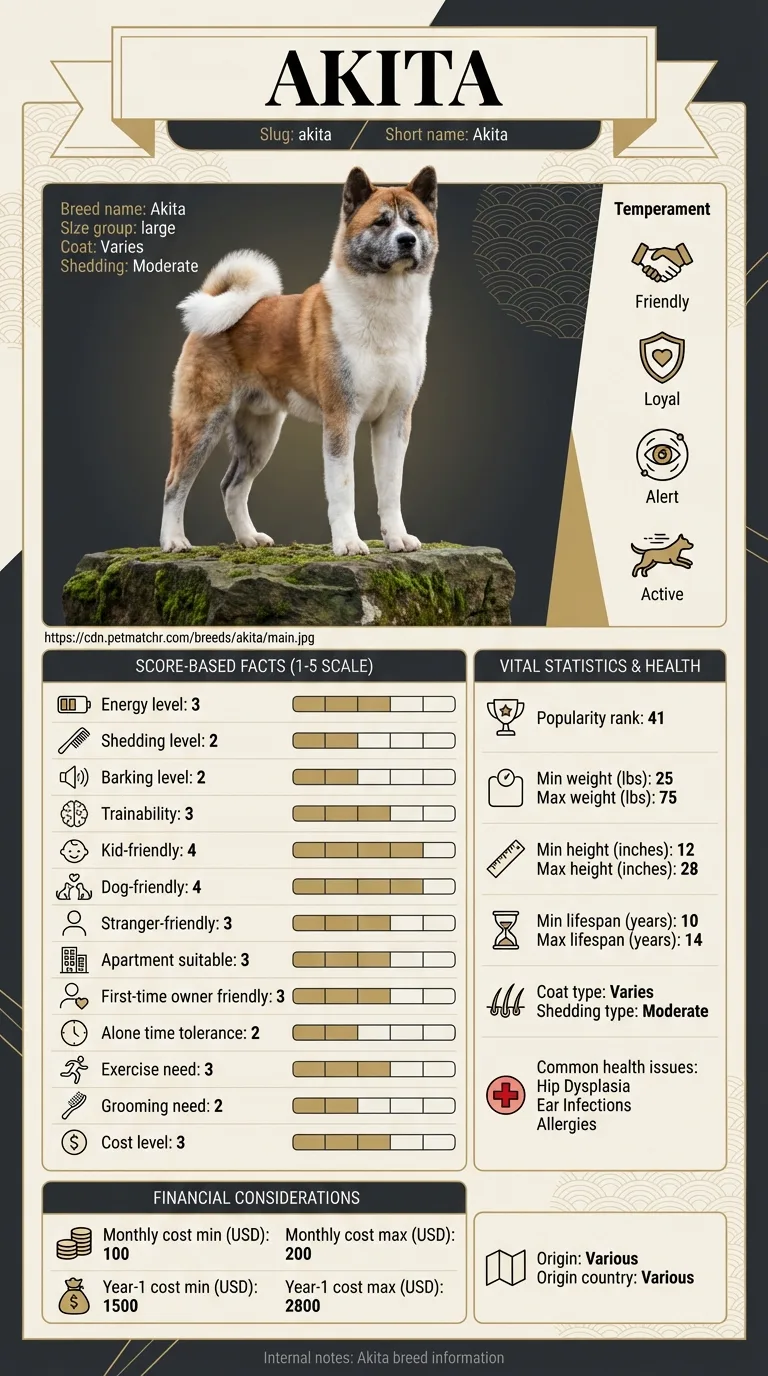
Choose the Akita if lifespan and cost matter. It lives 10 to 13 years against the Dane's 7 to 10 and costs $110–$240 a month against $200–$400. It also rates 2/5 for apartments against 1/5. You are accepting 1/5 for first-time owners, 2/5 with other dogs and strangers, 5/5 shedding and 3/5 grooming.
Choose great dane if...
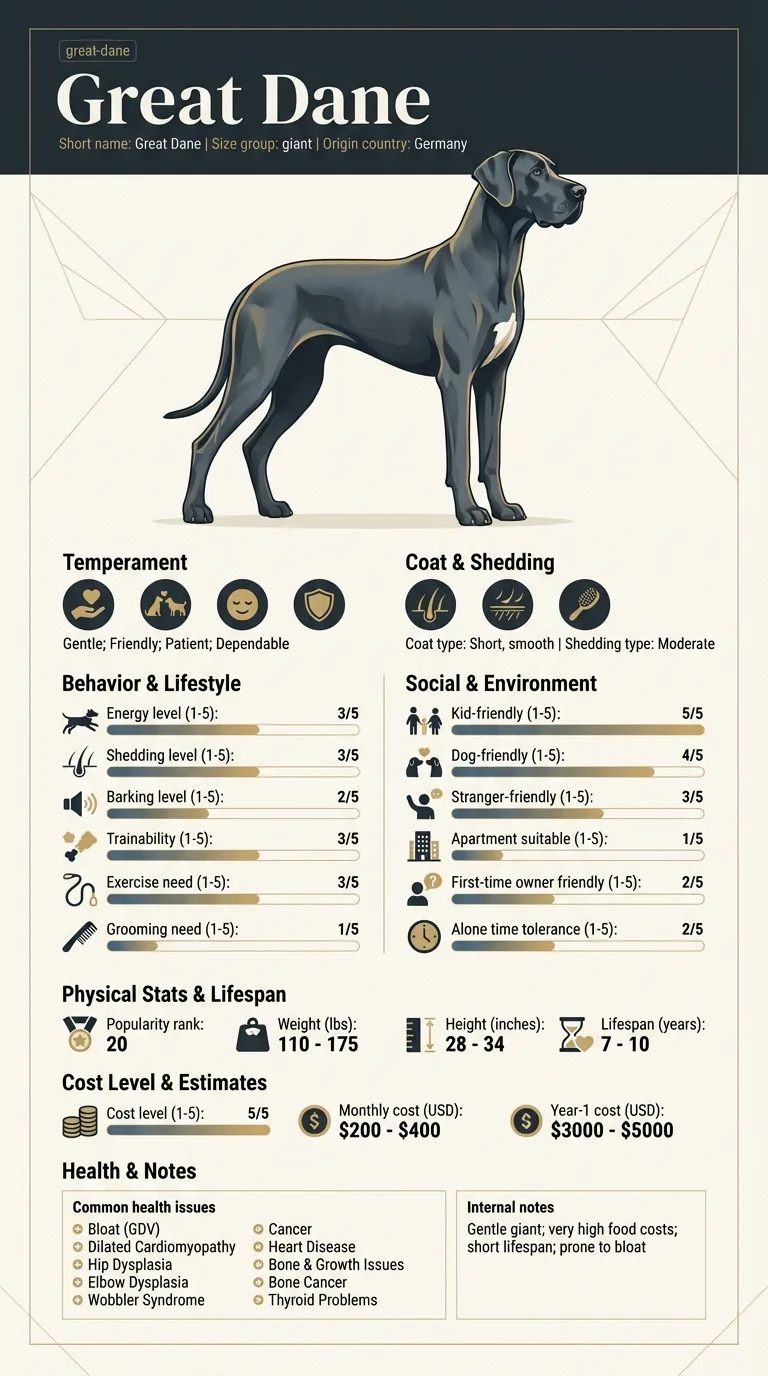
Choose the Great Dane if you want a genuinely gentle giant and can afford it. It rates 5/5 with children, 4/5 with other dogs and 3/5 with strangers, grooms at only 1/5 and sheds at 3/5. You are accepting a 7 to 10 year lifespan, the highest running cost on this site, and the highest bloat risk of any breed.
Head-to-head comparison
Feature
akita
great dane
Winner
Weight
70–130 lbs
110–175 lbs
Equal
Height
24–28 in
28–34 in
Equal
Lifespan
10–13 years
7–10 years
akita
Coat
Dense double coat
Short and smooth
Equal
Grooming need
Moderate (3/5)
Very low (1/5)
great dane
Shedding
Very high (5/5)
Moderate (3/5)
great dane
Energy level
Moderate (3/5)
Moderate (3/5)
Equal
Exercise need
Moderate (3/5)
Moderate (3/5)
Equal
Trainability
Moderate (3/5)
Moderate (3/5)
Equal
Barking
Low (2/5)
Low (2/5)
Equal
Good with kids
Moderate (3/5)
Very high (5/5)
great dane
Good with other dogs
Low (2/5)
High (4/5)
great dane
Friendly to strangers
Low (2/5)
Moderate (3/5)
great dane
Apartment suitability
Low (2/5)
Very low (1/5)
akita
Good for first-time owners
Very low (1/5)
Low (2/5)
great dane
Tolerates being alone
Moderate (3/5)
Low (2/5)
akita
Typical monthly cost
$110–$240
$200–$400
akita
Typical first-year cost
$1,700–$3,200
$3,000–$5,000
akita
Deep dive
Bloat sits at the top of the Great Dane's list for a reason
Gastric dilatation-volvulus heads the Great Dane's condition list, and among all breeds the Dane carries the highest risk of it. This is the most important paragraph on this page.
In GDV the stomach fills with gas and then rotates, cutting off its own blood supply and trapping the gas inside. Without surgery it is fatal, usually within hours. The conformation that causes it — a deep, narrow chest — is exactly what a Great Dane has.
The signs are: unproductive retching, a swelling or drum-tight abdomen, obvious restlessness and inability to settle, drooling, and pale gums. Any of these in a Dane is an immediate emergency, not a wait-and-see.
Because the risk is so high, many vets recommend a prophylactic gastropexy — tacking the stomach to the abdominal wall during neutering, so it cannot twist. It does not prevent the stomach distending but it prevents the rotation that kills. For this breed specifically, it is a conversation worth having before the dog is a year old.
The Akita is also deep-chested and carries a real bloat risk, though a lower one. Both households should know the signs and know where the nearest out-of-hours surgery is.
How a giant puppy has to be grown
Bone and growth issues appear on the Dane's condition list as a category of their own, and unusually for a health item, the owner controls a great deal of the risk.
A Great Dane goes from about a pound at birth to well over a hundred in eighteen months. Growing that fast puts enormous load on developing joints and growth plates, and pushing it faster causes problems: hypertrophic osteodystrophy, panosteitis, and joint deformity all appear in over-grown giant puppies.
The rules are counter-intuitive to anyone used to smaller dogs. Feed a large or giant breed puppy food with controlled calcium and energy, not a rich adult or performance diet. Do not supplement calcium — it actively causes harm in this breed. Keep the puppy lean, visibly so. Restrict forced exercise until the growth plates close: no long runs, no jogging alongside a bicycle, no repeated stairs, and no jumping.
The Akita grows fast too and benefits from the same restraint, but the margin for error is much wider in a 100-pound adult than in a 170-pound one.
Seven to ten years, and what shortens it
The Great Dane's lifespan is the shortest in this batch and one of the shortest of any breed. It is the price of the size.
Dilated cardiomyopathy is a major contributor — the heart muscle weakens and the chambers enlarge, and it is common in giant breeds. Annual cardiac examination from middle age is sensible. Bone cancer is the second: osteosarcoma is a disease of tall, heavy breeds and typically presents as a limp that does not resolve, so persistent lameness in a Dane means an X-ray rather than rest.
Wobbler syndrome — compression of the spinal cord in the neck — produces an unsteady, wobbling hind end and neck pain, and it appears in this breed specifically. Hip and elbow dysplasia and thyroid disease complete the list.
Ask a breeder about heart screening in the parents, the ages the grandparents reached, and any history of wobbler or bone cancer in the line.
The Akita's burden is autoimmune and endocrine — immune-mediated disease of skin, eyes and blood, hypothyroidism, progressive retinal atrophy — plus hip dysplasia and bloat, and it lives three years longer on average.
$200 to $400 a month, and what drives it
The Great Dane is the most expensive dog to run in this batch: $200–$400 a month and $3,000–$5,000 in the first year, against the Akita's $110–$240 and $1,700–$3,200.
Food is the obvious part. A 170-pound dog eats a great deal, and large-breed puppy food for eighteen months is not a small line.
The less obvious part is that almost everything else is dosed or sized by weight. Parasite treatments, most medications, anaesthesia, joint supplements and boarding all scale up. A course of antibiotics for a Dane costs several times what it costs for a spaniel.
The big-ticket risks are correspondingly large. Bloat surgery, cardiac management, or an orthopaedic procedure in a 150-pound dog are all four-figure events, and insurance for giant breeds is priced with that in mind.
Grooming is the one place the Dane saves you money: 1/5 and a rubber curry once a week, against the Akita's undercoat rake and two annual blows at 5/5 shedding. It is not enough to change the arithmetic.
Akita vs Great Dane: five ties and three decisive gaps
Energy, exercise, trainability and barking all tie at 3/5, 3/5, 3/5 and 2/5. Both are calm indoor dogs that want a walk rather than a workout, and neither is noisy.
The Dane is the more sociable animal by some distance: 5/5 with children, 4/5 with other dogs, 3/5 with strangers, against 3/5, 2/5 and 2/5. It is a genuinely soft-natured breed, and the guarding it does is presence rather than intent.
The three gaps that decide it are lifespan, cost and space. Seven to ten years against ten to thirteen. Two hundred to four hundred dollars a month against a hundred and ten to two hundred and forty. And a 1/5 apartment rating — the lowest available — against 2/5.
Grooming reverses in the Dane's favour: 1/5 against 3/5, 3/5 shedding against 5/5. It is the easiest coat on this page by a wide margin.
Akita or Great Dane: Two Quiet Giants, One Much Shorter Life - Akita vs Great Dane: five ties and three decisive gaps
Frequently asked questions
Why is bloat such a serious risk in Great Danes?
The breed carries the highest gastric dilatation-volvulus risk of any dog, because a deep narrow chest allows the stomach to distend and rotate. Without surgery it is fatal within hours. Learn the signs — unproductive retching, a drum-tight abdomen, restlessness, drooling — and treat any of them as an immediate emergency.
Should a Great Dane have a preventive gastropexy?
It is worth discussing with a vet before the dog is a year old, and it is commonly recommended in this breed specifically. The procedure tacks the stomach to the abdominal wall during neutering so it cannot twist. It does not stop the stomach distending, but it prevents the rotation that causes death.
How should a Great Dane puppy be fed?
On a large or giant breed puppy food with controlled calcium and energy, kept visibly lean, with no calcium supplementation — supplementing actively causes harm in this breed. Restrict forced exercise until the growth plates close: no jogging, no cycling alongside, no repeated stairs and no jumping.
Why do Great Danes live such short lives?
Seven to ten years is the price of the size. Dilated cardiomyopathy, bone cancer, wobbler syndrome and bloat all appear at elevated rates in giant breeds, and the cumulative load on the heart and skeleton is simply greater. The Akita, at 10 to 13 years, lives around three years longer on average.
Which costs more to keep?
The Great Dane, by a wide margin — $200–$400 a month against the Akita's $110–$240, and $3,000–$5,000 against $1,700–$3,200 in the first year. Food explains part of it and weight-dosed medication, anaesthesia and boarding explain the rest.
Which is better with children?
The Great Dane at 5/5 against the Akita's 3/5. It is genuinely soft-natured and tolerant, and the guarding it does is presence rather than intent. The obvious caveat is size: a wagging tail at head height and 150 pounds moving through a room need managing around toddlers.
Do they need the same amount of exercise?
Yes — both rate 3/5 for exercise and 3/5 for energy, around forty-five to sixty minutes a day for an adult. The Dane's caveat is age-specific rather than daily: a growing puppy must have forced exercise restricted entirely until its growth plates close.
The Great Dane if you want a genuinely gentle giant and can absorb $200–$400 a month and a 7 to 10 year lifespan. The Akita if cost and longevity matter — it lives around three years longer and costs roughly half as much.
Costs
How much does each cost per month?
The Great Dane runs $200–$400 a month and the Akita $110–$240, with first-year totals of $3,000–$5,000 and $1,700–$3,200. Almost everything for a giant breed is dosed and priced by weight.
Living
Which needs less grooming?
The Great Dane by a long way — 1/5 against the Akita's 3/5, and 3/5 shedding against 5/5. A rubber curry once a week covers a Dane. The Akita needs an undercoat rake through two shedding periods a year.
Living
Can a Great Dane live in a flat?
It rates 1/5, the lowest available. Its exercise need is only 3/5, so the problem is not output — it is that a 34-inch dog needs room to turn around, lie down and get past furniture without difficulty.
Related DogBreedCompass guides
Akita breed guide – The Akita profile covers guardian temperament and the long socialisation window the breed needs.
Great Dane breed guide – The Great Dane profile covers growth management, bloat prevention and cardiac screening.
Akita vs Mastiff – The Mastiff is the other giant breed most often weighed against the Great Dane.
Akita vs Saint Bernard – The Saint Bernard is the heavy-coated giant alternative worth comparing on cost.
Great Dane bloat and GDV – Bloat is the single most important emergency for any Great Dane owner to recognise.
Akita autoimmune diseases – Autoimmune disease is the Akita's most distinctive burden and the first question for a breeder.
Health information here is general and is not veterinary advice. If your dog shows pain, sudden behaviour change, or worsening symptoms, consult a licensed veterinarian.
Some links on this site are affiliate links. We may earn a commission at no extra cost to you, and we only suggest products we believe are helpful for dog owners.
We research and check what we publish, but we do not warrant that any figure, date, price, or statement is accurate, complete, or current, and we accept no liability for any loss, cost, injury, or other harm arising from the use of this site. Use it as one reference among several. You remain responsible for your own decisions and for your dog's care - confirm anything that matters with a licensed veterinarian or another qualified professional before you act on it. Full disclaimer.