Akita or Cocker Spaniel: A Guardian or a Merry Little Gundog
Quick answer
Akita vs Cocker Spaniel: which should I choose?
The Cocker Spaniel if you want a sociable, manageable family dog and will commit to weekly grooming and daily ear care. The Akita if you want low maintenance and a quiet guardian, and the house is often empty during the day.
The Cocker Spaniel rates 5/5 with children, 4/5 with other dogs, 4/5 with strangers and 4/5 for first-time owners. The Akita rates 3/5, 2/5, 2/5 and 1/5. Nothing on the training page closes that gap, because it is not a training gap.
This page is for someone weighing a sociable, manageable family dog against a large reserved guardian. It covers the coat and ear maintenance that dominates Cocker ownership, the sociability gap, a shared tendency toward autoimmune disease, and what each costs in money and time.
Quick verdict
The Cocker Spaniel is easier in every social respect and considerably more work every single week; the Akita is harder to read and far less demanding to maintain.
Choose akita if...
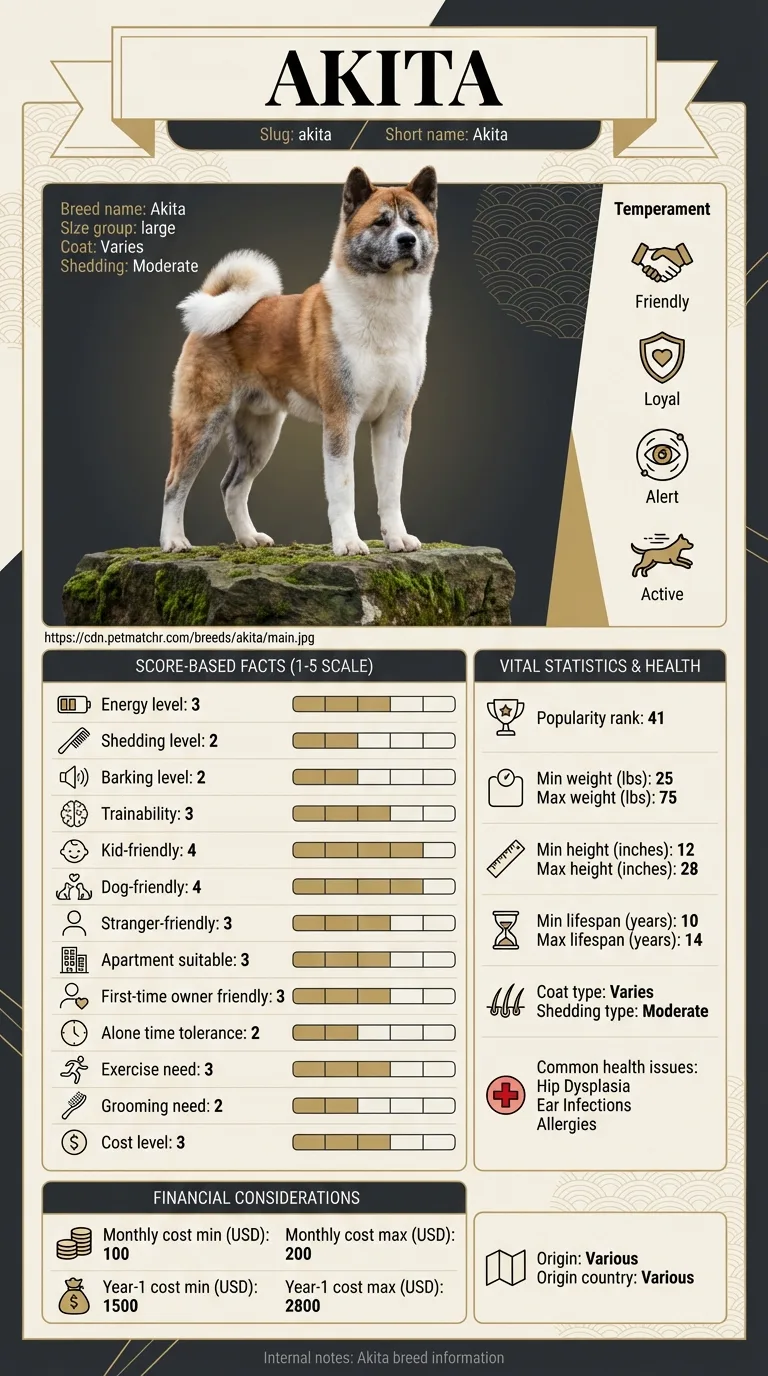
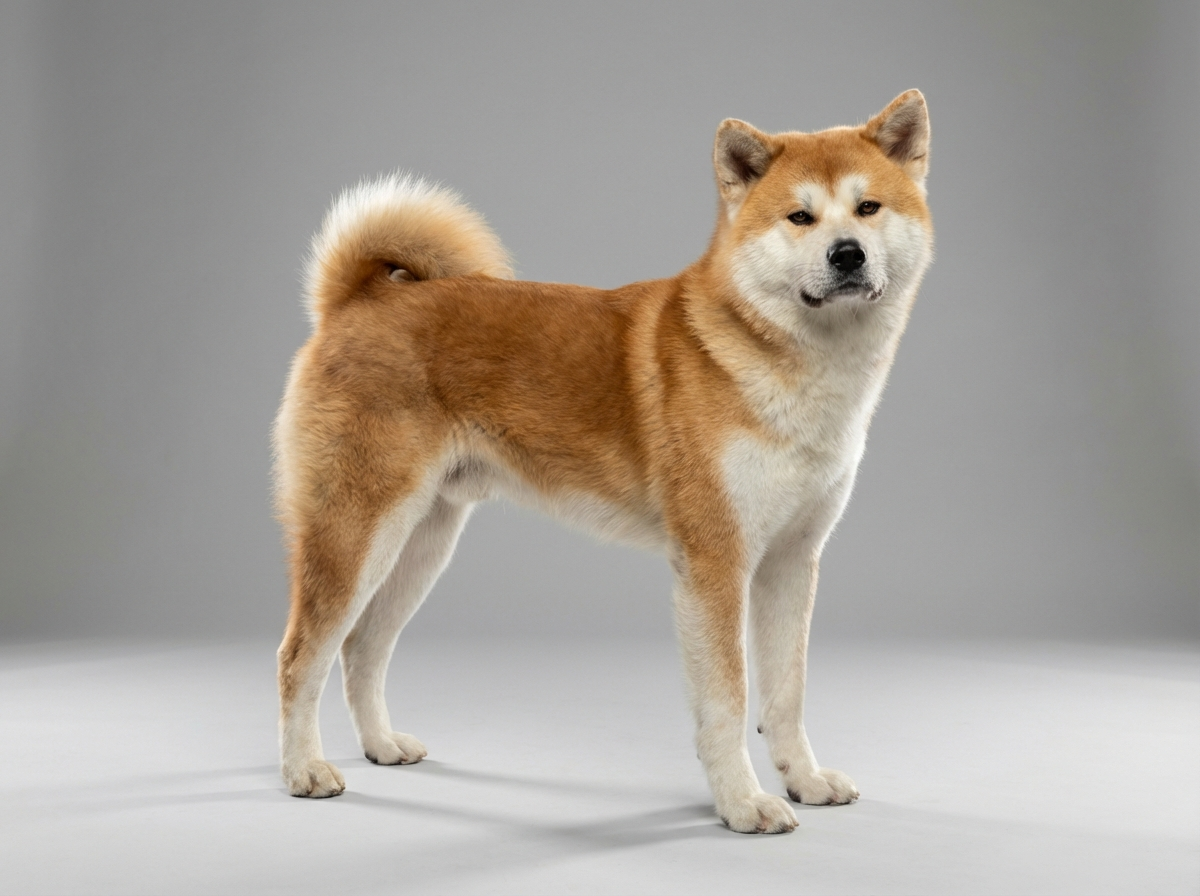
Choose the Akita if you want low weekly maintenance and the house is often empty. It grooms at 3/5 against the Cocker's 5/5, tolerates being alone at 3/5 against 2/5, and barks at 2/5 against 3/5. You are accepting 1/5 for first-time owners, 2/5 with other dogs and strangers, 5/5 shedding and up to 130 pounds.
Choose cocker spaniel if...
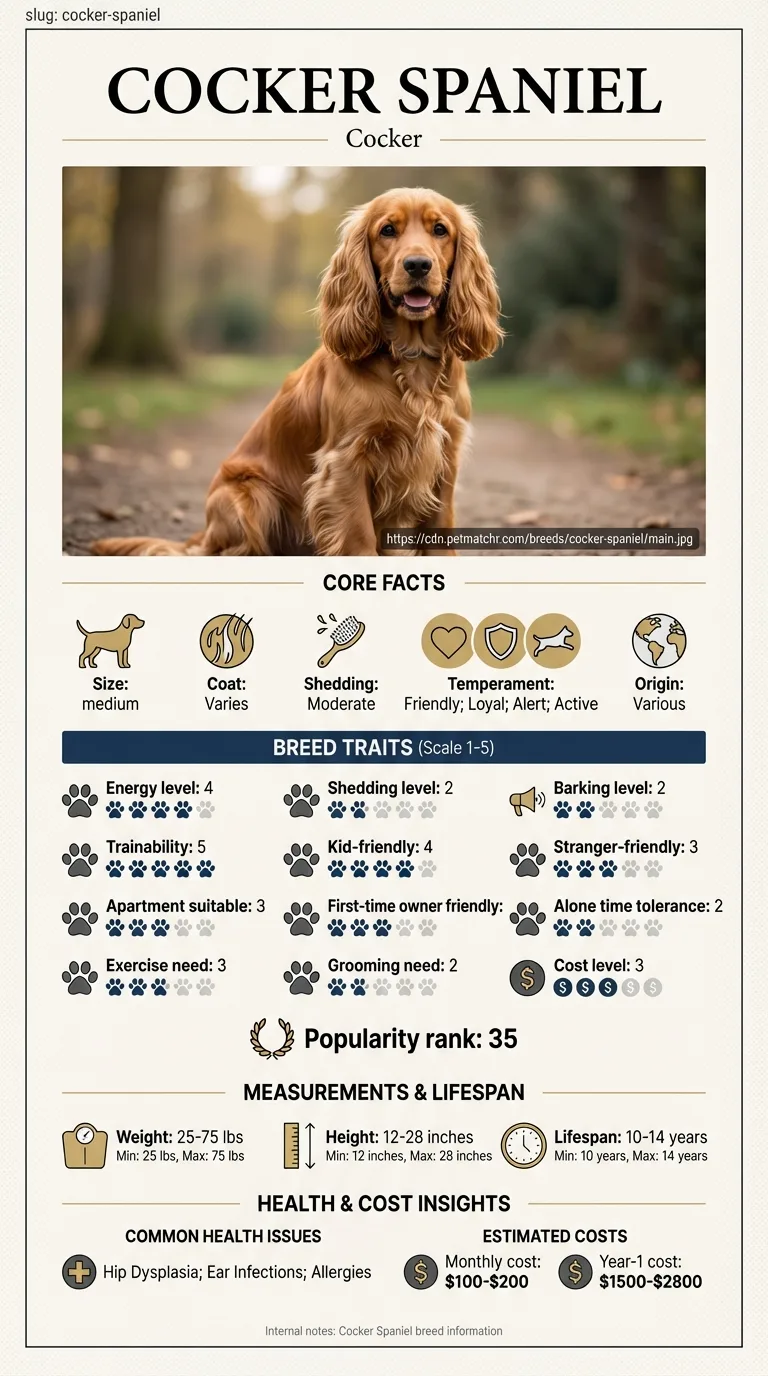
Choose the Cocker Spaniel if you want a sociable, biddable family dog of manageable size. It rates 5/5 with children, 4/5 with other dogs and strangers, 4/5 for trainability and 4/5 for apartments, and costs $80–$150 a month. You are accepting a 5/5 coat, chronic ear problems and a breed that dislikes being left alone.
Head-to-head comparison
Feature
akita
cocker spaniel
Winner
Weight
70–130 lbs
20–30 lbs
Equal
Height
24–28 in
13–16 in
Equal
Lifespan
10–13 years
10–14 years
cocker spaniel
Coat
Dense double coat
Silky and feathered
Equal
Grooming need
Moderate (3/5)
Very high (5/5)
akita
Shedding
Very high (5/5)
Moderate (3/5)
cocker spaniel
Energy level
Moderate (3/5)
Moderate (3/5)
Equal
Exercise need
Moderate (3/5)
Moderate (3/5)
Equal
Trainability
Moderate (3/5)
High (4/5)
cocker spaniel
Barking
Low (2/5)
Moderate (3/5)
akita
Good with kids
Moderate (3/5)
Very high (5/5)
cocker spaniel
Good with other dogs
Low (2/5)
High (4/5)
cocker spaniel
Friendly to strangers
Low (2/5)
High (4/5)
cocker spaniel
Apartment suitability
Low (2/5)
High (4/5)
cocker spaniel
Good for first-time owners
Very low (1/5)
High (4/5)
cocker spaniel
Tolerates being alone
Moderate (3/5)
Low (2/5)
akita
Typical monthly cost
$110–$240
$80–$150
cocker spaniel
Typical first-year cost
$1,700–$3,200
$1,100–$2,300
cocker spaniel
Deep dive
Ear infections are the Cocker's defining problem
Ear infections head the Cocker Spaniel's condition list, and among breeds prone to them the Cocker is close to the worst case.
The anatomy explains it. A long, heavy, well-feathered ear leaf lies flat over the canal, sealing in warmth and moisture; the canal itself tends to be narrow; and the breed produces more ear wax than most. A dog that swims, works in cover, or simply gets rained on has a warm damp environment sitting against its head all day.
The consequence is not one infection but a cycle. Repeated inflammation thickens the canal lining, the canal narrows further, treatment becomes less effective, and a proportion of chronic cases eventually need surgery to open the canal permanently.
Prevention is genuinely effective and genuinely daily: check the ears every day, dry them thoroughly after any water, keep the hair under the ear trimmed, and treat head shaking or a smell as a reason to be seen rather than to wait.
The Akita's upright ears are self-ventilating and this problem does not arise.
A 5/5 coat and what it costs in time
The Cocker's grooming rating matches the Chow Chow's — the highest on this site — for a completely different reason. It is not density, it is feathering.
The silky coat on the ears, chest, legs and belly picks up burrs, mud and seeds, and it mats where it rubs: behind the ears, under the elbows, in the armpits and around the tail. Left alone for a fortnight it will need cutting rather than brushing.
Most owners settle into brushing several times a week plus a professional groom every six to eight weeks. Grass seeds are the seasonal hazard — they work into the feathering and then into the skin or between the toes, and in a working coat they are easy to miss.
Shedding is 3/5, which is moderate and steady.
The Akita's 3/5 grooming is a different rhythm altogether: a weekly brush for most of the year and then two or three weeks, twice a year, of pulling a dense undercoat out in handfuls at 5/5 shedding. It never needs a professional groomer, and its coat should never be clipped.
Merry, biddable and poor at solitude
The Cocker's 4/5 trainability is real and pleasant to live with. It is a soft breed — it responds to a cheerful voice and food, and shuts down under sharp correction. Recall is achievable but needs proofing against scent, because a flushing spaniel that has found something interesting stops listening entirely.
Its 2/5 for time alone is the caveat that matters. Cockers are people-oriented to the point of following you between rooms, and long unbroken absences produce vocalising and destruction at doors. Absence training should start in the first week regardless of your current schedule.
There is also a temperament note worth stating plainly: the breed's popularity has produced a lot of poorly bred dogs, and resource guarding and startle-related snapping appear more often in badly bred lines than the 5/5 children rating suggests. Buy from someone who will discuss temperament in the parents.
The Akita's reserve is stable rather than variable. It assesses, decides and settles — and it needs socialisation continued past two years, because that is when its adult view of other dogs arrives.
A shared autoimmune tendency, and the money
The two health lists have one striking overlap. Autoimmune haemolytic anaemia appears on the Cocker's list, in which the immune system destroys the dog's own red blood cells; the Akita's list is headed by autoimmune disorders affecting skin, eyes and blood. Both breeds carry a real tendency toward immune-mediated disease, and in both it can present suddenly in a previously well dog.
Sudden lethargy, pale gums or unexplained collapse in either breed is an emergency, not a wait-and-see.
Beyond that they diverge. The Cocker adds cataracts, progressive retinal atrophy and hip dysplasia. The Akita adds hypothyroidism, progressive retinal atrophy, hip dysplasia and bloat as a deep-chested large breed.
On money the Cocker is cheaper to run at $80–$150 a month against $110–$240, and $1,100–$2,300 against $1,700–$3,200 in the first year — mostly a weight difference.
The honest adjustment is grooming and ears. A professional groom every six to eight weeks plus recurring ear treatment closes a good part of that gap in practice, and chronic ear surgery would close all of it at once.
Akita vs Cocker Spaniel: same effort, different week
Energy ties at 3/5 and exercise ties at 3/5, which means these two dogs want roughly the same amount of walking. Everything else about the daily commitment differs.
The Cocker's demand is maintenance. A 5/5 coat with feathering on the ears, legs and belly, plus drop ears that need checking constantly, adds up to something you do most days rather than most weeks.
The Akita's demand is judgement. Very little grooming for ten months of the year, then two heavy shedding periods — but a dog whose recall is conditional, whose tolerance of other dogs is 2/5, and whose adult opinions arrive at around two years old.
The sociability gap is the headline. Where the Cocker is 4/5 or 5/5 on every measure involving other beings, the Akita is 2/5 or 3/5. If your household has regular visitors, other dogs, or young children, that is the comparison in a line.
Akita or Cocker Spaniel: A Guardian or a Merry Little Gundog - Akita vs Cocker Spaniel: same effort, different week
Frequently asked questions
Why do Cocker Spaniels get so many ear infections?
Because a long, heavy, feathered ear leaf lies flat over a narrow canal and seals in warmth and moisture, and the breed produces more wax than most. Repeated infections thicken the canal, which makes the next one likelier. Daily checks, thorough drying after water, and trimming the hair under the ear are what prevent the cycle starting.
How much grooming does a Cocker Spaniel need?
A great deal — 5/5, the same rating as the Chow Chow. The feathering on the ears, chest, legs and belly mats where it rubs, and left for a fortnight it needs cutting rather than brushing. Most owners brush several times a week and use a professional groomer every six to eight weeks.
Which is better for a family with young children?
The Cocker Spaniel at 5/5 against the Akita's 3/5, with one caveat. The breed's popularity has produced many poorly bred dogs, and resource guarding appears more often in those lines than the rating suggests. Buy from a breeder who will discuss temperament in the parents, and the rating holds.
Which needs more exercise?
Neither — both rate 3/5, around forty-five to sixty minutes a day. The difference is where. A Cocker can be exercised anywhere and will happily do it with other dogs; an Akita needs securely fenced space and a walk planned to avoid unfamiliar dogs, because it rates 2/5 for dog tolerance.
Do both breeds get autoimmune disease?
Both carry a real tendency toward it. Autoimmune haemolytic anaemia is on the Cocker's list, and autoimmune disorders head the Akita's. In both breeds it can appear suddenly in a previously well dog, so lethargy, pale gums or collapse should be treated as an emergency rather than something to watch overnight.
Which is cheaper to keep?
The Cocker on the headline figures — $80–$150 a month against the Akita's $110–$240 — but the gap narrows in practice. A professional groom every six to eight weeks plus recurring ear treatment adds up, and surgery for a chronically narrowed ear canal would erase the difference in a single bill.
Which copes better with a working day?
The Akita at 3/5 against the Cocker's 2/5. Cockers follow their people between rooms and find long absences hard, producing vocalising and destruction at doors. Absence training from the first week helps considerably. The Akita is self-contained and will simply sleep.
The Cocker Spaniel if you want a sociable, manageable family dog and will commit to weekly grooming and daily ear care. The Akita if you want low maintenance and a quiet guardian, and the house is often empty during the day.
Costs
How much does each cost per month?
The Cocker runs $80–$150 a month and the Akita $110–$240, with first-year totals of $1,100–$2,300 and $1,700–$3,200. Add professional grooming every six to eight weeks for the Cocker.
Health
What is the single most important Cocker Spaniel routine?
Checking and drying the ears every day, and after every swim or wet walk. Chronic ear disease is the breed's defining problem, and it is largely preventable by a habit that takes under a minute.
Behavior
Which is better with other dogs?
The Cocker at 4/5 against the Akita's 2/5. Akita dog-intolerance is frequently same-sex and usually appears at social maturity around two years old rather than in puppyhood.
Related DogBreedCompass guides
Akita breed guide – The Akita profile covers guardian temperament and the long socialisation window the breed needs.
Cocker Spaniel breed guide – The Cocker Spaniel profile covers coat maintenance, ear care and the breed's temperament range.
Akita vs English Cocker Spaniel – The English Cocker is the larger, more field-oriented version of the same breed.
Akita vs English Springer Spaniel – The Springer is the bigger flushing spaniel worth weighing against the Cocker.
Cocker Spaniel ear infections – Chronic ear disease is the condition most Cocker owners will deal with at some point.
Akita autoimmune diseases – Autoimmune disease is the Akita's most distinctive burden and the first question for a breeder.
Health information here is general and is not veterinary advice. If your dog shows pain, sudden behaviour change, or worsening symptoms, consult a licensed veterinarian.
Some links on this site are affiliate links. We may earn a commission at no extra cost to you, and we only suggest products we believe are helpful for dog owners.
We research and check what we publish, but we do not warrant that any figure, date, price, or statement is accurate, complete, or current, and we accept no liability for any loss, cost, injury, or other harm arising from the use of this site. Use it as one reference among several. You remain responsible for your own decisions and for your dog's care - confirm anything that matters with a licensed veterinarian or another qualified professional before you act on it. Full disclaimer.