Akita or Miniature Schnauzer: A Beard to Strip or a Coat to Rake
Quick answer
Akita vs Miniature Schnauzer: which should I choose?
The Schnauzer if you live in a flat, want a low-shedding dog that copes with a working day, and will fund grooming every six to eight weeks. The Akita if you want quiet and no grooming appointments.
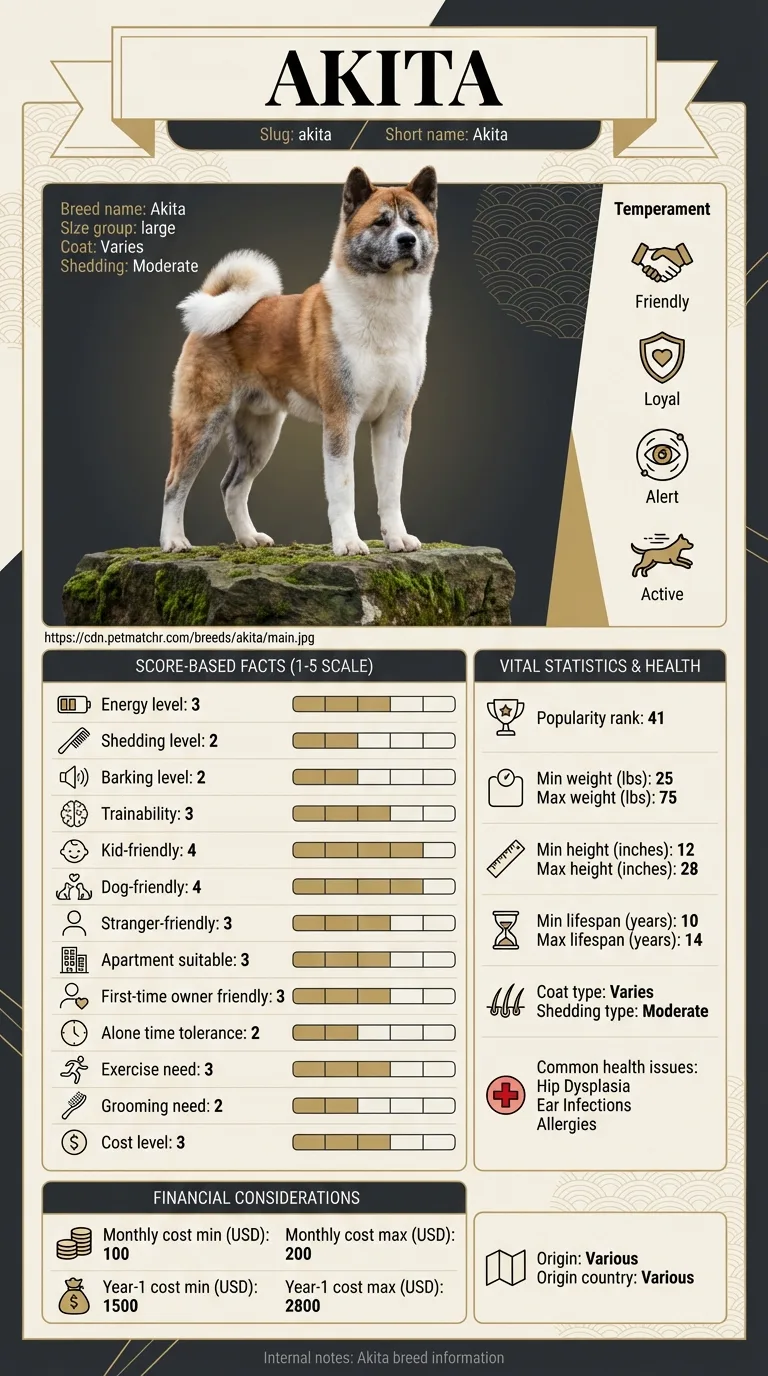
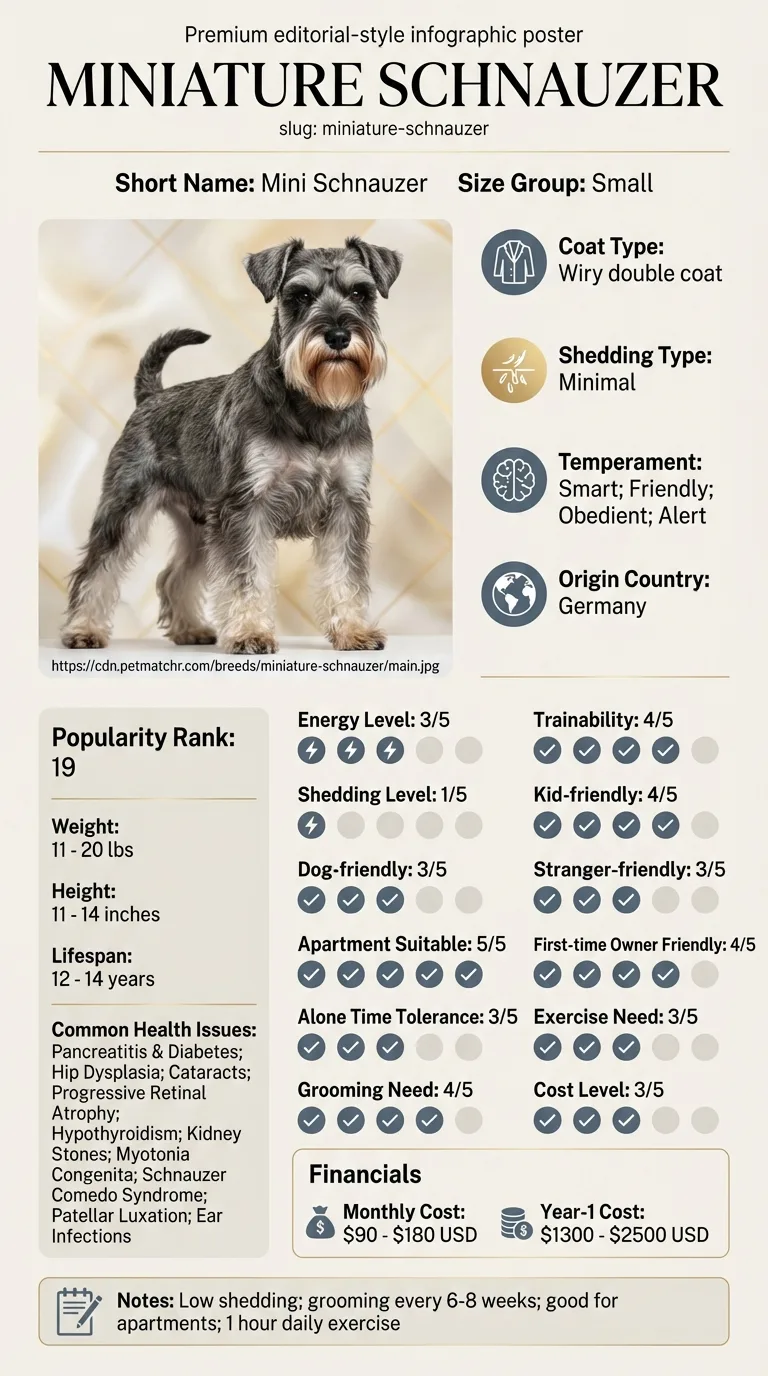
The Miniature Schnauzer sheds at 1/5 and grooms at 4/5. The Akita sheds at 5/5 and grooms at 3/5. Both are real work, and choosing between them is choosing which kind of work you would rather do: an appointment every eight weeks, or two weeks of raking twice a year.
This page is for someone weighing a small, low-shedding, alert companion against a large guardian. It covers coat maintenance in both, the Schnauzer's specific and manageable dietary risk, barking, apartment fit and cost.
Quick verdict
The Miniature Schnauzer is a small, tidy, highly trainable dog with one specific dietary vulnerability; the Akita is far bigger, far hairier and asks much less of your kitchen and your groomer.
Choose akita if...
Choose the Akita if you want quiet and no grooming appointments. It barks at 2/5 against the Schnauzer's 4/5 and grooms at 3/5 against 4/5, and it has no comparable dietary constraint. You are accepting 5/5 shedding, 1/5 for first-time owners, 2/5 with other dogs and strangers, and up to 130 pounds.
Choose miniature schnauzer if...
Choose the Miniature Schnauzer if you live in a flat and want a low-shedding dog that copes with a working day. It rates 5/5 for apartments, 4/5 for trainability and first-time owners, sheds at 1/5 and tolerates being alone at 3/5. You are accepting 4/5 barking, regular grooming and a lifelong low-fat diet.
Head-to-head comparison
Feature
akita
miniature schnauzer
Winner
Weight
70–130 lbs
11–20 lbs
Equal
Height
24–28 in
11–14 in
Equal
Lifespan
10–13 years
12–14 years
miniature schnauzer
Coat
Dense double coat
Wiry double coat
Equal
Grooming need
Moderate (3/5)
High (4/5)
akita
Shedding
Very high (5/5)
Very low (1/5)
miniature schnauzer
Energy level
Moderate (3/5)
Moderate (3/5)
Equal
Exercise need
Moderate (3/5)
Moderate (3/5)
Equal
Trainability
Moderate (3/5)
High (4/5)
miniature schnauzer
Barking
Low (2/5)
High (4/5)
akita
Good with kids
Moderate (3/5)
High (4/5)
miniature schnauzer
Good with other dogs
Low (2/5)
Moderate (3/5)
miniature schnauzer
Friendly to strangers
Low (2/5)
Moderate (3/5)
miniature schnauzer
Apartment suitability
Low (2/5)
Very high (5/5)
miniature schnauzer
Good for first-time owners
Very low (1/5)
High (4/5)
miniature schnauzer
Tolerates being alone
Moderate (3/5)
Moderate (3/5)
Equal
Typical monthly cost
$110–$240
$90–$180
miniature schnauzer
Typical first-year cost
$1,700–$3,200
$1,300–$2,500
miniature schnauzer
Deep dive
Stripping, clipping, and the Schnauzer beard
A correct Schnauzer coat is harsh and wiry, and it is maintained by hand-stripping — plucking dead hair out by the root — rather than by clipping.
Most pet Schnauzers are clipped, which is entirely normal and much cheaper. The consequence is that the coat softens over the years, loses its harsh texture and its dirt-shedding quality, and often changes colour, with salt-and-pepper dogs going paler. If the classic texture matters to you, find a groomer who strips; if it does not, clipping is fine and nobody is harmed by it.
Either way the schedule is every six to eight weeks for the life of the dog, plus brushing in between.
The beard and leg furnishings are the daily part. The beard holds water after every drink and food after every meal, and it needs combing and wiping regularly or it becomes matted and smells. Leg furnishings pick up mud and mat behind the elbows.
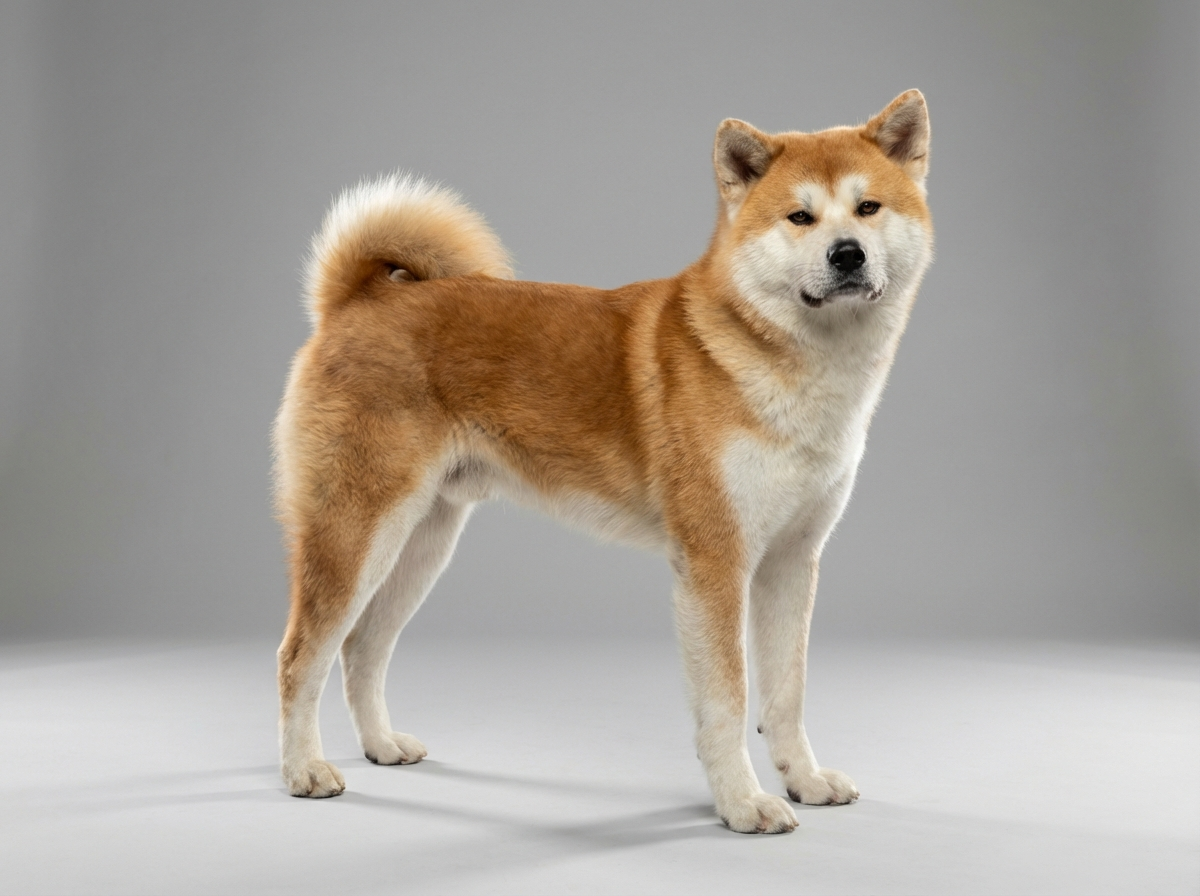
The Akita needs none of this: a weekly brush for ten months, then two or three weeks twice a year of raking out a dense undercoat. It never sees a groomer, and its coat should never be clipped.
Pancreatitis, blood fats and a lifelong low-fat rule
Pancreatitis and diabetes head the Miniature Schnauzer's condition list, and this is the single most actionable health item on this page.
The breed has a well-documented tendency toward hyperlipidaemia — persistently high fat levels in the blood. Elevated triglycerides are associated with pancreatitis, in which the pancreas becomes acutely inflamed, and repeated episodes can damage the organ enough to cause diabetes.
The practical rule is simple and it is lifelong: keep the diet low in fat. No fatty scraps, no leftovers from a roast, no rich treats, and a food chosen with fat content in mind. Many vets recommend checking triglyceride levels in this breed after a proper fast, which is worth asking about at an annual check.
Signs of pancreatitis are vomiting, abdominal pain — often a hunched, praying posture — lethargy and refusal to eat. It is a same-day veterinary problem.
Kidney and bladder stones also appear on the list, which makes water intake and prompt attention to straining worth watching.
The Akita has no equivalent dietary constraint; its burden is autoimmune and endocrine, with hip dysplasia and bloat.
Alert, trainable and vocal
The Schnauzer's 4/5 trainability is real. It is bright, keen and quick to learn, and it does well in obedience and scent work for a small dog. It also has a terrier's opinion about things, so it works best with short, interesting sessions rather than drilling.
The 4/5 barking is the other side of the same alertness. It was bred to notice rats and raise the alarm, and it still notices everything. Blocking window sightlines, teaching a settled alternative, and rewarding quiet all reduce it considerably — but it will not become a silent dog.
With other dogs at 3/5 and strangers at 3/5 it is moderately social rather than effusive, and prey drive toward small animals is genuine.
At 4/5 with children it is sturdier than most small breeds and copes with family life well.
The Akita's 2/5 barking is one of its clearest advantages here, and its 2/5 with strangers and other dogs the clearest cost. Its adult views arrive at social maturity around two years old, which is why socialisation continues well past the first year.
What each costs to run
The Schnauzer runs $90–$180 a month against the Akita's $110–$240, and $1,300–$2,500 against $1,700–$3,200 in the first year.
Grooming is the line that closes the gap. Every six to eight weeks for twelve to fourteen years is a large cumulative figure, and for a wire coat it is not something most owners do at home unless they learn to strip or clip themselves.
Diet is a smaller but persistent cost — a good low-fat food, and treats chosen with fat content in mind rather than whatever is nearest at the till.
Dental care is the usual small-breed item, and daily brushing genuinely reduces later anaesthetic dentistry.
The Akita's spending is food-dominated and flat, with autoimmune disease and bloat as the expensive but uncertain risks.
On lifespan the Schnauzer has the edge at 12 to 14 years against 10 to 13, and on housing it rates 5/5 for apartments against 2/5.
Akita vs Miniature Schnauzer: same walk, opposite coat
Energy ties at 3/5, exercise ties at 3/5, and time alone ties at 3/5. On the two things people usually worry about — how much walking and whether the dog copes with a working day — these breeds are equivalent, despite one weighing seven times the other.
The Schnauzer's alone-tolerance is worth flagging as unusual. Most small companion breeds rate 1/5 or 2/5. This one has enough terrier self-sufficiency to manage a normal day, which makes it a genuinely practical choice for a working household in a flat.
The coat is where they diverge completely: 1/5 shedding against 5/5, and 4/5 grooming against 3/5.
The other real difference is noise. 4/5 against 2/5 — a Schnauzer is an alert farm ratter and it announces things. In a flat with shared walls that needs managing rather than accepting.
Akita or Miniature Schnauzer: A Beard to Strip or a Coat to Rake - Akita vs Miniature Schnauzer: same walk, opposite coat
Frequently asked questions
How much grooming does a Miniature Schnauzer need?
4/5 — a professional appointment every six to eight weeks for life, plus brushing between visits and daily attention to the beard and leg furnishings. A correct coat is hand-stripped rather than clipped; most pet dogs are clipped, which softens and pales the coat over time but harms nothing.
Why do Miniature Schnauzers get pancreatitis?
The breed has a documented tendency toward hyperlipidaemia — persistently high fat levels in the blood — and elevated triglycerides are associated with pancreatitis. Repeated episodes can damage the pancreas enough to cause diabetes. A lifelong low-fat diet with no rich scraps is the main preventive measure.
What are the signs of pancreatitis?
Vomiting, abdominal pain often shown as a hunched or praying posture, lethargy and refusal to eat. It is a same-day veterinary problem rather than something to watch overnight. Ask your vet about checking fasting triglyceride levels at annual check-ups in this breed.
Do Miniature Schnauzers bark a lot?
Yes — 4/5, against the Akita's 2/5. It was bred as a farm ratter to notice things and raise the alarm, and it still notices everything. Blocking window sightlines and training a settled alternative reduces it considerably, but the baseline is high and it will not become a silent dog.
Can a Miniature Schnauzer be left during a working day?
Better than most small breeds, at 3/5 — the same rating as the Akita. It has enough terrier self-sufficiency to manage a normal day, which makes it unusually practical for a working household in a flat. Most small companion breeds rate 1/5 or 2/5 here.
Which sheds less?
The Schnauzer, at 1/5 against the Akita's 5/5. That is the appeal of a wire coat, and the trade is the grooming schedule. The Akita's shedding is concentrated into two intensive periods a year rather than spread out, and it needs no professional grooming at all.
Which is better for an apartment?
The Miniature Schnauzer at 5/5 against the Akita's 2/5 — small, low-shedding, and content with the same 3/5 exercise the Akita needs. The one caveat is noise: 4/5 barking in a building with thin walls is a management problem from the first week.
Akita vs Miniature Schnauzer: which should I choose?
The Schnauzer if you live in a flat, want a low-shedding dog that copes with a working day, and will fund grooming every six to eight weeks. The Akita if you want quiet and no grooming appointments.
Costs
How much does each cost per month?
The Schnauzer runs $90–$180 a month and the Akita $110–$240, with first-year totals of $1,300–$2,500 and $1,700–$3,200. Add grooming every six to eight weeks for the Schnauzer.
Health
What is the single most important Schnauzer rule?
Keep the diet low in fat, for life. No fatty scraps or rich treats. The breed's tendency to high blood fats is what drives its pancreatitis and diabetes risk, and diet is the part you control.
Living
Do they need the same amount of exercise?
Yes — both rate 3/5 for exercise and 3/5 for energy, around forty-five to sixty minutes a day. The difference is that an Akita needs securely fenced space and a route planned around unfamiliar dogs.
Related DogBreedCompass guides
Akita breed guide – The Akita profile covers guardian temperament and the long socialisation window the breed needs.
Miniature Schnauzer guide – The Miniature Schnauzer profile covers coat care, diet and the breed's health testing.
Akita vs Standard Schnauzer – The Standard Schnauzer is the larger original with the same coat and more drive.
Akita vs Miniature Poodle – The Miniature Poodle is the other small low-shedding breed most often compared.
Miniature Schnauzer skin allergies – Skin problems are common in wire-coated breeds and worth recognising early.
Akita autoimmune diseases – Autoimmune disease is the Akita's most distinctive burden and the first question for a breeder.
Health information here is general and is not veterinary advice. If your dog shows pain, sudden behaviour change, or worsening symptoms, consult a licensed veterinarian.
Some links on this site are affiliate links. We may earn a commission at no extra cost to you, and we only suggest products we believe are helpful for dog owners.
We research and check what we publish, but we do not warrant that any figure, date, price, or statement is accurate, complete, or current, and we accept no liability for any loss, cost, injury, or other harm arising from the use of this site. Use it as one reference among several. You remain responsible for your own decisions and for your dog's care - confirm anything that matters with a licensed veterinarian or another qualified professional before you act on it. Full disclaimer.