Malamute or English Cocker: Two 4/5 Coats and One Big Gap
Quick answer
Malamute vs English Cocker Spaniel: which should I choose?
The English Cocker if you want a sociable dog in ordinary housing and will do the grooming and daily ear care. The Malamute if you are athletic, have space and a secured garden, and want a large northern breed.
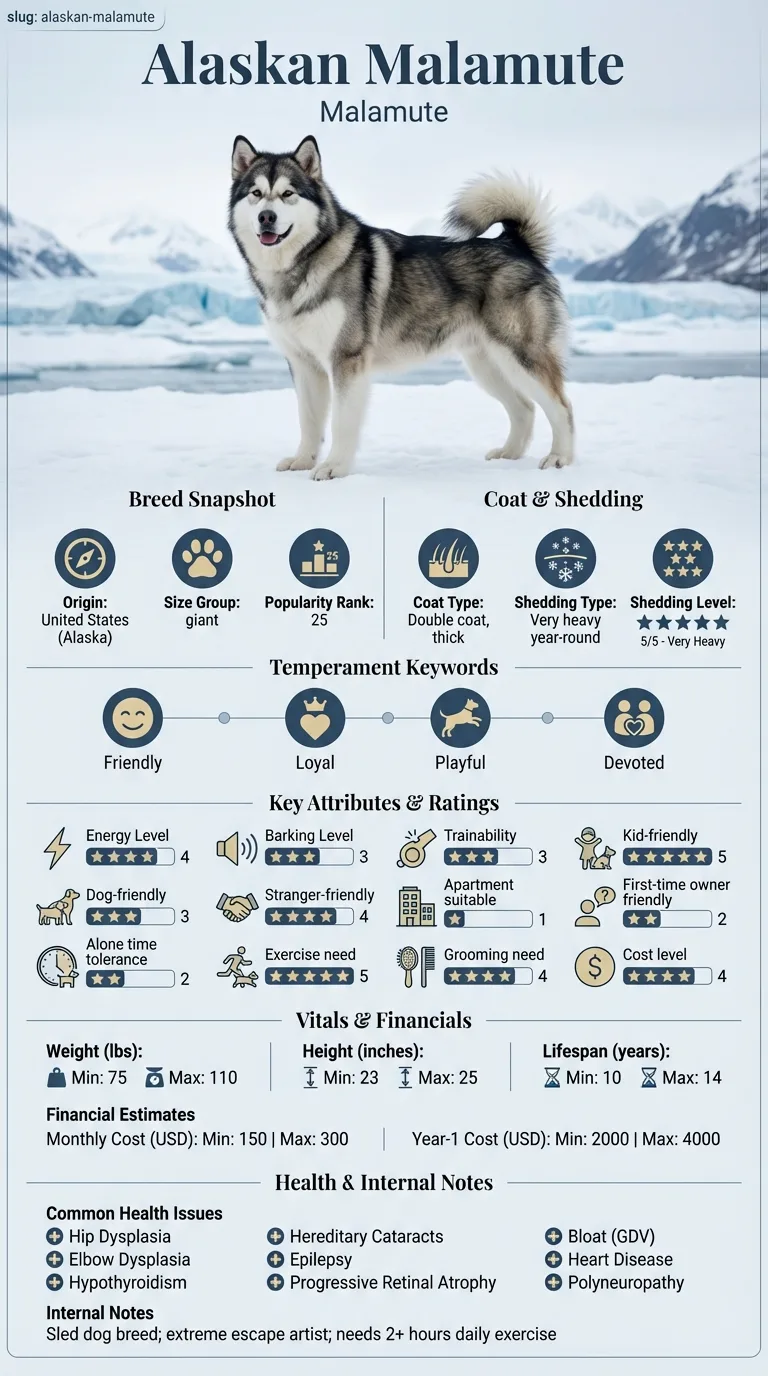
Five ratings match here — grooming, energy, barking, strangers and time alone — which is more agreement than you would expect between a hundred-pound Arctic freighting dog and a thirty-pound English gundog. What does not match is where they can live: 1/5 for apartments against 4/5.
This page is for someone weighing a mid-sized sporting breed against a large northern one. It covers the two kinds of coat work, the exercise difference, chronic ear disease, two inherited conditions with DNA tests, and cost.
Quick verdict
The English Cocker fits ordinary housing and needs daily ear care; the Malamute needs a landscape, a rake and twice the budget.
Choose alaskan malamute if...
Choose the Alaskan Malamute if you are athletic, have space and want a large sociable dog. It rates 5/5 with children against the Cocker's 5/5 and needs no daily ear routine. You are accepting $150–$300 a month against $100–$200, 5/5 shedding against 3/5, a 1/5 apartment rating against 4/5 and a determined escape artist.
Choose english cocker spaniel if...
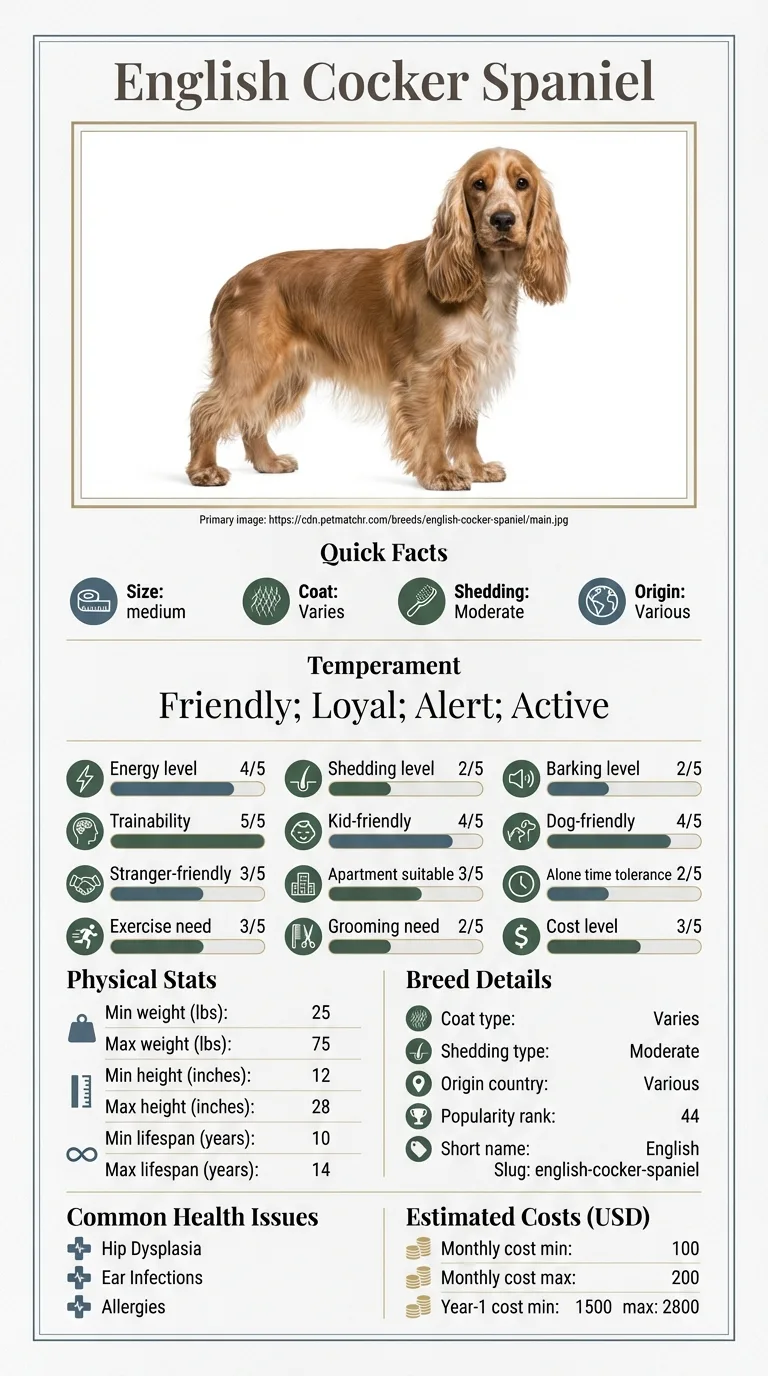
Choose the English Cocker if you walk a lot and want a sociable, capable dog of manageable size. It rates 4/5 for trainability, other dogs, apartments and first-time owners, 5/5 with children, and lives 12 to 14 years at $100–$200 a month. You are accepting a 4/5 coat and chronic ear risk.
Head-to-head comparison
Feature
alaskan malamute
english cocker spaniel
Winner
Weight
75–110 lbs
26–34 lbs
Equal
Height
23–25 in
15–17 in
Equal
Lifespan
10–14 years
12–14 years
english cocker spaniel
Coat
Thick double coat
Medium, silky, feathered
Equal
Grooming need
High (4/5)
High (4/5)
Equal
Shedding
Very high (5/5)
Moderate (3/5)
english cocker spaniel
Energy level
High (4/5)
High (4/5)
Equal
Exercise need
Very high (5/5)
High (4/5)
english cocker spaniel
Trainability
Moderate (3/5)
High (4/5)
english cocker spaniel
Barking
Moderate (3/5)
Moderate (3/5)
Equal
Good with kids
Very high (5/5)
Very high (5/5)
Equal
Good with other dogs
Moderate (3/5)
High (4/5)
english cocker spaniel
Friendly to strangers
High (4/5)
High (4/5)
Equal
Apartment suitability
Very low (1/5)
High (4/5)
english cocker spaniel
Good for first-time owners
Low (2/5)
High (4/5)
english cocker spaniel
Tolerates being alone
Low (2/5)
Low (2/5)
Equal
Typical monthly cost
$150–$300
$100–$200
english cocker spaniel
Typical first-year cost
$2,000–$4,000
$1,400–$2,900
english cocker spaniel
Deep dive
Alaskan Malamute vs English Cocker Spaniel: two 4/5 coats
The grooming rating matches and the work has nothing in common.
The English Cocker's is feathering. Silky hair on the ears, chest, legs and belly mats where it rubs and collects everything a hedgerow contains. Two or three brushing sessions a week that reach the skin, plus periodic trimming, is the realistic routine.
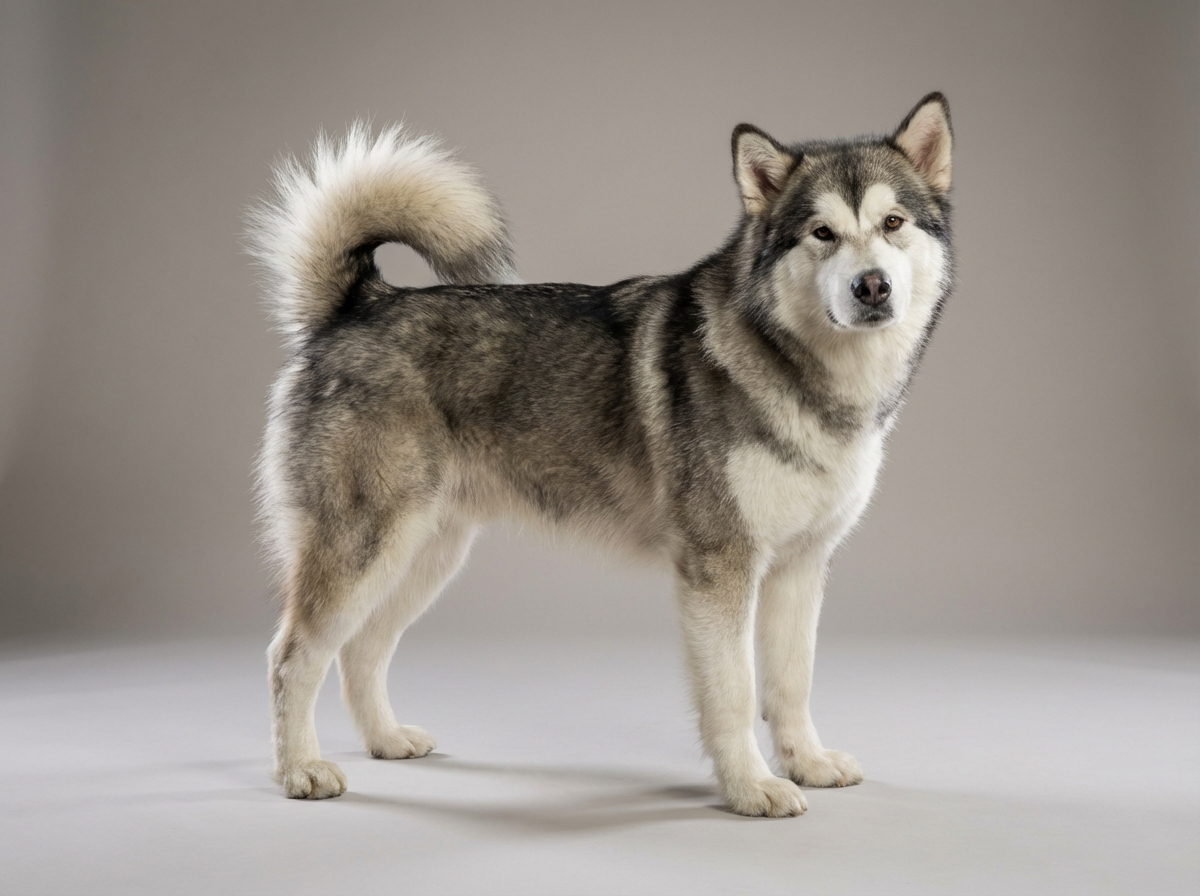
The Malamute's is undercoat. It sheds constantly at 5/5 and blows in sheets twice a year, and those weeks need an undercoat rake and several long sessions. It never mats, never needs a groomer, and should never be clipped.
Grass seeds are the Cocker's seasonal hazard. Barbed and unable to back out, they migrate inward from between the toes, an armpit or an ear canal. A two-minute check of feet, ears and armpits after summer walks prevents most of the minor surgery they cause.
So the Cocker is a weekly obligation with a summer inspection habit, and the Malamute is two intense fortnights with a year-round hair problem underneath.
The ear cycle, and how to stay out of it
Ear infections head the English Cocker's condition list for a straightforward anatomical reason: a long, heavy, feathered ear leaf lies flat over the canal and seals in warmth and moisture, and this is a breed that swims whenever it can.
What makes it worth taking seriously is that it is a cycle rather than an event. Each episode of inflammation thickens the canal lining, which narrows it further, which makes the next infection likelier and harder to treat. A proportion of chronic cases eventually need surgery.
Staying out of that cycle is genuinely achievable and genuinely daily: look inside every day, dry thoroughly after every swim or wet walk, keep the hair beneath the ear trimmed, and treat head shaking or a smell as a reason to be seen rather than to watch.
It takes under a minute and it is the single highest-value habit in owning this breed.
The Malamute's upright ears ventilate themselves, and this problem does not arise. Its equivalent routine is seasonal rather than daily.
Ninety minutes of searching against two hours of hauling
The Cocker rates 4/5 and wants around ninety minutes, and it should use its nose for a good part of that. Quartering ground, hunting hedgerows and retrieving in cover satisfy a flushing spaniel far more than distance on a lead — forty minutes of proper searching beats an hour of pavement.
The Malamute rates 5/5 and is tired by resistance: carting, scootering, canicross, loaded hikes. Two hours is realistic, and heat limits it, so summer sessions move to the cool ends of the day.
The housing consequence is the widest gap on this page: 4/5 for apartments against 1/5. A Cocker in a flat works; a Malamute does not.
Recall differs as well. A Cocker can be trained to a reliable recall at 4/5 trainability but needs it proofed against live scent — a spaniel that has picked up rabbit is not listening in any useful sense. A Malamute's recall should be treated as a bonus rather than a safety measure, and its own breed notes describe an extreme escape artist that digs, climbs and travels.
Both rate 2/5 for time alone and neither suits an empty house without cover.
Two DNA tests to ask for by name
Familial nephropathy is the English Cocker item most worth understanding. It is an inherited kidney disease affecting young dogs — typically between six months and two years — causing progressive renal failure. There is no treatment, and there is a DNA test.
The reason to ask for the result by name rather than accepting a general health assurance is that carriers are healthy. A breeder can honestly say both parents are well and still be mating two carriers, so the only useful answer is the test result itself.
Adult-onset neuropathy is the second, a progressive neurological condition appearing in middle age with an unsteady gait and weakness. It also has a DNA test.
Progressive retinal atrophy and hip dysplasia complete the list, with eye certification and hip scores as the corresponding asks.
The Malamute's own DNA-testable item is inherited polyneuropathy, which shows in young dogs as exercise intolerance, a wobbly or high-stepping gait and a change to the bark. Its list also carries hip and elbow dysplasia, hypothyroidism, hereditary cataracts, progressive retinal atrophy, epilepsy, heart disease, bloat and zinc-responsive skin disease.
What each costs to run
The Cocker runs $100–$200 a month against the Malamute's $150–$300, and $1,400–$2,900 against $2,000–$4,000 in the first year.
Grooming is where the identical 4/5 ratings diverge financially. Many Cocker owners use a professional groomer every couple of months for the feathering and the ears; the Malamute's coat needs no professional attention at all if you own a rake and have somewhere to use it.
Against that, recurring ear treatment is close to inevitable in a Cocker and can escalate to surgery.
The Malamute's expensive risks are orthopaedic surgery and a bloat emergency — larger, less frequent events at this size.
On lifespan the Cocker is slightly ahead at 12 to 14 years against 10 to 14, and on temperament the two are closer than the size gap suggests: children tie at 5/5 and strangers at 4/5, and neither breed guards anything at all.
Alaskan Malamute vs English Cocker Spaniel at a glance
Five ratings match here — grooming, energy, barking, strangers and time alone — which is more agreement than you would expect between a hundred-pound Arctic freighting dog and a thirty-pound English gundog. What does not match is where each can live: 1/5 for apartments against 4/5.
The English Cocker fits ordinary housing far better, rates 4/5 for trainability and other dogs, and needs a fraction of the space the Malamute does — but it needs daily ear care against chronic infection risk in that drop-eared coat. The Malamute needs a landscape, a rake for its 5/5 shedding coat, and roughly twice the monthly budget, with no equivalent daily maintenance routine.
Choose the Malamute if you are athletic, have space and want a large sociable dog. Choose the English Cocker if you walk a lot and want a sociable, capable dog of manageable size.
Malamute or English Cocker: Two 4/5 Coats and One Big Gap - Alaskan Malamute vs English Cocker Spaniel at a glance
Frequently asked questions
Which coat is more work?
They tie at 4/5 and the work differs completely. The Cocker's feathering mats where it rubs and needs two or three sessions a week plus periodic trimming. The Malamute's undercoat needs a rake and several long sessions during two heavy blows a year, and it never mats and never needs a groomer.
Why do English Cockers get ear infections?
A long, heavy, feathered ear leaf lies flat over the canal and seals in warmth and moisture, in a breed that swims whenever it can. Each infection thickens the canal and makes the next one likelier and harder to treat. Daily checks and thorough drying after water are what break the cycle.
What is familial nephropathy?
An inherited kidney disease affecting young English Cockers, typically between six months and two years, causing progressive renal failure with no treatment available. There is a DNA test. Ask for both parents' results by name — carriers are healthy, so a general assurance about health tells you nothing.
How much exercise does each need?
The Cocker needs around ninety minutes at 4/5, and it should include scent work — searching tires a flushing spaniel far more than distance. The Malamute needs around two hours at 5/5 and is tired by resistance: carting, scootering or loaded hikes rather than walking.
Which is better for a first-time owner?
The English Cocker at 4/5 against the Malamute's 2/5, provided you commit to the coat and the ears. It is sociable, trains at 4/5 and rates 4/5 for apartments. The Malamute needs two hours of physical work a day, serious fencing and a rake it will actually use.
What are grass seeds and why do they matter?
Barbed seed heads that work into feathering and then into skin, between toes or into an ear canal, and migrate inward because the barbs prevent them backing out. In a feathered working coat they are easy to miss. A two-minute check after summer walks prevents most of the surgery they cause.
Which is cheaper to keep?
The English Cocker, at $100–$200 a month against the Malamute's $150–$300, and $1,400–$2,900 against $2,000–$4,000 in the first year. Professional grooming and recurring ear treatment narrow that gap in practice, and chronic ear surgery would close a large part of it at once.
Malamute vs English Cocker Spaniel: which should I choose?
The English Cocker if you want a sociable dog in ordinary housing and will do the grooming and daily ear care. The Malamute if you are athletic, have space and a secured garden, and want a large northern breed.
Costs
How much does each cost per month?
The Malamute runs $150–$300 a month and the Cocker $100–$200, with first-year totals of $2,000–$4,000 and $1,400–$2,900. Add a professional groom every couple of months for the Cocker.
Health
What DNA tests should an English Cocker have?
Familial nephropathy and adult-onset neuropathy, plus progressive retinal atrophy. Hip scores and eye certification complete the picture. Ask for each result by name rather than accepting a general assurance.
Living
Which is better for a flat?
The Cocker at 4/5 against the Malamute's 1/5. It is small enough, quiet enough at 3/5 barking, and its exercise happens outdoors rather than needing a garden. The Malamute needs a landscape and a fence dug in at the base.
Health information here is general and is not veterinary advice. If your dog shows pain, sudden behaviour change, or worsening symptoms, consult a licensed veterinarian.
Some links on this site are affiliate links. We may earn a commission at no extra cost to you, and we only suggest products we believe are helpful for dog owners.
We research and check what we publish, but we do not warrant that any figure, date, price, or statement is accurate, complete, or current, and we accept no liability for any loss, cost, injury, or other harm arising from the use of this site. Use it as one reference among several. You remain responsible for your own decisions and for your dog's care - confirm anything that matters with a licensed veterinarian or another qualified professional before you act on it. Full disclaimer.