DogBreedCompass

Akita or Labradoodle: A Low-Shedding Athlete or a Quiet Guardian

People choose a Labradoodle for the coat and then discover the engine. It rates 5/5 for exercise and 5/5 for energy — higher than the Goldendoodle, higher than most retrievers — and only 2/5 for apartments. The shedding rating is the reason most buyers are looking; the exercise rating is the reason many of them should not be.

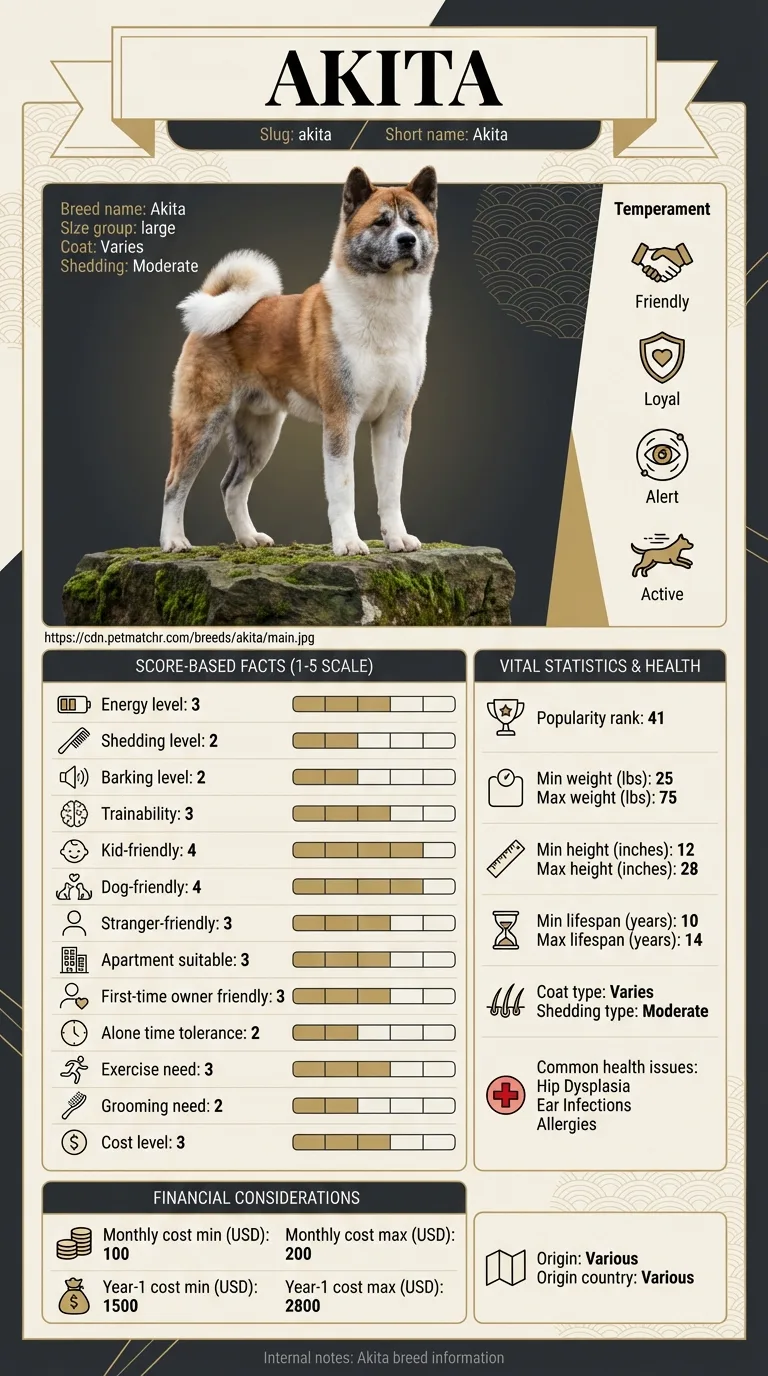
akita infographic
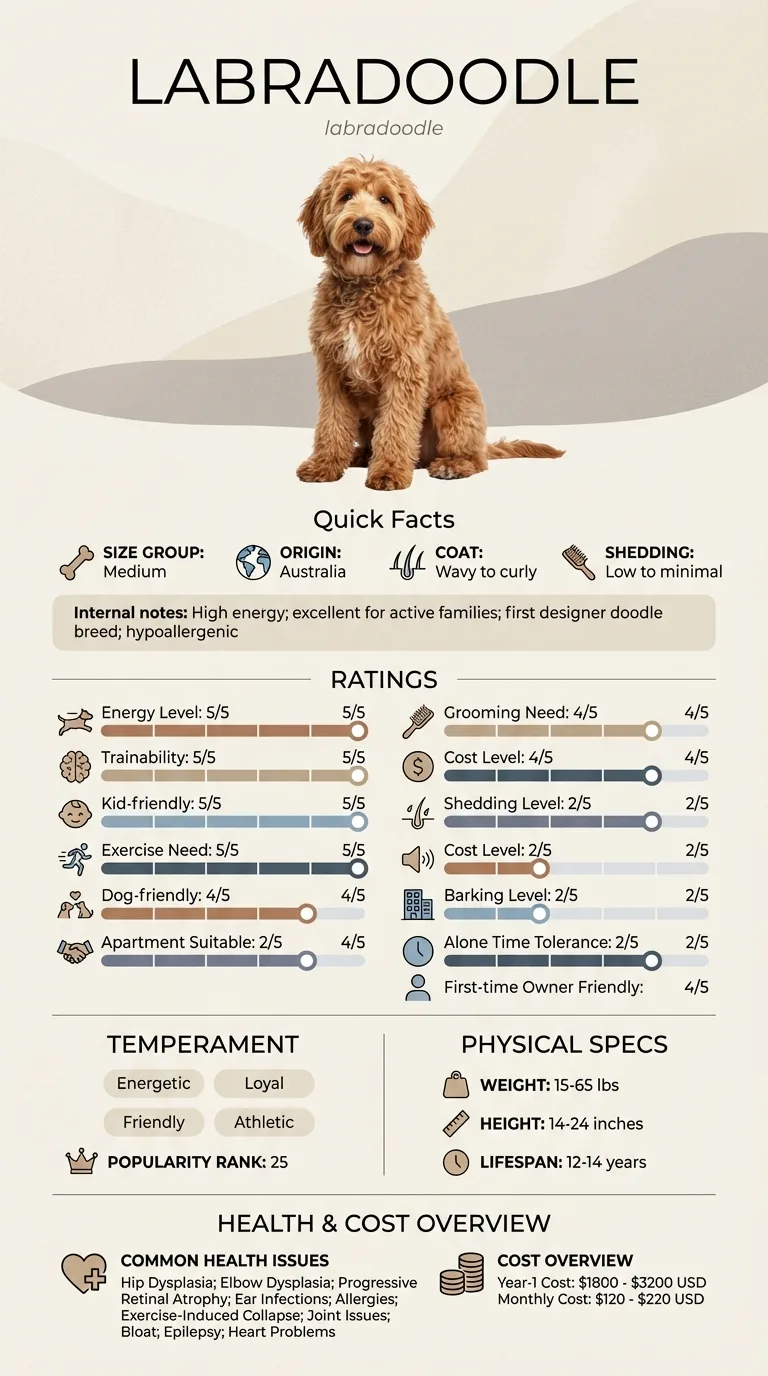
labradoodle infographic

This page is for someone drawn to a low-shedding family dog and weighing it against a large guardian. It covers the exercise requirement honestly, coat and grooming, an inherited collapse condition worth testing for, size unpredictability, and cost.

Quick verdict

The Labradoodle is a sociable, highly trainable athlete in a coat that needs professional maintenance; the Akita sheds enormously, needs no groomer, and asks for a fraction of the exercise.

Choose akita if...

Choose the Akita if you cannot commit two hours a day. It needs 3/5 exercise against the Labradoodle's 5/5, grooms at 3/5 against 4/5, and tolerates being alone at 3/5 against 2/5. You are accepting 5/5 shedding, 1/5 for first-time owners, 2/5 with other dogs and strangers, and up to 130 pounds of dog.

Choose labradoodle if...

Choose the Labradoodle if you are active, want a low-shedding dog and will fund grooming. It rates 1/5 lower on shedding than almost anything, 5/5 for trainability and with children, 4/5 with other dogs and strangers, and barks at only 2/5. You are accepting 5/5 exercise, a 2/5 apartment rating and real uncertainty about adult size.

Head-to-head comparison

FeatureakitalabradoodleWinner
Weight70–130 lbs15–65 lbsEqual
Height24–28 in14–24 inEqual
Lifespan10–13 years12–14 yearslabradoodle
CoatDense double coatWavy to curlyEqual
Grooming needModerate (3/5)High (4/5)akita
SheddingVery high (5/5)Low (2/5)labradoodle
Energy levelModerate (3/5)Very high (5/5)Equal
Exercise needModerate (3/5)Very high (5/5)akita
TrainabilityModerate (3/5)Very high (5/5)labradoodle
BarkingLow (2/5)Low (2/5)Equal
Good with kidsModerate (3/5)Very high (5/5)labradoodle
Good with other dogsLow (2/5)High (4/5)labradoodle
Friendly to strangersLow (2/5)High (4/5)labradoodle
Apartment suitabilityLow (2/5)Low (2/5)Equal
Good for first-time ownersVery low (1/5)High (4/5)labradoodle
Tolerates being aloneModerate (3/5)Low (2/5)akita
Typical monthly cost$110–$240$120–$220Equal
Typical first-year cost$1,700–$3,200$1,800–$3,200akita

Deep dive

How it differs from a Goldendoodle

If you are choosing between the two retriever crosses, the differences are real and mostly about drive.

The Labradoodle rates 5/5 for exercise and energy against the Goldendoodle's 4/5, and 2/5 for apartments against 3/5. Labradors mature into working dogs faster and harder than Goldens, and the cross reflects it.

On temperament the Goldendoodle edges it socially — 5/5 with other dogs against 4/5 — while both rate 5/5 with children and 5/5 for trainability.

There is also a lineage distinction worth knowing. A first-cross Labradoodle is one Labrador and one Poodle, and its coat is a lottery. The Australian Labradoodle is a separate multi-generational development with other breeds in the background, bred for coat consistency. If a predictable coat matters, that difference matters.

The Akita has no such variables. What the ratings say is what every Akita is, which is a genuine advantage a cross cannot offer.

A 2/5 shedding coat costs 4/5 in grooming

The trade at the heart of every doodle is this: a coat that does not shed still grows and still dies, so the dead hair stays in the coat and mats instead of falling on the floor.

The practical routine is brushing to the skin in sections several times a week — line brushing with a comb, not a slicker over the top — plus a professional groom every six to eight weeks for the dog's life. Behind the ears, the armpits, the collar line and the tail are where mats start.

The transition at eight to twelve months is where most owners come unstuck. The adult coat pushes through while the puppy coat is still present, the two felt together underneath, and by the time it is visible the dog has to be clipped off.

Ear hair grows inside the canal and traps moisture, which is why ear infections appear on the condition list. Plucking or trimming it, and drying the ears after swimming, is routine care.

The Akita's coat mats never. Ten months of a weekly brush, then two or three weeks twice a year with an undercoat rake, and it never sees a groomer.

Exercise-induced collapse in a 5/5 exercise dog

Exercise-induced collapse appears on the Labradoodle's condition list because it comes from the Labrador side, and it is worth understanding precisely because this cross is built to run.

Affected dogs are entirely normal at rest and in ordinary activity. After roughly five to twenty minutes of intense, excited exercise, the hind legs weaken and the dog collapses, sometimes with disorientation. Most recover fully within half an hour. A minority of episodes are fatal.

It is not a fitness problem and it cannot be trained through. There is a DNA test, and it is a fair and specific question for any breeder using Labrador lines.

If a dog is affected, the management is to avoid the specific trigger — sustained high-excitement exercise such as repeated retrieves in hot weather — rather than to avoid exercise generally.

The rest of the list is hip and elbow dysplasia, joint issues, progressive retinal atrophy, allergies, epilepsy, heart problems and bloat. Ask for hip and elbow scores, eye certification and cardiac examination on both parents.

The Akita's burden is autoimmune and endocrine, with hip dysplasia and bloat alongside.

What each costs, including the part nobody quotes

The Labradoodle runs $120–$220 a month against the Akita's $110–$240, and $1,800–$3,200 against $1,700–$3,200 in the first year. As budgets go they are the same dog.

Neither figure includes grooming, and that is the difference. A professional appointment every six to eight weeks for a medium to large curly-coated dog, across twelve to fourteen years, is a substantial cumulative cost. It should be written into the budget explicitly, not discovered.

The Akita has no equivalent line. A rake, a brush and a garden cover it.

Size is the other budgeting variable. A Labradoodle can be 15 pounds or 65 depending on the poodle parent and the generation, and food, medication and boarding all scale with that. Ask what size the poodle ancestors were and what previous litters from these parents have grown to.

On lifespan the Labradoodle has the edge at 12 to 14 years against 10 to 13.

Akita vs Labradoodle: the exercise row is the one to read

Barking ties at 2/5 and apartments tie at 2/5. The apartment tie is instructive: a 40-pound curly dog and a 130-pound guardian rate the same, because the Labradoodle's problem is output rather than size.

5/5 exercise and 5/5 energy is a Labrador's engine with a Poodle's brain on top, and the Poodle contributes drive rather than calm — Standard Poodles are working water dogs, not lap dogs. Two athletic parents produce an athletic cross.

The temperament rows are excellent: 5/5 trainability, 5/5 with children, 4/5 with other dogs and strangers, 4/5 for first-time owners. Provided the exercise happens, this is a very easy dog to live with.

The Akita's offer is the reverse. 3/5 exercise, no grooming appointments, and a dog that is content to do nothing — in exchange for 5/5 shedding and a temperament that has to be actively managed.

Frequently asked questions

How much exercise does a Labradoodle need?

Around two hours a day at 5/5 exercise and 5/5 energy — more than a Goldendoodle and more than most people expect from a curly-coated family dog. Both parent breeds are working dogs. An under-exercised Labradoodle is bouncy, mouthy and destructive rather than merely restless.

How is a Labradoodle different from a Goldendoodle?

Chiefly drive. The Labradoodle rates 5/5 for exercise and energy against the Goldendoodle's 4/5, and 2/5 for apartments against 3/5. Both rate 5/5 for trainability and with children. Labradors mature into working dogs harder and faster than Goldens, and the cross reflects that.

Does a Labradoodle shed?

Very little — 2/5 against the Akita's 5/5 — though it varies by generation and individual, and a first-cross puppy's coat is genuinely unpredictable. The trade is grooming at 4/5: hair that does not fall out stays in the coat and mats, so it needs brushing to the skin and a groomer every six to eight weeks.

What is exercise-induced collapse?

An inherited condition from the Labrador side in which a dog that is normal at rest collapses after five to twenty minutes of intense, excited exercise, usually recovering within half an hour. A minority of episodes are fatal. There is a DNA test, and it is a fair question for any breeder using Labrador lines.

Why does the weight range span 15 to 65 pounds?

Because the poodle parent may be Miniature or Standard, and later generations compound the variation. Ask what size the poodle ancestors were and what previous litters from these parents have grown to. Food, medication and boarding all scale with adult weight, so the answer affects your budget.

What is an Australian Labradoodle?

A separate multi-generational development with other breeds in the background, bred specifically for coat consistency, as distinct from a first-cross Labrador-and-Poodle whose coat is a lottery. If a predictable non-shedding coat is the reason you are buying, that distinction is worth understanding before you choose a breeder.

Which is better for a first-time owner?

The Labradoodle at 4/5 against the Akita's 1/5, provided the exercise happens. It rates 5/5 for trainability and with children and 4/5 with other dogs and strangers. The Akita is an independent guardian whose adult views on other dogs arrive at around two years old.

Quick answers

View more answers
Living

Akita vs Labradoodle: which should I choose?

The Labradoodle if you are active, want a low-shedding sociable dog, and will fund grooming every six to eight weeks. The Akita if you cannot commit two hours a day and would rather rake a coat twice a year.

Costs

How much does each cost per month?

The Labradoodle runs $120–$220 a month and the Akita $110–$240, with first-year totals of $1,800–$3,200 and $1,700–$3,200. Neither figure includes grooming, which the Labradoodle needs for life.

Living

Can a Labradoodle live in a flat?

It rates 2/5, the same as the Akita, for opposite reasons — output rather than size. It is possible for an owner whose routine is built around the dog's exercise, but it is not a sensible default choice.

Behavior

Which is quieter?

They tie at 2/5, which is a genuine advantage for both. Neither is a nuisance barker — unusual in a high-energy cross, and worth weighing if noise is a constraint where you live.

Related DogBreedCompass guides

  • Akita breed guideThe Akita profile covers guardian temperament and the long socialisation window the breed needs.
  • Labradoodle breed guideThe Labradoodle profile covers coat types, generations and exercise requirements.
  • Akita vs GoldendoodleThe Goldendoodle is the calmer retriever cross most often weighed against this one.
  • Akita vs Labrador RetrieverThe Labrador is one half of the cross and the comparison worth reading alongside it.
  • Labradoodle ear infectionsEar infections are a recurring issue in breeds with hair growing in the canal.
  • Akita autoimmune diseasesAutoimmune disease is the Akita's most distinctive burden and the first question for a breeder.

Related guides

Important reminder

Health information here is general and is not veterinary advice. If your dog shows pain, sudden behaviour change, or worsening symptoms, consult a licensed veterinarian.

Some links on this site are affiliate links. We may earn a commission at no extra cost to you, and we only suggest products we believe are helpful for dog owners.

Find Your Perfect Breed

Match your lifestyle to the right dog.

Take quiz

Find your match

Not sure which breed is right for you? Take our 2-minute quiz to find out.

Take the quiz