DogBreedCompass

Malamute or Great Dane: Four Extra Years or Ninety Extra Pounds

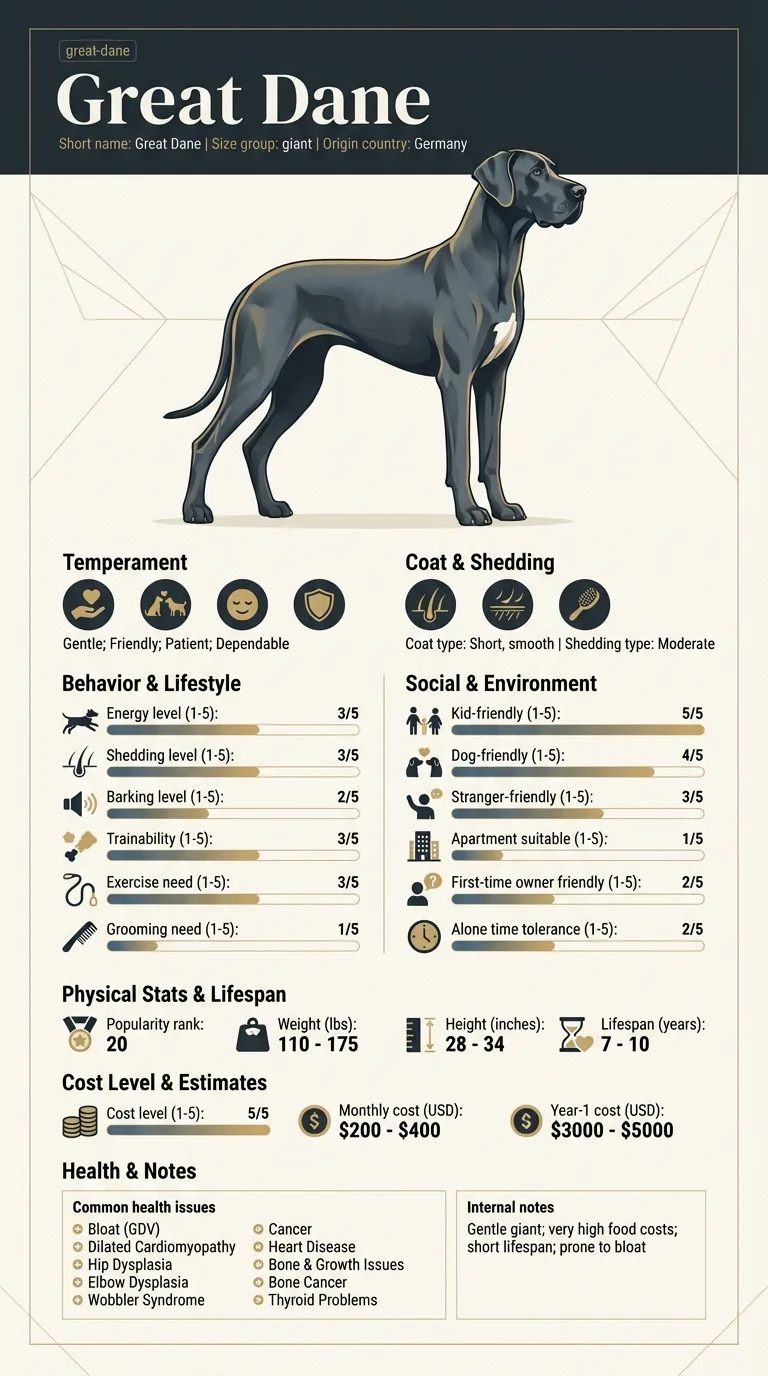
The Great Dane can outweigh the Malamute by 65 pounds and stand nine inches taller, and it needs two exercise ratings less. It also lives, on average, three to four years fewer.

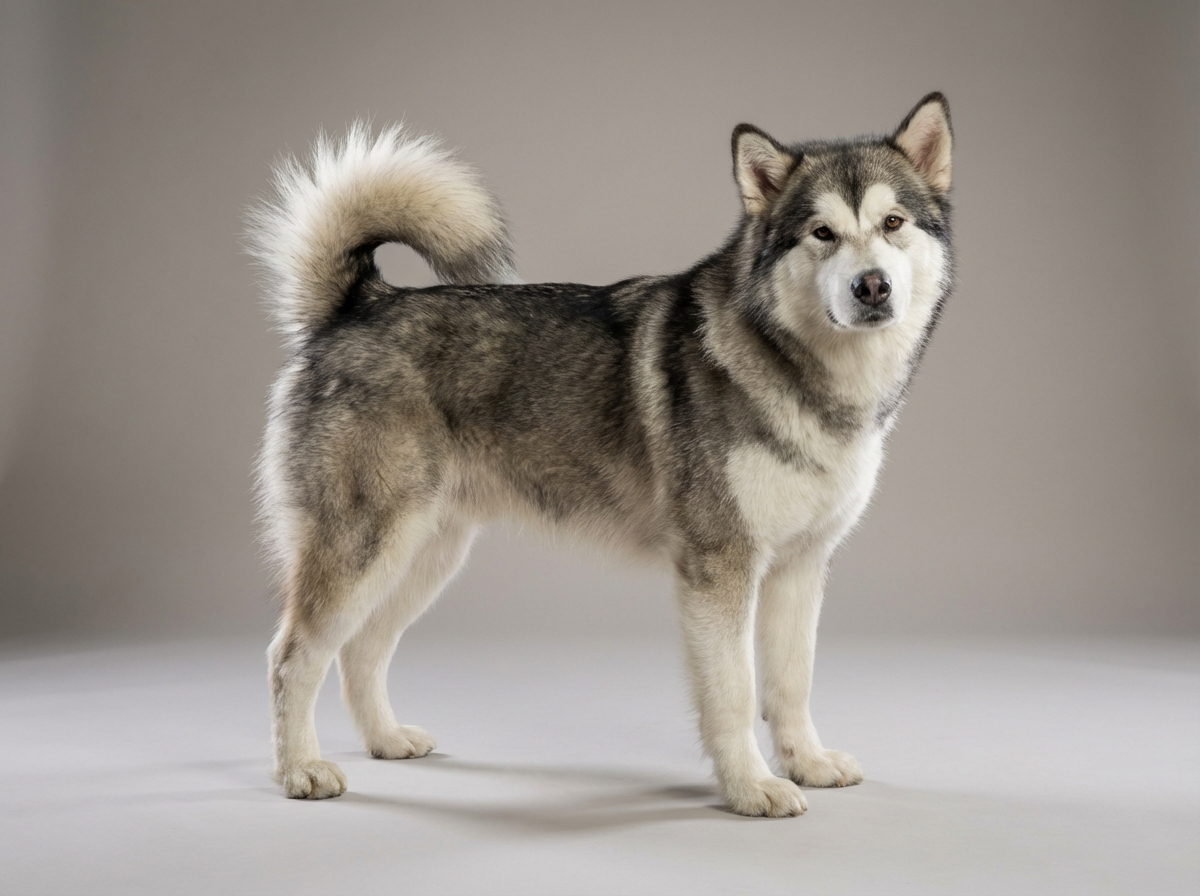
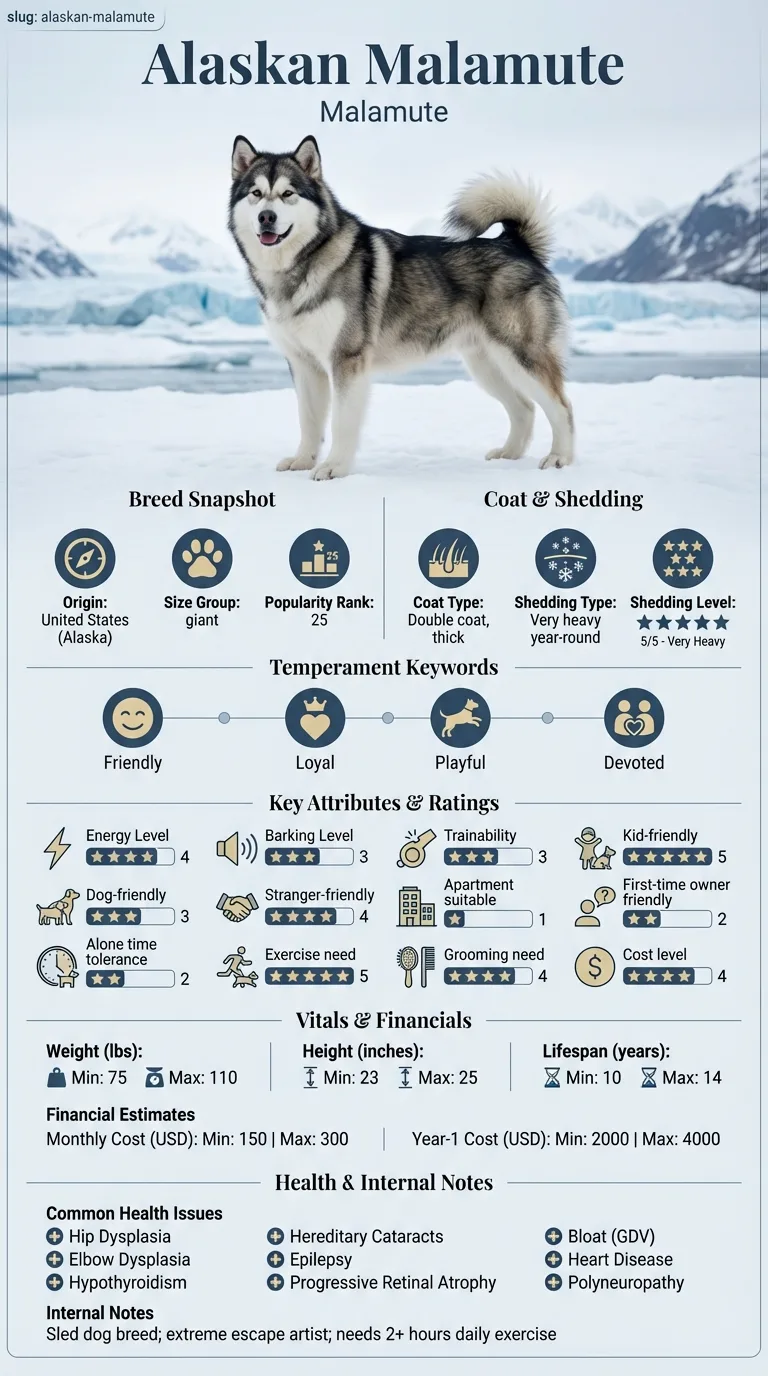
alaskan malamute infographic
great dane infographic

This page is for someone who has decided they want a genuinely large dog and is now working out which kind of large — an athlete that will demand two hours a day for a dozen years, or a gentle giant that will lie across the sofa and be gone far too soon.

Quick verdict

The Great Dane is the far easier giant to exercise and groom but the harder one to afford, to keep healthy and to lose; the Malamute demands more of your day and gives back three or four more years.

Choose alaskan malamute if...

Choose the Alaskan Malamute if you want an active outdoor life with a large dog, you have cold weather and secure fencing, and a longer expected lifespan matters more to you than an easy daily routine.

Choose great dane if...

Choose the Great Dane if you want enormous presence with modest exercise demands and almost no grooming, you have the budget for the highest running costs on this page, and you can accept a seven to ten year life.

Head-to-head comparison

Featurealaskan malamutegreat daneWinner
Weight75–110 lbs110–175 lbsalaskan malamute
Height23–25 in28–34 inalaskan malamute
Lifespan10–14 years7–10 yearsalaskan malamute
CoatThick double coatShort, smoothgreat dane
Grooming need4/51/5great dane
Shedding5/5 — very heavy year-round3/5 — moderategreat dane
Energy level4/53/5great dane
Exercise need5/53/5great dane
Trainability3/53/5Equal
Barking3/52/5great dane
Good with kids5/55/5Equal
Good with other dogs3/54/5great dane
Friendly to strangers4/53/5alaskan malamute
Apartment suitability1/51/5Equal
Good for first-time owners2/52/5Equal
Tolerates being alone2/52/5Equal
Typical monthly cost$150–300$200–400alaskan malamute
Typical first-year cost$2,000–4,000$3,000–5,000alaskan malamute

Deep dive

Exercise 5/5 against 3/5: the counterintuitive result

People assume exercise need scales with size. These two breeds are a clean demonstration that it scales with job history instead.

The Malamute was bred to haul freight over Arctic distance, and its 5/5 exercise rating is not padding. Its own breed notes specify two or more hours daily, and the activity that satisfies it involves resistance: a weighted pack, a pulling harness, a rig, steep ground, snow. Flat lead-walking for an hour does not touch it. There is no bad-weather substitute and no indoor version, and in a warm climate the routine relocates to dawn and dusk for months because the coat sets a hard thermal limit.

The Great Dane was bred to hunt boar and then redirected almost entirely into companionship, and at 3/5 exercise and 3/5 energy it is genuinely modest. Adult Danes are content with forty-five minutes to an hour of walking, split across two outings, plus the chance to stretch out properly a few times a week. Much of an adult Dane's day is spent horizontal. The famous descriptor is accurate: a very large dog with a very small daily requirement.

There is a critical caveat on the Dane side that does not apply to the Malamute. Danes grow from roughly two pounds to well over a hundred in eighteen months, and that growth plate window is fragile. Forced exercise, long runs, stairs and repetitive jumping before about eighteen months are associated with the bone and growth problems on the breed's own health list. A Dane puppy needs deliberately restrained exercise — free play on soft ground, short walks, nothing forced. A Malamute puppy needs restraint too, but the Dane's window is longer and the consequences are more severe.

So the day-to-day picture inverts: the smaller dog owns your mornings, and the bigger one waits on the sofa.

Seven to ten years against ten to fourteen

This is the hardest number on the page and it deserves to be treated plainly rather than softened.

The Great Dane's expected lifespan is 7 to 10 years. That is the shortest range of any breed profiled on this site, and it is a direct consequence of extreme size: giant breeds age faster, carry more cardiac load, and have far higher rates of bone cancer and heart disease. A Dane is middle-aged at four and old at seven. Owners frequently describe the arithmetic afterwards — the dog was a puppy for two years and a senior for two, leaving a short window in the middle.

The Malamute's 10 to 14 years is remarkable for a dog that can reach 110 pounds, and it is one of the strongest practical arguments for the breed. A Malamute is often still hiking at nine and comfortably mobile at eleven.

The difference is roughly a third of a dog's life, and it changes what the two commitments actually are. Choosing a Dane means accepting a shorter, heavier, more expensive relationship with a higher probability of a difficult end — bloat, dilated cardiomyopathy and osteosarcoma all appear on the breed's list and all tend to arrive suddenly. Choosing a Malamute means committing to a decade or more of daily physical work, which is its own kind of demand.

Neither is the better choice in the abstract. But anyone choosing a Dane should look at the number honestly before falling for the puppy, and anyone choosing a Malamute should recognise that the fourteenth year still needs a walk.

Bloat, gastropexy and the one conversation to have before you buy

Bloat — gastric dilatation and volvulus — appears on both breeds' health lists, but the Great Dane is the single highest-risk breed for it that exists. That fact should shape the purchase decision, not merely inform it.

The mechanism is a stomach that fills with gas and then rotates on its axis, cutting off blood supply. It kills in hours. The presentation is a dog that becomes restless, tries repeatedly to vomit and produces nothing, has a distending abdomen and is clearly in distress. There is no home remedy and no waiting until morning — it is a drive-to-the-emergency-clinic-now event, and the cost of surgical correction commonly runs to several thousand dollars.

Because the Dane's risk is so high, prophylactic gastropexy is a mainstream recommendation for the breed rather than a fringe one. The stomach is tacked to the abdominal wall so it cannot rotate, and it is frequently done at the same time as spay or neuter to avoid a second anaesthetic. It does not prevent gas distension, but it prevents the twist that does the killing. Any Dane owner should have that conversation with their vet early, and any Dane breeder should expect the question.

For the Malamute the risk is real but far lower, and the management is behavioural: split the daily food into two or three meals, avoid strenuous exercise in the hour either side of eating, and slow down a fast eater with a maze bowl.

Both breeds are large enough that knowing your nearest out-of-hours surgery, and roughly what it charges, is a sensible thing to establish in the first week rather than at two in the morning.

Cost level 5/5: the Dane is the most expensive dog on this page

The Great Dane is one of very few breeds rated 5/5 for cost, and the figures back it: $200–400 a month against the Malamute's $150–300, with a first year of $3,000–5,000 against $2,000–4,000.

Food is the obvious component. A 150 pound dog eats a great deal, and a giant-breed puppy needs a formulation with controlled calcium and a specific calorie density to avoid accelerating growth — the wrong food is genuinely a health risk in the first eighteen months, not just an expense.

The less obvious costs are the ones weighed by the kilogram. Parasite prevention, antibiotics, anaesthesia, pain relief and sedation are all dosed by body weight, so every routine event costs more. A dental under general anaesthetic on a Dane is a bigger procedure with more drug and more risk than the same job on a 90 pound Malamute. Insurance premiums for Danes are among the highest of any breed because of the cardiac, orthopaedic and cancer history.

Then there is the equipment. Crates, beds, ramps for the car, gates, harnesses and boarding fees all step up a tier at Dane size, and some boarding kennels either decline giant breeds or surcharge them.

The Malamute has one cost the Dane does not: grooming. At 4/5 grooming and 5/5 shedding against the Dane's 1/5 and 3/5, the Malamute needs an undercoat rake two or three times a week and possibly professional de-shedding twice a year. The Dane needs a rubber mitt occasionally and nothing else. That is real, but it does not close a gap of $50 to $100 a month in the other direction.

Living with each: space, sociability and the practical week

Both rate 1/5 for apartments and 5/5 with children, and the reasons diverge entirely. The Malamute is unsuited to small spaces because it will not settle without serious outdoor work. The Dane is unsuited because of physics: a dog that stands 34 inches at the shoulder clears a coffee table with its tail and cannot turn around in a narrow hallway. A Dane in a large flat with a lift is more workable than a Malamute in the same flat, but neither is a good idea.

With strangers the Malamute is warmer at 4/5 against 3/5. Neither is a guard dog, though a Dane's sheer size does deterring work that its temperament never intended. At 2/5 barking against 3/5, the Dane is also the quieter neighbour — when it does bark, the volume is memorable.

With other dogs the Dane leads 4/5 to 3/5, and the Malamute's friction point is same-sex adult pairings. Around cats the Dane is generally the safer bet; the Malamute retains a real hunting drive that most owners treat as permanently managed rather than resolved.

Both rate 2/5 for time alone and 3/5 for trainability. The Dane's 3/5 is about sensitivity and slow maturation rather than stubbornness — it responds poorly to harsh handling and takes two to three years to grow up mentally. The Malamute's 3/5 is genuine independence. In both cases loose-lead walking matters enormously, because a dog that outweighs its handler and has not learned to walk politely is not a dog that gets walked.

One last practical note: drool. The Dane produces it, particularly after drinking, and it travels. The Malamute does not. Everyone weighs the coat and forgets the towels.

Alaskan Malamute vs Great Dane at a glance

The Great Dane can outweigh the Malamute by 65 pounds and stand nine inches taller, yet it needs two exercise ratings less. It also lives, on average, three to four years fewer — the trade running the length of this comparison in both directions.

The Dane is by far the easier giant to exercise and groom, satisfied without the daily physical output a Malamute demands. What it costs is real money: the Dane carries the highest running costs on this page, a heightened bloat risk, and a life that typically ends at seven to ten years rather than ten to fourteen.

Choose the Malamute if you want an active outdoor life with a large dog, you have cold weather and secure fencing, and a longer expected lifespan matters more than an easy daily routine. Choose the Great Dane if you want enormous presence with modest exercise demands and almost no grooming, and you have the budget for the highest costs here and can accept a shorter life.

Frequently asked questions

Which giant breed needs less exercise?

The Great Dane, at 3/5 against the Malamute's 5/5, despite being much larger. Forty-five minutes to an hour split across two walks suits an adult Dane. The Malamute needs two or more hours with real physical resistance to be satisfied.

Why does the Malamute live so much longer?

10 to 14 years against 7 to 10. Extreme size shortens life — giant breeds age faster and carry higher rates of bone cancer, dilated cardiomyopathy and heart disease. At 110 pounds the Malamute sits below the threshold where that penalty becomes severe.

Should a Great Dane have a preventive gastropexy?

It is a mainstream recommendation for the breed rather than an unusual one, because the Dane is the highest-risk breed for bloat. It is often done alongside spay or neuter to avoid a second anaesthetic. Discuss timing with your own vet.

Which costs more to keep?

The Great Dane, at $200–400 a month against $150–300, and $3,000–5,000 in the first year against $2,000–4,000. Food, weight-based dosing, anaesthesia and insurance all price higher. Only grooming runs the other way.

Which sheds less?

The Dane comfortably — 3/5 shedding and 1/5 grooming against the Malamute's 5/5 and 4/5. A Dane needs an occasional rubber mitt; a Malamute needs an undercoat rake two or three times a week and blows its coat twice a year.

Are both good with children?

Both rate 5/5 and both are genuinely gentle. The practical caution differs: a Dane knocks small children over without noticing, while a Malamute is dense and strong enough to pull a child off their feet on a lead.

How much exercise should a Great Dane puppy get?

Deliberately little. Growth plates stay open until around eighteen months and forced exercise, long runs, stairs and repeated jumping in that window are linked to the bone and growth problems on the breed's health list. Free play on soft ground is the goal.

Quick answers

View more answers
Living

Malamute or Great Dane: which should I choose?

The Dane if you want enormous presence with a modest daily routine, almost no grooming, and you can afford the highest running costs here. The Malamute if you want an outdoor life with a large dog and three or four more years with it.

Costs

Which is the more expensive dog?

The Great Dane by a clear margin — cost level 5/5 against 4/5, $200–400 a month against $150–300, and a first year of $3,000–5,000 against $2,000–4,000.

Health

What is the biggest health risk for a Great Dane?

Bloat, which the breed is more prone to than any other. Dilated cardiomyopathy, wobbler syndrome and bone cancer follow. All tend to present suddenly, which is why an emergency plan matters.

Training

Which is easier to train?

Both rate 3/5, for different reasons. The Dane is sensitive and slow to mature, needing gentle handling over two to three years. The Malamute is independent and will weigh up whether an instruction is worth following.

Related DogBreedCompass guides

  • Alaskan Malamute breed guideThe Malamute profile covers the exercise load, coat work and containment the breed actually requires.
  • Great Dane breed guideThe Great Dane profile covers growth-stage management, space needs and the breed's short lifespan.
  • bloat in Great DanesBloat is the defining emergency risk for the breed and the reason gastropexy is routinely discussed.
  • dilated cardiomyopathy in Great DanesDilated cardiomyopathy is a leading cause of sudden loss in giant breeds and sits high on the Dane's list.
  • arthritis in Alaskan MalamutesJoint wear catches up with both giants, and arthritis management shapes the last third of either dog's life.
  • adopting a Great DaneDanes are surrendered often, usually for size and cost, so adult adoption is a realistic route into the breed.

Related guides

Important reminder

Health information here is general and is not veterinary advice. Giant-breed risks and preventive options such as gastropexy should be discussed with your own veterinarian.

Some links on this site are affiliate links. We may earn a commission if you buy through them, at no additional cost to you.

Find Your Perfect Breed

Match your lifestyle to the right dog.

Take quiz

Find your match

Not sure which breed is right for you? Take our 2-minute quiz to find out.

Take the quiz