DogBreedCompass

Malamute or Maltese: Twenty Times the Dog, the Same Grooming Score

A 5 pound Mediterranean lapdog and a 95 pound Arctic freighting dog both rate 4/5 for grooming need. One of them sheds at 5/5 and the other at 1/5, which is the full width of the scale.

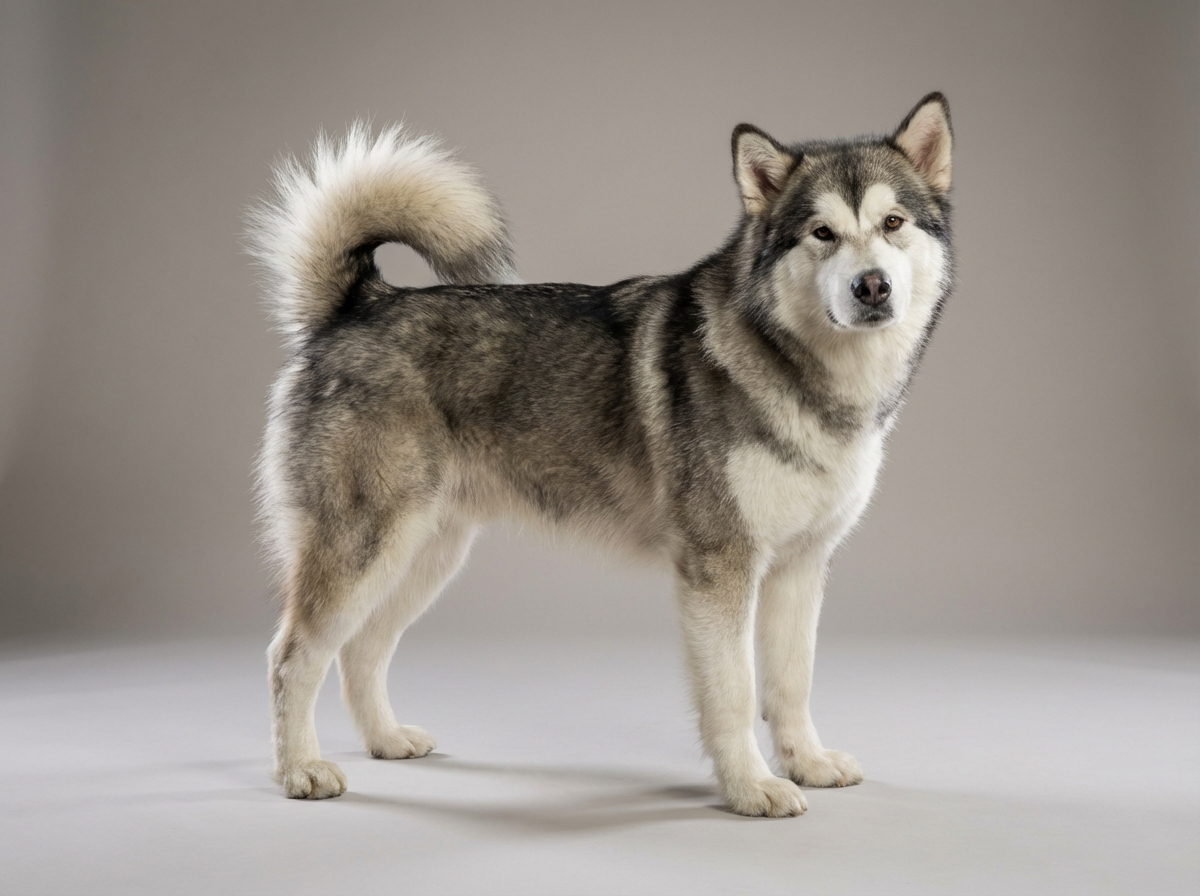
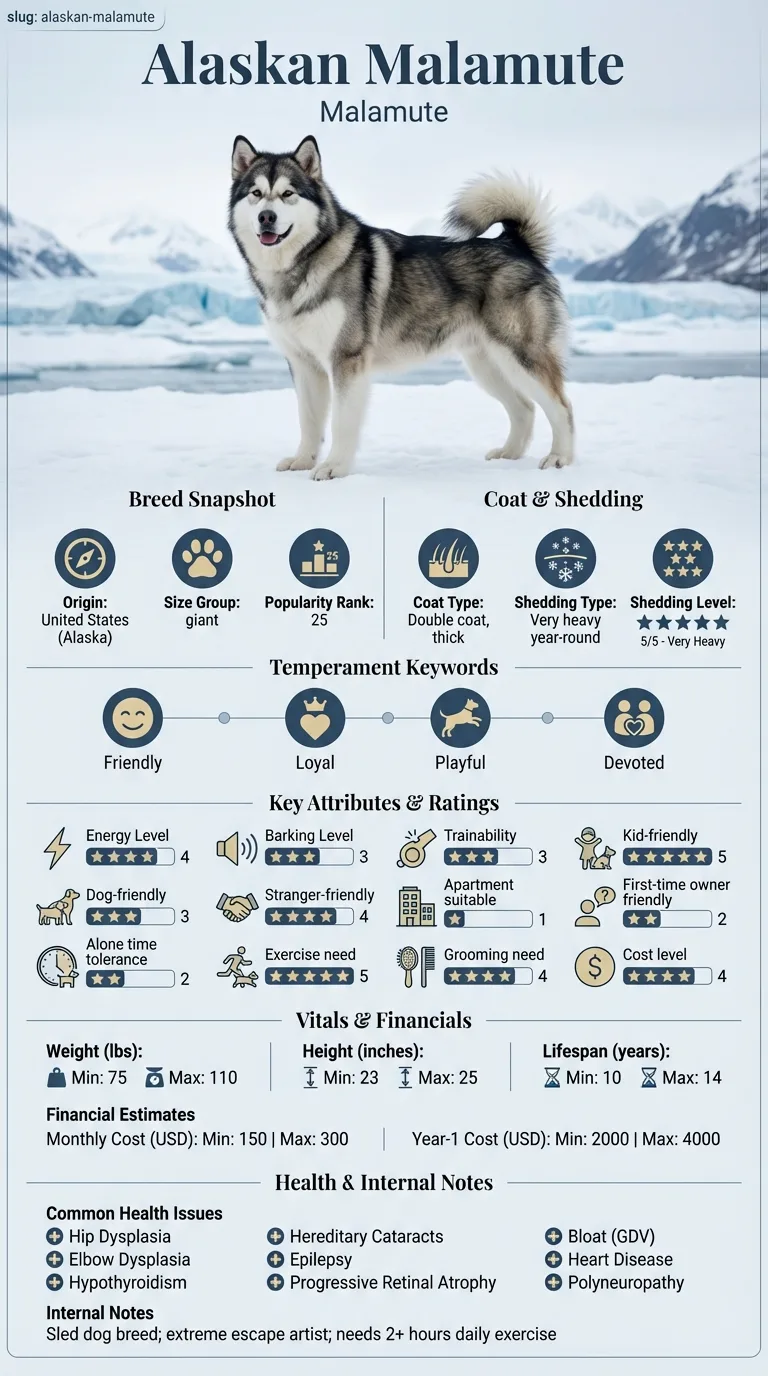
alaskan malamute infographic
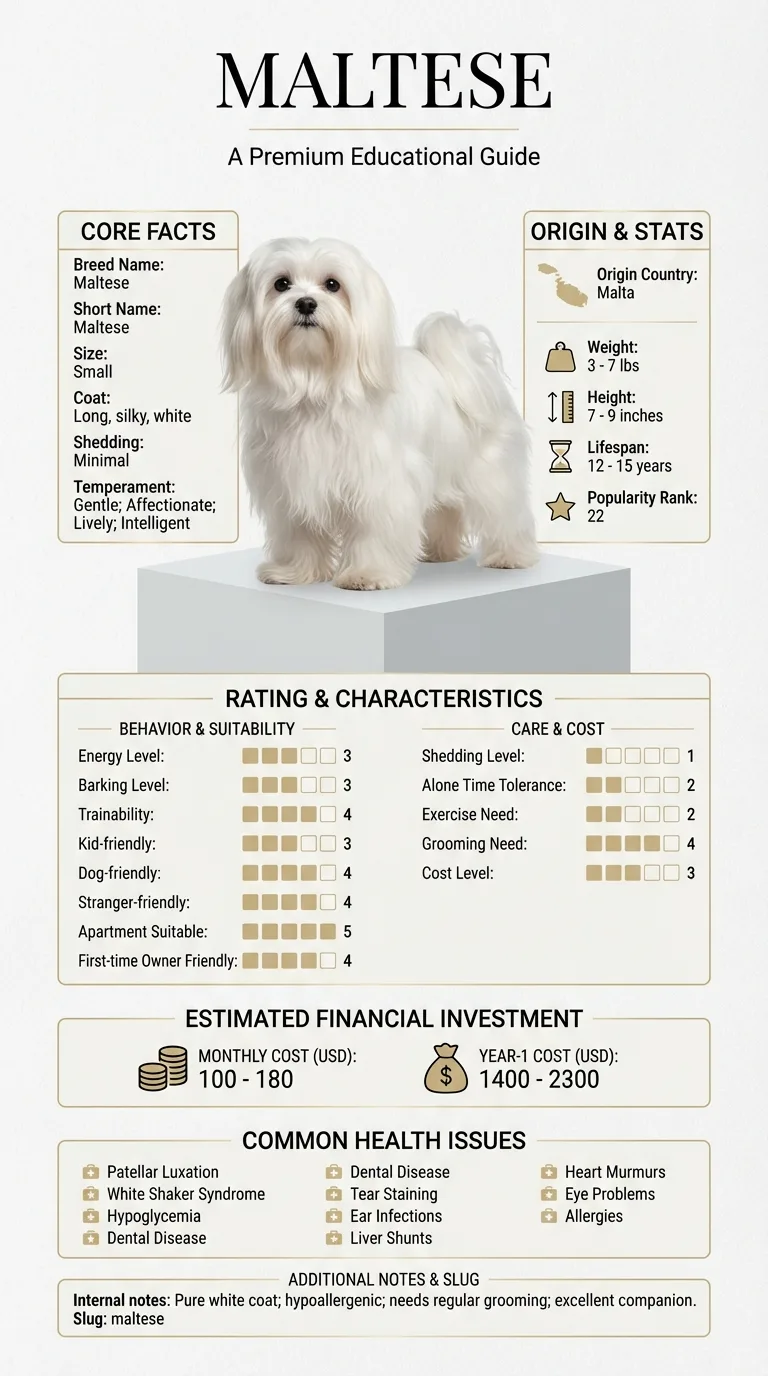
maltese infographic

This page is for a household with limited space deciding whether the large dog they admire is realistic, and for anyone who assumes a tiny non-shedding dog must be the low-maintenance option.

Quick verdict

The Maltese is the only workable choice for most small homes, and its real costs are dental care, daily combing and a coat that shows every stain rather than anything to do with exercise.

Choose alaskan malamute if...

Choose the Alaskan Malamute if you have cold weather, a securely fenced garden and two hours a day for physical work, and you want a large outdoor dog rather than a constant indoor companion.

Choose maltese if...

Choose the Maltese if you live in a flat or small house, want a 12 to 15 year companion that needs half an hour of walking, and you will comb it daily and budget for dentals across its whole life.

Head-to-head comparison

Featurealaskan malamutemalteseWinner
Weight75–110 lbs3–7 lbsEqual
Height23–25 in7–9 inEqual
Lifespan10–14 years12–15 yearsmaltese
CoatThick double coatLong, silky, whiteEqual
Grooming need4/54/5Equal
Shedding5/5 — very heavy year-round1/5 — minimalmaltese
Energy level4/53/5maltese
Exercise need5/52/5maltese
Trainability3/54/5maltese
Barking3/53/5Equal
Good with kids5/53/5alaskan malamute
Good with other dogs3/54/5maltese
Friendly to strangers4/54/5Equal
Apartment suitability1/55/5maltese
Good for first-time owners2/54/5maltese
Tolerates being alone2/52/5Equal
Typical monthly cost$150–300$100–180maltese
Typical first-year cost$2,000–4,000$1,400–2,300maltese

Deep dive

What a twentyfold weight difference actually changes

The Malamute can weigh twenty times what the Maltese does, and that ratio changes the nature of ownership rather than just its scale.

A 5 pound dog is a dog you carry. It goes in a bag on a train, it fits under an aeroplane seat, it can be lifted away from a situation you do not like the look of, and it will never pull you over. That portability is the whole point of a toy breed and it is a real, practical benefit that people undervalue when comparing on paper.

It is also a dog that is genuinely fragile. A fall from a sofa can break a Maltese leg. A door swinging shut, a foot in the dark, a bigger dog playing too enthusiastically — all are live risks in a way they simply are not for a 95 pound Malamute. Toy breeds are also prone to hypoglycaemia, which is on the Maltese health list: a very small dog, especially a puppy, has almost no glycogen reserve, so missed meals or a long stressful day can drop its blood sugar into weakness, wobbling and, untreated, collapse. Maltese puppies need frequent small meals for that reason, and owners of the smallest examples usually keep a glucose gel in the house.

The Malamute's physical risks run the other way: it can pull an adult off their feet, clear a garden fence, and injure a small child by accident rather than intent. Neither dog is a low-consequence animal — the consequences just land on opposite sides.

The rating that reflects this is children: 5/5 for the Malamute against 3/5 for the Maltese. The Maltese score is not about temperament. It is about a dog that a toddler can seriously hurt.

Both 4/5 for grooming: a rake against a comb, every day

This tie is the most instructive line in the table, because the two 4/5 ratings share nothing except the hours they consume.

The Malamute's coat is a shedding job. Rated 5/5 and very heavy year-round, needing an undercoat rake taken to the skin two or three times a week and daily during the two annual blows, when the wool comes away in sheets. Everything can be done at home. The consumable cost is a vacuum cleaner. The rule is that the coat is never shaved, because a double coat insulates in both directions and does not reliably grow back correctly.

The Maltese coat is a texture and colour job. It is a single coat — no undercoat at all — of long, fine, silky hair that grows continuously and sheds at 1/5, meaning almost nothing falls out. It behaves more like human hair than like a typical dog coat, which is why it tangles rather than drifts. Left more than a day or two it forms fine mats close to the skin, and because the hair is so fine those mats tighten quickly.

Then there is the white. Tear staining appears on the breed's own health list, and it is the reddish-brown discoloration below the eyes caused by porphyrins in tear fluid oxidising on a pale coat. It needs daily wiping of the face and, often, a trimmed inner corner to stop hair wicking moisture across the skin. The beard picks up food, the feet pick up grass stains, and everything shows.

Most Maltese owners eventually choose between a full-length show coat with daily combing and wrapping, or a short puppy clip every four to six weeks that reduces the daily job to a few minutes. The clip is the sensible option for a pet, and unlike the Malamute there is no coat damage in taking it.

Dental disease: the toy-breed cost nobody budgets for

Dental disease sits high on the Maltese health list and it deserves a section of its own, because across a 12 to 15 year life it is likely to be the single largest recurring veterinary expense.

The mechanism is simple geometry. A toy breed carries the same forty-two adult teeth as a large dog in a jaw a fraction of the size. Teeth crowd, overlap and trap plaque in places a tongue cannot clear, so tartar builds faster, gums recede earlier and teeth loosen sooner. Retained puppy teeth are also common in small breeds and make the crowding worse if not removed.

What that means practically: daily toothbrushing from puppyhood is not optional advice for a Maltese, it is the intervention that determines whether the dog reaches ten with its teeth. Professional scaling under general anaesthetic typically becomes necessary every one to three years, and each one carries both a cost and an anaesthetic risk that rises with age. Extractions add substantially to the bill.

The Malamute's mouth is comparatively low-maintenance. It is a large-jawed breed with well-spaced teeth, and while dental care still matters, it is not the defining lifetime cost.

The rest of the Maltese list carries the small-breed pattern: patellar luxation, liver shunts, heart murmurs, ear infections, eye problems, allergies and white shaker syndrome — a tremor condition seen in small white breeds that responds well to treatment but is alarming the first time an owner sees it. Ask a breeder about patellar evaluation, cardiac auscultation and any liver shunt history in the line.

Space, exercise and how each dog spends a day

The Maltese rates 5/5 for apartments and the Malamute 1/5, and the exercise ratings explain most of it: 2/5 against 5/5.

A Maltese needs roughly twenty to thirty minutes of walking a day plus indoor play, and at 4/5 trainability it enjoys short training sessions and learns tricks readily. Its 3/5 energy is real — it is lively rather than lazy, and it will trot around a flat happily — but the requirement is small and can be met without leaving the building on a bad day.

A Malamute needs two hours minimum with physical resistance in it: a loaded pack, a pulling harness, a rig, snow or steep ground. No indoor substitute exists, and in a warm climate the Arctic coat pushes the routine to first and last light for months of the year. A Malamute without that work does not become a quieter dog; it becomes a destructive one.

Climate reverses too. The Maltese has no undercoat, so it feels cold quickly and genuinely benefits from a coat in winter, while it copes well with Mediterranean warmth. The Malamute is the opposite in both directions.

On sociability, the Maltese is 4/5 with other dogs against 3/5 and 4/5 with strangers, matching the Malamute. Neither is a guard dog. Both rate 3/5 for barking, though the Maltese's is a sharp alert at the door rather than sustained noise, and both rate 2/5 for time alone — the Maltese because centuries of companion breeding produced a dog that wants company, the Malamute because boredom turns into landscaping.

Cost favours the Maltese but less than the size gap suggests: $100–180 a month against $150–300, cost level 3/5 against 4/5. Grooming appointments and dentals are why a 5 pound dog is not five times cheaper than a 95 pound one.

Choosing well: the questions that matter for each breed

For the Maltese, the risks concentrate at the point of purchase. Toy breeds attract volume breeding, and the smallest examples — sometimes marketed as teacup, which is not a recognised size — carry disproportionate rates of hypoglycaemia, liver shunt, open fontanelle and fragile bones. A responsible Maltese breeder is not producing the smallest dogs they can. Ask what both parents weigh, ask about patellar evaluation and cardiac checks, ask whether any puppy in previous litters was diagnosed with a shunt, and be wary of anyone selling before twelve weeks — small puppies need longer with the litter and a stable feeding routine before they move.

For the Malamute, the risks concentrate after purchase. The breed's own notes describe an extreme escape artist needing two or more hours daily, and the failure mode is a well-bred dog in an unsuitable life. Hip and elbow scores on both parents are the screening questions; the honest self-assessment questions are about your fence, your climate and your mornings.

Both breeds live a long time by their own standards, so the commitment is real either way. A Maltese bought at 25 may still be alive when you are 40. A Malamute needs its walk in the fourteenth year as well as the first.

If the choice genuinely sits between these two, the deciding factor is almost never temperament — both are pleasant, sociable dogs. It is whether your home, climate and week can support a working breed at all. If they cannot, the Maltese is not a downgrade; it is a different kind of dog that happens to fit.

Alaskan Malamute vs Maltese at a glance

A 5 pound Mediterranean lapdog and a 95 pound Arctic freighting dog both rate 4/5 for grooming need. One sheds at 5/5 and the other at 1/5 — the full width of the scale between two dogs that otherwise share nothing.

The Maltese is the only workable choice for most small homes, and its real ongoing costs have nothing to do with exercise: daily combing to prevent matting, dental care across a 12 to 15 year life, and a white coat that shows every stain. The Malamute's demands run the opposite direction — space, cold weather, and two hours of physical work a day.

Choose the Malamute if you have cold weather, a securely fenced garden, and two hours a day for physical work, and you want a large outdoor dog rather than a constant indoor companion. Choose the Maltese if you live in a flat or small house and will comb it daily and budget for dental care across its whole life.

Frequently asked questions

Why do both breeds rate 4/5 for grooming when one barely sheds?

Because the work is different. The Malamute needs raking two or three times a week to clear shed undercoat. The Maltese sheds almost nothing, so dead hair stays in the coat and mats — it needs combing to the skin daily plus regular trims.

Is a Maltese good with young children?

It rates 3/5 against the Malamute's 5/5, and the reason is fragility rather than temperament. At 3 to 7 pounds a Maltese can be seriously injured by a toddler, so the supervision protects the dog.

What is tear staining and can it be prevented?

Reddish-brown marks below the eyes from pigments in tear fluid oxidising on a white coat. Daily face wiping, keeping the inner corner hair trimmed and treating any underlying eye irritation all help. On a white breed it is managed rather than eliminated.

Which is more expensive to keep?

The Malamute at $150–300 a month against $100–180, though the gap is far smaller than the size difference implies. Maltese grooming appointments and repeated dental work under anaesthetic close much of it.

How much exercise does a Maltese need?

About twenty to thirty minutes of walking a day plus indoor play, on a 2/5 exercise rating. The Malamute needs two hours minimum with physical resistance and has no indoor alternative.

Which lives longer?

The Maltese at 12 to 15 years against 10 to 14. That is a normal small-breed advantage, and dental health is one of the biggest factors in whether an individual Maltese reaches the top of the range comfortably.

Can either be left alone all day?

Neither — both rate 2/5. The Maltese was bred for centuries purely as a companion and wants company. The Malamute is bored rather than anxious, and turns that boredom into digging and escape attempts.

Quick answers

View more answers
Living

Malamute or Maltese: which should I choose?

The Maltese for any small home — 5/5 for flats, 2/5 exercise, 12 to 15 years of companionship — as long as you will comb daily and budget for dentals. The Malamute only with cold weather, secure fencing and two hours of daily work.

Costs

Which is cheaper to own?

The Maltese at $100–180 a month against $150–300, and $1,400–2,300 in the first year against $2,000–4,000. Cost level 3/5 against 4/5.

Health

What is the biggest health cost for a Maltese?

Dental disease. Crowded teeth in a tiny jaw mean daily brushing from puppyhood and professional scaling under anaesthetic every one to three years across a 12 to 15 year life.

Training

Which is easier to train?

The Maltese at 4/5 against 3/5. It enjoys short indoor sessions and learns tricks readily. House-training is the one area where small breeds often take longer, so consistency matters more than cleverness.

Related DogBreedCompass guides

  • Alaskan Malamute breed guideThe Malamute profile covers exercise load, coat raking and the containment work the breed needs.
  • Maltese breed guideThe Maltese profile covers coat options, companionship needs and small-breed care.
  • dental disease in the MalteseDental disease is the dominant lifetime cost for the breed and the reason daily brushing matters.
  • patellar luxation in the MaltesePatellar luxation is the most common orthopaedic problem in toy breeds and ranges from mild to surgical.
  • cataracts in Alaskan MalamutesHereditary cataracts appear on the Malamute's list and are picked up through eye certification.
  • apartment dogs that do not shedReaders ruling out a large coated breed on hair usually want the wider low-shedding shortlist.

Related guides

Important reminder

Health information here is general and is not veterinary advice. Toy-breed risks such as hypoglycaemia and liver shunt should be discussed with your own veterinarian.

Some links on this site are affiliate links. We may earn a commission if you buy through them, at no additional cost to you.

Find Your Perfect Breed

Match your lifestyle to the right dog.

Take quiz

Find your match

Not sure which breed is right for you? Take our 2-minute quiz to find out.

Take the quiz