DogBreedCompass

Malamute or Cocker Spaniel: Both Coats Are Work

The Cocker Spaniel grooms at 5/5 and the Malamute at 4/5, and neither number is about the same thing. One coat mats where it rubs and needs combing through several times a week; the other sheds in sheets twice a year and needs a rake and a bin bag. Whichever you choose, the coat is part of the deal.

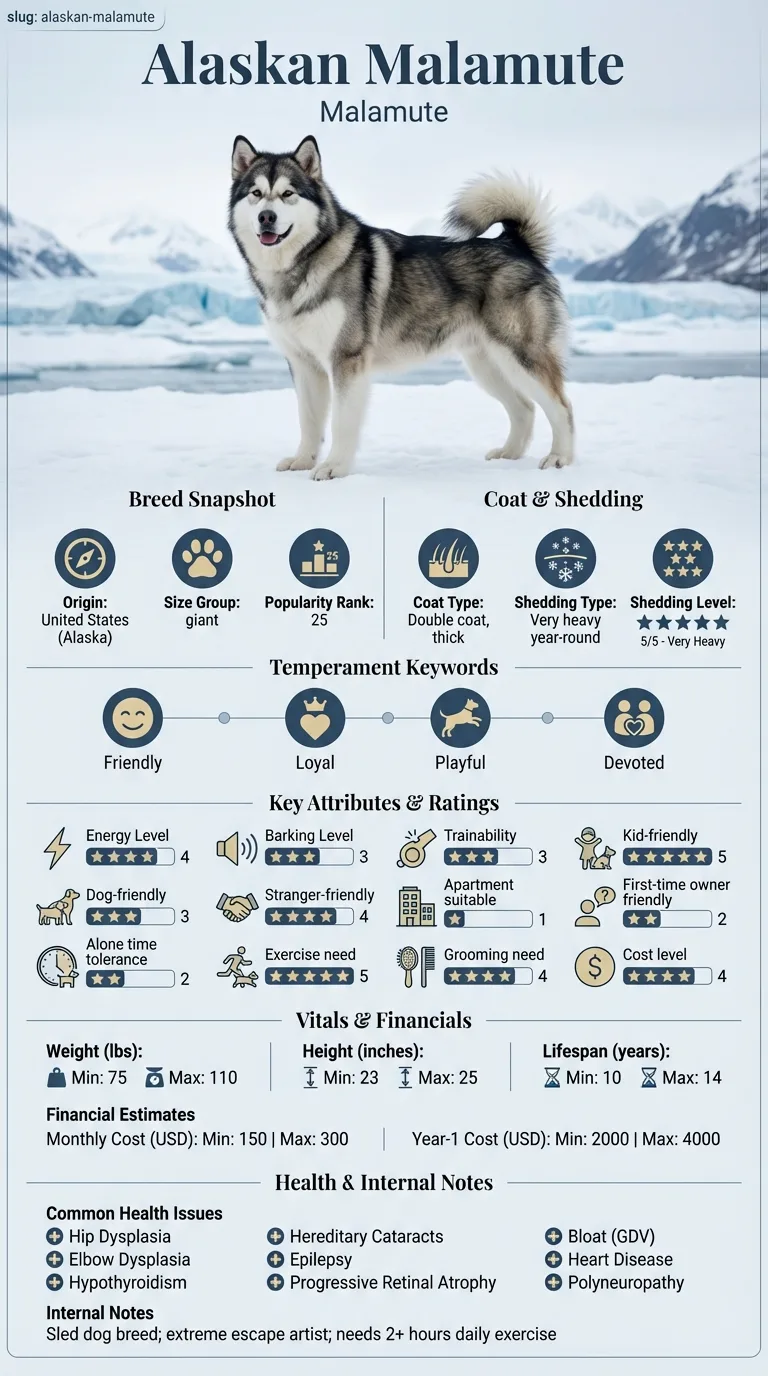
alaskan malamute infographic
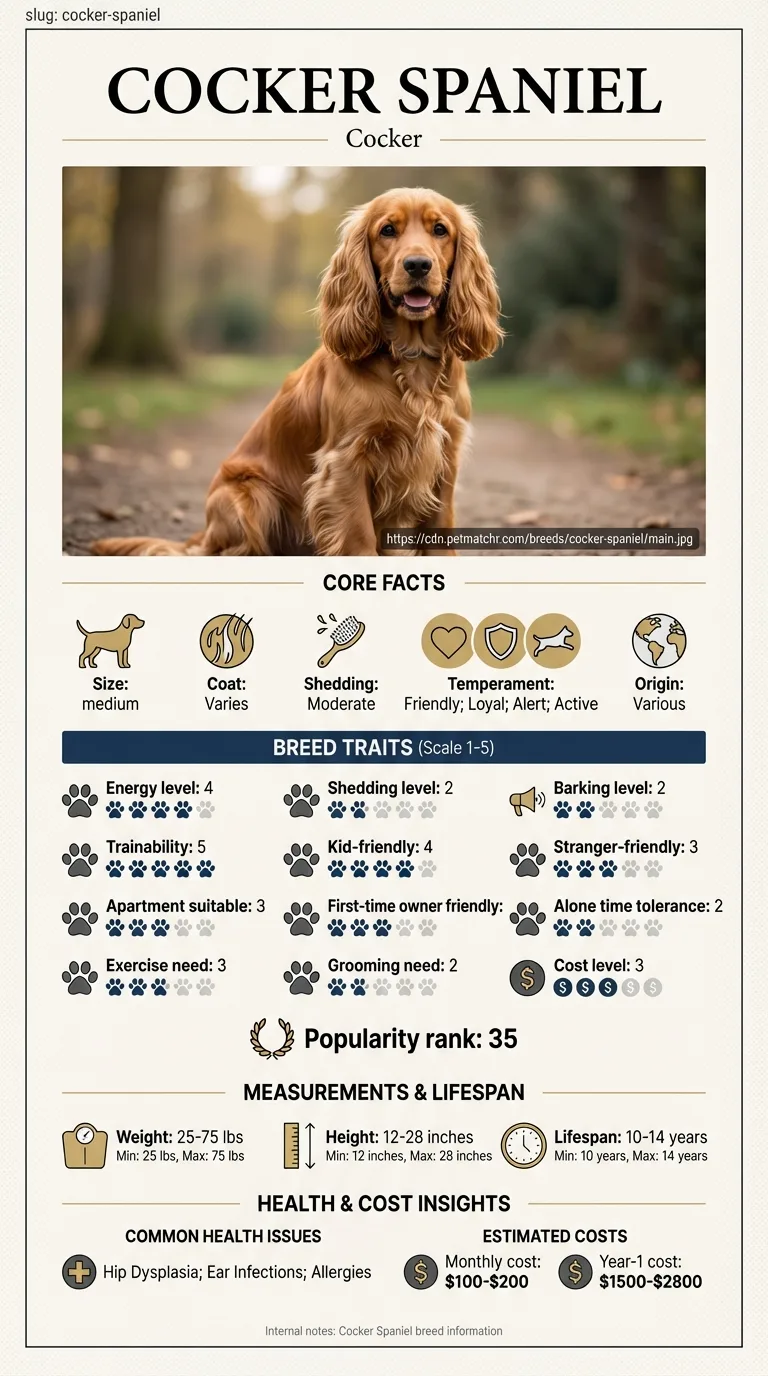
cocker spaniel infographic

This page is for someone weighing a small sociable gundog against a large northern working breed. It covers the two kinds of coat work, the exercise gap, chronic ear disease, an autoimmune condition worth recognising, and cost.

Quick verdict

The Cocker is cheaper, smaller, more manageable and needs daily ear care; the Malamute needs two hours a day outdoors and a rake twice a year.

Choose alaskan malamute if...

Choose the Alaskan Malamute if you are athletic, have space and want a large sociable dog. It grooms at 4/5 against the Cocker's 5/5 and needs no daily ear routine. You are accepting $150–$300 a month against $80–$150, 5/5 exercise against 3/5, 5/5 shedding against 3/5 and a 1/5 apartment rating against 4/5.

Choose cocker spaniel if...

Choose the Cocker Spaniel if you want a sociable, manageable family dog. It rates 5/5 with children like the Malamute, 4/5 with other dogs, strangers, trainability and first-time owners, needs only 3/5 exercise and costs $80–$150 a month. You are accepting a 5/5 coat and chronic ear risk.

Head-to-head comparison

Featurealaskan malamutecocker spanielWinner
Weight75–110 lbs20–30 lbsEqual
Height23–25 in13–16 inEqual
Lifespan10–14 years10–14 yearsEqual
CoatThick double coatSilky and featheredEqual
Grooming needHigh (4/5)Very high (5/5)alaskan malamute
SheddingVery high (5/5)Moderate (3/5)cocker spaniel
Energy levelHigh (4/5)Moderate (3/5)Equal
Exercise needVery high (5/5)Moderate (3/5)cocker spaniel
TrainabilityModerate (3/5)High (4/5)cocker spaniel
BarkingModerate (3/5)Moderate (3/5)Equal
Good with kidsVery high (5/5)Very high (5/5)Equal
Good with other dogsModerate (3/5)High (4/5)cocker spaniel
Friendly to strangersHigh (4/5)High (4/5)Equal
Apartment suitabilityVery low (1/5)High (4/5)cocker spaniel
Good for first-time ownersLow (2/5)High (4/5)cocker spaniel
Tolerates being aloneLow (2/5)Low (2/5)Equal
Typical monthly cost$150–$300$80–$150cocker spaniel
Typical first-year cost$2,000–$4,000$1,100–$2,300cocker spaniel

Deep dive

Alaskan Malamute vs Cocker Spaniel: 5/5 and 4/5 mean different things

The Cocker's 5/5 is feathering. Silky hair on the ears, chest, legs and belly picks up burrs, mud and seeds and mats where it rubs — behind the ears, in the armpits, around the tail. Left for a fortnight it needs cutting rather than brushing, so most owners settle into brushing several times a week plus a professional groom every six to eight weeks.

The Malamute's 4/5 is undercoat. It sheds constantly at 5/5 and blows twice a year in sheets, which means an undercoat rake and several long sessions during those weeks. It never mats and never needs a groomer, and it should never be clipped — a double coat insulates against heat as well as cold.

So one dog has a standing appointment and the other has two intense fortnights.

On shedding the Cocker is the easier household at 3/5 against 5/5, and on grooming effort the Malamute is easier at 4/5 against 5/5. Neither is a low-maintenance coat, and it is worth being clear about which kind of maintenance you will actually do.

The Cocker's ears are its defining problem

Ear infections head the Cocker Spaniel's condition list, and among breeds prone to them this one is close to the worst case.

The anatomy explains it entirely. A long, heavy, well-feathered ear leaf lies flat over the canal and seals in warmth and moisture; the canal tends to be narrow; and the breed produces more wax than most. A dog that swims, works in cover or simply gets rained on has a warm damp environment sitting against its head all day.

The consequence is a cycle rather than an event. Repeated inflammation thickens the canal lining, the canal narrows further, treatment becomes less effective, and a proportion of chronic cases eventually need surgery to open the canal permanently — which is effective and major, with permanent deafness on that side as the trade.

Prevention is genuinely effective and genuinely daily: check the ears every day, dry them thoroughly after any water, keep the hair beneath them trimmed, and treat head shaking or a smell as a reason to be seen rather than to wait.

The Malamute's upright ears ventilate themselves and this problem does not arise.

An hour against two, and where it happens

The Cocker rates 3/5 for exercise and 3/5 for energy — around an hour a day, and it should include using its nose. Hunting hedgerows, scent games and varied off-lead ground do more for a flushing spaniel than distance on a lead.

The Malamute rates 5/5 and 4/5, and it is tired by resistance rather than distance: carting, scootering, canicross, loaded hikes. Two hours is realistic, and heat limits it, so summer sessions move to the cool ends of the day.

The housing consequence is 4/5 for apartments against 1/5. A Cocker is a genuinely workable flat dog; a Malamute is not.

Recall differs too. A Cocker can be trained to a good recall at 4/5 trainability, though it needs proofing against live scent — a spaniel that has picked up rabbit is not listening. A Malamute's recall should be treated as a bonus rather than a safety measure at any stage, and its own breed notes describe an extreme escape artist that digs, climbs and travels.

Both rate 2/5 for time alone and neither suits an empty house without cover.

Autoimmune anaemia and the rest of the lists

Autoimmune haemolytic anaemia appears on the Cocker's condition list and it is worth recognising because it presents suddenly in a previously well dog.

The immune system destroys the dog's own red blood cells. The signs are sudden lethargy, weakness, pale or white gums, rapid breathing and sometimes jaundice. It is an emergency rather than a wait-and-see, and outcomes depend heavily on how quickly treatment starts.

The rest of the Cocker's list is ear infections, cataracts, progressive retinal atrophy and hip dysplasia. Eye certification and hip scores on both parents are the standard asks.

The Malamute's list runs to hip and elbow dysplasia, hypothyroidism, hereditary cataracts, progressive retinal atrophy, epilepsy, heart disease, bloat, inherited polyneuropathy and zinc-responsive skin disease. Polyneuropathy has a DNA test and shows in young dogs as exercise intolerance and a wobbly gait — ask for the result by name.

Only the Malamute carries a real bloat risk, and that household should know the signs: unproductive retching, a distending abdomen, restlessness.

Lifespan ties at 10 to 14 years, which is unusual across such a size difference.

Temperament and running costs

On temperament the two are closer than the size gap suggests. Children tie at 5/5, strangers tie at 4/5 and barking ties at 3/5. Both are demonstrative, sociable breeds and neither guards anything.

The Cocker is easier on the remaining rows: 4/5 with other dogs against 3/5, 4/5 trainability against 3/5, and 4/5 for first-time owners against 2/5.

One temperament note is worth stating plainly: the Cocker's popularity has produced a great many poorly bred dogs, and resource guarding and startle-related snapping appear more often in those lines than the 5/5 children rating suggests. Buy from someone who will discuss temperament in the parents.

On money the Cocker runs $80–$150 a month against $150–$300, and $1,100–$2,300 against $2,000–$4,000 in the first year.

The adjustment is grooming and ears. A professional groom every six to eight weeks plus recurring ear treatment closes a meaningful part of that gap, and chronic ear surgery would close all of it at once.

Alaskan Malamute vs Cocker Spaniel at a glance

The Cocker Spaniel grooms at 5/5 and the Malamute at 4/5, and the two numbers describe entirely different work. The Cocker's coat mats where it rubs and needs combing through several times a week plus daily ear checks, since the breed's drop ears and hair-lined canals make ear infections a recurring risk. The Malamute sheds in sheets twice a year and the work is an undercoat rake and a bin bag, with very little to do in between.

The Cocker is the more manageable dog for most households: 4/5 for apartments against 1/5, only 3/5 exercise against 5/5, and roughly half the running cost. The Malamute is the more sociable of the two with children, matching the Cocker's 5/5, but needs real space and two hours of physical work a day.

Choose the Malamute if you are athletic, have space and want a large sociable dog. Choose the Cocker Spaniel if you want a sociable, manageable family dog and will keep up daily ear care.

Frequently asked questions

Which coat is more work?

The Cocker Spaniel's at 5/5 against the Malamute's 4/5, but the kinds differ. The Cocker's feathering mats where it rubs and needs combing several times a week plus a groomer every six to eight weeks. The Malamute's undercoat needs a rake and several long sessions during two heavy blows a year.

Why do Cocker Spaniels get so many ear infections?

A long, heavy, feathered ear leaf lies flat over a narrow canal and seals in warmth and moisture, and the breed produces more wax than most. Each infection thickens the canal, making the next likelier and harder to treat. Daily checks and thorough drying after any water are what break the cycle.

How much exercise does each need?

The Cocker needs around an hour at 3/5 and should use its nose — hedgerow work and scent games do more than distance. The Malamute needs around two hours at 5/5 and is tired by resistance: carting, scootering or loaded hikes rather than walking.

What is autoimmune haemolytic anaemia?

The immune system destroying the dog's own red blood cells. It appears on the Cocker's list and presents suddenly in a previously well dog: lethargy, weakness, pale or white gums, rapid breathing, sometimes jaundice. It is an emergency, and outcomes depend heavily on how quickly treatment starts.

Which is better for a first-time owner?

The Cocker Spaniel at 4/5 against the Malamute's 2/5, provided you commit to the coat and the ears. It is sociable, trains at 4/5 and fits ordinary housing at 4/5 for apartments. The Malamute needs two hours of physical work daily and serious fencing.

Do both breeds struggle alone?

Yes — both rate 2/5. The Cocker is closely bonded and vocalises and chews at doors; the Malamute gets bored and digs up the garden. Absence training from week one and cover for a full working day apply whichever dog you choose.

Which is cheaper to keep?

The Cocker, at $80–$150 a month against the Malamute's $150–$300, and $1,100–$2,300 against $2,000–$4,000 in the first year. Grooming every six to eight weeks and recurring ear treatment narrow the gap, and chronic ear surgery would close it in a single bill.

Quick answers

View more answers
Living

Malamute vs Cocker Spaniel: which should I choose?

The Cocker if you want a sociable family dog in ordinary housing and will do weekly grooming and daily ear care. The Malamute if you are athletic, have space and a secured garden, and want a large northern breed.

Costs

How much does each cost per month?

The Malamute runs $150–$300 a month and the Cocker $80–$150, with first-year totals of $2,000–$4,000 and $1,100–$2,300. Add professional grooming every six to eight weeks for the Cocker.

Health

What is the single most useful Cocker habit?

Checking and drying the ears every day, and after every swim or wet walk. Chronic ear disease is the breed's defining problem and it is largely preventable by a habit that takes under a minute.

Health

Do they live the same length of time?

Yes — both 10 to 14 years, which is unusual across a size gap this wide. A large working breed and a small gundog rarely land on the same figure.

Related DogBreedCompass guides

  • Alaskan Malamute breed guideThe Malamute profile covers exercise, containment and the breed's coat.
  • Cocker Spaniel breed guideThe Cocker Spaniel profile covers coat maintenance, ear care and temperament range.
  • Malamute vs English Cocker SpanielThe English Cocker is the larger, more field-oriented version of the same breed.
  • Akita vs Cocker SpanielThe Akita comparison covers the same Cocker issues against a Japanese guardian breed.
  • Cocker Spaniel ear infectionsChronic ear disease is the condition most Cocker owners will deal with at some point.
  • Malamute bloat and GDVBloat is a genuine emergency in the Malamute and every owner should know the signs.

Related guides

Important reminder

Health information here is general and is not veterinary advice. If your dog shows pain, sudden behaviour change, or worsening symptoms, consult a licensed veterinarian.

Some links on this site are affiliate links. We may earn a commission at no extra cost to you, and we only suggest products we believe are helpful for dog owners.

Find Your Perfect Breed

Match your lifestyle to the right dog.

Take quiz

Find your match

Not sure which breed is right for you? Take our 2-minute quiz to find out.

Take the quiz