Akita or Havanese: The Dog That Follows You to the Bathroom
Quick answer
Akita vs Havanese: which should I choose?
The Havanese if someone is home most of the day and you want a small, long-lived, sociable companion. The Akita if the house is empty during the day — it is self-contained where the Havanese rates 1/5 for solitude.
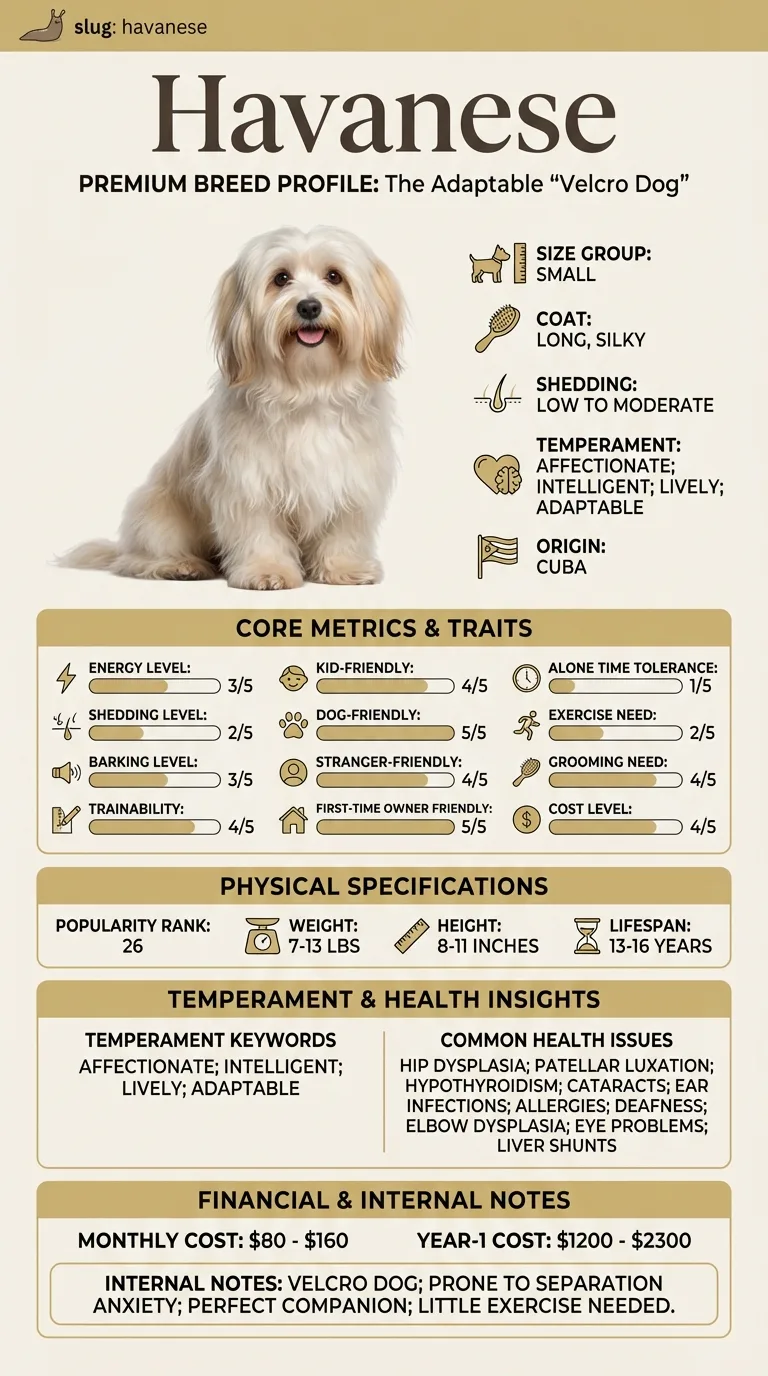
The Havanese rates 1/5 for tolerating time alone — the lowest rating on the scale — and 5/5 with other dogs, 5/5 for apartments and 5/5 for first-time owners. It is a companion breed in the most literal sense: it was bred to be with someone, and it does badly when there is nobody to be with.
This page is for someone weighing a small, long-lived companion breed against a large guardian. It covers the solitude problem in detail, coat maintenance that is heavier than the size suggests, a liver condition worth knowing about, and what each costs to keep.
Quick verdict
The Havanese is the easier dog in every respect except one, and that one — needing company almost all the time — decides whether it can live with you at all.
Choose akita if...
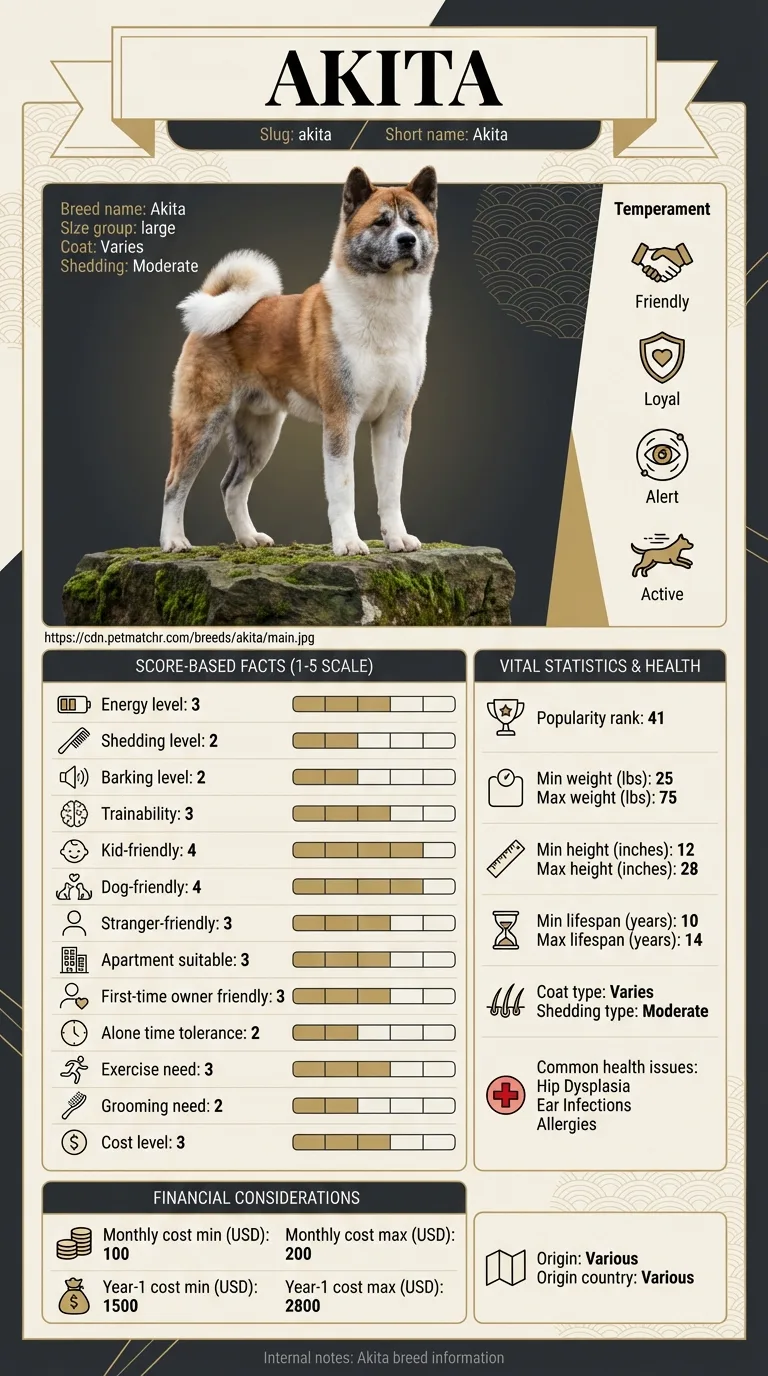
Choose the Akita if the house is empty during the day. It tolerates being alone at 3/5 against the Havanese's 1/5, barks at 2/5 against 3/5, and grooms at 3/5 against 4/5. You are accepting 1/5 for first-time owners, 2/5 with other dogs and strangers, 5/5 shedding, up to 130 pounds and a shorter life at 10 to 13 years.
Choose havanese if...
Choose the Havanese if someone is home most of the day and you want a small, cheerful, long-lived companion. It rates 5/5 for apartments and first-time owners, 5/5 with other dogs, 4/5 with children and strangers, lives 13 to 16 years and costs $80–$160 a month. You are accepting daily coat work and a dog that cannot be left.
Head-to-head comparison
Feature
akita
havanese
Winner
Weight
70–130 lbs
7–13 lbs
Equal
Height
24–28 in
8–11 in
Equal
Lifespan
10–13 years
13–16 years
havanese
Coat
Dense double coat
Long and silky
Equal
Grooming need
Moderate (3/5)
High (4/5)
akita
Shedding
Very high (5/5)
Low (2/5)
havanese
Energy level
Moderate (3/5)
Moderate (3/5)
Equal
Exercise need
Moderate (3/5)
Low (2/5)
havanese
Trainability
Moderate (3/5)
High (4/5)
havanese
Barking
Low (2/5)
Moderate (3/5)
akita
Good with kids
Moderate (3/5)
High (4/5)
havanese
Good with other dogs
Low (2/5)
Very high (5/5)
havanese
Friendly to strangers
Low (2/5)
High (4/5)
havanese
Apartment suitability
Low (2/5)
Very high (5/5)
havanese
Good for first-time owners
Very low (1/5)
Very high (5/5)
havanese
Tolerates being alone
Moderate (3/5)
Very low (1/5)
akita
Typical monthly cost
$110–$240
$80–$160
havanese
Typical first-year cost
$1,700–$3,200
$1,200–$2,300
havanese
Deep dive
What a 1/5 alone-tolerance really means
Havanese owners use the word velcro, and it is not affectionate exaggeration. This is a breed that follows a person from room to room, settles wherever that person settles, and treats a closed door as a problem to be solved.
Separation-related behaviour is the predictable consequence: vocalising that starts within minutes, scratching and chewing at doors, house-soiling in an otherwise clean dog, and refusing food until someone comes home.
It can be managed, and the management has to start immediately rather than when the problem appears. Graduated absences from the first week, beginning at seconds rather than minutes. A settled place the dog is rewarded for using. Never making departures or returns emotionally significant. For a household that works full time, a midday walker or day care is not a luxury.
What does not work is acquiring the dog and hoping it adapts. It does not adapt; it deteriorates.
The Akita at 3/5 is genuinely self-contained. It does not experience an empty house as a loss, and it will sleep through the afternoon without noticing.
A 4/5 coat on a 10-pound dog
The Havanese's grooming rating is higher than most people expect from a small dog, and it is accurate.
The coat is long, silky and low-shedding at 2/5 — which means the dead hair stays in the coat rather than falling out, and mats. It needs brushing through to the skin several times a week, minimum, with attention behind the ears, under the collar, in the armpits and around the tail.
There are three realistic approaches. Keep it long and commit to daily brushing plus a professional groom every six to eight weeks. Keep it in a short puppy clip, which most owners eventually do and which cuts the work substantially. Or cord it — the traditional Cuban presentation, which looks remarkable and requires expert help to establish.
Eye and ear care come with the territory. Hair grows into the ear canal and traps moisture, and ear infections are on the condition list.
The Akita's 3/5 is a different rhythm entirely: a weekly brush for ten months, then two or three weeks twice a year of pulling out a dense undercoat at 5/5 shedding. It never needs a groomer and its coat should never be clipped.
Liver shunts, knees and a long life
The Havanese can live 13 to 16 years, the longest in this batch, and most of that time is usually healthy. The conditions worth knowing about are specific rather than pervasive.
Liver shunts head the interesting part of the list. A portosystemic shunt is a blood vessel that bypasses the liver, so toxins are not filtered out. Signs in a puppy include poor growth, disorientation or unsteadiness after meals, excessive drinking and, in some cases, seizures. It is diagnosed with a bile acid blood test and imaging, and treated by diet, medication or surgery depending on type. Any small-breed puppy that fails to thrive deserves this test.
Patellar luxation is the common orthopaedic one — a kneecap that slips out of its groove, producing a skipping step. Congenital deafness also appears, which is why BAER testing is worth asking about.
Cataracts, other eye problems, hypothyroidism, allergies and hip dysplasia complete the list.
The Akita's burden is autoimmune and endocrine, with hip dysplasia and bloat, and it lives three to five years less.
Cheap to feed, not cheap to maintain
The Havanese runs $80–$160 a month against the Akita's $110–$240, and $1,200–$2,300 against $1,700–$3,200 in the first year. On food and weight-dosed products it is much the cheaper dog.
Two things adjust that. The first is grooming: a professional appointment every six to eight weeks across a fifteen-year life is a substantial cumulative sum, and for a coat like this it is closer to necessary than optional.
The second is day cover. If the household works full time, a dog with a 1/5 solitude rating needs a walker or day care, and that is a recurring cost that can exceed everything else on the list combined. It belongs in the budget from the start rather than being discovered in month three.
Dental care is the usual small-breed cost — crowded teeth in a small jaw, so daily brushing genuinely reduces later anaesthetic dentistry.
The Akita's expensive risks are autoimmune disease and bloat: less frequent, larger, and not predictable.
On exercise the Havanese needs 2/5 against 3/5 — two short walks and indoor play cover the day.
Akita vs Havanese: one row decides most households
The Havanese wins fourteen of the eighteen rows on this table. It is smaller, cheaper, longer-lived, more sociable, easier to train, better in a flat and easier for a first-time owner in every respect.
Then there is the solitude row, and for a large number of households that single 1/5 outweighs all fourteen.
Energy ties at 3/5, which surprises people about both breeds — the Havanese is not a frantic small dog and the Akita is not a driven large one. Both are calm indoors.
The Akita's other genuine advantage is noise: 2/5 barking against 3/5. That matters less than it sounds, because a Havanese with company is a fairly quiet dog and a Havanese without it is not — the barking rating and the solitude rating are the same problem measured twice.
Akita or Havanese: The Dog That Follows You to the Bathroom - Akita vs Havanese: one row decides most households
Frequently asked questions
Can a Havanese be left alone during a working day?
Not without cover. It rates 1/5 for solitude, the lowest on the scale, and it is a genuine velcro breed — it follows people between rooms and treats a closed door as a problem. Expect vocalising within minutes, chewing at doors and refusal to eat. A midday walker or day care is a requirement, not a luxury.
How much grooming does a Havanese need?
4/5, which is high for a 10-pound dog. The coat is long, silky and low-shedding, so dead hair stays in it and mats. Brush to the skin several times a week and use a groomer every six to eight weeks, or keep the dog in a short puppy clip, which most owners eventually do.
What is a liver shunt?
A portosystemic shunt is a blood vessel that bypasses the liver so toxins are not filtered out. In a puppy it shows as poor growth, unsteadiness or disorientation after meals, excessive drinking and sometimes seizures. It is diagnosed by a bile acid blood test and imaging — worth requesting for any small-breed puppy that fails to thrive.
Which lives longer?
The Havanese, at 13 to 16 years against the Akita's 10 to 13 — the longest lifespan in this batch. That is worth planning for properly: fifteen years of daily grooming, day cover if the house is empty, and a companion breed that will still need company at the end of it.
Is the Havanese good with other dogs?
Exceptionally, at 5/5 against the Akita's 2/5. It is one of the most consistently dog-social breeds on this site and often does well in a multi-dog household — which is also one of the more effective answers to its solitude problem, though a second dog is not a substitute for a person.
Does the Havanese shed?
Very little, at 2/5 against the Akita's 5/5. That is the reason the grooming rating is high — hair that does not fall out stays in the coat and mats. A low-shedding coat is a trade rather than a saving: you brush it out instead of hoovering it up.
Which is better for a first-time owner?
The Havanese at 5/5 against the Akita's 1/5, with the single condition that someone is home most of the day. It is small, cheerful, trains at 4/5 and is friendly with everyone. The Akita is an independent guardian whose adult views on other dogs arrive at around two years old.
The Havanese if someone is home most of the day and you want a small, long-lived, sociable companion. The Akita if the house is empty during the day — it is self-contained where the Havanese rates 1/5 for solitude.
Costs
How much does each cost per month?
The Havanese runs $80–$160 a month and the Akita $110–$240, with first-year totals of $1,200–$2,300 and $1,700–$3,200. Add grooming every six to eight weeks and day cover if the house is empty.
Living
Which needs less exercise?
The Havanese at 2/5 against the Akita's 3/5 — two short walks and some indoor play cover the day. Neither is a high-output dog, and both rate 3/5 for energy, which surprises people about both breeds.
Health
What should I ask a Havanese breeder?
BAER hearing testing, patella scores, eye certification and hip scores. Ask whether liver shunts have appeared in the line, and whether any puppy from these parents has needed a bile acid test.
Related DogBreedCompass guides
Akita breed guide – The Akita profile covers guardian temperament and the long socialisation window the breed needs.
Havanese breed guide – The Havanese profile covers coat options, companionship needs and health testing.
Health information here is general and is not veterinary advice. If your dog shows pain, sudden behaviour change, or worsening symptoms, consult a licensed veterinarian.
Some links on this site are affiliate links. We may earn a commission at no extra cost to you, and we only suggest products we believe are helpful for dog owners.
We research and check what we publish, but we do not warrant that any figure, date, price, or statement is accurate, complete, or current, and we accept no liability for any loss, cost, injury, or other harm arising from the use of this site. Use it as one reference among several. You remain responsible for your own decisions and for your dog's care - confirm anything that matters with a licensed veterinarian or another qualified professional before you act on it. Full disclaimer.