Health
Is Wobbler syndrome the right diagnosis to search for a wobbly Papillon?
Usually not; atlantoaxial instability, a toy-breed-specific neck condition, is the far more likely explanation.

Quick answer
Is Wobbler syndrome the right diagnosis to search for a wobbly Papillon?
Usually not; atlantoaxial instability, a toy-breed-specific neck condition, is the far more likely explanation.
A wobbly gait in a Papillon points toward a toy-breed neck problem with its own name and its own mechanism, not the large-breed disease the search term describes.
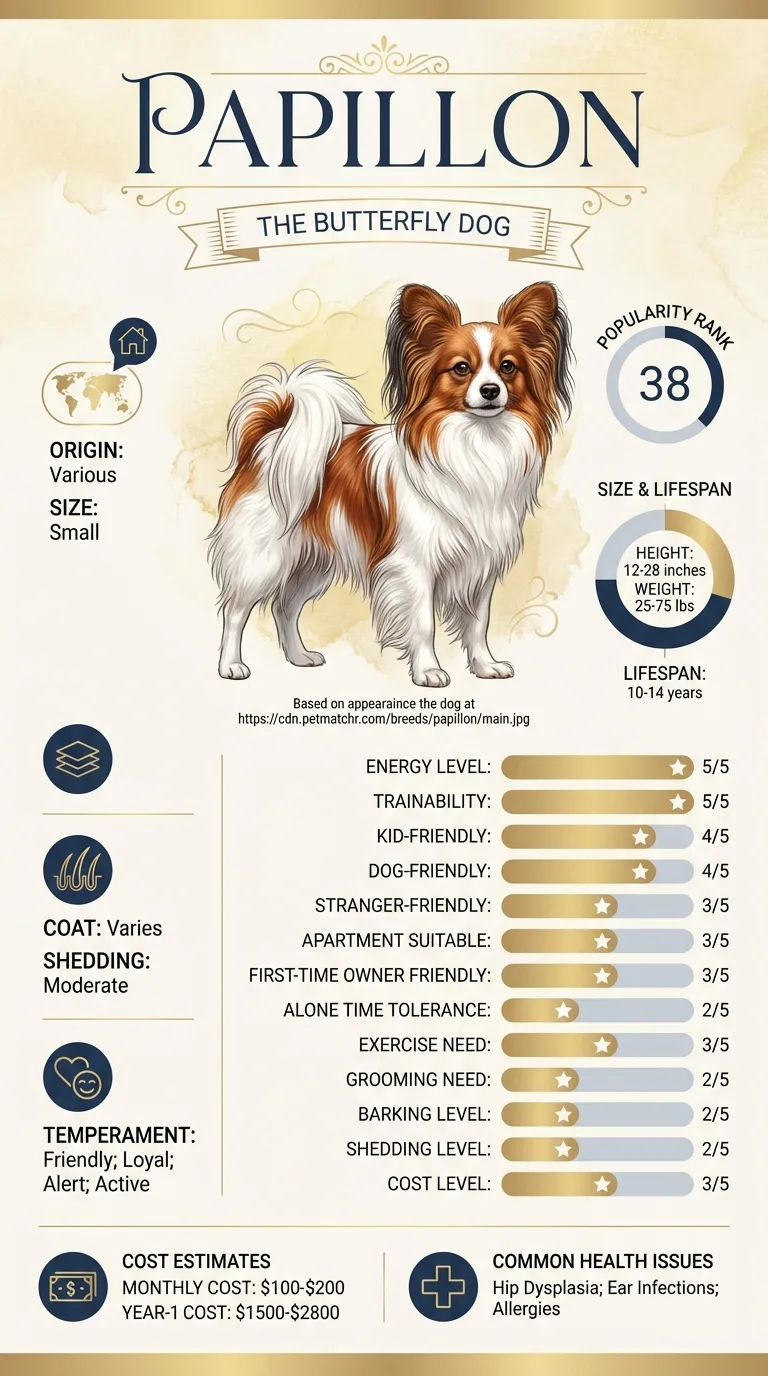
This affects owners of young Papillons, often puppies still growing, who have noticed an unsteady, wobbly gait or neck pain and searched for an explanation, landing on a condition typically described for dogs many times their size.
This guide is not medical advice. If your dog shows pain, sudden behavior change, or worsening symptoms, consult a licensed veterinarian.
Some links may be affiliate links. We may earn a commission at no extra cost to you. We only suggest products we believe are helpful for dog owners.
We research and check what we publish, but we do not warrant that any figure, date, price, or statement is accurate, complete, or current, and we accept no liability for any loss, cost, injury, or other harm arising from the use of this site. Use it as one reference among several. You remain responsible for your own decisions and for your dog's care - confirm anything that matters with a licensed veterinarian or another qualified professional before you act on it. Full disclaimer.
Wobbler syndrome as classically defined is a large and giant breed disease driven by rapid growth and body size, and it does not fit the Papillon's small, slow-growing structure. A wobbly gait or neck pain in this breed points instead toward atlantoaxial instability, a congenital malformation at the top of the neck where an underdeveloped stabilizing joint can put pressure directly on the spinal cord, ranging from mild discomfort to sudden severe neurological signs.
Classic Wobbler syndrome is documented almost exclusively in large and giant breeds and is not a fit for the Papillon's size and growth pattern. Atlantoaxial instability is recognized in toy breeds generally; detailed Papillon-specific prevalence data is limited, so it is best treated as an individual finding to confirm with a vet rather than an expected breed-wide statistic.
The Papillon's small size and proportionate growth do not create the large-breed mechanism behind classic Wobbler syndrome. Where neck instability occurs in this breed, it is through a congenital malformation of the joint at the top of the neck, a pattern recognized across small and toy breeds generally rather than something driven by the Papillon's growth rate.
Physical activity, particularly jumping from height or rough play, can trigger or worsen symptoms in a puppy with an already unstable joint, even though the underlying malformation itself is congenital rather than caused by any environmental factor.
See a vet the same day for any new neck pain, wobbly or uncoordinated gait, reluctance to move the head, or sudden weakness in a Papillon puppy, since this condition can progress to severe neurological symptoms without warning. This is not a wait-and-watch situation given how directly the affected joint sits against the spinal cord.
See all Papillon health problems, which breeds are prone to wobbler syndrome, or the full Papillon breed guide for temperament, exercise needs and ownership costs.
Diagnosis typically requires imaging and can be confirmed within days of the first vet visit. Conservative management, where appropriate, is usually trialed over several weeks of strict rest; surgical stabilization has a longer recovery period measured in weeks to a couple of months.
Success looks like a stable, pain-free neck and a return to normal activity, whether achieved through careful conservative management or surgical stabilization, with the specific path depending on how severe the instability was at diagnosis.
Classic Wobbler syndrome develops from compression of the spinal cord somewhere along the neck, most often related to malformed vertebrae or disc changes that accumulate as a large, fast-growing dog's rapid skeletal development outpaces its own soft tissue support. This is fundamentally a large-breed growth-and-structure problem.
What toy breeds, Papillons among them, can experience instead is atlantoaxial instability, a congenital malformation at the very top of the neck, where the first two vertebrae, the atlas and axis, meet at the joint that lets the head pivot. In a normally formed neck, a small bony peg called the dens locks that joint in place. In atlantoaxial instability, the dens is malformed, underdeveloped, or occasionally entirely absent, so the joint is unstable and can shift with normal head movement, putting pressure on the spinal cord right at the base of the skull.
The outward symptoms overlap enough that a search for wobbly gait can plausibly land on either condition: neck pain, reluctance to move the head, an unsteady or wobbly walk, and in severe cases, sudden collapse or paralysis. But the mechanism, the age of onset, and the treatment are all different. Atlantoaxial instability is congenital and often shows up in puppies still growing, sometimes triggered or worsened by a minor jump or fall that would be unremarkable in a structurally normal neck. Classic Wobbler syndrome in large breeds typically develops later, over years, as an accumulating consequence of size and growth rate.
Because the joint instability in atlantoaxial instability sits directly at the top of the spinal cord, the potential severity is genuinely serious, ranging from mild, intermittent neck pain to sudden paralysis or worse from even a relatively minor neck movement in a severely affected dog. This is not a condition to treat casually just because the breed is small; the mechanism is different from the large-breed disease the search term describes, but the urgency, once symptoms appear, is not smaller for it.
Because this is a structural instability rather than a wear-and-tear condition, activity management and correct diagnosis matter more here than in almost any other issue in this breed's profile.

If you think your Papillon has wobbler syndrome, the plan is three steps: write down what you have seen and when it started, book a veterinary appointment rather than waiting for the next flare, and take video of the behaviour or symptom before you go — the thing you are worried about rarely happens in the consulting room. Screening in the parents covers patellar luxation, progressive retinal atrophy, dental disease.
What the vet visit should produce is a diagnosis and a written plan, not just reassurance: what is being ruled out, what the monitoring interval is, and which signs mean you come back sooner. Ask what the treatment costs across a year rather than per visit, because that is the number that decides whether you are managing this condition or reacting to it.
Between appointments, keep a short log — dates, what you saw, what changed. It is the single most useful thing an owner brings to a follow-up, and for wobbler syndrome it is often what separates a clear pattern from a guess.
Yara's Papillon puppy, Pip, began holding his head oddly and yelping occasionally when picked up around four months old. A quick search for the symptoms led her to articles about Wobbler syndrome, which described a disease profile that did not seem to fit Pip's size at all, most of it focused on large dogs many times his weight. At the vet, imaging revealed the actual issue: an underdeveloped stabilizing joint at the top of Pip's neck, a congenital malformation unrelated to the large-breed condition Yara had been reading about. The vet explained that Pip's symptoms had likely started, or worsened, after he jumped off the couch a few days earlier, an ordinary puppy behavior that an unstable joint could not tolerate the way a normal one would. Given that Pip's case was caught early and was moderate rather than severe, the vet recommended a trial of strict conservative management first: crate rest, a supportive brace, and no jumping of any kind for six weeks, before considering surgery. Pip's symptoms resolved fully during that period, and Yara has kept furniture ramps in place since, understanding that his neck, unlike a typical Papillon's, does not tolerate ordinary jumping without risk.
Key takeaway: A wobbly gait in a young Papillon usually points to a congenital neck-joint instability rather than the large-breed disease the search term describes, and catching it early, before repeated episodes accumulate, gives conservative management a real chance to work.
Not in the same way. Classic Wobbler syndrome is a large-breed disease tied to rapid growth and body size. A wobbly gait in a Papillon is much more likely to be atlantoaxial instability, a different, toy-breed-specific neck condition with its own distinct cause.
A congenital malformation at the top two vertebrae of the neck, where the small bony peg that normally locks the joint in place is underdeveloped or missing, allowing the joint to shift and put pressure on the spinal cord.
It ranges from mild, intermittent neck pain to sudden paralysis, since the instability sits directly at the top of the spinal cord. Any symptoms should be treated as a genuine concern regardless of the breed's small size.
Neck pain, reluctance to move or lower the head, a wobbly or uncoordinated gait, and in severe cases, sudden weakness or collapse, sometimes following a minor jump or fall.
Mild cases are sometimes managed conservatively with strict activity restriction and a neck brace. More significant or worsening instability typically needs surgical stabilization of the joint.
Conservative management with imaging and a brace is on the lower end, roughly several hundred dollars, while surgical stabilization is a much larger undertaking, commonly running from a few thousand up to around seven thousand dollars depending on the surgeon and region.
Many dogs do well with appropriate treatment, whether conservative or surgical, particularly if diagnosed and managed before severe or repeated neurological episodes occur. Severity at diagnosis is the biggest factor in long-term outcome.
Usually not; atlantoaxial instability, a toy-breed-specific neck condition, is the far more likely explanation.
A congenital malformation of the joint at the top of the neck, where the stabilizing bony peg is underdeveloped or absent.
Most often in puppies still growing, sometimes triggered or worsened by a minor jump or fall.
Conservative management runs a few hundred dollars; surgical stabilization commonly ranges from a few thousand up to around seven thousand dollars.
Yes, it should be treated as a same-day vet concern given how serious the underlying instability can become.
A one-page prep sheet for this condition: the signs, the questions to ask, what to get priced. Unlocks here.
You get: Vet visit prep sheet
No spam. One-click unsubscribe. See our privacy policy.
Preview page 1 before you decide.