Health
How do I know if my Papillon is overweight?
By feel, not sight. You should find the ribs easily under light pressure and see a waist from above with the coat smoothed down.

Quick answer
How do I know if my Papillon is overweight?
By feel, not sight. You should find the ribs easily under light pressure and see a waist from above with the coat smoothed down.
Nobody overfeeds a small dog by pouring a bowl. They do it a biscuit at a time, from four different people, none of whom knows about the others.
Owners who cannot understand how a dog that eats so little has gained a pound, households where several people feed the dog, and anyone whose vet has said the words a little heavy about an animal that looks fine under its coat.
This guide is not medical advice. If your dog shows pain, sudden behavior change, or worsening symptoms, consult a licensed veterinarian.
Some links may be affiliate links. We may earn a commission at no extra cost to you. We only suggest products we believe are helpful for dog owners.
We research and check what we publish, but we do not warrant that any figure, date, price, or statement is accurate, complete, or current, and we accept no liability for any loss, cost, injury, or other harm arising from the use of this site. Use it as one reference among several. You remain responsible for your own decisions and for your dog's care - confirm anything that matters with a licensed veterinarian or another qualified professional before you act on it. Full disclaimer.
Weight gain in a Papillon is an arithmetic problem disguised as a behavioural one. The dog's daily energy budget is small enough that ordinary human generosity overwhelms it, and its long silky single coat conceals the result until a vet puts hands on the ribs. The consequences land on structures the breed already has trouble with: kneecaps sitting in a shallow groove, a windpipe prone to weakening, and heat tolerance limited by a tiny body.
Excess weight is among the most frequently identified health problems in companion dogs across all breeds, and small dogs are far from exempt. Papillons are often assumed to be safe because they are lively and eat little, but the smallness that makes their intake look trivial is exactly what makes each addition significant.
The Papillon's five to ten pound body gives it a very small caloric budget, so the margin for error is narrow. Its long silky single coat sits away from the body and hides contour, meaning owners lose the visual feedback that would prompt them to act. The breed's alert, confident temperament also makes it an accomplished beggar, and its exceptional trainability means it has learned exactly which person in the house is the softest touch.
Multi-person households are the classic setting, because the total intake is never visible to any one person. Feeding by scoop introduces steady drift as the scoop is filled a little more generously over time. Reduced walking, whether from bad weather, an owner's injury or a dog's own sore knee, removes energy expenditure without anyone adjusting the food to match.
Book an appointment before starting a reduction plan, so you have a target weight based on your dog's frame rather than a guess, and to rule out medical causes if the gain happened without a change in intake. See a vet promptly if weight gain comes with lethargy, coat thinning, cold seeking or increased thirst. Seek urgent care for an overweight Papillon that is struggling to breathe, coughing continuously, collapsing, or in obvious distress in warm weather, since excess weight compounds both airway and heat emergencies.
See all Papillon health problems, which breeds are prone to obesity, or the full Papillon breed guide for temperament, exercise needs and ownership costs.
Expect two to four months to move a Papillon a pound with a safe, measured approach, and expect the first fortnight to feel like nothing is happening. Weight on a small dog changes in ounces, so monthly weigh ins show progress that weekly ones do not. Maintenance is permanent rather than a phase.
Success is ribs you can find with light pressure, a waist visible from above with the coat smoothed, a stable monthly number, and a household that all feeds from the same container without anyone having to police it.
Daily energy requirement scales with body size, so a five to ten pound dog needs a fraction of what a mid sized dog needs. Against that small budget, ordinary treats are enormous.
A single commercial dog biscuit sized for a general audience can represent a substantial share of a Papillon's daily calories. A cube of cheese offered while you make lunch, a corner of toast, a dental chew designed for a twenty pound dog and the training treats used during an evening session can, between them, exceed what the dog gets in its bowl.
The multi-person problem compounds it. In a household of three adults, each giving what feels like one small thing, the dog receives three. Nobody has done anything unreasonable and the dog has eaten a third meal.
The fix is not deprivation, it is accounting. Weigh the day's food, including everything intended as treats, into one container each morning, and let the household feed only from that container. What is not gone by bedtime was not needed. This single change resolves most Papillon weight problems without anyone feeling mean, because the dog still receives things all day, just from a fixed allowance.
Using part of the measured ration for training also solves a second problem in a breed that scores at the very top for trainability and genuinely needs mental work.

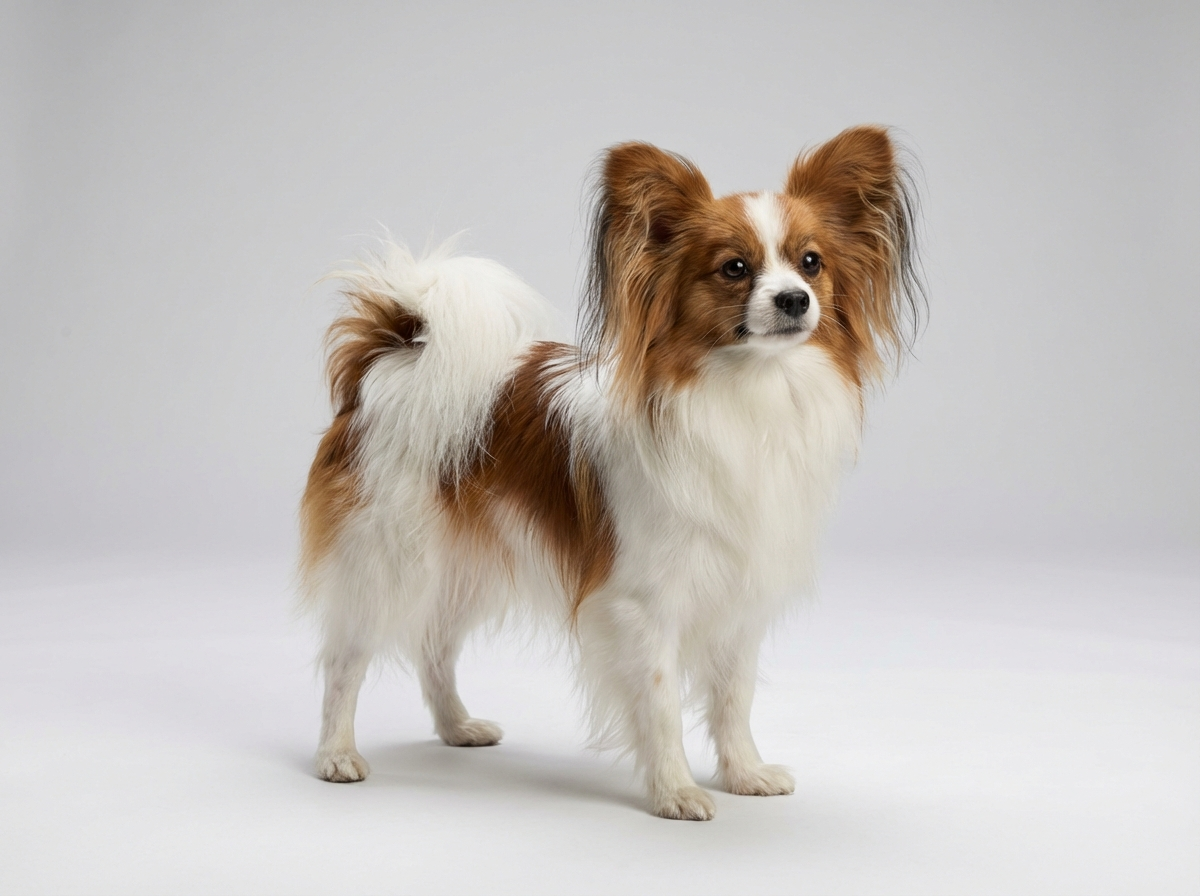
Body condition is a tactile assessment in this breed. If you are judging by appearance alone you are judging the coat, not the dog.
Nadia's Papillon Fig weighed six pounds ten ounces at three and nine pounds four at six. Nadia insisted she fed him exactly what the bag said, and she did. Her vet asked her to write down, for one week, everything Fig ate. The list included his measured meals, plus a biscuit from her father each morning, cheese from her flatmate at lunch, a dental chew sized for a medium dog every evening, and the training treats Nadia herself used because Fig was clever and she enjoyed teaching him things. The fix took one jar. Every morning Nadia weighed out Fig's whole day, including the chew broken into pieces, and put it on the counter. Everyone fed from the jar. Nobody had to refuse him anything. He was back to seven pounds one ounce in eleven weeks and his occasional hind leg skip became rare.
Key takeaway: In a five to ten pound dog the problem is almost never the bowl. Make the whole day visible in one container, feel the ribs rather than looking at the coat, and the arithmetic does the rest.
The breed's healthy range is five to ten pounds, and where an individual sits within it depends on frame rather than preference. A large boned Papillon at nine pounds can be lean while a fine boned one at eight is overweight. Your vet will give you a target based on body condition scoring, and that target is what you manage to, not the range.
Because of proportion. One pound on a seven pound dog is over fourteen percent of bodyweight, which in a large adult human would be well over twenty pounds. That extra load passes through kneecaps that in this breed already sit in a shallow groove, and it makes an already small dog work harder in heat.
A digital kitchen scale for a puppy, or a baby scale for an adult, both of which read in ounces. Bathroom scales cannot resolve the differences that matter here. Weigh at the same time of day, ideally before breakfast, and record every reading so you have a trend rather than a series of impressions.
Look first at whether intake really is unchanged, including everything given by other people and everything used in training. If it genuinely is, and activity has not dropped, ask your vet about an underlying cause. Reduced thyroid function is the classic one, and in a dog that has also lost coat quality and become lethargic it deserves a blood test.
Collapsing trachea is documented in this breed, and excess weight, particularly around the chest and neck, makes the airway work harder and worsens the characteristic honking cough. Weight loss is one of the first recommendations for an affected dog, and it is one of the few interventions that reliably reduces coughing episodes.
Slowly and under veterinary guidance. Rapid weight loss in a small dog is neither safe nor sustainable, and crash dieting an animal this size risks nutritional deficiency. A modest weekly reduction, achieved by measuring rather than by skipping meals, gets there over two to four months and stays.
By feel, not sight. You should find the ribs easily under light pressure and see a waist from above with the coat smoothed down.
Portion the whole day's food and treats into one container each morning and let everyone feed only from that. Nobody has to say no, and the total is fixed.
Yes, and you should. This breed is exceptionally trainable and needs the mental work, and using the measured ration keeps calories inside the daily budget.
It adds load to joints, airway and heart across a fourteen to sixteen year lifespan. Staying lean is one of the highest value things an owner controls.
A one-page prep sheet for this condition: the signs, the questions to ask, what to get priced. Unlocks here.
You get: Vet visit prep sheet
No spam. One-click unsubscribe. See our privacy policy.
Preview page 1 before you decide.