Health
What is the earliest sign of a heart condition in a Papillon?
A murmur found on a routine exam, before the dog shows anything at all. The earliest sign you can spot yourself is a rising resting breathing rate during sleep.

Quick answer
What is the earliest sign of a heart condition in a Papillon?
A murmur found on a routine exam, before the dog shows anything at all. The earliest sign you can spot yourself is a rising resting breathing rate during sleep.
Most Papillon heart conditions are found by a stethoscope years before the dog acts sick. That gap is the whole opportunity.
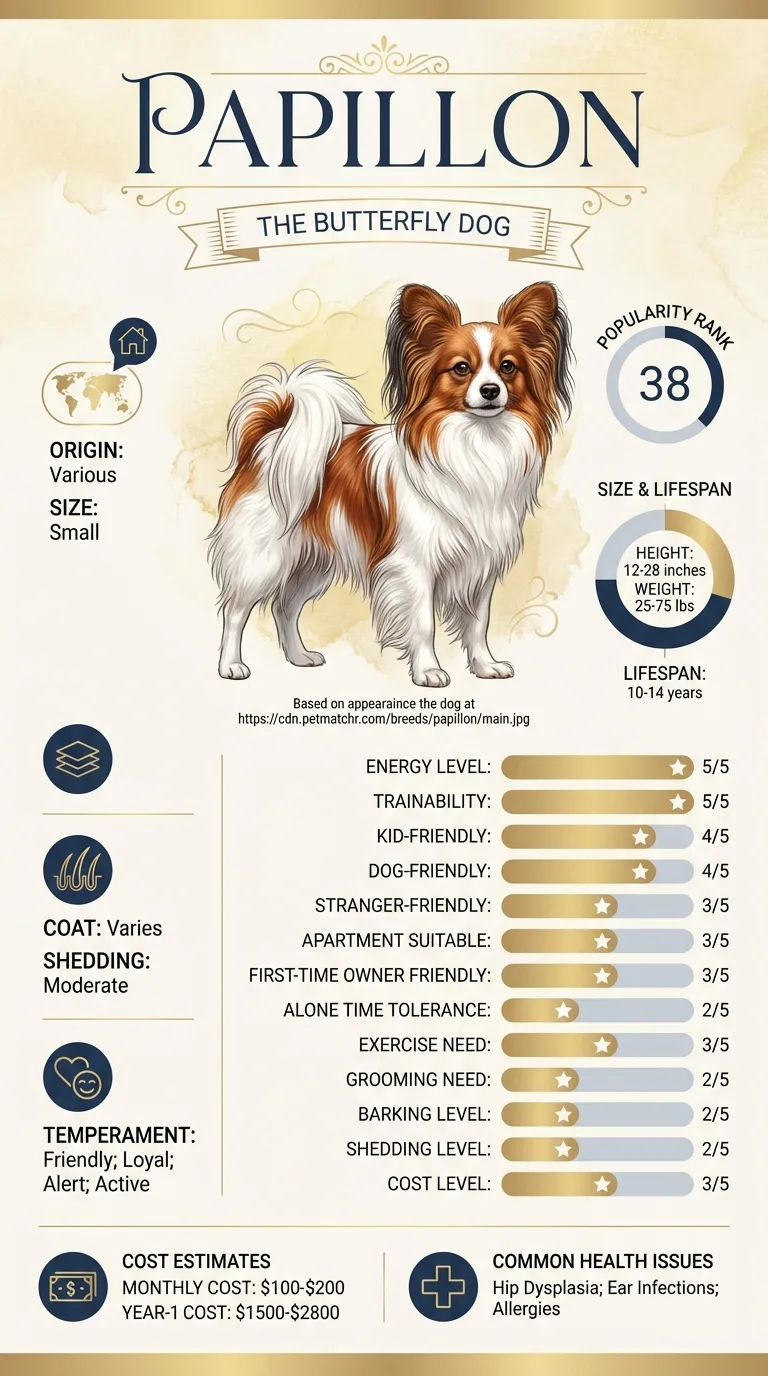
This page is for owners whose vet has just said the words we hear a murmur, and for owners of Papillons over eight who have started coughing and cannot tell whether the problem is the heart or the windpipe.
This guide is not medical advice. If your dog shows pain, sudden behavior change, or worsening symptoms, consult a licensed veterinarian.
Some links may be affiliate links. We may earn a commission at no extra cost to you. We only suggest products we believe are helpful for dog owners.
We research and check what we publish, but we do not warrant that any figure, date, price, or statement is accurate, complete, or current, and we accept no liability for any loss, cost, injury, or other harm arising from the use of this site. Use it as one reference among several. You remain responsible for your own decisions and for your dog's care - confirm anything that matters with a licensed veterinarian or another qualified professional before you act on it. Full disclaimer.
Heart conditions in Papillons are mostly acquired rather than congenital, and mostly valvular rather than muscular. The typical story is a murmur picked up in middle age that stays quiet for years, then slowly progresses as the left side works harder against a leaking valve. Because the breed also carries collapsing trachea, the cough that finally brings owners in often has nothing to do with the heart.
Acquired valve disease is the most frequently diagnosed cardiac problem in small companion breeds, and the Papillon's fourteen to sixteen year lifespan means more dogs live into the age band where it appears. Even so, most Papillons with a murmur never reach the stage requiring daily medication.
Small breeds carry a genetic tendency for the collagen in the mitral valve leaflets to degenerate with age, thickening and curling until the valve no longer seals. The Papillon sits squarely in that group, and its exceptional longevity compounds the effect: a breed that routinely reaches fifteen spends more years inside the risk window than a breed that reaches ten.
Nothing in a household causes valve degeneration, but several things change what it costs the dog. Excess weight raises the volume the heart must move. Untreated periodontal disease keeps a low grade inflammatory load running. And a home where nobody counts sleeping breaths notices the shift from stable to fluid overloaded days later than it could have.
Book an urgent appointment if the resting or sleeping breathing rate climbs and stays high, if your Papillon is restless at night and will not settle flat, or if a cough turns wet and constant. Go straight to an emergency clinic tonight if breathing looks laboured with the belly pumping, if the gums or tongue look grey or blue, or if the dog collapses. Fainting in a small dog can be cardiac and deserves same day attention even if the dog seems normal ten minutes later.
These errors are not neglect. They come from owners reacting to the word heart before anyone has established what is happening in the chest.
See all Papillon health problems, which breeds are prone to heart conditions, or the full Papillon breed guide for temperament, exercise needs and ownership costs.
Expect the first six months after a murmur is found to be mostly observation: a baseline echo, a breathing rate habit, a recheck. If disease is progressing, changes show up over years. Once medication becomes necessary, most owners see the dog settle within one to two weeks.
Success is not a cured valve. It is a Papillon reaching fourteen or fifteen still walking, still eating, still sleeping flat and breathing quietly, with a murmur that has been tracked the whole way rather than discovered during a crisis.
This is the most useful thing a Papillon owner can learn, because the breed carries risk in both places at once and the two coughs sound nothing alike once you know what to listen for.
A tracheal cough is dry, loud and abrupt, often compared to a goose honk. It fires in bursts of three or four, triggered by something mechanical: excitement at the door, a tug on the collar, a drink of water, cold air. The dog shakes it off and carries on. It is worse during the active part of the day.
A cardiac cough behaves in the opposite direction. Softer, wetter, more persistent, worst at night or early morning after the dog has been lying down. It arrives with a change in resting breathing rather than a change in activity. If your Papillon starts choosing to sleep propped up, that pattern points at the heart.
The measurement that separates them costs nothing. With the dog genuinely asleep, count each rise and fall of the chest for thirty seconds and double it. Do this on a few normal nights so you know your own dog's baseline.

Beatrix was ten, six and a half pounds, and had carried a soft murmur since she was seven. When she started a dry honking cough that spring, her owner Marta assumed the heart had finally turned. Marta filmed two episodes. Both fired when Beatrix bounced at the front door, and both stopped within seconds. Her vet watched the clips, ran radiographs, and found a heart that had barely changed in three years and a windpipe that narrowed on the inspiratory film. The fix was unglamorous: a padded harness instead of a collar, eleven ounces lost over four months, and a mat trained settle for the doorbell. Marta kept a sleeping breath log anyway, and two years later it was that log, not the cough, that flagged the day the murmur finally started to matter.
Key takeaway: In a Papillon the cough and the murmur are often two separate stories. Sort out which one you are watching before deciding how worried to be, and keep measuring the quiet one.
Your vet grades what they hear on a one to six scale and notes where in the chest it is loudest. If the murmur is soft and the dog is symptom free, many vets simply recheck in six months. If it is louder, or the dog is coughing or tiring early, the next step is an echocardiogram with a cardiologist.
No. Small breeds as a group have a high rate of age related valve change, and a Papillon that reaches fifteen has had a long time to develop it, but many never do. Family line matters, and so does whether the dog stayed lean. Treat it as a risk to monitor, not a certainty.
Slowly, usually. Many Papillons sit in a quiet murmur stage for years with no change to daily life, and progression is measured in annual comparisons rather than weeks. Things speed up only when the left side of the heart enlarges enough to press on the airway and back fluid into the lungs.
In the early stages, no. Normal walks and play support muscle tone and weight control, both of which help. What you avoid is forcing exertion when the dog wants to stop, and pushing activity in heat. If a cardiologist has staged your dog further along, follow their specific limits.
It is the only test that tells you what you are dealing with. A stethoscope says something is leaking and radiographs say whether the heart is enlarged, but only an echo shows the valve and measures the chambers. Book it if the result would change what you do next.
There is a long standing association between chronic oral infection and heart valve health, and Papillons carry a documented tendency toward dental disease. Keep the mouth clean. Discuss anesthesia planning with your vet if your dog already has a known murmur, since it changes how the procedure is monitored.
A murmur found on a routine exam, before the dog shows anything at all. The earliest sign you can spot yourself is a rising resting breathing rate during sleep.
Wait until the dog is genuinely asleep, count each rise and fall of the chest for thirty seconds, and double it. Record it weekly so you know your own dog's normal range.
Not necessarily. Young puppies can have soft flow murmurs that fade as they grow. A murmur first heard in a middle aged or senior Papillon is the one needing a real workup.
Routine care for the breed runs roughly eighty to one hundred fifty dollars a month. Echocardiograms and follow up radiographs sit on top of that as a periodic expense.
A one-page prep sheet for this condition: the signs, the questions to ask, what to get priced. Unlocks here.
You get: Vet visit prep sheet
No spam. One-click unsubscribe. See our privacy policy.
Preview page 1 before you decide.