Behavior
How do I tell separation anxiety from boredom barking?
Use a camera. Distress starts within minutes and never settles. Boredom barking follows a nap and comes in bursts triggered by sounds outside.

Quick answer
How do I tell separation anxiety from boredom barking?
Use a camera. Distress starts within minutes and never settles. Boredom barking follows a nap and comes in bursts triggered by sounds outside.
The dog is not being naughty and it is not being spiteful. It is also, from your neighbour's side of the wall, entirely unbearable.
Apartment dwellers who have received a note about barking, owners returning to destroyed doorframes or accidents from a house trained dog, and anyone whose Papillon starts pacing the moment they pick up their keys.
This guide is not medical advice. If your dog shows pain, sudden behavior change, or worsening symptoms, consult a licensed veterinarian.
Some links may be affiliate links. We may earn a commission at no extra cost to you. We only suggest products we believe are helpful for dog owners.
We research and check what we publish, but we do not warrant that any figure, date, price, or statement is accurate, complete, or current, and we accept no liability for any loss, cost, injury, or other harm arising from the use of this site. Use it as one reference among several. You remain responsible for your own decisions and for your dog's care - confirm anything that matters with a licensed veterinarian or another qualified professional before you act on it. Full disclaimer.
Separation related problems in Papillons combine three breed traits: low tolerance for being alone, high alertness, and exceptional learning ability. The first creates genuine distress in some dogs. The second creates reactive barking at everything audible through a wall. The third means the dog has already decoded your departure routine. Because the two underlying problems look identical from outside the front door, video evidence is the starting point rather than an optional extra.
Separation related behaviour is among the most frequently reported problems in companion dogs generally, and breeds that bond closely and dislike solitude appear disproportionately. The Papillon's low alone time tolerance places it in that group. In apartment settings the problem is reported more often, not necessarily because it is worse but because a neighbour hears it.
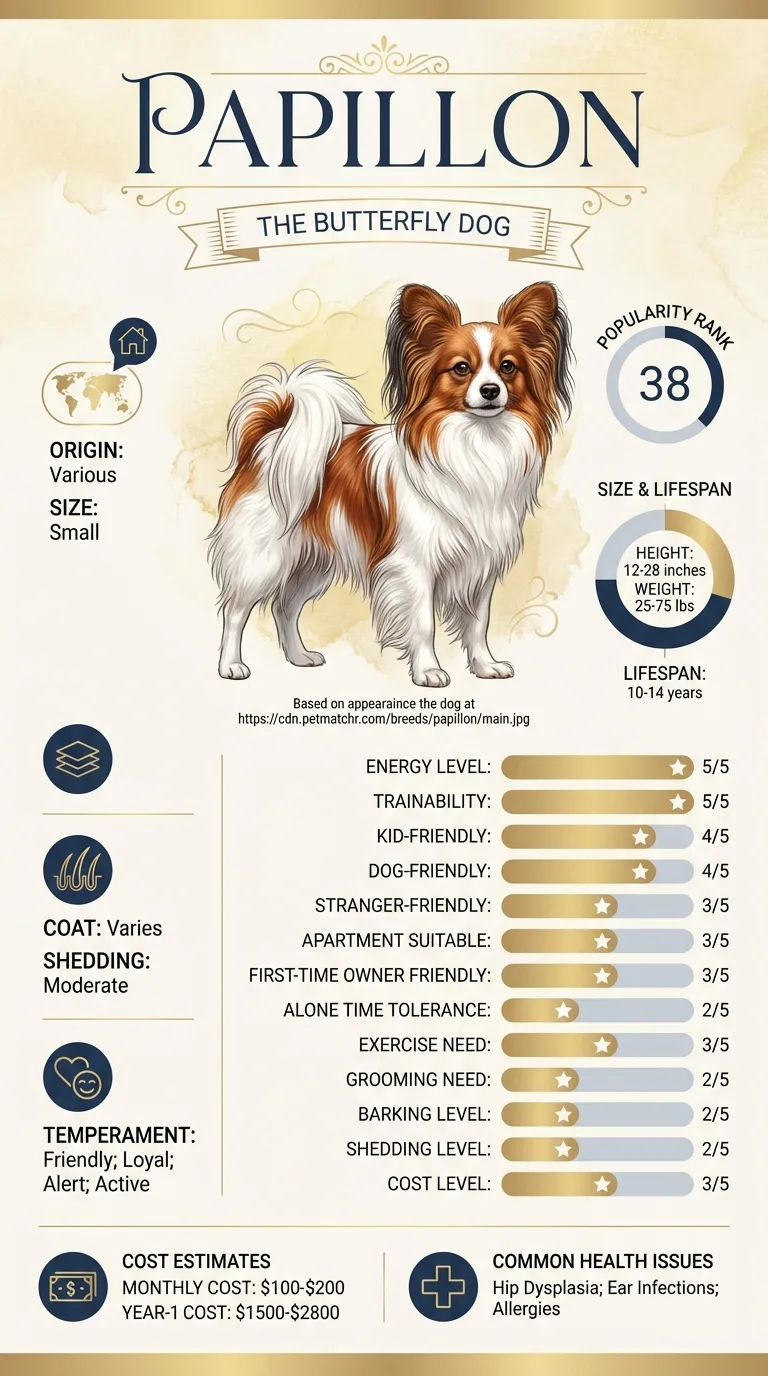
The Papillon was developed as a close companion dog and its scores reflect that: strongly attached, alert, confident and vocal. Low tolerance for solitude is not a training failure, it is a temperament trait that has to be worked with. The breed's exceptional trainability cuts both ways, because a dog that learns a new trick in three repetitions learns your leaving sequence just as fast. Its high alertness means it notices and comments on things a less watchful dog would sleep through.
Apartments concentrate every factor. Sound carries through shared walls, corridors generate constant footsteps and lift noise, and a window at street level gives an alert dog an endless stream of things to announce. Households that changed suddenly from constant presence to daily absence produce the sharpest onset. And a home where the dog is left with nothing to do provides no alternative to barking.
Bring in a qualified behaviour professional as soon as the camera shows genuine distress rather than boredom, because true separation anxiety responds poorly to improvised plans and can worsen with the wrong approach. Look for someone who works with reward based methods and who will build a graduated absence protocol. For the boredom pattern, a general trainer or your own structured enrichment plan is usually sufficient, and this breed's high trainability makes progress quick.
Involve your vet early if your Papillon is injuring itself, breaking teeth or nails on doors or crates, refusing food while alone, or in a state of panic that has not improved with several weeks of structured work. Also see a vet if the behaviour appeared abruptly in a previously settled adult, because pain, sensory decline and endocrine disease can all present as new anxiety. Seek urgent care for any dog that has injured itself escaping, is bleeding, is coughing continuously after prolonged barking, or is in obvious respiratory distress.
See all Papillon health problems, which breeds are prone to separation anxiety, or the full Papillon breed guide for temperament, exercise needs and ownership costs.
Boredom driven barking often improves within one to two weeks of managing triggers and adding enrichment. Genuine separation distress is slower: expect two to six months of graduated work, with plateaus and setbacks, and expect the first month to feel like nothing is happening. Progress is measured in tolerated absence duration, not in whether the dog looks pleased to see you.
Success is footage of a dog that settles within a few minutes of your leaving and sleeps through most of an absence, and a neighbour who has stopped mentioning it. It is not a dog that no longer prefers your company.
The single most useful thing you can do is put a camera on the dog, because these look identical from the corridor and need opposite responses.
Genuine separation distress has a shape. It starts within minutes of departure, often before you have left the building. The dog panics: pacing, whining escalating into frantic barking, drooling, trembling, scrabbling at the door or window through which you left, sometimes urinating or defecating despite being reliably house trained. Destruction is concentrated at exit points rather than distributed around the room. The dog does not settle at all, and the state can persist for hours. This is a panic disorder and no amount of exercise will drain it away.
Boredom barking has a different shape. The dog settles first, sleeps for a while, then wakes and starts responding to things: footsteps in the corridor, a delivery, a dog outside, a lift door. It barks in bursts with quiet in between, and it is barking at something rather than about your absence. Destruction, if any, involves interesting objects rather than doors.
A Papillon's alertness rating means the second pattern is extremely common in this breed, and it is far easier to solve. Managing the triggers, blocking window views, adding sound masking and leaving genuine mental work behind will change it within days. Real separation distress requires a slower, structured behavioural programme and often veterinary involvement.

Desensitising the departure ritual is where most programmes start, precisely because this breed reads the ritual so well.
Roos found a polite note from her downstairs neighbour about barking. She assumed separation anxiety, felt guilty, and started leaving her Papillon Tobias with a chew and a longer morning walk. Nothing changed. She bought a cheap camera. The footage showed Tobias asleep within four minutes of the door closing, staying asleep for over an hour, then waking when the lift doors opened and barking hard for two minutes. Then sleep. Then the postman. Then sleep. He was not distressed at all; he was on duty. Roos moved his bed away from the hallway wall, put a radio on low, and started leaving a snuffle mat with half his breakfast in it. The barking dropped to almost nothing inside a fortnight. She took the neighbour a bottle of wine and asked him to tell her if it started again. He has not needed to.
Key takeaway: Do not treat a problem you have not watched. In an alert, clever breed living behind a shared wall, a great deal of what gets called separation anxiety is a bored guard dog with an excellent view and nothing to do.
The breed tolerates alone time poorly, scoring near the bottom of that scale, which makes it more vulnerable than a naturally independent breed. It is not a certainty, and plenty of Papillons are left routinely without difficulty. What raises the risk is a dog that has rarely been left, or one whose routine changed abruptly when a household went back to working outside the home.
There is no fixed number and it depends heavily on the individual dog and its training history. A conditioned adult managing four to five hours comfortably is a reasonable target for many households, with a midday visit for longer days. What matters more than the number is whether the dog is genuinely settled during that time, which only a camera can tell you.
Sometimes, and sometimes it produces two barking dogs. True separation distress is usually about the absence of a specific person rather than about loneliness in general, so a companion frequently does not touch it. Acquiring a second dog is a fifteen year commitment for this breed and a poor experiment to run on a hypothesis.
Only if the dog already loves the crate and chooses to rest in it when you are home. A dog in genuine panic can injure itself trying to escape confinement, and crating a distressed dog usually intensifies the distress rather than containing it. For boredom barking, an open pen with enrichment is generally more useful than a closed crate.
Tell them before they complain rather than after. Explain that you are aware, that you are working on it with a specific plan, and ask them to tell you what times they hear barking, which gives you free monitoring data. Neighbours who feel consulted are dramatically more patient than neighbours who feel ignored.
For genuine separation distress, yes, and it should be discussed with your vet rather than dismissed. Medication does not replace behavioural work but it can lower a dog's baseline panic enough that the training becomes possible. That is a veterinary decision based on an assessment of your individual dog, and never something to source or improvise yourself.
Use a camera. Distress starts within minutes and never settles. Boredom barking follows a nap and comes in bursts triggered by sounds outside.
Because this breed learns extremely fast. Your leaving ritual has become a reliable predictor, so the anxiety begins before you reach the door.
Very well on size and exercise needs, but their alertness and readiness to bark make sound management and settle training essential in shared buildings.
Block the window view, add sound masking, and leave real mental work behind. That alone resolves a large share of Papillon barking complaints.
Behaviour changes often start with pain. The prep sheet for this page covers what to rule out, and what to ask.
You get: Vet visit prep sheet
No spam. One-click unsubscribe. See our privacy policy.
Preview page 1 before you decide.