Health
Where do Papillons with environmental allergies itch?
Feet, face, ears, armpits, groin and belly. Brown saliva staining on the front paws is a common visual marker in this breed.

Quick answer
Where do Papillons with environmental allergies itch?
Feet, face, ears, armpits, groin and belly. Brown saliva staining on the front paws is a common visual marker in this breed.
A Papillon licking its front paws raw in August and a Papillon chewing its tail base in September are usually telling you two different things.
Owners watching their Papillon lick, chew and scratch through an evening, and those already three foods deep into an elimination process with no clear improvement.
This guide is not medical advice. If your dog shows pain, sudden behavior change, or worsening symptoms, consult a licensed veterinarian.
Some links may be affiliate links. We may earn a commission at no extra cost to you. We only suggest products we believe are helpful for dog owners.
We research and check what we publish, but we do not warrant that any figure, date, price, or statement is accurate, complete, or current, and we accept no liability for any loss, cost, injury, or other harm arising from the use of this site. Use it as one reference among several. You remain responsible for your own decisions and for your dog's care - confirm anything that matters with a licensed veterinarian or another qualified professional before you act on it. Full disclaimer.
Allergic skin disease means the immune system overreacting to something ordinary, producing inflammation and itch. In dogs the three main routes are environmental allergens, flea saliva and food components, and they produce different distributions on the body. Skin disease is not on the Papillon's documented list of common health issues, but the breed gets the same allergies every dog does, and its single silky coat makes the affected skin unusually easy to inspect.
Itchy skin is one of the most frequent reasons dogs of any breed are taken to a vet, and allergic disease accounts for a large share of it. The Papillon is not recognised as a particularly allergic breed, so an itchy Papillon is having an ordinary canine problem rather than a breed specific one. That is genuinely good news for the prognosis.
There is no documented allergic predisposition in the Papillon, whose recognised issues concern the kneecaps, eyes, teeth, skull and windpipe. What the breed contributes is coat architecture. The long fine single coat leaves skin accessible and visible, which favours early detection. The heavy fringing on the ears, chest, hind legs and tail works the other way, holding moisture and debris in exactly the warm folded areas where secondary infection prefers to establish itself.
The environment supplies the allergens, and a nine inch tall dog spends its life at grass level with its face and belly in direct contact with lawns, pavements and floors. Household factors matter too: how often floors are washed and with what, whether carpets are treated with powders, whether the home is humid, and above all whether flea prevention is applied consistently to every animal in the house rather than sporadically to one.
Book an appointment for itch that has lasted more than a couple of weeks, for any area the dog has chewed raw, for recurrent ear infections, or for skin that smells or looks greasy and crusted. Take your itch map and your photographs. Seek same day care for a rapidly spreading moist raw patch, for facial swelling or hives, for skin that is hot and painful to touch, or for any skin change accompanied by lethargy, fever or difficulty breathing, since those suggest something more than local irritation.
See all Papillon health problems, which breeds are prone to skin allergies, or the full Papillon breed guide for temperament, exercise needs and ownership costs.
Secondary infections typically clear over two to four weeks of prescribed treatment, and much of the itch often goes with them. Identifying an environmental trigger and establishing a management plan usually takes several months across a season. A properly conducted diet trial takes eight to twelve weeks with strict control. Nothing here is fast.
Success is a dog that itches occasionally and mildly, with clean ears, unstained paws and no raw patches, on a plan that continues indefinitely. A dog that never itches at all is not the target and expecting it leads to endless product churn.
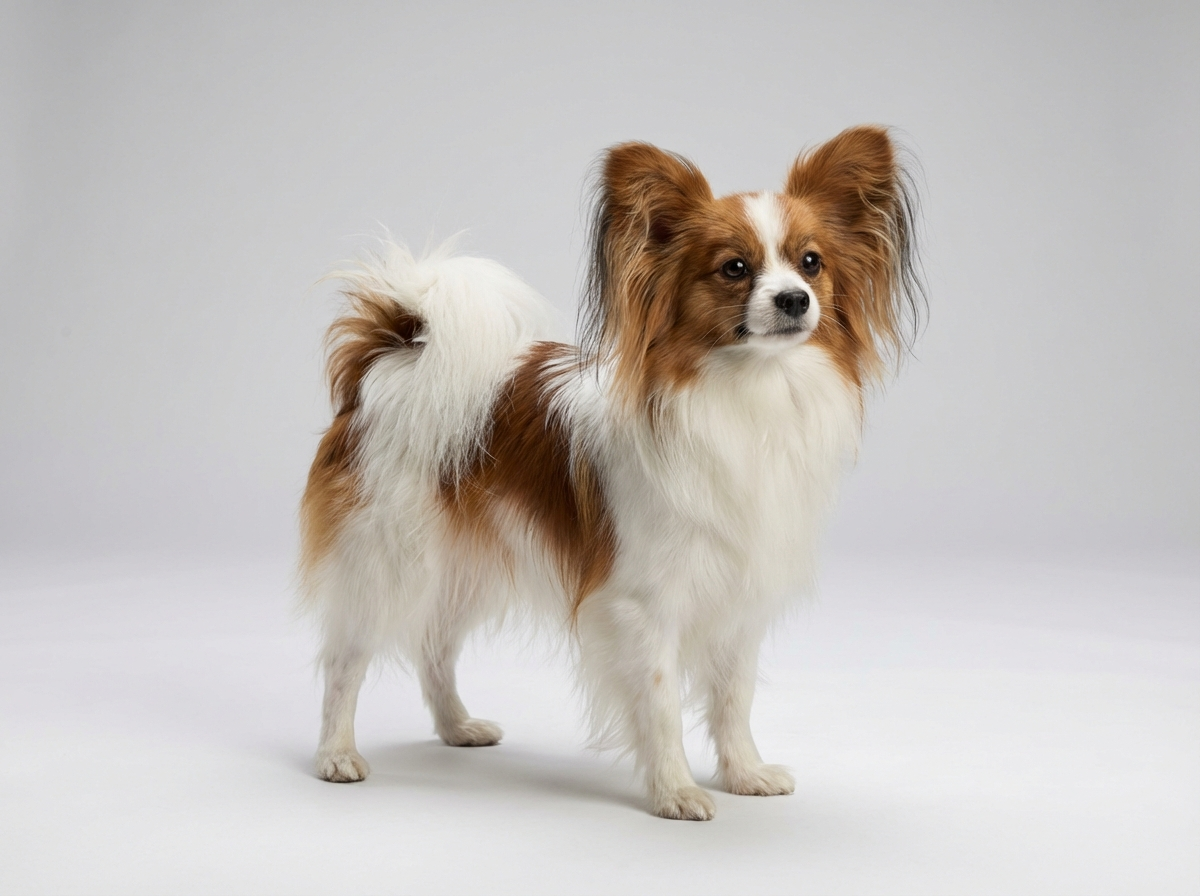
Environmental allergy, the commonest allergic skin disease in dogs, produces a characteristic distribution. It concentrates on the feet, the muzzle and around the eyes, the ears, the armpits, the groin and the underside of the body. These are the thin skinned, sparsely coated areas in most contact with grass, floors and airborne allergens. In a light coloured Papillon the front paws often show rusty brown staining, which is saliva from persistent licking rather than dirt, and it is one of the most reliable visual markers of chronic itch.
Flea allergy produces almost the opposite map. It concentrates over the lower back, the base of the tail and the backs of the thighs, with crusting and hair loss in that region. A dog sensitised to flea saliva can react intensely to a single bite, so seeing no fleas proves nothing.
Food related itch is less predictably distributed and frequently, though not always, comes with digestive signs alongside. This is one reason it is investigated later rather than first.
Seasonality is the other big clue. Itch that appears in spring and fades in autumn suggests pollens. Year round itch that never lets up suggests house dust mites, or a food component, or a secondary infection that has taken on a life of its own.
Write the map down and note the months. That single page will shorten the diagnostic process considerably.

This breed offers an unusual diagnostic advantage over most long coated dogs, provided you use it.
Petar's Papillon Ilse had been itchy for two years and had been through four foods. He arrived at a dermatology referral with a bag of packaging and no other information. The dermatologist asked him to stop changing anything and instead mark a printed body outline every week with where Ilse had been licking, plus one photograph of her front paws a month. After eleven months the pattern was unmissable: paws, muzzle and armpits, worst from April through September, almost quiet in midwinter, with nothing at the tail base at all. That map ruled flea allergy well down the list and pointed firmly at seasonal environmental allergens. Ilse went onto a management plan built around that, with medicated washes during flare months and paw wiping after every walk. Petar's only regret was the four foods, none of which had ever been given a fair trial.
Key takeaway: The distribution and the calendar do more diagnostic work than any product on a shelf. Map the itch, photograph the paws, hold the diet steady, and let the pattern tell you which of three very different causes you are dealing with.
Usually not. Environmental allergy and flea allergy are both commoner than food allergy, and a diet trial done properly requires a strictly controlled prescription food for eight to twelve weeks with absolutely nothing else, which is difficult and slow. Your vet will normally rule out parasites and treat any secondary infection first, since both can be resolved much faster.
That is saliva staining from persistent licking, and it is one of the clearest signs of chronic itch in a light coated dog. It indicates the dog has been licking for weeks or months, not days. Paws are a classic environmental allergy site, so brown paws plus a seasonal pattern is a meaningful combination to report.
Allergic skin disease is managed rather than cured. The realistic goal is a comfortable dog with occasional mild flares rather than a dog that never itches. Long term management may involve prescribed medication, immunotherapy if specific allergens are identified, medicated washes, and consistent parasite prevention. It is a relationship with the condition rather than a course of treatment.
Because ear canals are lined with skin, so a dog with allergic skin disease has allergic ear disease too. Recurrent ear infections in an itchy dog are usually a symptom of the underlying allergy rather than an independent problem, and treating each infection without addressing the allergy produces an endless cycle. A Papillon's substantial ear fringing adds moisture retention on top.
Appropriate bathing with a product your vet recommends helps, by physically removing allergens from the coat and by treating any surface infection. Frequent bathing with unsuitable shampoos strips the skin barrier and worsens things. In a single coated breed, a wash also needs proper drying at the skin, particularly under the fringes.
Look for redness that has become greasy or crusted, a distinctive smell, small pustules, or areas the dog has chewed into a moist raw patch. Secondary bacterial and yeast infections are extremely common on allergic skin and they cause a great deal of the itch. They need veterinary treatment, and they often make the underlying allergy look worse than it is.
Feet, face, ears, armpits, groin and belly. Brown saliva staining on the front paws is a common visual marker in this breed.
Classically flea allergy. A sensitised dog can react intensely to a single bite, so seeing no fleas does not rule it out.
Usually not. Parasites and secondary infection are commoner and far quicker to resolve, and a proper diet trial takes eight to twelve weeks of strict control.
Yes. A single silky coat parts straight to the skin, so redness and crusting are visible early, provided the fringes are also being combed.
A one-page prep sheet for this condition: the signs, the questions to ask, what to get priced. Unlocks here.
You get: Vet visit prep sheet
No spam. One-click unsubscribe. See our privacy policy.
Preview page 1 before you decide.