Health
Do Chihuahuas get wobbler syndrome like Great Danes?
Not the same disease. A wobbly gait in this breed usually points to atlantoaxial instability at the top of the neck, a different joint and mechanism.

Quick answer
Do Chihuahuas get wobbler syndrome like Great Danes?
Not the same disease. A wobbly gait in this breed usually points to atlantoaxial instability at the top of the neck, a different joint and mechanism.
Two dogs can both be called 'wobblers' and be describing completely different structures: one a narrowed canal partway down a Great Dane's neck, the other a loose joint at the very top of a five-pound dog's spine.
Owners who searched wobbler syndrome, found large-breed information about a lower-neck disease, and applied the wrong expectations and timeline to their own toy breed's very different condition.
This guide is not medical advice. If your dog shows pain, sudden behavior change, or worsening symptoms, consult a licensed veterinarian.
Some links may be affiliate links. We may earn a commission at no extra cost to you. We only suggest products we believe are helpful for dog owners.
We research and check what we publish, but we do not warrant that any figure, date, price, or statement is accurate, complete, or current, and we accept no liability for any loss, cost, injury, or other harm arising from the use of this site. Use it as one reference among several. You remain responsible for your own decisions and for your dog's care - confirm anything that matters with a licensed veterinarian or another qualified professional before you act on it. Full disclaimer.
Wobbler syndrome as documented in giant breeds is a lower-neck spinal canal narrowing and is not the mechanism behind a wobbly gait in this breed. Here, cervical vertebral instability almost always means atlantoaxial instability, a malformation or looseness at the top two neck vertebrae just below the skull, often linked to the same incomplete bone ossification behind this breed's documented open fontanelle and hydrocephalus risk. It can present suddenly, sometimes after a minor fall, and ranges from mild to a genuine spinal cord emergency.
Atlantoaxial instability is a well-recognized cause of neck pain and wobbly gait specifically in toy and small breeds, distinct from the giant-breed condition sharing a popular name. Its exact frequency in this breed is not precisely quantified, but it is one of the recognized causes of sudden neurological symptoms in small dogs generally.
This breed's documented tendency toward incomplete bone ossification, most visibly seen in a frequently open fontanelle and associated hydrocephalus risk, extends to the top of the spine as well, where the small dens meant to anchor the first two vertebrae together can be malformed or fail to fuse securely. This structural vulnerability means normal-seeming activity, a jump or a fall that a dog with a fully fused joint would shrug off, can produce genuine spinal cord injury in an affected individual.
Furniture and stairs built for human scale mean routine jumps represent a proportionally larger impact for a dog this size, increasing the chance of a jolt severe enough to shift an unstable joint. Collar use applies direct pressure to the neck during walks or if a dog pulls, adding mechanical stress precisely at the vulnerable joint in a way a harness does not.
Book an appointment for any puppy or young dog showing neck pain, reluctance to lower or raise its head, or an unsteady, wobbly gait, so imaging can assess the atlantoaxial joint specifically. Seek emergency care immediately for sudden collapse, inability to walk, or weakness in more than one limb following any fall, jump or head movement, since this can indicate acute spinal cord compression at a level high enough to be life-threatening.
See all Chihuahua health problems, which breeds are prone to wobbler syndrome, or the full Chihuahua breed guide for temperament, exercise needs and ownership costs.
Mild cases managed conservatively with strict activity restriction may show improvement over several weeks, though the joint itself typically remains inherently unstable without surgical stabilization. Surgical cases generally require a structured recovery period of six to eight weeks with significant activity restriction, after which many dogs return to a good quality of life.
Success is a dog free of neck pain, walking normally, with a management or surgical plan appropriately matched to the joint's actual stability. For many dogs this means permanent precautions, such as harness use and avoiding jumping, rather than a joint that becomes fully normal on its own.
The atlas and axis are the first and second vertebrae of the neck, sitting directly beneath the skull, and their normal design allows the head to rotate through this joint independently of the rest of the spine. That rotation depends on a small bony peg, the dens, projecting up from the second vertebra and being held securely in place by ligaments. In some toy breeds, including this one, the dens can be malformed, abnormally short, or in rare cases essentially absent, and the ligaments holding the joint together can be looser than normal, together producing genuine instability at this single, very high point in the neck.
This is connected to a broader pattern already documented in this breed: incomplete ossification, meaning bone that has not fully hardened and fused, is the same underlying process behind the frequently open fontanelle, or molera, and the resulting hydrocephalus risk seen in this breed's skull. Atlantoaxial instability represents a similar incomplete-ossification pattern showing up one joint lower, at the top of the spine rather than in the skull itself, rather than being an unrelated coincidence.
Because the instability sits directly beneath the skull, even a relatively minor jolt, a jump from a couch, a fall, or occasionally just an enthusiastic head shake, can cause the loose joint to shift and compress or bruise the spinal cord at a point high enough to affect all four limbs and, in severe cases, breathing. This is why a young dog suddenly reluctant to move its neck, yelping with head movement, or showing weakness after a fall needs prompt imaging rather than a wait-and-see approach, in sharp contrast to the more gradually progressive lower-neck disease seen in giant breeds under the same popular name.

These are the practical differences worth knowing before reading further about 'wobbler syndrome' online.
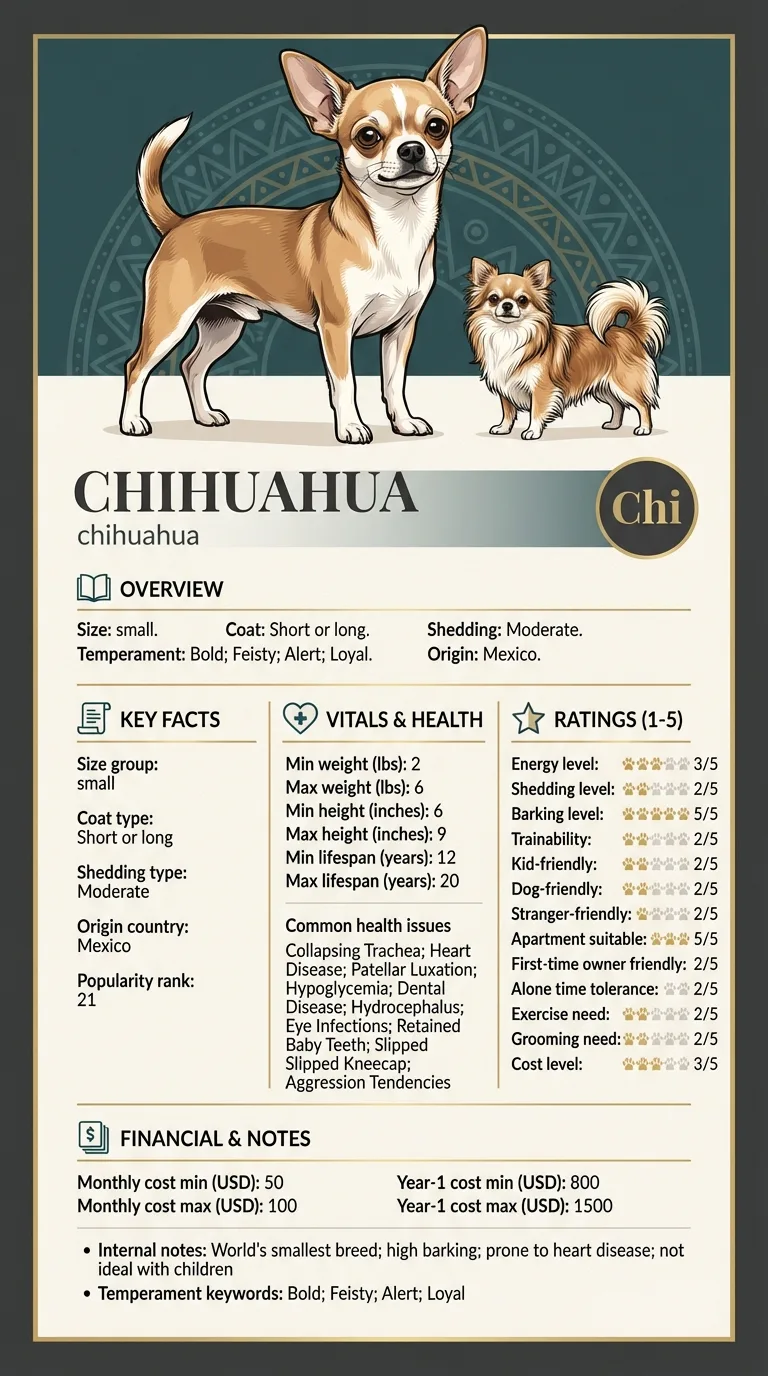
If you think your Chi has wobbler syndrome, the plan is three steps: write down what you have seen and when it started, book a veterinary appointment rather than waiting for the next flare, and take video of the behaviour or symptom before you go — the thing you are worried about rarely happens in the consulting room. Screening in the parents covers collapsing trachea, heart disease, patellar luxation.
What the vet visit should produce is a diagnosis and a written plan, not just reassurance: what is being ruled out, what the monitoring interval is, and which signs mean you come back sooner. Ask what the treatment costs across a year rather than per visit, because that is the number that decides whether you are managing this condition or reacting to it.
Between appointments, keep a short log — dates, what you saw, what changed. It is the single most useful thing an owner brings to a follow-up, and for wobbler syndrome it is often what separates a clear pattern from a guess.
Lalo yelped once, sharply, after jumping down from the couch at five months old, and then stood oddly still, holding his neck stiffly and clearly reluctant to lower his head toward his food bowl that evening. His owner Ximena had read briefly about wobbler syndrome in large dogs years earlier and assumed, incorrectly, that a small puppy like Lalo simply was not the right size or age for anything like that to apply. An emergency vet visit that same evening included neck imaging, which showed a malformed dens and clear instability between the first two neck vertebrae, consistent with atlantoaxial instability rather than the lower-neck disease Ximena had vaguely remembered reading about. Because Lalo was still able to walk and had no weakness in his limbs, his vet recommended strict crate confinement and a harness-only policy first, reserving surgery as the next step if conservative management failed. Six weeks of confinement resolved the acute pain, and eighteen months later Lalo has had no further episodes, walking exclusively on a harness with furniture jumping replaced by a small ramp his owner installed by the couch.
Key takeaway: The large-breed version of this condition and the toy-breed version share a popular name and little else. A young dog suddenly guarding its neck after an ordinary jump deserves same-day imaging aimed at the top of the spine, not a search result written for a completely different dog and a completely different joint.
Not the same disease mechanically. A wobbly, unsteady gait in this breed almost always traces to atlantoaxial instability, a looseness at the very top two neck vertebrae, rather than the lower-neck canal narrowing documented in giant breeds under the same popular name.
Most often a malformed, unusually short, or in rare cases absent dens, the bony peg that normally anchors the top two neck vertebrae together, combined with looser than normal supporting ligaments. This connects to the same incomplete bone ossification pattern documented behind this breed's open fontanelle and hydrocephalus risk.
Diagnosis and treatment can range widely, roughly from several hundred dollars for imaging and conservative management up to several thousand for surgical stabilization in more severe cases, depending on severity and the specific approach recommended.
Milder cases are sometimes managed with strict activity restriction and external support, though outcomes vary and surgical stabilization is often recommended for a more definitive, reliable fix, particularly in dogs with significant or progressive symptoms.
Use a harness rather than a collar to avoid any pressure on the neck, avoid situations involving jumping from furniture or rough play that could jolt the head and neck, and treat any sudden neck pain, reluctance to move the head, or weakness as an urgent, same-day concern.
No. Intervertebral disc disease involves disc material compressing the spinal cord, typically further down the back or in the lower neck. Atlantoaxial instability involves a structural joint problem at the very top of the neck, immediately below the skull, a different location and a different mechanism entirely.
Not the same disease. A wobbly gait in this breed usually points to atlantoaxial instability at the top of the neck, a different joint and mechanism.
Looseness or malformation at the top two neck vertebrae, just below the skull, often linked to the same incomplete bone ossification seen in this breed's open fontanelle.
Roughly $500 for conservative management up to around $7,000 for surgical stabilization, depending on severity.
Yes, especially if this instability is a known or suspected risk, since collar pressure loads the unstable joint directly.
A one-page prep sheet for this condition: the signs, the questions to ask, what to get priced. Unlocks here.
You get: Vet visit prep sheet
No spam. One-click unsubscribe. See our privacy policy.
Preview page 1 before you decide.