Living
Which is bigger?
The Golden Retriever, at 55-75 lbs versus the Papillon's 5-10 lbs.

Quick answer
Which is bigger?
The Golden Retriever, at 55-75 lbs versus the Papillon's 5-10 lbs.
Golden Retriever or Papillon? On paper they differ most on apartment suitability, and on the scales Golden Retriever is the heavier at 55–75 lbs. Here is how the two compare on everything that shapes an ordinary week.
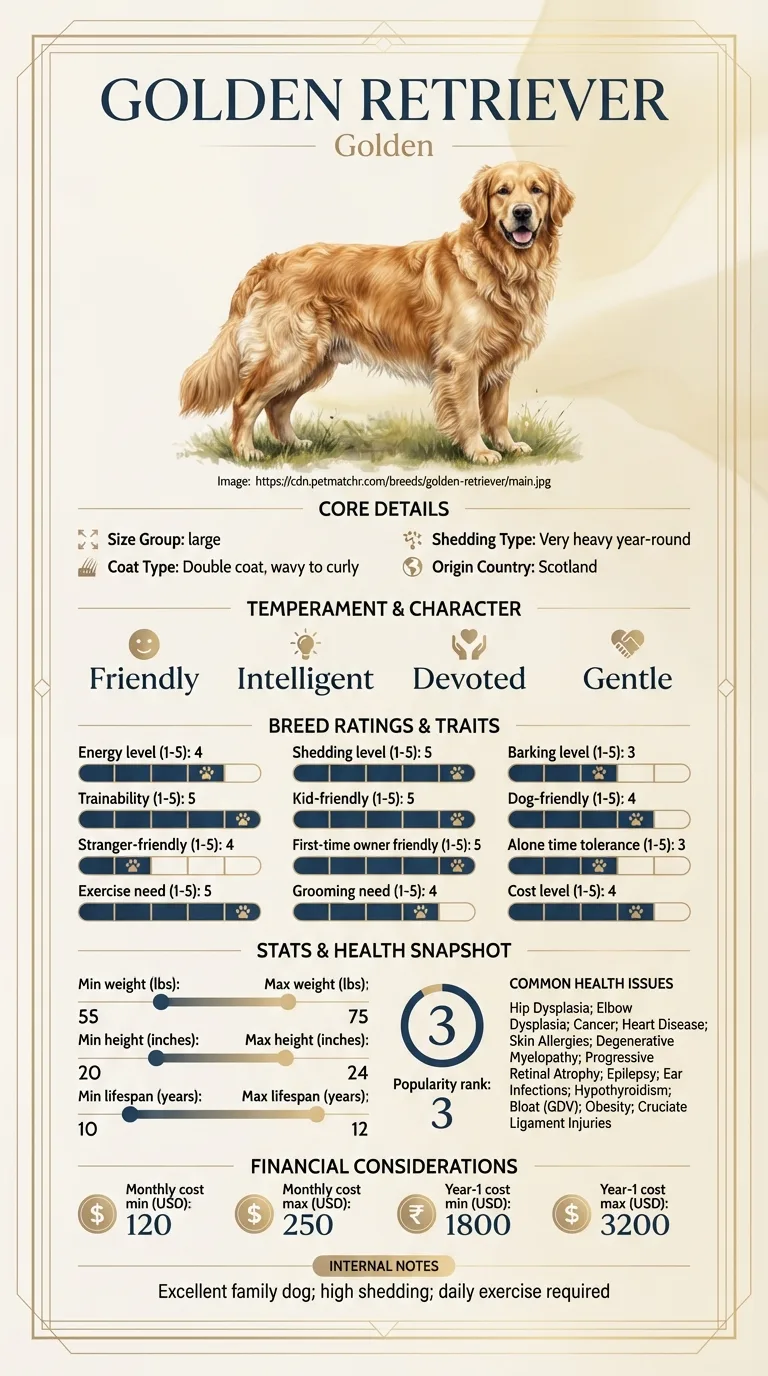
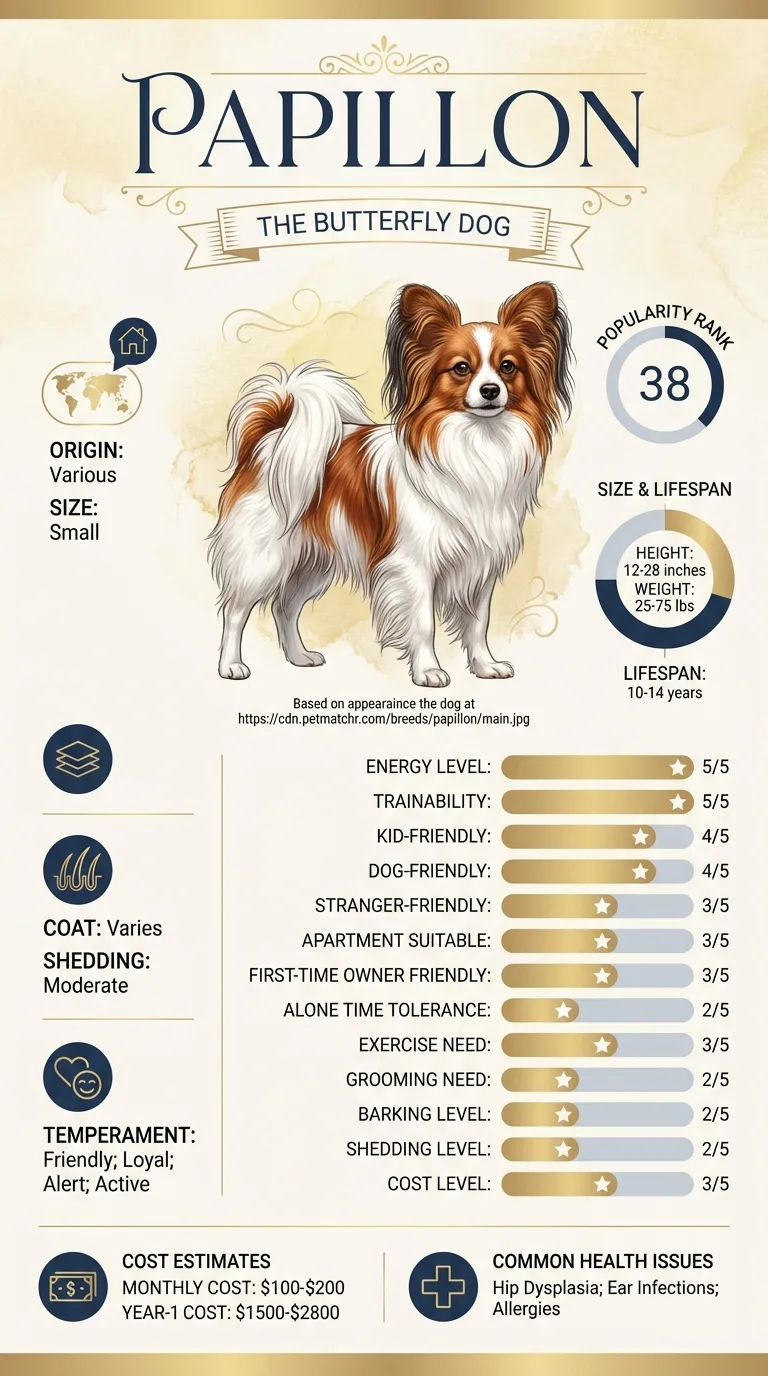
This is for someone already down to Golden Retriever and Papillon and deciding between them. For this pair the decision usually turns on apartment suitability and shedding, so those are covered first and in most detail. Anyone choosing from a flat has a clear answer here: Papillon rates 5/5 against 2/5. Breed history is left out; what follows is what you will actually live with.
Between Golden Retriever and Papillon, apartment suitability is what separates them, and Papillon is the lower-effort dog of the two to keep.
Choose Golden Retriever if this is your first dog, the dog will be alone during the working day and there are young children at home.
Choose Papillon if you are in a flat or a smaller home, you do not want a standing grooming appointment and shedding is a problem in your house.
| Feature | golden retriever | papillon | Winner |
|---|---|---|---|
| Size class | large | small | Equal |
| Weight | 55–75 lbs | 5–10 lbs | Equal |
| Height | 20–24 in | 8–11 in | Equal |
| Lifespan | 10–12 years | 14–16 years | papillon |
| Exercise need | Very high (5/5) | Moderate (3/5) | papillon |
| Grooming need | High (4/5) | Low (2/5) | papillon |
| Shedding | Very high (5/5) | Low (2/5) | papillon |
| Energy level | High (4/5) | High (4/5) | Equal |
| Barking | Moderate (3/5) | High (4/5) | golden retriever |
| Apartment suitability | Low (2/5) | Very high (5/5) | papillon |
| Good for first-time owners | Very high (5/5) | High (4/5) | golden retriever |
| Tolerates being alone | Moderate (3/5) | Low (2/5) | golden retriever |
| Trainability | Very high (5/5) | Very high (5/5) | Equal |
| Good with kids | Very high (5/5) | Moderate (3/5) | golden retriever |
| Good with other dogs | High (4/5) | High (4/5) | Equal |
| Friendly to strangers | High (4/5) | High (4/5) | Equal |
| Cost level | High (4/5) | Low (2/5) | papillon |
| Coat | Double coat, wavy to curly | Long, silky single coat | Equal |
| Origin | Scotland | Various | Equal |
| Typical monthly cost | $120–$250 | $80–$150 | Equal |
| Typical first-year cost | $1,800–$3,200 | $1,100–$2,300 | Equal |
Picture the size gap directly: a 65 lb Golden Retriever standing 20-24 inches at the shoulder next to an 8-11 inch Papillon that might weigh as little as 5 lbs — this is a large breed against a true toy breed, sharing almost nothing on the scale. The Papillon's name comes from its butterfly-shaped ears, and its long, silky single coat is a completely different maintenance category from the Golden's dense double coat. Despite the dramatic weight difference, the two share nearly identical High energy-level scores, which surprises people who assume a tiny dog is automatically calmer than a 65-70 lb retriever.
Both breeds score High (4/5) on general energy level, but their exercise needs diverge — the Golden rates Very High (5/5) while the Papillon sits at Moderate (3/5). That's a meaningful practical difference: the Golden genuinely needs sustained physical outlets like running or swimming, while the Papillon's energy tends to burn off through indoor play, short bursts of activity, and mental stimulation like trick training, since its small legs cover the same ground with far less exertion. A Papillon owner living a sedentary lifestyle can still meet its needs with two or three short walks; a Golden owner in the same situation would end up with a frustrated dog.
This is one of the widest gaps in the whole comparison: the Golden rates High (4/5) grooming and Very High (5/5) shedding, while the Papillon rates Low (2/5) grooming and Low (2/5) shedding. The Papillon's long silky single coat lacks the dense undercoat that drives the Golden's year-round hair loss, so a quick brush a couple of times a week keeps it presentable, versus the near-daily brushing many Golden owners adopt during shedding season. Anyone with allergy sensitivity or a strong aversion to vacuuming pet hair will find the Papillon dramatically easier to live with on this specific axis.
Apartment suitability flips decisively toward the Papillon, which rates Very High (5/5) against the Golden's Low (2/5) — a predictable result of the size and exercise-need gap. The tradeoff is noise: the Papillon rates High (4/5) on barking versus the Golden's Moderate (3/5), so a Papillon in a thin-walled building may draw more complaints even though it needs far less space and exercise. Alone-time tolerance also favors the Golden, Moderate (3/5) versus the Papillon's Low (2/5), meaning the tiny dog that fits a studio apartment is also the one more likely to struggle when its owner works long hours.
Both breeds rate Very High (5/5) on trainability, and Papillons are in fact one of the most consistently high-scoring toy breeds in obedience circles, backed here by temperament tags of Quick-witted and Confident. Where they differ is first-time-owner suitability: the Golden rates Very High (5/5) against the Papillon's still-solid High (4/5). The gap is small but real — Papillons can be more assertive and vocal than their size suggests, and a first-time owner unfamiliar with small-dog handling may find the learning curve slightly steeper than with the famously easygoing Golden.
With kids specifically, the Golden pulls ahead clearly, rating Very High (5/5) against the Papillon's Moderate (3/5) — Papillons are delicate enough that rough handling by young children poses a real injury risk, a common caution with toy breeds. Both rate High on good-with-other-dogs and friendly-to-strangers, so socially neither breed is standoffish. Temperament-wise the Golden's Friendly, Devoted, Gentle profile suits a chaotic multi-kid household, while the Papillon's Alert, Quick-witted, Confident personality tends to bond tightly with one or two people and do best in a calmer home, perhaps with older children who understand how to handle a small dog carefully.
The Papillon holds a substantial lifespan edge, averaging 14-16 years against the Golden's 10-12 — roughly four extra years of companionship, a factor that matters a great deal to families thinking long-term. Their health lists don't overlap at all: the Papillon's five flagged conditions are Patellar Luxation, Progressive Retinal Atrophy, Dental Disease, Open Fontanel, and Collapsing Trachea, mostly small-breed structural issues, while the Golden's thirteen-condition list is dominated by larger-breed concerns like Cancer, Hip Dysplasia, and Bloat (GDV). Progressive Retinal Atrophy is the one condition both breeds share, so retinal screening is worth asking about regardless of which one a family chooses.
Cost favors the Papillon clearly: it carries a Low (2/5) cost rating with a $80-$150 monthly range and $1,100-$2,300 first-year cost, well under the Golden's High (4/5) rating, $120-$250 monthly, and $1,800-$3,200 first year. Smaller portions of food, smaller-dose medications, and lower-cost grooming all compound over a Papillon's lifetime, and since it also tends to live several years longer, total lifetime spending gets spread differently than the headline numbers alone suggest. Prospective owners chasing a lower-cost breed on a tight or fixed budget will find the Papillon the more forgiving choice on nearly every cost line.
Golden Retriever weighs 55–75 lbs and lives 10–12 years; Papillon weighs 5–10 lbs and lives 14–16 years. The two diverge most on apartment suitability, shedding and exercise need and 3 other rated axes. They are level on good with other dogs, energy level and friendly to strangers, so those cannot decide it. The comparison marks an easier option only where one exists. Facts like weight and country of origin are not scored. Both dogs are rated from the same dataset, which is what makes the numbers comparable with each other even though any individual dog sits somewhere inside its breed's range.

Less so than a Golden Retriever — the Papillon rates only Moderate (3/5) on good-with-kids because its small size makes it vulnerable to injury from rough handling, while the Golden rates Very High (5/5).
The Papillon by a wide margin, rating Very High (5/5) apartment suitability against the Golden's Low (2/5), though its High (4/5) barking tendency is worth considering in a thin-walled building.
No — they rate Low (2/5) on shedding thanks to a silky single coat without a dense undercoat, compared to the Golden's Very High (5/5).
The Papillon, typically 14-16 years versus the Golden Retriever's 10-12 years.
Yes — they rate Very High (5/5) trainability, matching the Golden Retriever, and are known for being quick-witted and food-motivated in training sessions.
The Papillon rates Moderate (3/5) on exercise need against the Golden's Very High (5/5) — short play sessions and walks are typically enough.
Yes, noticeably — its Low (2/5) cost rating and $1,100-$2,300 first-year range run well under the Golden's High (4/5) rating and $1,800-$3,200 first year.
The Golden Retriever, at 55-75 lbs versus the Papillon's 5-10 lbs.
The Papillon, rated High (4/5) versus the Golden's Moderate (3/5).
The Papillon, rated Low (2/5) versus the Golden's High (4/5).
The Papillon, rated Very High (5/5) apartment suitability versus the Golden's Low (2/5).
Secure checkout on Stripe. We never see your card.
7-day money-back guarantee. Instant access.

Health information here is general and is not veterinary advice. If your dog shows pain, sudden behaviour change, or worsening symptoms, consult a licensed veterinarian.
Some links on this site are affiliate links. We may earn a commission at no extra cost to you, and we only suggest products we believe are helpful for dog owners.
We research and check what we publish, but we do not warrant that any figure, date, price, or statement is accurate, complete, or current, and we accept no liability for any loss, cost, injury, or other harm arising from the use of this site. Use it as one reference among several. You remain responsible for your own decisions and for your dog's care - confirm anything that matters with a licensed veterinarian or another qualified professional before you act on it. Full disclaimer.
Match your lifestyle to the right dog.
Take quizNot sure which breed is right for you? Take our 2-minute quiz to find out.
Take the quiz