Health
What does a grade 2 murmur mean in a Papillon?
Soft but consistently audible. In an adult Papillon with no symptoms it is usually monitored with a recheck in about six months rather than investigated immediately.

Quick answer
What does a grade 2 murmur mean in a Papillon?
Soft but consistently audible. In an adult Papillon with no symptoms it is usually monitored with a recheck in about six months rather than investigated immediately.
The two questions that matter are how loud and how old. Everything else follows from those.
Buyers who have just been told a Papillon puppy has a murmur at its first vaccination visit, and owners of adult dogs holding a note that says grade two or grade three without knowing what the number means.
This guide is not medical advice. If your dog shows pain, sudden behavior change, or worsening symptoms, consult a licensed veterinarian.
Some links may be affiliate links. We may earn a commission at no extra cost to you. We only suggest products we believe are helpful for dog owners.
We research and check what we publish, but we do not warrant that any figure, date, price, or statement is accurate, complete, or current, and we accept no liability for any loss, cost, injury, or other harm arising from the use of this site. Use it as one reference among several. You remain responsible for your own decisions and for your dog's care - confirm anything that matters with a licensed veterinarian or another qualified professional before you act on it. Full disclaimer.
A heart murmur is turbulence you can hear. In Papillons the finding splits neatly by age: in puppies it is frequently an innocent flow murmur that resolves as the dog grows, and occasionally a structural defect present from birth. In adults it is most often the first audible evidence of valve tissue that has begun to degenerate. Grade, location and timing within the heartbeat are what tell the two apart.
Soft transient murmurs are a routine finding at puppy visits across all small breeds, and most disappear. Adult onset murmurs become steadily more common through a Papillon's second decade, which is a longer decade than most dogs get. Being told your dog has one is not unusual and is not, on its own, bad news.
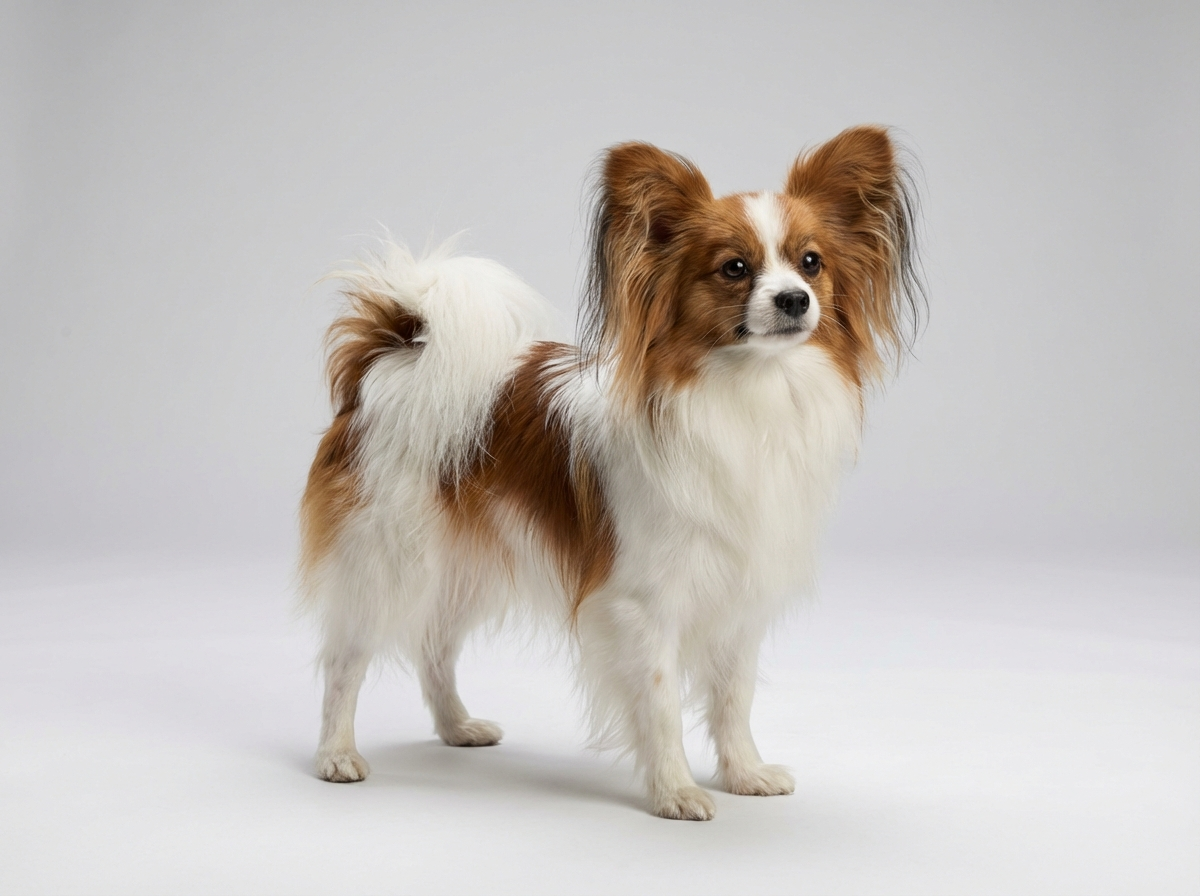
Toy breeds concentrate two separate murmur sources. Their valve connective tissue is prone to age related degeneration, so leaks develop in later life. And because small breeds have been selected for extreme size reduction, congenital plumbing faults such as a vessel that should close at birth but does not appear at a higher rate than in mid sized dogs. A Papillon at five to ten pounds sits inside both patterns.
Nothing an owner does creates a murmur, but plenty affects whether it is detected. Loud clinics, panting, a thick ruff of coat around the chest and a wriggling five pound dog all make soft sounds easy to miss. Practices that examine small dogs in a quiet room, before the dog has been excited by the waiting area, find grade one murmurs that a rushed exam does not.
Get an appointment promptly if a known murmur has grown louder, if your Papillon has begun coughing at night, or if it now stops on walks it used to finish. Seek emergency care immediately for collapse, fainting, open mouth breathing at rest, or gums that are pale, grey or blue. In a young Papillon, a loud murmur combined with poor growth or exercise intolerance is also urgent rather than routine, because some congenital defects have a limited window for correction.
See all Papillon health problems, which breeds are prone to heart murmurs, or the full Papillon breed guide for temperament, exercise needs and ownership costs.
A puppy murmur is usually resolved one way or the other by six months. An adult murmur commonly holds steady for two to five years before any grade change, and many never progress to the point of treatment. Expect a recheck rhythm rather than a cure.
Success is a documented grade history, an answer to the question of what is causing the sound, and a dog whose care team knows about it before anyone reaches for an anesthetic.
Veterinarians grade murmurs from one to six by loudness alone. Grade one is barely audible in a quiet room and often takes a minute of listening to find. Grade two is soft but obvious. Grade three is easily heard the moment the stethoscope lands. Grade four is loud. Grades five and six carry a palpable thrill, meaning you can feel the turbulence through the chest wall with a flat hand, and grade six is audible with the stethoscope lifted slightly off the coat.
Loudness correlates with severity, but only loosely. A grade five in a Papillon puppy with a congenital defect can matter more than a grade three in a twelve year old with slow valve change. Two other details from the same exam carry as much weight: where the sound is loudest, and whether it occurs while the heart contracts or while it fills.
A murmur loudest low on the left chest wall, over the mitral area, points at the valve most Papillons eventually leak through. One loudest higher and toward the front suggests an outflow tract problem, the pattern seen with congenital narrowing. A continuous washing machine sound that never stops is a hallmark of an abnormal vessel that should have closed at birth.
So the useful question at the desk is not just what grade, but where and when in the cycle.

Young hearts sometimes make noise for reasons that resolve. The mistake is assuming that outcome instead of checking for it.
Ilse picked up her Papillon puppy Fenn at nine weeks and took him for a first check two days later. The vet found a grade two murmur low on the left side and told her to come back in a month rather than panic. Ilse did not enjoy that month. At the next visit the murmur was grade one and harder to find. At sixteen weeks it was there only intermittently. At six months, in a quiet room with a calm puppy, it was gone. Fenn is now four and has been murmur free at every annual since. The breeder had told Ilse this happened in one of her previous litters, and the sequence matched exactly. What made the wait bearable was writing each finding down, because the trend across four exams was visibly heading in one direction long before the sound disappeared.
Key takeaway: In a Papillon puppy a soft murmur is often a growth phase artefact, but only a series of rechecks can prove it. Record every grade and let the trend, not a single visit, do the reassuring.
Yes, and it frequently does. Soft murmurs in growing puppies often reflect fast blood flow through a heart that is still proportioning itself, and they commonly fade by four to six months. That is why vets recheck rather than immediately image. A murmur that persists past six months is treated as real.
Any murmur of grade three or above deserves imaging regardless of age, and any murmur in a dog with symptoms deserves imaging regardless of grade. A grade one or two in an otherwise well adult Papillon is usually monitored rather than investigated straight away, with the grade rechecked in six months.
Ask the breeder to have the puppy examined by a cardiologist before you commit, and ask for the finding in writing. A soft physiologic murmur is a low concern. A loud murmur in a young puppy can indicate a structural defect, and that changes both the medical picture and the price conversation.
Not automatically and often not for years. Medication becomes appropriate at a defined stage, when imaging shows the heart chambers have enlarged past a threshold. Plenty of Papillons carry a stable grade two through the whole back half of their fourteen to sixteen year lifespan without ever starting a drug.
Apparent changes usually reflect the listening conditions rather than the heart. A panting, excited Papillon in a noisy room can hide a soft murmur. Fever, anaemia and dehydration can also change flow enough to alter what is heard. If two exams disagree, ask for a third in a quiet room.
It can, which matters because this breed needs regular dental work. Tell the practice about the murmur before booking, and expect them to want recent bloodwork and possibly imaging. Anesthetic protocols are routinely adjusted for cardiac patients, but only if the team knows in advance.
Soft but consistently audible. In an adult Papillon with no symptoms it is usually monitored with a recheck in about six months rather than investigated immediately.
An echocardiogram. It shows which valve or vessel is responsible and measures chamber size, which is what turns a sound into a stage.
The sound itself causes no discomfort. What may eventually affect the dog is the underlying leak, and that develops slowly enough to be tracked.
Yes. Ask for cardiac exam records on the parents and for any littermate findings. Good Papillon breeders keep and share this without being pushed.
A one-page prep sheet for this condition: the signs, the questions to ask, what to get priced. Unlocks here.
You get: Vet visit prep sheet
No spam. One-click unsubscribe. See our privacy policy.
Preview page 1 before you decide.