Health
What is the first sign of PRA?
Reluctance in dim light. A dog that will not go into a dark garden or hesitates at unlit stairs is showing night blindness, which is usually mistaken for stubbornness.

Quick answer
What is the first sign of PRA?
Reluctance in dim light. A dog that will not go into a dark garden or hesitates at unlit stairs is showing night blindness, which is usually mistaken for stubbornness.
Dogs go blind far better than their owners handle it, and a calm, steady breed like this one adapts remarkably well.
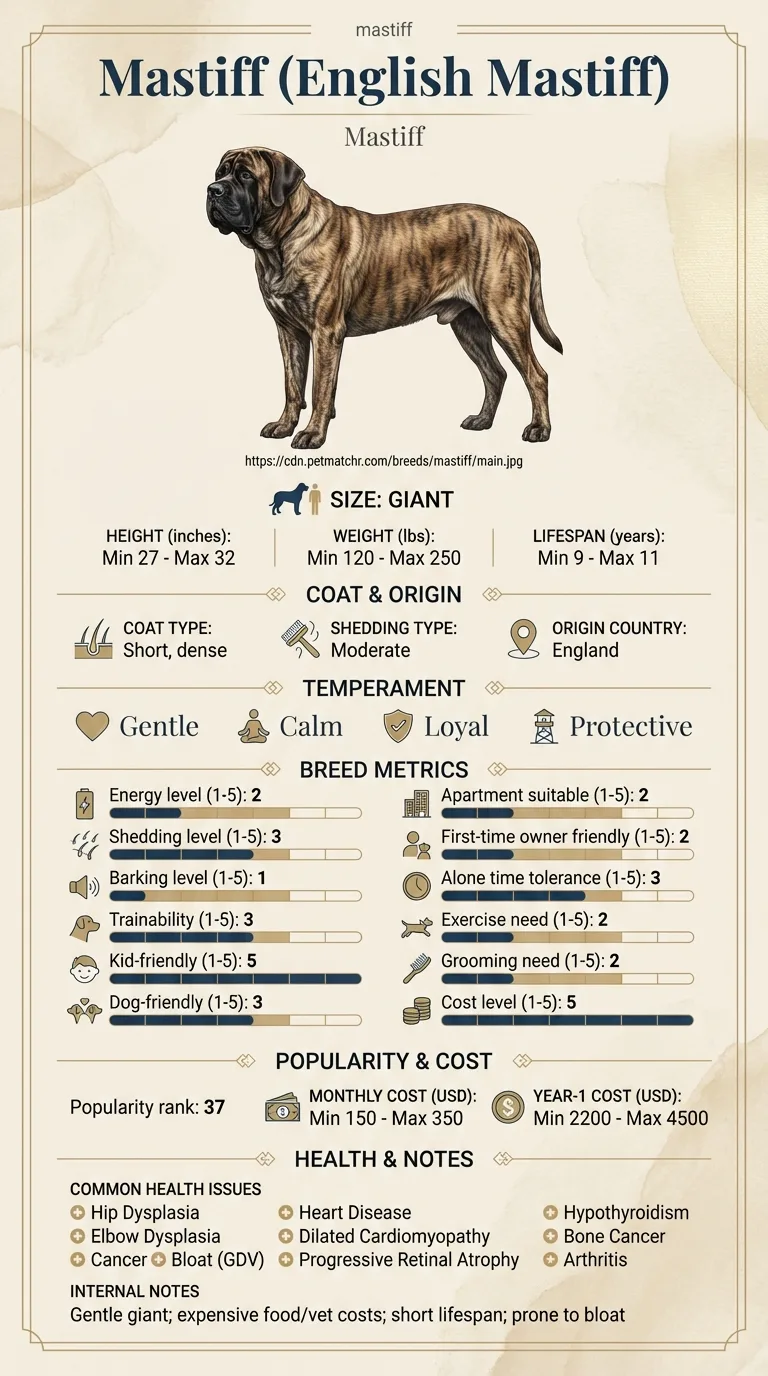
Owners who have noticed their Mastiff hesitating in the dark or bumping into things, and owners with a confirmed diagnosis who need to rearrange a household around a two-hundred-pound dog that cannot see.
This guide is not medical advice. If your dog shows pain, sudden behavior change, or worsening symptoms, consult a licensed veterinarian.
Some links may be affiliate links. We may earn a commission at no extra cost to you. We only suggest products we believe are helpful for dog owners.
We research and check what we publish, but we do not warrant that any figure, date, price, or statement is accurate, complete, or current, and we accept no liability for any loss, cost, injury, or other harm arising from the use of this site. Use it as one reference among several. You remain responsible for your own decisions and for your dog's care - confirm anything that matters with a licensed veterinarian or another qualified professional before you act on it. Full disclaimer.
Progressive retinal atrophy is an inherited degeneration of the retina that removes vision gradually and painlessly, affecting both eyes and starting with dim-light vision. It is documented among the Mastiff's health issues. There is no treatment, so the value of a diagnosis lies in explaining the dog's behaviour and in allowing a household to adapt while the dog still has partial sight to learn the new arrangement.
Progressive retinal atrophy appears explicitly on the Mastiff's documented list of common health issues, alongside conditions such as hip dysplasia, cancer and heart disease. It does not affect every dog in the breed, but it is common enough that breed eye screening is standard practice and that night-vision changes in an ageing Mastiff should prompt a specialist examination.
This is a genetic condition rather than a mechanical one, and its presence in Mastiffs is a matter of inheritance rather than anything to do with the breed's size or head shape. Progressive retinal atrophy is listed explicitly among the breed's documented health problems, which places it in the same category as hip dysplasia and cardiac disease as something responsible breeders screen for. Where the breed's size does become relevant is afterwards: a blind dog of 120 to 250 pounds standing 27 to 32 inches at the shoulder collides with objects at head height and cannot be lifted out of trouble.
Nothing in the environment causes retinal degeneration, and owners should not search for something they did wrong. Environment governs how well a dog copes. A house with a stable layout, gated stairs, textured floor cues and a fenced garden allows a blind Mastiff to move confidently. A house where furniture shifts, where objects are left in walkways, or where an unfenced drop exists in the garden turns the same condition into a source of injury and anxiety. Households that adapt early consistently report calmer dogs than those that wait for a crisis.
Book a specialist eye examination if your Mastiff has become hesitant in the dark, is bumping into objects, has pupils that look permanently wide, or startles when approached. A definite diagnosis matters, because several causes of vision loss are treatable and one is urgent. Seek same-day care instead for any eye that is red, cloudy, squinting or painful, for a pupil that suddenly differs from the other, for a visibly enlarged eye, or for vision that disappears over hours to days rather than months, since sudden painful vision loss can indicate raised pressure inside the eye and is an emergency.
See all Mastiff health problems, which breeds are prone to progressive retinal atrophy pra, or the full Mastiff breed guide for temperament, exercise needs and ownership costs.
Progression typically runs over months to a few years. Night vision goes first, often unnoticed for a considerable period, and daylight vision follows. Adaptation is quicker than the disease: most dogs navigate a stable, familiar home confidently within a few weeks of significant vision loss, and owners generally find the adjustment harder than the dog does. There is no treatment timeline, because there is no treatment.
Success is a dog who moves around the house confidently, walks happily on familiar routes, is not startled or anxious, and continues to enjoy food, company and rest. It is not preserved vision. Owners are often surprised by how completely a blind dog can return to a normal life, and by how little the dog appears to mourn what it has lost. In a breed described as gentle, calm and loyal, the temperament is genuinely on your side here.
The earliest change is usually reluctance in poor light. A dog that will not go into a dark garden, hesitates at the top of unlit stairs, or seems to lose track of you at dusk is describing night blindness, though almost no owner interprets it that way at the time. It is far more often filed under stubbornness or age.
As the condition progresses, daylight vision deteriorates too. Even then, dogs conceal it extremely well in familiar surroundings, navigating by memory, scent and sound. Owners commonly report that they only realised how much sight had gone when the furniture was moved, or when the dog was somewhere unfamiliar and suddenly seemed lost.
Other things become noticeable. Pupils may look permanently wide, and the eyes can develop a greenish or unusually bright reflection when light catches them. Some dogs bump into low objects specifically, because peripheral and low-level vision goes before central. Startling when approached from the side is common and is often mistaken for a temperament change.
Diagnosis is made by examination of the back of the eye, usually by a veterinary ophthalmologist, sometimes with an electrical test of retinal function. Where a genetic variant is known for a breed, DNA testing may also be available. A specialist examination also matters because it separates PRA from other causes of vision loss, some of which are treatable and some of which are urgent.
Adaptation works, and it works better if it starts while the dog still has some sight to learn the new layout with.

Lachlan first noticed something at his Mastiff Wilhelmina's seventh summer. She would go out at dusk without hesitation but planted herself at the back door once it was properly dark. He assumed she had been spooked by something, and for the best part of a year he simply put the outside light on. What changed his mind was a weekend away. In an unfamiliar cottage she walked into a coffee table twice in an afternoon, in broad daylight. The ophthalmologist confirmed progressive retinal atrophy, already well advanced. Lachlan felt he had missed a year. His vet pointed out that a year of treatment would not have existed, but a year of adaptation would have. So he adapted. Nothing in the house moved again. He gated the stairs, put a rough coir mat at the back door and a soft rug by her bed, and taught himself to say her name before every single touch. He taught her step and careful on walks. Within two months she was moving around the house so normally that guests did not realise she was blind. She lived to eleven.
Key takeaway: The refusal to go out after dark was the diagnosis, a year before anyone read it that way. Nothing could have saved Wilhelmina's sight, but the adaptations that made her confident again were all things that would have been easier to teach while she could still see them being set up.
No, and that is genuinely important. It is a degeneration rather than an inflammation, and affected dogs are comfortable throughout. If your Mastiff is squinting, holding an eye closed, or the eye is red, something else is going on and it needs same-day assessment rather than being attributed to PRA.
There is no established treatment that halts or reverses it. Be sceptical of supplements marketed as preserving vision in PRA, as evidence for them is weak. What genuinely helps is early diagnosis, so the household can adapt while the dog still has partial sight to learn the changes with.
It varies considerably, typically over months to a few years rather than weeks. Night vision goes first and daylight vision follows. Because dogs compensate so well at home, the perceived speed is often much faster than the actual progression, since owners notice a threshold rather than the decline itself.
Most do not, but startling is common and can be misread as aggression. A blind dog touched without warning may react defensively, which is a normal response rather than a temperament change. Consistently speaking before touching, and teaching visitors and children to do the same, prevents nearly all of it.
Sometimes it helps and sometimes it adds stress, and it depends heavily on the individual. This breed is only moderately dog-friendly, so introducing a new dog to a blind adult Mastiff is a significant decision. If your dog already lives with a settled companion, that relationship often does become a real navigational aid.
Ask whether both parents have had eye examinations by a veterinary ophthalmologist, with dates and certificates, and whether any DNA testing relevant to the breed has been done. Progressive retinal atrophy is documented in Mastiffs, so this is a reasonable and expected question rather than an awkward one.
The early signs are set out in the sections above, and they are the reason to book a veterinary appointment rather than wait. Progressive Retinal Atrophy (PRA) in Mastiffs is diagnosed by a vet, not from a symptom list, and the sooner it is on record the more options remain open.
The early signs are set out in the sections above, and they are the reason to book a veterinary appointment rather than wait. Progressive Retinal Atrophy (PRA) in Mastiff (English Mastiff)s is diagnosed by a vet, not from a symptom list, and the sooner it is on record the more options remain open.
Reluctance in dim light. A dog that will not go into a dark garden or hesitates at unlit stairs is showing night blindness, which is usually mistaken for stubbornness.
No. It is a painless degeneration. A squinting, closed or red eye means something else is wrong and needs same-day veterinary assessment.
No established treatment halts or reverses it. Early diagnosis matters because it lets the household adapt while the dog still has some sight to learn by.
Stop moving furniture. A blind dog navigates from a memorised map, and rearranging a room erases it. Tell visitors and family explicitly.
Speak the dog's name before approaching or touching, every single time, and teach visitors and children to do the same.
A one-page prep sheet for this condition: the signs, the questions to ask, what to get priced. Unlocks here.
You get: Vet visit prep sheet
No spam. One-click unsubscribe. See our privacy policy.
Preview page 1 before you decide.