Behavior
Which breed needs more exercise?
The Vizsla, rated very high (5/5) versus the Mastiff's low (2/5).

Quick answer
Which breed needs more exercise?
The Vizsla, rated very high (5/5) versus the Mastiff's low (2/5).
Mastiff (English Mastiff) or Vizsla? On paper they differ most on exercise need, and on the scales Mastiff (English Mastiff) is the heavier at 120–250 lbs. Here is how the two compare on everything that shapes an ordinary week.
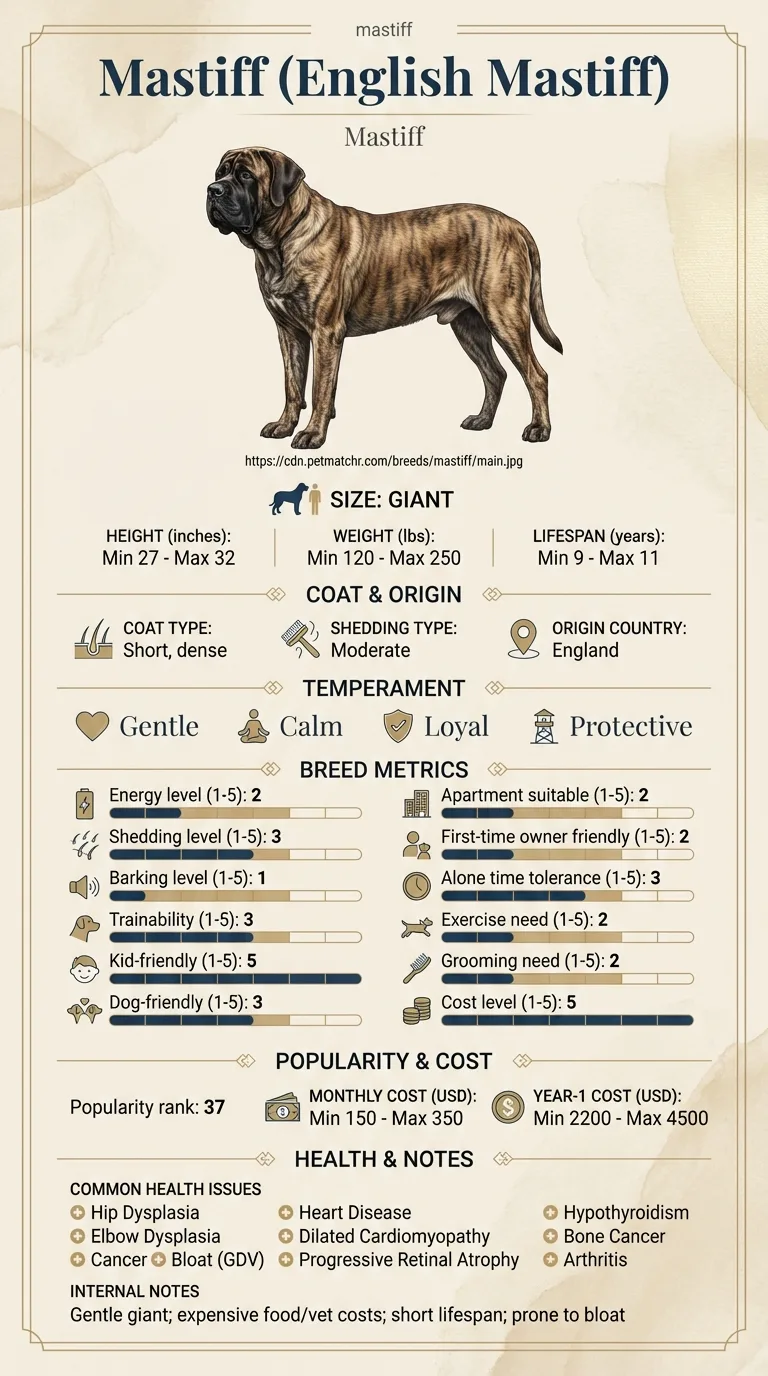
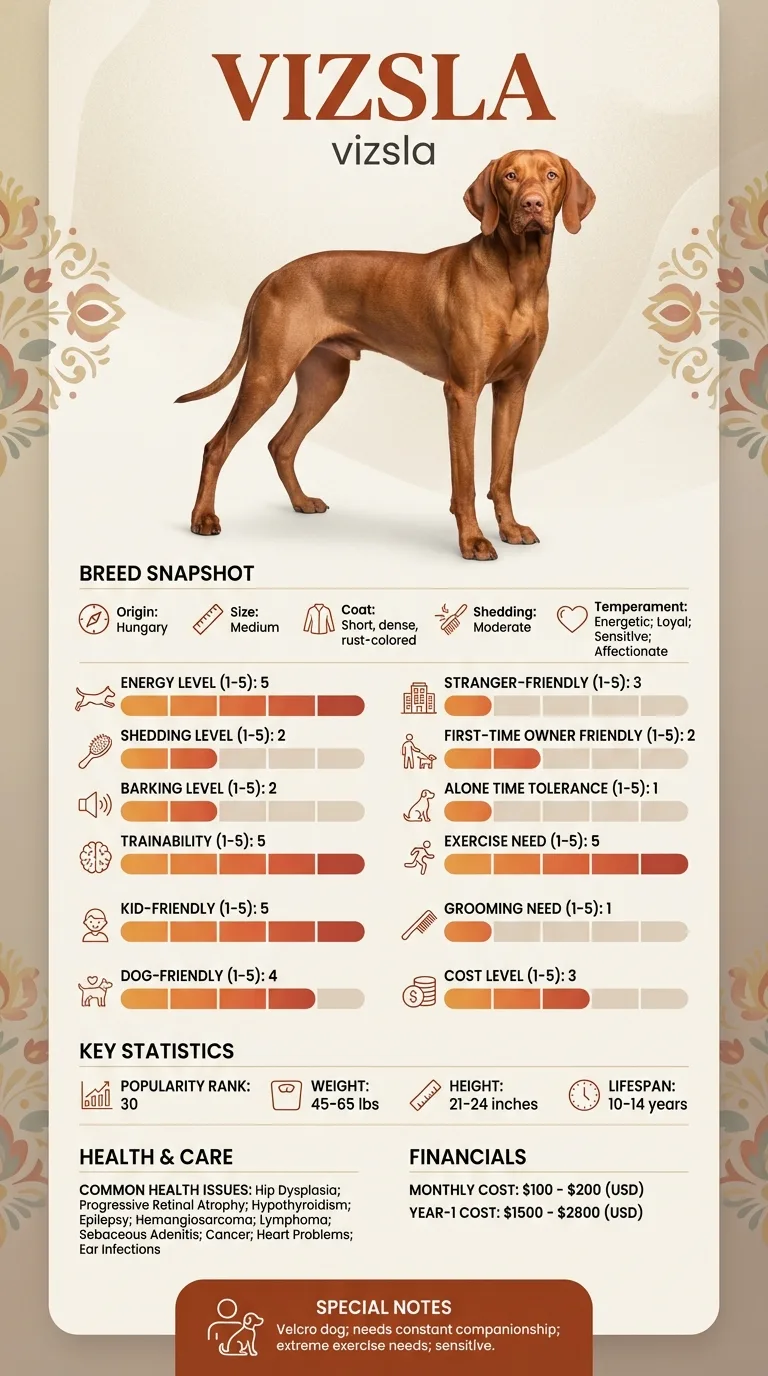
This is for someone already down to Mastiff (English Mastiff) and Vizsla and deciding between them. For this pair the decision usually turns on exercise need and energy level, so those are covered first and in most detail. Anyone choosing from a flat has a clear answer here: Mastiff (English Mastiff) rates 2/5 against 1/5. Breed history is left out; what follows is what you will actually live with.
Between Mastiff (English Mastiff) and Vizsla, exercise need is what separates them, and Mastiff (English Mastiff) is the lower-effort dog of the two to keep.
Choose Mastiff (English Mastiff) if your walking routine is modest and the dog will be alone during the working day.
Choose Vizsla if you do not want a standing grooming appointment, shedding is a problem in your house and you already have another dog.
| Feature | mastiff | vizsla | Winner |
|---|---|---|---|
| Size class | giant | medium | Equal |
| Weight | 120–250 lbs | 45–65 lbs | Equal |
| Height | 27–32 in | 21–24 in | Equal |
| Lifespan | 9–11 years | 10–14 years | vizsla |
| Exercise need | Low (2/5) | Very high (5/5) | mastiff |
| Grooming need | Low (2/5) | Very low (1/5) | vizsla |
| Shedding | Moderate (3/5) | Low (2/5) | vizsla |
| Energy level | Low (2/5) | Very high (5/5) | Equal |
| Barking | Very low (1/5) | Low (2/5) | mastiff |
| Apartment suitability | Low (2/5) | Very low (1/5) | mastiff |
| Good for first-time owners | Low (2/5) | Low (2/5) | Equal |
| Tolerates being alone | Moderate (3/5) | Very low (1/5) | mastiff |
| Trainability | Moderate (3/5) | Very high (5/5) | vizsla |
| Good with kids | Very high (5/5) | Very high (5/5) | Equal |
| Good with other dogs | Moderate (3/5) | High (4/5) | vizsla |
| Friendly to strangers | Moderate (3/5) | Moderate (3/5) | Equal |
| Cost level | Very high (5/5) | Moderate (3/5) | vizsla |
| Coat | Short, dense | Short, dense, rust-colored | Equal |
| Origin | England | Hungary | Equal |
| Typical monthly cost | $150–$350 | $100–$200 | Equal |
| Typical first-year cost | $2,200–$4,500 | $1,500–$2,800 | Equal |
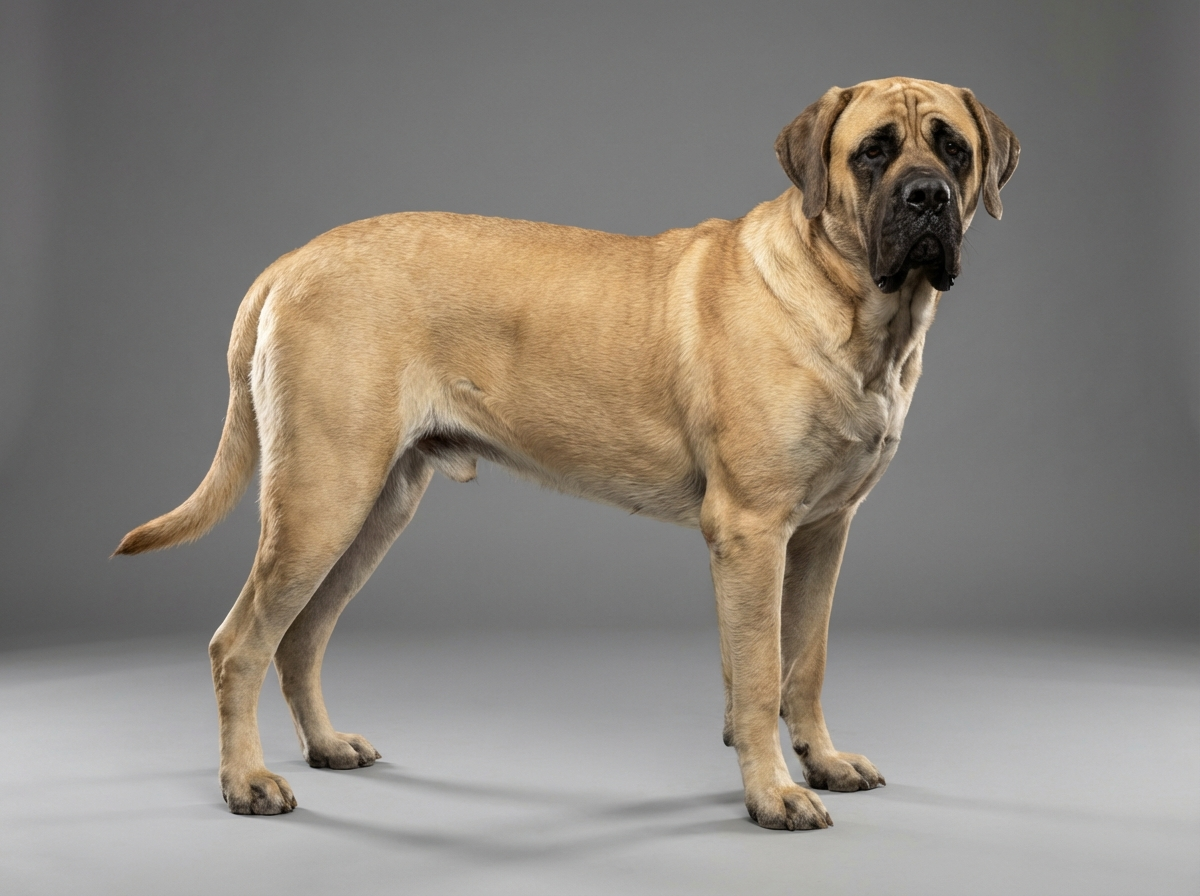
A Vizsla, at 45-65 pounds and 21-24 inches, is roughly a third the weight of a Mastiff's 120-250 pound range, though the height gap is smaller — the Mastiff stands just 3 to 8 inches taller at 27-32 inches. That relatively modest height difference against a huge weight difference tells you about build: the Vizsla is lean, athletic muscle built for running and pointing in the field, while the Mastiff is dense, heavy bone and mass built for guarding. A Vizsla can be lifted into a car by most adults; a Mastiff generally needs to walk itself up the ramp.
This pairing produces one of the starkest exercise contrasts in this comparison set: the Vizsla rates very high (5/5) for both exercise need and energy level, while the Mastiff rates low (2/5) on both. Known as 'velcro dogs' for their intense attachment to their owners, Vizslas need vigorous daily running or field work, not just a stroll, and get anxious or destructive without it. The Mastiff's giant-breed calm means moderate activity is genuinely enough. A runner or hunter looking for a tireless companion will find the Vizsla ideal and the Mastiff frustratingly sedentary; someone wanting a low-key housemate will find the reverse just as true.
Both breeds are easy on the grooming front relative to many others on this site, but the Vizsla edges ahead — very low (1/5) grooming need against the Mastiff's low (2/5) — and sheds less too, low (2/5) versus moderate (3/5). The Vizsla's short, dense, rust-colored coat needs almost no brushing beyond an occasional wipe-down, while the Mastiff's short coat sheds a bit more steadily and comes with more drool to manage. Neither breed demands the coat-care commitment of a long-haired dog. For an owner focused purely on minimizing brushing time, the Vizsla holds a slight edge, though the difference between these two is small compared to most other pairings.
Both breeds rate poorly for apartment life — very low (1/5) for the Vizsla, low (2/5) for the Mastiff — but for very different reasons. The Vizsla's very low (1/5) tolerance for being alone and intense exercise needs make confined living genuinely stressful for the dog, regardless of barking, which is rated low (2/5). The Mastiff barks even less, very low (1/5), but its sheer bulk simply doesn't fit comfortably in tight quarters. A Vizsla in a spacious house with an always-present owner could actually do fine despite the apartment score; a Mastiff in the same house still needs the square footage its size demands.
The Vizsla rates very high (5/5) for trainability, matching the top score on this site, driven by an eager, sensitive, biddable temperament that responds fast to positive reinforcement — though that same sensitivity means harsh corrections can backfire badly. The Mastiff sits at moderate (3/5), capable but less quick to pick up new commands. Oddly, neither breed rates well for first-time owners — Vizsla low (2/5), Mastiff also low (2/5) — a rare tie. The Vizsla's difficulty is intensity and neediness rather than stubbornness; the Mastiff's is sheer physical management. Both are best suited to owners with some prior dog experience rather than a true beginner.
Both breeds tie at very high (5/5) with kids, reflecting genuinely gentle natures despite their very different sizes and energy levels. The Vizsla edges ahead with other dogs, high (4/5) versus the Mastiff's moderate (3/5), consistent with its affectionate, loyal temperament extending readily to canine companions. Both land at moderate (3/5) with strangers, though the underlying reasons differ — the Vizsla's sensitivity can make it a touch reserved with unfamiliar people, while the Mastiff's protective instinct produces a watchful rather than instantly warm greeting. Families with an active, always-home lifestyle may thrive with the affectionate, high-energy Vizsla; those wanting a calmer guardian presence will lean toward the Mastiff.
The Vizsla's 10-14 year lifespan outpaces the Mastiff's 9-11, though its ten-condition health list carries serious cancer risk — hemangiosarcoma and lymphoma both appear by name alongside general cancer risk, making it a breed where cancer screening deserves real attention. The Mastiff's list similarly includes cancer and bone cancer, plus giant-breed staples like bloat, dilated cardiomyopathy, and hip dysplasia. Both breeds share hip dysplasia, hypothyroidism, and PRA. Neither list is short or reassuring, but the Vizsla's slightly longer expected lifespan combined with its lower body mass may mean a somewhat gentler physical toll over the same years, even with comparable disease risk.
Cost level rates very high (5/5) for the Mastiff against moderate (3/5) for the Vizsla, and the dollar ranges track closely — $150-$350 monthly and $2,200-$4,500 first-year for the Mastiff, versus $100-$200 monthly and $1,500-$2,800 for the Vizsla. As with most Mastiff comparisons on this site, food volume tied to its enormous size drives most of the difference, since a Mastiff can outweigh a Vizsla by 150 pounds or more. Grooming costs stay low for both breeds given their short coats. Over a typical decade of ownership, the Vizsla is meaningfully the more affordable of the two to feed and maintain.
Mastiff (English Mastiff) weighs 120–250 lbs and lives 9–11 years; Vizsla weighs 45–65 lbs and lives 10–14 years. The two diverge most on exercise need, energy level and tolerates being alone and 2 other rated axes. They are level on good for first-time owners, good with kids and friendly to strangers, so those cannot decide it. The comparison marks an easier option only where one exists. Facts like weight and country of origin are not scored. Both dogs are rated from the same dataset, which is what makes the numbers comparable with each other even though any individual dog sits somewhere inside its breed's range.

Not really, despite its athletic build — it rates very low (1/5) for apartment suitability and very low (1/5) for tolerating being alone, needing a lot of exercise and near-constant companionship.
The Vizsla, rated very high (5/5) for trainability against the Mastiff's moderate (3/5), thanks to an eager, sensitive temperament that responds well to positive reinforcement.
They're prone to it — rated very low (1/5) for tolerating being alone, the lowest score available, a reflection of their intensely loyal, affectionate 'velcro dog' reputation.
The Vizsla, rated low (2/5) versus the Mastiff's moderate (3/5), though both are relatively easy-care, short-coated breeds compared to most others.
Their health list specifically names hemangiosarcoma and lymphoma alongside general cancer risk, making cancer a meaningful concern for the breed despite its otherwise athletic build.
The Vizsla, at roughly $1,500-$2,800 in its first year versus the Mastiff's $2,200-$4,500, largely due to the Mastiff's much greater food volume.
Both tie at very high (5/5) with kids. The Mastiff offers calm patience despite its size, while the Vizsla brings an affectionate, playful energy — either can work well in a family with appropriate supervision.
The Vizsla, rated very high (5/5) versus the Mastiff's low (2/5).
The Vizsla, rated very high (5/5) versus the Mastiff's moderate (3/5).
The Mastiff, up to 250 lbs versus the Vizsla's 65 lbs.
The Vizsla, at 10-14 years versus the Mastiff's 9-11 years.
Secure checkout on Stripe. We never see your card.
7-day money-back guarantee. Instant access.
Health information here is general and is not veterinary advice. If your dog shows pain, sudden behaviour change, or worsening symptoms, consult a licensed veterinarian.
Some links on this site are affiliate links. We may earn a commission at no extra cost to you, and we only suggest products we believe are helpful for dog owners.
We research and check what we publish, but we do not warrant that any figure, date, price, or statement is accurate, complete, or current, and we accept no liability for any loss, cost, injury, or other harm arising from the use of this site. Use it as one reference among several. You remain responsible for your own decisions and for your dog's care - confirm anything that matters with a licensed veterinarian or another qualified professional before you act on it. Full disclaimer.
Match your lifestyle to the right dog.
Take quizNot sure which breed is right for you? Take our 2-minute quiz to find out.
Take the quiz