Costs
What's the single most expensive claim category for Labradors?
Cancer treatment tends to generate the highest per-claim costs, even though it occurs less frequently than orthopedic or skin claims.

Quick answer
What's the single most expensive claim category for Labradors?
Cancer treatment tends to generate the highest per-claim costs, even though it occurs less frequently than orthopedic or skin claims.
Knowing which conditions actually generate claims — not just which ones sound scary — is the difference between choosing a policy that covers what your dog is statistically likely to need and one that looks comprehensive on paper but leaves gaps exactly where a Lab tends to have problems.
New owners comparing insurance quotes without knowing what to weigh them against, and current owners deciding whether a higher premium with lower orthopedic exclusions is actually worth it for this specific breed.
This guide is not medical advice. If your dog shows pain, sudden behavior change, or worsening symptoms, consult a licensed veterinarian.
Some links may be affiliate links. We may earn a commission at no extra cost to you. We only suggest products we believe are helpful for dog owners.
We research and check what we publish, but we do not warrant that any figure, date, price, or statement is accurate, complete, or current, and we accept no liability for any loss, cost, injury, or other harm arising from the use of this site. Use it as one reference among several. You remain responsible for your own decisions and for your dog's care - confirm anything that matters with a licensed veterinarian or another qualified professional before you act on it. Full disclaimer.
Pet insurance claims data for Labrador Retrievers consistently highlights orthopedic conditions, skin allergies, cancer, and gastrointestinal issues including bloat as the categories driving the majority of claim volume and dollars. Understanding this pattern helps owners choose coverage that actually matches what this breed is statistically likely to need, rather than comparing policies on premium alone.
These claim patterns are consistent enough across insurers that they're treated as a known characteristic of the breed's overall health profile, though any individual dog's actual claims history depends heavily on genetics, weight management, and luck.
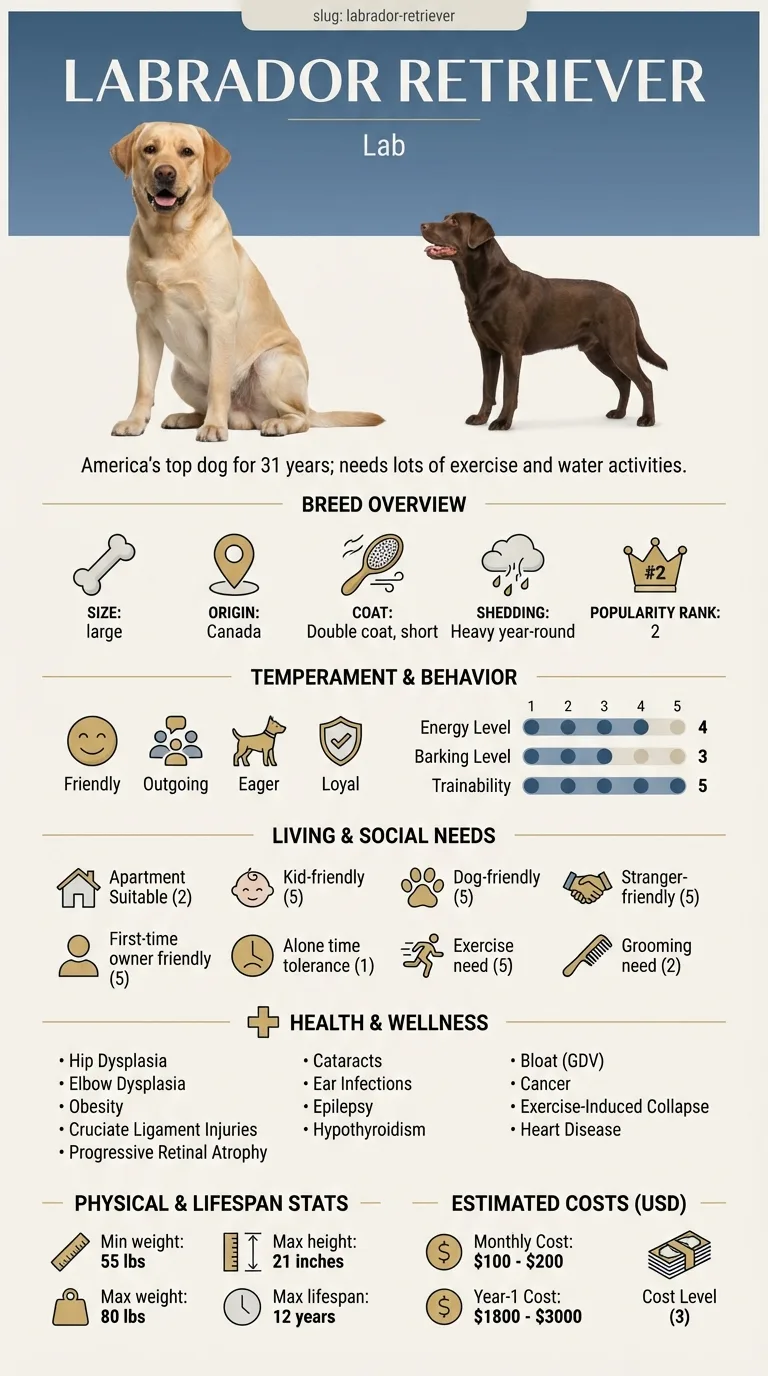
As a large, active breed weighing 55 to 80 pounds with high exercise drive, Labradors put real cumulative stress on joints, which shows up in claims data as elevated orthopedic surgery costs relative to smaller, less active breeds. Their documented predisposition toward certain cancers and skin allergy patterns further shapes which categories dominate claims data specifically for this breed.
How a policy is used also reflects owner behavior — obesity, under-conditioning before intense exercise, and delayed vet visits for early symptoms can all increase the severity, and therefore cost, of conditions that eventually get claimed, on top of whatever baseline breed risk exists.
This is primarily a financial planning topic rather than a medical one, but ask your vet which conditions they see most often in Labradors at their specific practice — local caseload can add useful color on top of national claims data when deciding what coverage matters most to you.
See all Labrador Retriever health problems, which breeds are prone to insurance claims, or the full Labrador Retriever breed guide for temperament, exercise needs and ownership costs.
Choosing and comparing policies is typically a one-time or occasional research task, ideally done before your dog turns two, while premiums are lower and no conditions have been diagnosed yet that could become excluded.
Success looks like a policy that would actually cover the conditions this breed statistically develops most, at a payout limit that meaningfully offsets a real orthopedic or cancer bill — not necessarily the cheapest premium on the market.
Orthopedic conditions — hip dysplasia, cruciate ligament injuries, elbow dysplasia — are consistently among the highest-cost claim categories for large, active breeds like Labradors, both because they're relatively common in the breed and because treatment, especially surgical treatment, is expensive. Skin conditions, including allergies and related infections, tend to generate a high volume of smaller claims rather than a few large ones, since they're often managed with recurring vet visits and medication rather than one big procedure.
Cancer is a smaller number of claims but a disproportionately large share of total dollars paid, since oncology treatment — surgery, chemotherapy, radiation — runs into the thousands of dollars per case. Gastrointestinal issues, including pancreatitis and bloat, round out the other major category, and bloat specifically is one of the few true emergency surgical conditions that can generate a single claim in the multiple thousands of dollars.
What this pattern actually means for a policy decision is that orthopedic coverage and a reasonable annual or per-incident limit matter more for a Labrador than, say, dental coverage would — not because dental issues don't happen, but because they're rarely what drains a policy's limit for this specific breed.

Given what tends to drive claims in this breed, here's what's worth scrutinizing in the fine print rather than just comparing headline premiums.
Two years after buying a budget pet insurance policy for her Lab, Ranger, Elena filed a claim when he tore his cruciate ligament chasing a frisbee. The surgery cost $4,200. Her policy reimbursed only $1,500 because orthopedic conditions had a separate, lower annual sub-limit she hadn't noticed when she signed up, focused instead on the low monthly premium advertised. When shopping for her next Lab puppy's policy a year later, Elena specifically compared orthopedic sub-limits across three insurers before choosing, even though it meant a higher monthly premium than her first policy.
Key takeaway: The headline premium tells you very little about whether a policy will actually cover the conditions this breed is statistically most likely to need — the sub-limits and exclusions in the fine print matter far more.
Orthopedic conditions like hip dysplasia and cruciate ligament injuries, skin allergies and related infections, cancer, and gastrointestinal issues including bloat are consistently among the top claim categories for this breed.
Given that this breed carries real orthopedic and cancer risk with high treatment costs, many owners find insurance worthwhile, particularly a policy purchased while the dog is young and healthy, before any condition becomes a pre-existing exclusion.
It depends on the policy and when it was purchased — many insurers cover it if the policy started before any symptoms or diagnosis, but exclude it if there's a documented pre-existing condition or breed-specific waiting period.
Surgical repair for a cruciate ligament tear commonly runs $3,000–$6,000 per knee, making it one of the more expensive single-incident claims filed for this breed.
Buying while your Lab is young and has no diagnosed conditions is generally the best strategy, since almost all policies exclude pre-existing conditions and this breed can develop orthopedic or skin issues by early adulthood.
Routine wellness care like vaccines and annual exams usually requires a separate add-on, pre-existing conditions are excluded, and some policies cap orthopedic or cancer payouts at a lower sub-limit than the general annual limit.
Monthly premiums for accident and illness coverage commonly range from $35–$65 depending on age, deductible, and coverage limit, generally increasing as the dog gets older.
Cancer treatment tends to generate the highest per-claim costs, even though it occurs less frequently than orthopedic or skin claims.
As early as possible, ideally as a puppy, since pre-existing conditions are excluded from coverage once diagnosed.
Most accident and illness policies cover bloat surgery if purchased before any diagnosis, and it's one of the more expensive single-incident emergency claims.
Roughly $35–$65 a month for accident and illness coverage, depending on age, deductible, and payout limit chosen.
Generally yes for illness coverage, though they tend to generate frequent smaller claims rather than one large payout.
A one-page prep sheet for this condition: the signs, the questions to ask, what to get priced. Unlocks here.
You get: Vet visit prep sheet
No spam. One-click unsubscribe. See our privacy policy.
Preview page 1 before you decide.