Costs
What health costs are most likely for this breed?
Orthopedic issues, eye conditions, and ongoing management costs for allergies and hypothyroidism are the most relevant categories.

Quick answer
What health costs are most likely for this breed?
Orthopedic issues, eye conditions, and ongoing management costs for allergies and hypothyroidism are the most relevant categories.
The goal here is matching a policy to what this breed's real risk profile actually looks like, not guessing.
New Aussie owners comparing pet insurance policies for the first time, and current owners surprised by a claim denial they didn't expect.
This guide is not medical advice. If your dog shows pain, sudden behavior change, or worsening symptoms, consult a licensed veterinarian.
Some links may be affiliate links. We may earn a commission at no extra cost to you. We only suggest products we believe are helpful for dog owners.
We research and check what we publish, but we do not warrant that any figure, date, price, or statement is accurate, complete, or current, and we accept no liability for any loss, cost, injury, or other harm arising from the use of this site. Use it as one reference among several. You remain responsible for your own decisions and for your dog's care - confirm anything that matters with a licensed veterinarian or another qualified professional before you act on it. Full disclaimer.
Pet insurance claims for Australian Shepherds tend to concentrate in two categories tied directly to this breed's documented health profile: orthopedic conditions like hip and elbow dysplasia, and eye conditions requiring specialist care, alongside smaller but recurring claims from lifelong-management issues like allergies and hypothyroidism. Understanding this pattern helps owners evaluate a policy's hereditary-condition coverage and waiting periods realistically before they need them.
This isn't a medical statistic but a financial-planning pattern; the categories described here reflect this breed's documented common health issues rather than a specific claims-frequency figure, since precise claims data varies by insurer and region.
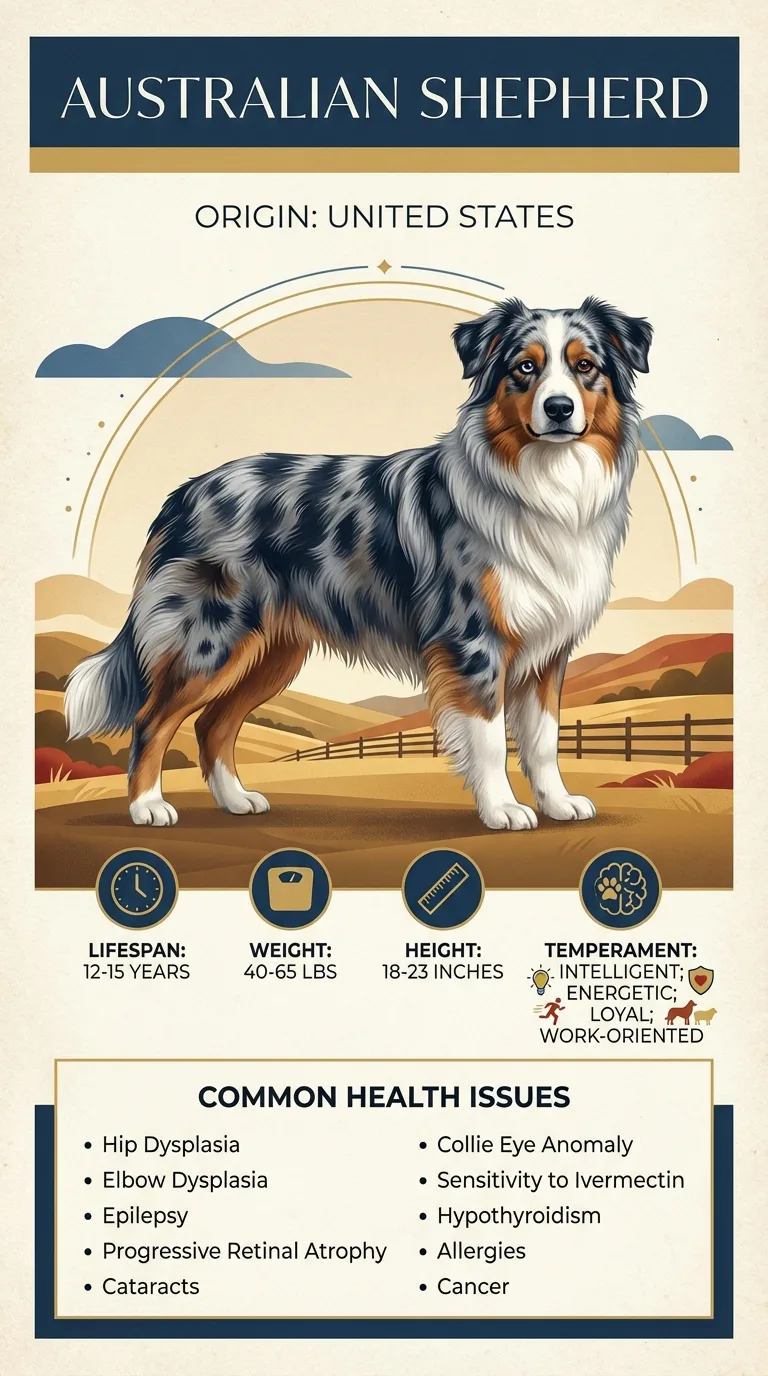
This breed's documented common health issues — orthopedic conditions, eye conditions, hypothyroidism, allergies, and cancer — directly shape which categories of veterinary cost are most likely to arise over a dog's lifetime, and therefore which categories tend to generate insurance claims.
An active lifestyle involving hard herding, sport, or working activity can increase the likelihood of orthopedic injury or accelerate wear on joints already predisposed to dysplasia, which can influence both the timing and frequency of related claims.
This is a financial planning topic rather than a medical one, so a vet isn't the primary resource for policy comparison, though your vet can help you understand which documented conditions are most relevant to discuss with an insurer for your specific dog.
See all Australian Shepherd health problems, which breeds are prone to insurance claims, or the full Australian Shepherd breed guide for temperament, exercise needs and ownership costs.
Policy comparison and enrollment can typically be completed within a single sitting, though waiting periods before certain conditions are covered can range from a couple of weeks to six months or more depending on the condition and insurer.
Success looks like a policy that genuinely covers this breed's most likely risk categories — hereditary orthopedic and eye conditions especially — chosen based on informed comparison rather than premium price alone, so a real claim doesn't come with an unpleasant surprise.
Given this breed's documented health profile — hip and elbow dysplasia, eye conditions like progressive retinal atrophy and cataracts, hypothyroidism, allergies, and cancer — two broad categories tend to be the real cost drivers over a dog's lifetime. Orthopedic issues, especially hip and elbow dysplasia, can generate significant one-time or recurring costs, from diagnostic imaging to ongoing joint support to, in some cases, surgery. Eye conditions can involve specialist ophthalmology referrals that are considerably more expensive than a routine vet visit.
Separately, lifelong-management conditions like allergies and hypothyroidism tend to generate smaller but genuinely recurring claims — ongoing bloodwork, prescription diets, medication — rather than one large expense. Cancer, when it occurs, can involve some of the largest single-condition costs a dog owner faces, from diagnostics through treatment. None of this is a guarantee about what will happen to any individual dog, but it's a reasonable picture of where the actual financial risk in owning this breed tends to concentrate.
Given that orthopedic and hereditary eye conditions are a real, documented risk category for this breed, the single most important thing to check in any policy is how it treats hereditary and congenital conditions — some policies exclude them entirely, some cover them only with an add-on, and some cover them fully as standard. It's also worth checking waiting periods (the time after enrollment before certain conditions are covered) and whether orthopedic conditions specifically carry a longer waiting period than the general policy, which many insurers apply given how commonly they're claimed across active breeds.
A cheaper policy that excludes hereditary conditions may end up being a poor value specifically for a breed whose most likely major expenses are hereditary or congenital in nature. Reading the exclusions list carefully, and asking directly about hip and eye condition coverage before enrolling, is worth more than comparing headline premium prices alone.

If you think your Aussie has insurance claims, the plan is three steps: write down what you have seen and when it started, book a veterinary appointment rather than waiting for the next flare, and take video of the behaviour or symptom before you go — the thing you are worried about rarely happens in the consulting room. Screening in the parents covers hip dysplasia, elbow dysplasia, epilepsy.
What the vet visit should produce is a diagnosis and a written plan, not just reassurance: what is being ruled out, what the monitoring interval is, and which signs mean you come back sooner. Ask what the treatment costs across a year rather than per visit, because that is the number that decides whether you are managing this condition or reacting to it.
Between appointments, keep a short log — dates, what you saw, what changed. It is the single most useful thing an owner brings to a follow-up, and for insurance claims it is often what separates a clear pattern from a guess.
When their three-year-old Aussie, Diesel, was diagnosed with hip dysplasia requiring surgery, the Ramirez family submitted a claim to the budget pet insurance policy they'd enrolled him in as a puppy, expecting it to cover a meaningful portion of the cost. The claim was denied. Reading the fine print more carefully afterward, they discovered their policy classified hip dysplasia as a hereditary condition excluded from coverage entirely, something they hadn't noticed when comparing plans mainly by monthly premium two years earlier. After paying for the surgery out of pocket, they switched Diesel to a different insurer for future coverage, this time reading the hereditary-condition section first and confirming hip and eye coverage explicitly with the new company before enrolling.
Key takeaway: The cheapest policy on paper can turn out to be the most expensive one in practice if it excludes exactly the category of condition this breed is actually most likely to need covered — reading the exclusions list is worth more than comparing premiums alone.
Orthopedic issues like hip and elbow dysplasia, eye conditions requiring specialist care, and ongoing management costs for conditions like allergies and hypothyroidism tend to be the most relevant categories, based on this breed's documented health profile.
Yes — this is one of the most important things to check, since several of this breed's most likely major expenses (hip dysplasia, certain eye conditions) are hereditary or congenital in nature, and some policies exclude these by default.
It's the time after enrolling before certain conditions become eligible for coverage. Many insurers apply a longer waiting period specifically for orthopedic conditions, which matters given how commonly they're claimed for active breeds like this one.
Generally, no — pre-existing conditions are typically excluded from coverage once diagnosed, which is why enrolling while a dog is young and healthy is usually the most financially advantageous time to do so.
This varies by policy — some cover chronic, recurring conditions fully once initially covered, while others impose annual limits that can be used up faster by a condition needing frequent smaller claims rather than one large one.
Yes — cancer is documented as a common health issue for this breed and can involve some of the largest single-condition costs, making comprehensive cancer coverage worth confirming explicitly rather than assuming it's included.
This depends on individual financial circumstances and risk tolerance, but given this breed's documented orthopedic, eye, and other health risks, insurance can meaningfully offset costs that are more likely than average to occur over a dog's lifetime.
Orthopedic issues, eye conditions, and ongoing management costs for allergies and hypothyroidism are the most relevant categories.
How it treats hereditary and congenital conditions, since several of this breed's likely major expenses fall into that category.
The time after enrollment before certain conditions become eligible for coverage, often longer for orthopedic issues.
Generally no — pre-existing conditions are typically excluded once diagnosed.
Yes — cancer is documented as a common health issue for this breed and can be one of the largest single expenses.
A one-page prep sheet for this condition: the signs, the questions to ask, what to get priced. Unlocks here.
You get: Vet visit prep sheet
No spam. One-click unsubscribe. See our privacy policy.
Preview page 1 before you decide.