Costs
Labrador Retriever cost in Denver
About $115–$225/month, $1,800–$3,050 for year one — above average, with a real conditioning habit worth building before demanding foothills hikes given this breed's documented joint risk.

See Labrador Retriever price across all cities →
Quick answer
Labrador Retriever cost in Denver
About $115–$225/month, $1,800–$3,050 for year one — above average, with a real conditioning habit worth building before demanding foothills hikes given this breed's documented joint risk.
A Labrador Retriever in Denver costs about $115–$225 a month, with the first year around $1,800–$3,050 — above the national average, and worth a real conditioning approach before jumping straight into Denver's popular foothills hikes, given how demanding sudden elevation gain can be on this breed's documented cruciate ligament risk.
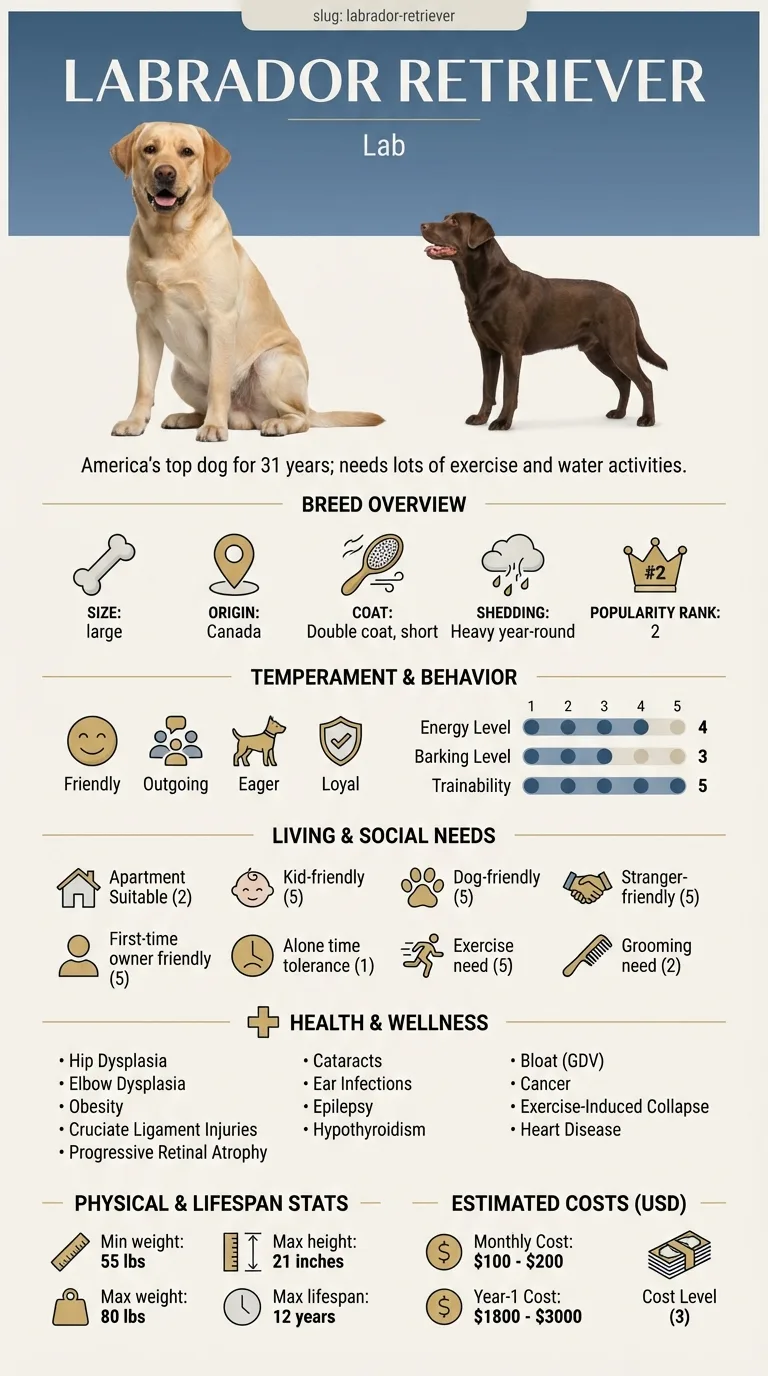
Cruciate ligament injuries are a well-documented, common orthopedic issue in this breed, often requiring surgery in the $3,000–$5,000 range. Bloat (GDV) is the separate, sudden emergency risk given this breed's deep chest — no warning, immediate surgery needed.
These figures reflect Denver's above-national-average mountain-town pricing, with a note on the real, low-cost value of gradual conditioning before demanding foothills hikes.
Estimate · source: estimation · confidence: medium · updated 2026-09-05 · not a quote
| Item | Cost range |
|---|---|
One-time setup (initial vet visit, spay/neuter, gear) Covers the first exam, vaccinations, spay/neuter if needed, and basic gear — priced at Denver's above-average rates. | $365 - $615 |
| Item | Cost range |
|---|---|
Food Above the national average, consistent with Denver's mountain-town price level; this breed's large size and documented obesity risk make portion control worth watching closely. | $52 - $98 |
Grooming (short double coat) Genuinely low compared to a longer-coated breed, priced at Denver's above-average rates, though this breed's documented heavy shedding means frequent brushing at home matters more. | $20 - $45 |
Each range starts from a national baseline for this breed's size class and is then adjusted for local cost of living and veterinary pricing. The baselines, and the source each one came from, are listed on our sources page (dataset 2026.09). Two inputs, the purchase price and the emergency reserve, have no published national figure we could verify, so we leave them to you rather than invent them.
These are planning estimates, not quotes. Your own numbers will move with the individual dog, your vet and your insurer. Build a budget with your own figures.
For a Labrador Retriever in Denver, insurance is worth taking seriously given the breed's extensive documented health risk list, on top of the region's above-average general pricing.
This breed's real cruciate ligament injury and bloat statistics make insurance worth locking in early — a policy bought before any diagnosis covers costs a self-funded emergency fund alone often can't stretch to match, more relevant still for a genuinely active weekend-hiking household.
Owners with a solid emergency fund and the discipline to leave it untouched for anything but a genuine vet emergency can reasonably self-insure instead.
Denver's above-average costs are real, but a simple conditioning habit is a genuinely low-cost way to protect this breed's joints on the trail.
Cruciate ligament tears rank among the most commonly documented injuries in this breed, and the specific strain pattern that tends to cause them, sudden, hard directional stops and twists, shows up a lot on the steep, uneven terrain of Denver's popular foothills trails. A dog that's mostly sedentary during the week and then goes straight into a demanding weekend hike carries real, avoidable extra risk compared to one with a gradually built-up base fitness level.
Building toward longer, steeper hikes over several weeks rather than treating every weekend as a maximum-effort outing is a genuinely low-cost way to reduce that risk.
That's worth factoring into Denver's already above-average general pricing for vet care and pet services, consistent with a mountain-town market that runs a little higher than the Midwest average across most categories.

A Denver Labrador Retriever owner treated most weeks as rest days before an ambitious foothills hike every Saturday, assuming the dog's natural energy meant it was always ready for a hard trail. A sudden hind-leg limp partway through one hike turned out to be a torn cruciate ligament, requiring surgery and months of recovery. A gradual, week-by-week conditioning plan for the following season kept the dog injury-free through a full summer of increasingly demanding hikes.
Key takeaway: In Denver specifically, this breed's real cruciate ligament risk is worth managing with gradual conditioning before the city's genuinely demanding foothills trails, not assumed away by natural energy alone.
About $115–$225, above the national average, consistent with Denver's genuinely above-average mountain-town pricing for vet care and pet services.
Roughly $1,800–$3,050, including the initial vet exam, spay/neuter if needed, and gear on top of ongoing monthly costs.
A sudden jump from a sedentary week straight into a demanding foothills hike carries real, avoidable extra strain — building up fitness gradually over several weeks is a genuinely low-cost way to reduce that risk.
Denver's mountain-town market runs genuinely above the Midwest average for vet care and pet services, and this breed's extensive documented health risk list adds to that.
Worth pricing out given this breed's extensive documented health risks, including cruciate ligament injuries and bloat, bought while the dog is young and before anything is on record.
Around $840 covers a typical significant vet visit in this market, reflecting Denver's above-average general pricing.
About $115–$225/month, $1,800–$3,050 for year one — above average, with a real conditioning habit worth building before demanding foothills hikes given this breed's documented joint risk.
This guide is not medical advice. If your dog shows pain, sudden behavior change, or worsening symptoms, consult a licensed veterinarian.
Some links may be affiliate links. We may earn a commission at no extra cost to you. We only suggest products we believe are helpful for dog owners.
We research and check what we publish, but we do not warrant that any figure, date, price, or statement is accurate, complete, or current, and we accept no liability for any loss, cost, injury, or other harm arising from the use of this site. Use it as one reference among several. You remain responsible for your own decisions and for your dog's care - confirm anything that matters with a licensed veterinarian or another qualified professional before you act on it. Full disclaimer.
One sheet with every line item, the emergency fund and when insurance pays off - unlocks on this page.
You get: 12-month budget sheet
No spam. One-click unsubscribe. See our privacy policy.
Preview page 1 before you decide.