DogBreedCompass
← Back to breed profile

Structural Heart Problems in Labrador Retrievers: What Congenital Screening Catches

Quick answer

What causes sudden collapse in a young, healthy-looking Lab?

A congenital heart defect like subvalvular aortic stenosis is one possible cause, especially if collapse happens during or right after intense exercise — it warrants an immediate vet visit.

A congenital narrowing below the aortic valve forces the heart to pump against extra resistance every single beat, for the dog's entire life, and in severe cases the first symptom is sudden collapse during exercise.

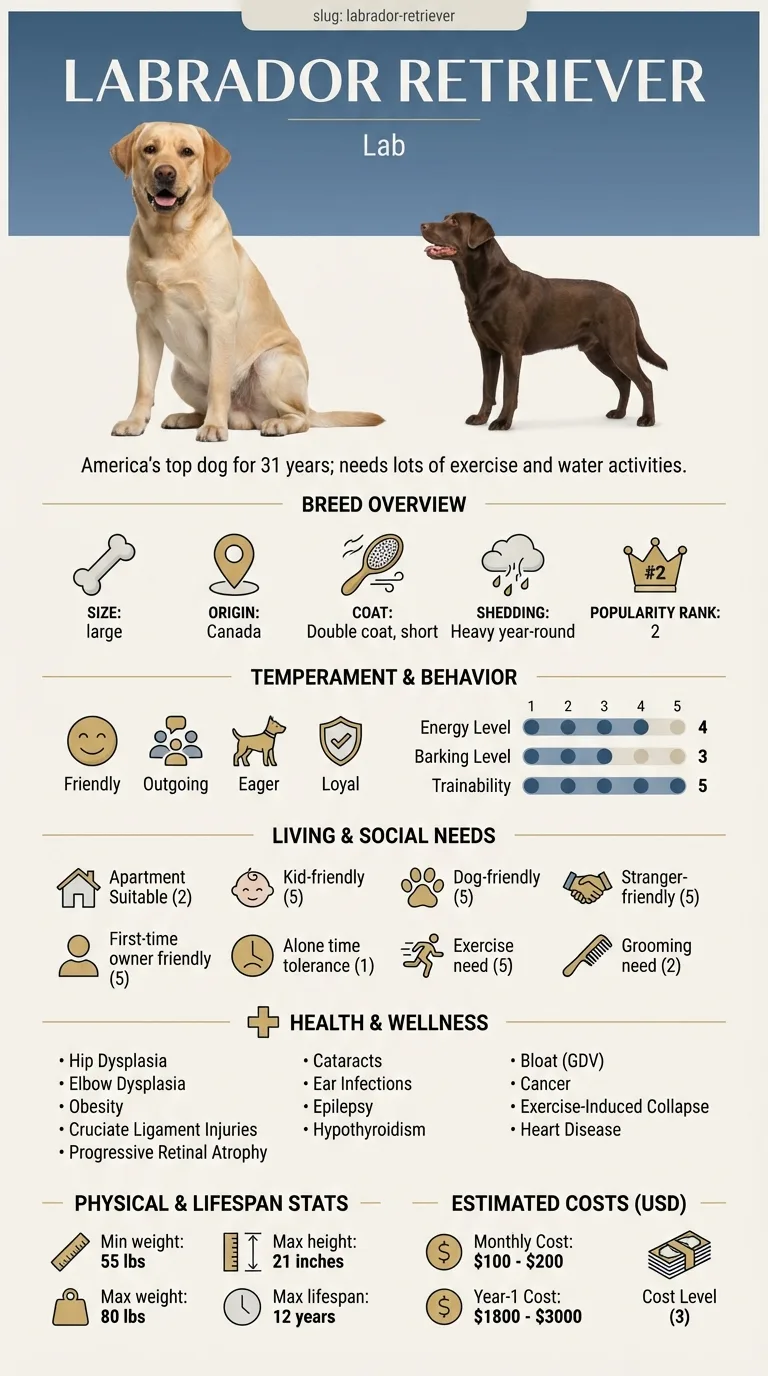
Structural Heart Problems in Labrador Retrievers: What Congenital Screening Catches infographic

Prospective puppy buyers deciding whether to ask a breeder for cardiac clearance, and owners of young, athletic Labs who've had an unexplained fainting episode during a hard play session.

Important reminder

This guide is not medical advice. If your dog shows pain, sudden behavior change, or worsening symptoms, consult a licensed veterinarian.

Some links may be affiliate links. We may earn a commission at no extra cost to you. We only suggest products we believe are helpful for dog owners.

What this problem looks like

Structural heart problems in Labrador Retrievers most often refer to congenital defects like subvalvular aortic stenosis, a narrowing below the aortic valve present from birth. Unlike age-related valve disease, these are structural and can only be reliably diagnosed with an echocardiogram, which is why breeder screening plays such a central role in prevention.

Common triggers

  • Inherited genetic predisposition from breeding parents
  • Congenital tissue abnormality present from birth, not acquired later
  • High-intensity exercise in an undiagnosed dog revealing the defect through collapse
  • Lack of cardiologist-performed echocardiogram screening in breeding stock
  • Underlying thickened heart muscle from years of compensating for the narrowing

SAS is not among the most frequently reported conditions in Labrador Retrievers, but it's well documented enough in large athletic breeds that cardiologists specifically screen for it in breeding programs. Most cases identified are mild and never become clinically significant.

Why this happens

Breed factors

Labradors are a large, athletic breed bred for sustained high-intensity retrieving and swimming, which means a congenital narrowing that might stay silent in a low-activity dog is more likely to reveal itself under this breed's typical exertion levels. Their long 10 to 12 year lifespan also means more years for the heart muscle to progressively thicken in response to the narrowed outflow.

Environment factors

There's no environmental trigger for the underlying defect itself, since it's congenital, but the environment a dog is exercised in matters for risk — intense, unmonitored exertion in an undiagnosed dog is when collapse is most likely to occur, particularly in warm weather that adds cardiovascular strain on top of the structural issue.

What you can do at home (once it is not an emergency)

When to talk to your vet

Seek same-day veterinary care for any collapse episode, especially one tied to exercise, along with pale gums, rapid or labored breathing, or an inability to get back up quickly — these can indicate a serious structural cardiac event rather than simple exhaustion.

At home, alongside your vet's plan

  • Ask for cardiologist echocardiogram results, not just a general vet's clearance, before committing to a puppy from breeding parents.
  • If your Lab hasn't been screened, ask your vet whether a baseline echocardiogram before six months old is worthwhile given the breed.
  • Avoid pushing an unscreened young dog into maximum-intensity exercise sessions, especially in hot weather.
  • Watch for any collapse, even brief, during or immediately after hard exercise, and treat it as worth investigating rather than a one-off.
  • Keep a record of any cardiac findings so a growing dog's history is documented across vet visits.

See all Labrador Retriever health problems, which breeds are prone to heart problems, or the full Labrador Retriever breed guide for temperament, exercise needs and ownership costs.

What to expect, and how you know it is working

Diagnosis via echocardiogram is typically a single appointment, though your vet may want a follow-up scan months later to track whether the heart muscle thickening is progressing. Any activity restrictions are usually set at diagnosis and reassessed at each recheck.

For mild cases, success looks like an unremarkable life with periodic monitoring and no restriction at all. For moderate to severe cases, success means a managed, activity-adjusted life — this condition doesn't resolve, so 'success' means stability and avoided emergencies, not disappearance.

What Subvalvular Aortic Stenosis Actually Is

Subvalvular aortic stenosis is a ring or ridge of abnormal tissue that forms just below the aortic valve, narrowing the path blood has to take on its way out of the heart to the rest of the body. The heart compensates by working harder to push blood through the narrowed passage, and over years that extra workload thickens the heart muscle in a way that can eventually cause arrhythmias or, in severe cases, sudden death during exertion.

Severity ranges widely. A mild case might never cause a clinical problem in the dog's entire life. A severe case carries real risk of sudden collapse, particularly during high-intensity exercise like hard retrieving or swimming — exactly the activities Labs are bred to love. This is part of why SAS is taken seriously in breeding programs for large, athletic breeds: a puppy can look completely normal and healthy while carrying a defect that only becomes apparent under exertion.

Diagnosis requires an echocardiogram; a stethoscope exam alone can miss milder cases entirely, or misgrade severity. This is why reputable breeders have breeding stock cardiac-cleared by a cardiologist rather than relying on a general practitioner's exam alone.

Structural Heart Problems in Labrador Retrievers - subvalvular aortic stenosis

What to Ask a Breeder Before Bringing Home a Puppy

Because SAS is congenital, prevention starts before the puppy is even born. Here's what a responsible screening conversation with a breeder looks like.

  • Ask whether both parents have had a cardiologist-performed echocardiogram, not just a general vet listening with a stethoscope.
  • Ask for the specific clearance certificate and date, not just a verbal 'yes, they're healthy.'
  • Ask whether any littermates from previous breedings have shown cardiac issues.
  • Ask if the breeder screens puppies before placement, and at what age.
  • If you've already brought a puppy home without this history, ask your vet whether a baseline echocardiogram before six months of age is worth doing.

What to do next about heart problems in Labs

If you think your Lab has heart problems, the plan is three steps: write down what you have seen and when it started, book a veterinary appointment rather than waiting for the next flare, and take video of the behaviour or symptom before you go — the thing you are worried about rarely happens in the consulting room. Screening in the parents covers hip dysplasia, elbow dysplasia, obesity.

What the vet visit should produce is a diagnosis and a written plan, not just reassurance: what is being ruled out, what the monitoring interval is, and which signs mean you come back sooner. Ask what the treatment costs across a year rather than per visit, because that is the number that decides whether you are managing this condition or reacting to it.

Between appointments, keep a short log — dates, what you saw, what changed. It is the single most useful thing an owner brings to a follow-up, and for heart problems it is often what separates a clear pattern from a guess.

The Collapse During a Game of Fetch

Tyler's ten-month-old Lab, Duke, collapsed mid-sprint chasing a ball at the park, was back on his feet within ten seconds, and acted completely normal afterward. Tyler almost wrote it off as tripping, but brought him in anyway. An echocardiogram found moderate subvalvular aortic stenosis that had never shown up on any prior stethoscope exam. Duke was started on a beta-blocker and Tyler was given specific exercise guidelines — no more max-effort sprinting, longer warm-ups, and no exercise in extreme heat. Two years later, Duke still retrieves and swims, just at a pace his heart can sustain, and hasn't had another collapse episode.

Key takeaway: A single brief collapse during hard exercise is worth a full cardiac workup even if the dog seems fine minutes later — some structural defects only reveal themselves under exertion, and a stethoscope alone can miss them.

Frequently asked questions

What is subvalvular aortic stenosis in Labradors?

It's a congenital narrowing of tissue just below the aortic valve that forces the heart to work harder to pump blood out to the body. It's present from birth, ranges from mild to severe, and can only be reliably diagnosed with an echocardiogram.

Can a Labrador with SAS still exercise?

It depends heavily on severity. Mild cases often have no restrictions at all. Moderate to severe cases usually come with specific activity limits set by a cardiologist, since intense exertion is when the risk of an arrhythmia or collapse is highest.

Is subvalvular aortic stenosis hereditary?

Yes, it has a genetic component, which is why cardiac clearance of breeding parents by a cardiologist — not just a general checkup — is the main prevention strategy available to breeders and puppy buyers.

What are the warning signs of a structural heart problem in a young Lab?

Fainting or brief collapse during or right after intense exercise is the classic warning sign, though many mild cases show no signs at all and are only found through screening. Any collapse episode warrants an immediate vet visit.

How is SAS diagnosed?

An echocardiogram performed by a veterinary cardiologist is the standard, since a routine stethoscope exam can miss mild cases or underestimate severity. Some breeders have puppies screened as early as eight weeks.

How much does cardiac clearance testing cost?

A cardiology echocardiogram typically runs $300–$600. Breeders factor this into the cost of responsible breeding, which is part of why cardiac-cleared puppies from health-tested parents often cost more upfront.

Can SAS be treated or cured?

There's no cure for the structural narrowing itself. Management focuses on medication to reduce strain on the heart and, in some cases, activity restriction. Severe cases carry real long-term risk even with management, which is why prevention through breeder screening matters so much.

Quick answers

View more answers
Health

What causes sudden collapse in a young, healthy-looking Lab?

A congenital heart defect like subvalvular aortic stenosis is one possible cause, especially if collapse happens during or right after intense exercise — it warrants an immediate vet visit.

Behavior

Should I ask a Labrador breeder about cardiac testing?

Yes — ask specifically whether both parents have had a cardiologist echocardiogram, not just a general vet exam.

Costs

How much does cardiac clearance cost a breeder?

Roughly $300–$600 per dog for a cardiology echocardiogram, a cost that's often reflected in the price of health-tested puppies.

Health

Is subvalvular aortic stenosis common in Labradors?

It's not among the most common issues in the breed, but it's serious enough that responsible breeding programs screen for it specifically.

Health

Can a mild case of SAS go unnoticed forever?

Yes — many mild cases never cause a clinical problem and are only found incidentally on an echocardiogram done for another reason.

Related DogBreedCompass guides

  • all Labrador heart conditionsThis structural issue is one of several distinct cardiac categories in the breed.
  • Labrador heart murmurs explainedA murmur is often the first clue a structural defect exists.
  • Labrador heart disease and dietDiet-associated heart muscle disease is a separate but related risk.
  • Labrador ownership cost breakdownUnderstand health-testing costs before committing to a puppy.
  • Labrador exercise-induced collapseExercise-induced collapse from a different cause is also documented in this breed.

Bring the right questions to the vet

A one-page prep sheet for this condition: the signs, the questions to ask, what to get priced. Unlocks here.

You get: Vet visit prep sheet

No spam. One-click unsubscribe. See our privacy policy.

Preview page 1 before you decide.

Related guides