Health
What causes diet-linked DCM in Labs?
Diets heavy in peas, lentils, or other legumes as the primary carbohydrate appear to interfere with taurine levels the heart muscle depends on.

Quick answer
What causes diet-linked DCM in Labs?
Diets heavy in peas, lentils, or other legumes as the primary carbohydrate appear to interfere with taurine levels the heart muscle depends on.
This is one of the few heart conditions where a specific dietary choice — not just genetics or age — appears to be a major driver, which means it's also one of the few where an owner's decision can meaningfully change the risk.
This lands hardest on owners who switched to a trendy grain-free food years ago in good faith, assuming it was the healthier option, and are now learning the opposite may be true for their breed.
This guide is not medical advice. If your dog shows pain, sudden behavior change, or worsening symptoms, consult a licensed veterinarian.
Some links may be affiliate links. We may earn a commission at no extra cost to you. We only suggest products we believe are helpful for dog owners.
Heart disease in Labrador Retrievers most often means dilated cardiomyopathy, a progressive weakening of the heart muscle that reduces pumping efficiency. What sets this breed apart is a documented link between certain grain-free, legume-heavy diets and DCM cases identified since 2018 — making diet one of the few modifiable risk factors for a cardiac condition in any breed.
DCM was historically uncommon in Labs compared to genetically predisposed breeds like Dobermans, but reported cases rose sharply after 2018 alongside the popularity of grain-free diets. It remains far from universal, but it's common enough that veterinary cardiologists now specifically ask about diet history during a workup.
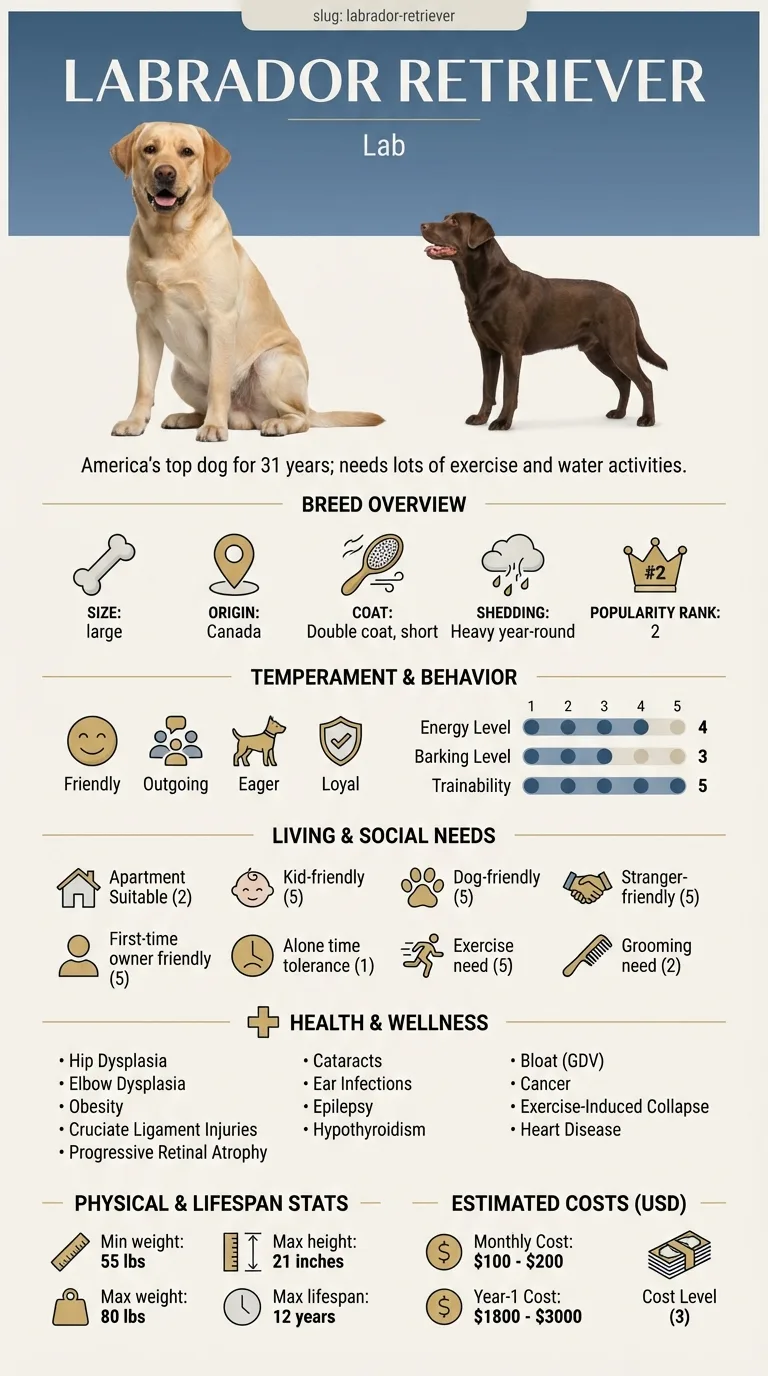
Labs don't carry the same strong inherited DCM predisposition seen in breeds like Dobermans or Great Danes, which is exactly what made the 2018 cluster of retriever cases so notable to cardiologists — the trigger looked environmental rather than genetic. At 55 to 80 pounds with a 10 to 12 year lifespan, a Lab's heart also does more cumulative work over its life than a small breed's, which can make any diet-driven taurine deficiency show up as clinical disease sooner.
Diet is the dominant environmental driver here — specifically grain-free formulations using peas, lentils, or other pulses as the main carbohydrate source instead of grains. The exact mechanism is still being studied, but the pattern across affected dogs was consistent enough that the FDA opened an investigation into it.
Contact your vet promptly for a new cough (especially overnight or after lying down), noticeable drop in stamina, fainting, or labored breathing. Any of these combined with a known history of grain-free feeding warrants a specific conversation about DCM, not just a general checkup.
See all Labrador Retriever health problems, which breeds are prone to heart disease, or the full Labrador Retriever breed guide for temperament, exercise needs and ownership costs.
After a suspected DCM diagnosis, expect an echocardiogram to confirm severity, a diet change if a link is suspected, and medication starting immediately. A recheck echocardiogram at three to six months shows whether the heart is stabilizing, improving, or continuing to decline.
For diet-associated cases caught early, success can mean measurable improvement in heart function after the diet change. For more advanced or genetically driven cases, success means a stable, medicated dog with a good quality of life rather than a cure — this is a distinction worth asking your cardiologist to spell out clearly for your specific case.
DCM is a disease of the heart muscle itself. The walls of the heart's chambers stretch and thin out, so each beat pumps less blood than it should. Over time the heart enlarges to compensate, which only makes the pumping less efficient, not more. Eventually this leads to congestive heart failure, where fluid backs up into the lungs or abdomen because the heart can't keep up with circulation demand.
In most breeds, DCM is primarily genetic — a small number of breeds like Dobermans and Great Danes carry a strong inherited predisposition. Labrador Retrievers historically had a much lower baseline rate. What changed is diet. Investigators found a pattern of DCM in dogs eating grain-free kibble built around peas, lentils, and other pulses as the primary carbohydrate, in place of grains. The leading theory involves taurine, an amino acid the heart muscle depends on — some of these diet formulations appear to interfere with how dogs synthesize or absorb it, even in breeds that don't have a known genetic taurine deficiency.
The encouraging part is that some diet-associated cases are reversible if caught early and the diet is changed, unlike genetically driven DCM, which is not.

You don't need a cardiologist to start reducing this specific risk factor. Here's what to check on the bag in your pantry right now.
If you think your Lab has heart disease, the plan is three steps: write down what you have seen and when it started, book a veterinary appointment rather than waiting for the next flare, and take video of the behaviour or symptom before you go — the thing you are worried about rarely happens in the consulting room. Screening in the parents covers hip dysplasia, elbow dysplasia, obesity.
What the vet visit should produce is a diagnosis and a written plan, not just reassurance: what is being ruled out, what the monitoring interval is, and which signs mean you come back sooner. Ask what the treatment costs across a year rather than per visit, because that is the number that decides whether you are managing this condition or reacting to it.
Between appointments, keep a short log — dates, what you saw, what changed. It is the single most useful thing an owner brings to a follow-up, and for heart disease it is often what separates a clear pattern from a guess.
Marcus had fed his Lab, Bo, a popular grain-free salmon-and-pea formula for three years because a pet store employee recommended it. At age six, Bo started panting more on short walks and lost interest in retrieving. His vet heard a soft murmur and referred him for an echocardiogram, which showed early-stage dilated cardiomyopathy along with a low taurine level. Bo was switched immediately to a grain-inclusive diet with a published feeding trial, started on taurine supplementation and cardiac medication, and rechecked four months later. His heart function had measurably improved, though it hadn't fully normalized. Marcus now checks every bag of food for legume content before it goes in the cart.
Key takeaway: Diet-associated DCM caught at an early stage can genuinely improve with a diet change, but the earlier it's caught, the more that improvement tends to matter — which makes routine screening worth doing before symptoms appear, not after.
Not automatically, but diets built around peas, lentils, and other legumes as the main carbohydrate source have been linked to diet-associated DCM in retriever breeds. If your Lab doesn't have a diagnosed grain allergy, there's usually no medical reason to choose grain-free over a grain-inclusive diet with established feeding trials.
Reduced stamina, a cough that appears when lying down or at night, and occasional lethargy are the earliest signs most owners notice. Because these are subtle, DCM is often first picked up as a murmur or irregular rhythm at a routine vet exam.
In some cases, yes — if it's caught early and the dog is switched off the suspected diet and supported with taurine and cardiac medication, some dogs show significant improvement. This is not guaranteed and depends heavily on how advanced the disease is at diagnosis, which is why early detection matters so much.
An echocardiogram is the standard diagnostic tool — it lets a cardiologist directly measure chamber size and pumping efficiency. Bloodwork, including a taurine level and sometimes a cardiac biomarker called NT-proBNP, is often run alongside it.
Diagnosis with an echocardiogram typically runs $300–$600. Ongoing management usually includes multiple daily medications, which can run $75–$200 a month depending on the combination and your dog's weight, plus periodic recheck echocardiograms.
Both mechanisms exist, but the sharp rise in cases identified since 2018 has been specifically linked to diet in this breed, distinguishing it from the primarily inherited DCM seen in breeds like Dobermans. That's part of why changing food is a real, actionable step for Lab owners in a way it isn't for every breed.
It's a reasonable precaution, especially if the diet has been fed for more than a year. Ask your vet about a baseline auscultation, and discuss whether taurine testing or an echocardiogram makes sense given how long your dog has eaten the diet.
Diets heavy in peas, lentils, or other legumes as the primary carbohydrate appear to interfere with taurine levels the heart muscle depends on.
Sometimes, if diet-associated and caught early — switching food plus cardiac support can lead to real improvement in some dogs.
Roughly $75–$200 a month for ongoing medication, plus periodic recheck testing.
A diet from a manufacturer with published feeding trials, without peas or lentils as a top-five ingredient, unless a vet has specifically prescribed otherwise.
It can be — a nighttime or lying-down cough is one of the more reliable early signs of fluid buildup from heart disease.
A one-page prep sheet for this condition: the signs, the questions to ask, what to get priced. Unlocks here.
You get: Vet visit prep sheet
No spam. One-click unsubscribe. See our privacy policy.
Preview page 1 before you decide.