Health
Is a heart murmur an emergency in a Labrador?
Rarely on its own. A new murmur found at a routine visit is a reason to schedule follow-up testing, not a reason to rush to the emergency room, unless it comes with collapse or breathing distress.

Quick answer
Is a heart murmur an emergency in a Labrador?
Rarely on its own. A new murmur found at a routine visit is a reason to schedule follow-up testing, not a reason to rush to the emergency room, unless it comes with collapse or breathing distress.
A 65-pound dog with a failing heart doesn't limp or whine — it just gets tired earlier on the walk than it used to, which is easy to miss in a breed built to keep working past discomfort.
This affects owners of middle-aged and senior Labs most, plus anyone who adopted an adult dog without a full cardiac history, since a murmur discovered at a routine exam can arrive with no warning at all.
This guide is not medical advice. If your dog shows pain, sudden behavior change, or worsening symptoms, consult a licensed veterinarian.
Some links may be affiliate links. We may earn a commission at no extra cost to you. We only suggest products we believe are helpful for dog owners.
Labrador Retrievers can develop several unrelated cardiac problems across their lifetime, from benign age-related murmurs to progressive muscle disease. Because this breed is bred to work through fatigue, the early signs are usually behavioral and subtle rather than dramatic, which means many cases are first caught at a routine wellness exam rather than because the owner noticed something was wrong.
Cardiac disease becomes meaningfully more common in Labs past middle age, similar to the pattern seen across large breeds generally. It's uncommon in puppies and young adults outside of congenital cases, which is why annual auscultation becomes more important, not less, as a Lab gets older.
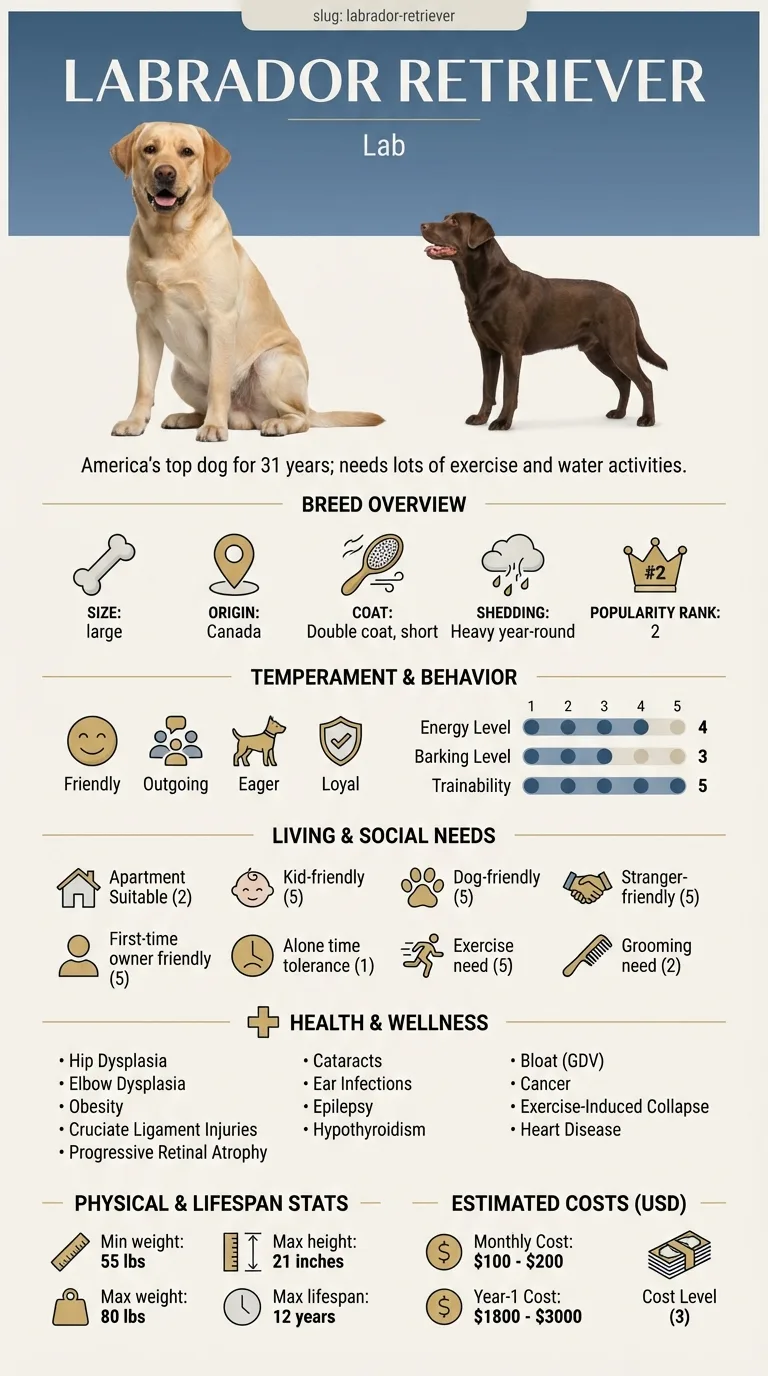
At 55 to 80 pounds with a life expectancy of 10 to 12 years, Labradors carry a heart working at large-breed volume for over a decade, which is simply more cumulative wear than a small dog's heart experiences. Their working drive also means they'll keep swimming, retrieving, and playing past the point a lower-energy breed would stop, so early cardiac fatigue can go unnoticed for longer.
An underexercised, overweight Lab puts chronic extra load on the heart every single day, which accelerates whatever baseline risk is already there. Diet plays a documented role too — several boutique and grain-free formulations have been associated with diet-related dilated cardiomyopathy cases in retriever breeds specifically, likely tied to taurine metabolism.
Call your vet the same day if your Lab develops a new cough (especially one that happens at rest or overnight), sudden lethargy, fainting or brief collapse, or noticeably labored breathing — these can indicate a cardiac emergency and shouldn't wait for the next available appointment.
See all Labrador Retriever health problems, which breeds are prone to heart conditions, or the full Labrador Retriever breed guide for temperament, exercise needs and ownership costs.
A murmur discovered incidentally is often just monitored yearly with no change in the dog's life at all. A confirmed diagnosis like DCM typically means starting medication within weeks of diagnosis, with a recheck echocardiogram three to six months later to see how the dog is responding.
Success rarely means a cure. It means a stable murmur that doesn't progress, or a managed condition where medication keeps the dog comfortable and active for as long as possible — most owners measure success in maintained quality of life, not in the disease disappearing.
A heart murmur is a sound, not a disease. It's turbulent blood flow your vet can hear through a stethoscope, and in a Labrador it's usually caused by one of two very different things: a leaky valve that develops with age, or a structural narrowing the dog was born with. Dilated cardiomyopathy (DCM) is a separate problem entirely — the heart muscle itself thins and stretches until it can't pump efficiently, which is a disease of the tissue, not the plumbing.
This distinction changes everything about what happens next. A soft murmur from mild valve wear might be monitored yearly with no treatment at all. DCM, by contrast, is progressive and eventually needs daily medication to manage. Labs also carry some risk for subvalvular aortic stenosis, a congenital narrowing below the aortic valve that a breeder-screened puppy exam can sometimes catch before the dog is ever symptomatic.
Because the underlying causes are so different, a murmur graded 2/6 at a wellness visit is not automatically a red flag — but it is a reason to ask your vet whether an echocardiogram is worth the cost to see what's actually happening underneath the sound.

Because Labs are bred to push through discomfort, the first signs of heart disease rarely look dramatic. Here's what actually shows up before a crisis does.
If you think your Lab has heart conditions, the plan is three steps: write down what you have seen and when it started, book a veterinary appointment rather than waiting for the next flare, and take video of the behaviour or symptom before you go — the thing you are worried about rarely happens in the consulting room. Screening in the parents covers hip dysplasia, elbow dysplasia, obesity.
What the vet visit should produce is a diagnosis and a written plan, not just reassurance: what is being ruled out, what the monitoring interval is, and which signs mean you come back sooner. Ask what the treatment costs across a year rather than per visit, because that is the number that decides whether you are managing this condition or reacting to it.
Between appointments, keep a short log — dates, what you saw, what changed. It is the single most useful thing an owner brings to a follow-up, and for heart conditions it is often what separates a clear pattern from a guess.
Dana's ten-year-old Lab, Scout, started coughing a few times a night, always after he'd settled down to sleep. She assumed it was a mild kennel cough picked up at the groomer and waited a week before mentioning it to her vet. An exam turned up a moderate heart murmur that hadn't been there the year before, and an echocardiogram confirmed mitral valve degeneration with early fluid buildup in the lungs. Scout started on two medications the same week. Within ten days the nighttime cough was gone. Dana now brings him in every four months instead of once a year, and she's learned to watch his resting breathing rate at home — a habit her cardiologist taught her that catches fluid buildup faster than almost anything else.
Key takeaway: A cough that shows up specifically at rest or overnight is one of the more reliable early warning signs of heart disease in an older Lab, and it's worth a same-week vet visit rather than a wait-and-see week.
A murmur is a sound caused by turbulent blood flow — it can come from something as minor as age-related valve wear or as serious as a congenital defect. Heart disease, like dilated cardiomyopathy, is a diagnosis about the muscle or structure itself. A murmur is a clue that prompts further testing, not a diagnosis on its own.
Labs aren't among the highest-risk breeds for inherited cardiac disease, but they're a large breed with a long life expectancy, and cardiac issues do show up more often past age seven. Yearly auscultation at wellness visits is the main way these are caught early.
A baseline exam with auscultation is usually included in a wellness visit. If your vet hears something and refers you to a cardiologist, an echocardiogram typically runs $300–$600, and ongoing medication for a confirmed condition can run $50–$150 a month depending on the diagnosis.
It depends entirely on the grade and cause. A mild, stable murmur often comes with no exercise restriction at all. A murmur linked to a structural defect or advancing muscle disease usually means your vet will set specific limits — this is not a call to make without imaging.
DCM is a disease where the heart muscle thins and stretches, reducing how efficiently the heart pumps blood. It's progressive, meaning it gets worse over time, and it's the reason some Labs eventually go on long-term heart medication even without a congenital defect.
Once a year at a routine wellness exam for most healthy adult Labs, moving to twice yearly once a dog is a senior or if a murmur has already been noted. Any new coughing, fatigue, or fainting should trigger an unscheduled visit.
Some puppy murmurs are 'innocent' — physiologic murmurs that fade as the puppy grows and disappear by six months. Others point to a congenital defect that needs monitoring for life. Your vet can usually tell the difference by location, grade, and whether it persists past six months.
Large and giant breeds generally share more structural heart-defect risk than small breeds, and some retriever lines have been flagged in diet-linked DCM investigations. None of this means a given Lab will develop heart disease — it just means routine screening matters more in this size class.
Rarely on its own. A new murmur found at a routine visit is a reason to schedule follow-up testing, not a reason to rush to the emergency room, unless it comes with collapse or breathing distress.
Reduced stamina on walks or during retrieving games is usually the earliest visible change, often months before any other symptom appears.
Yes — certain grain-free and boutique diet formulations have been linked to diet-associated DCM cases in retriever breeds, which is why many cardiologists now recommend diets with established feeding trials.
Typically $50–$150 a month depending on the specific drugs and dosage needed for the diagnosis.
Many dogs on managed medication live comfortably for years after diagnosis, though the underlying disease is usually progressive rather than curable.
A one-page prep sheet for this condition: the signs, the questions to ask, what to get priced. Unlocks here.
You get: Vet visit prep sheet
No spam. One-click unsubscribe. See our privacy policy.
Preview page 1 before you decide.