Health
Is cherry eye common in Labradors?
No, it's not documented as a hallmark condition for this breed, though it can still occur in individual dogs.

Quick answer
Is cherry eye common in Labradors?
No, it's not documented as a hallmark condition for this breed, though it can still occur in individual dogs.
A sudden pink lump in the corner of your Lab's eye looks alarming, but cherry eye, if that's what it is, is rarely an emergency and usually has a straightforward fix.
Owners of young adult Labradors who notice a sudden, visible lump at the inner corner of one eye are the ones most likely to encounter this, since the condition typically appears before two years of age when it does occur.
This guide is not medical advice. If your dog shows pain, sudden behavior change, or worsening symptoms, consult a licensed veterinarian.
Some links may be affiliate links. We may earn a commission at no extra cost to you. We only suggest products we believe are helpful for dog owners.
Cherry eye is the visible prolapse of the third eyelid gland, appearing as a pink lump in the corner of the eye. It isn't documented as a hallmark condition for Labrador Retrievers the way it is for breeds like Bulldogs or Beagles, but individual dogs can still develop it due to weak connective tissue holding the gland in place. It's rarely painful or an emergency, and is typically resolved with a straightforward surgical repositioning.
Genuinely uncommon in this breed compared to breeds with a documented predisposition, but not so rare that it should be dismissed if it appears; any individual dog can develop it regardless of overall breed tendency.
Labrador Retrievers don't carry a documented predisposition to weak third-eyelid connective tissue the way certain flat-faced and loose-skinned breeds do, which is why cherry eye isn't listed among this breed's typical health concerns. When it occurs, it reflects an individual dog's connective tissue strength rather than a breed-wide structural trait.
There's no established environmental trigger for cherry eye; it's considered primarily a matter of individual anatomical variation rather than something caused by lifestyle, diet, or activity.
See your vet within a few days of noticing any pink lump or swelling in the corner of your dog's eye. It's not typically an emergency, but delaying treatment allows more irritation to develop and doesn't improve the odds of it resolving alone.
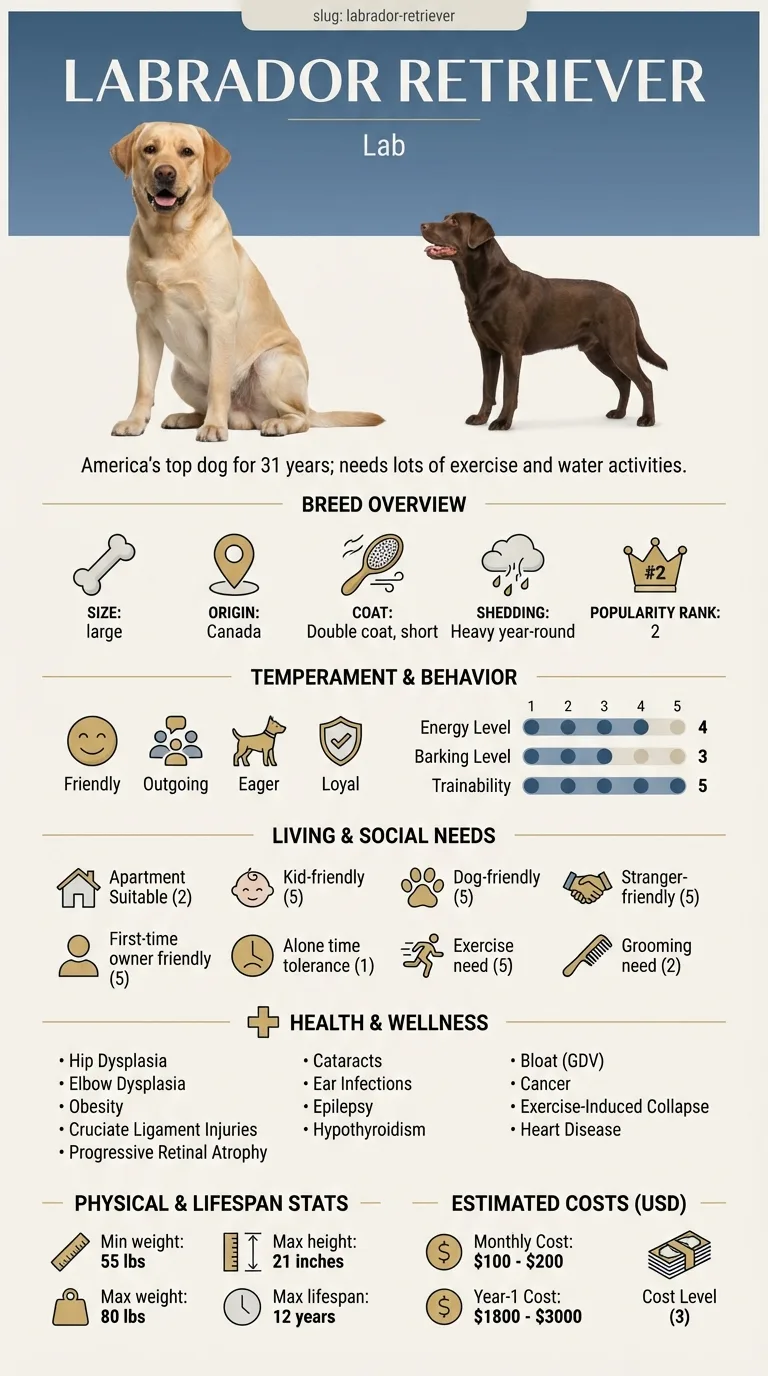
See all Labrador Retriever health problems, which breeds are prone to cherry eye, or the full Labrador Retriever breed guide for temperament, exercise needs and ownership costs.
Surgery is typically scheduled within a few weeks of diagnosis, with the procedure itself quick and recovery generally complete within one to two weeks with an e-collar in place to prevent rubbing.
Success is a properly repositioned gland with normal tear production and no recurrence, achieved in the large majority of cases with the first surgical procedure.
Cherry eye results from weak connective tissue attachments holding the third eyelid gland in place, a trait more strongly linked to certain flat-faced and loose-skinned breed structures than to a Labrador's build. It doesn't appear in this breed's documented health concerns, and it isn't something Labrador owners need to actively watch for the way they would ear infections or joint issues. That said, "uncommon" isn't "impossible," and any individual dog, regardless of breed tendency, can develop weak connective tissue in this one specific structure.
Cherry eye itself isn't painful in most cases and isn't a medical emergency, though it does warrant a vet visit rather than waiting to see if it resolves alone, since it rarely does. Modern veterinary treatment favors surgically repositioning and tacking the gland back into place rather than removing it outright, since that gland contributes meaningfully to tear production and removing it can raise the risk of dry eye later in life. The procedure is generally straightforward with a good success rate, though a small number of dogs experience recurrence and need a second procedure.

If you think your Lab has cherry eye, the plan is three steps: write down what you have seen and when it started, book a veterinary appointment rather than waiting for the next flare, and take video of the behaviour or symptom before you go — the thing you are worried about rarely happens in the consulting room. Screening in the parents covers hip dysplasia, elbow dysplasia, obesity.
What the vet visit should produce is a diagnosis and a written plan, not just reassurance: what is being ruled out, what the monitoring interval is, and which signs mean you come back sooner. Ask what the treatment costs across a year rather than per visit, because that is the number that decides whether you are managing this condition or reacting to it.
Between appointments, keep a short log — dates, what you saw, what changed. It is the single most useful thing an owner brings to a follow-up, and for cherry eye it is often what separates a clear pattern from a guess.
Juniper, a fourteen-month-old Labrador, came in from the yard one afternoon with an unmistakable pink lump bulging from the corner of her left eye. Her owner, having never heard of cherry eye in this breed, worried it might be something more serious. The vet confirmed a classic cherry eye presentation, reassuring her owner that while uncommon in Labradors specifically, it does happen in individual dogs and is very treatable. Juniper had the gland surgically repositioned within two weeks, wore a cone for ten days during healing, and has had no recurrence in the two years since.
Key takeaway: Cherry eye in a Labrador is uncommon but not impossible, and a straightforward surgical repositioning typically resolves it without lasting effects.
It's not documented as a hallmark condition for this breed the way it is for Bulldogs or Beagles, but individual Labs can still develop it since it comes down to the strength of connective tissue in one specific eye structure, not breed-wide anatomy.
Usually not significantly painful on its own, though the exposed gland can become irritated or inflamed if left untreated for a long time, which is why a vet visit is still worthwhile even without obvious distress.
It rarely resolves without treatment. Some vets attempt a brief period of massage or medication first, but surgical repositioning is typically needed for a lasting fix.
Modern veterinary practice generally favors repositioning the gland rather than removing it, since it contributes to tear production and removal raises the risk of dry eye later in life.
Typically a moderate cost, less than most orthopedic procedures, though it varies by clinic and region and can be somewhat more if both eyes are affected.
A small percentage of dogs experience recurrence and need a second procedure, though most cases are resolved successfully with the first repositioning surgery.
Not necessarily, though it can happen in some dogs, since the same connective tissue weakness could theoretically affect both sides. Your vet can advise based on your individual dog.
No, it's not documented as a hallmark condition for this breed, though it can still occur in individual dogs.
Not typically an emergency, but it warrants a prompt, non-urgent vet visit rather than waiting to see if it resolves alone.
In most cases yes, since it rarely resolves without a procedure to reposition the gland back into place.
Generally a moderate surgical cost, less than most joint or abdominal surgeries, though pricing varies by clinic.
There's no proven prevention since it relates to individual connective tissue strength rather than a controllable lifestyle factor, but prompt treatment prevents complications if it does occur.
A one-page prep sheet for this condition: the signs, the questions to ask, what to get priced. Unlocks here.
You get: Vet visit prep sheet
No spam. One-click unsubscribe. See our privacy policy.
Preview page 1 before you decide.