Health
What are the two main documented eye conditions in Labradors?
Progressive Retinal Atrophy and cataracts are the two conditions specifically documented in this breed's health profile.

Quick answer
What are the two main documented eye conditions in Labradors?
Progressive Retinal Atrophy and cataracts are the two conditions specifically documented in this breed's health profile.
The most useful thing an owner can do for a Labrador's eye health isn't worrying generally, it's knowing which two conditions are actually documented for this breed and getting eyes checked with that specific knowledge in mind.
Owners of Labradors from breeding lines without documented eye screening history, and owners of any Lab entering middle age, are the ones for whom understanding this breed's real eye disorder profile matters most.
This guide is not medical advice. If your dog shows pain, sudden behavior change, or worsening symptoms, consult a licensed veterinarian.
Some links may be affiliate links. We may earn a commission at no extra cost to you. We only suggest products we believe are helpful for dog owners.
We research and check what we publish, but we do not warrant that any figure, date, price, or statement is accurate, complete, or current, and we accept no liability for any loss, cost, injury, or other harm arising from the use of this site. Use it as one reference among several. You remain responsible for your own decisions and for your dog's care - confirm anything that matters with a licensed veterinarian or another qualified professional before you act on it. Full disclaimer.
Labrador Retrievers have two eye conditions specifically documented in their breed health profile: Progressive Retinal Atrophy, a genetic, gradual retinal degeneration with no current treatment, and cataracts, lens clouding that's often surgically treatable. Some individual dogs also develop eyelid conformation issues like entropion or ectropion. Routine and, for breeding dogs, formal eye screening is the most effective way to catch any of these early.
PRA and cataracts are both specifically documented as real concerns for this breed, making eye health a genuine, multi-condition area worth regular monitoring rather than a single, simple risk.
Progressive Retinal Atrophy and cataracts are both directly documented among Labrador Retrievers' health concerns, reflecting genuine inherited and age-related risk to two different eye structures, the retina and the lens respectively. Individual variation in eyelid conformation accounts for the less consistently documented but still real occurrence of entropion or ectropion in some dogs.
Environment plays a limited role in PRA, which is primarily genetic, but diabetes and prior eye injury can accelerate cataract formation regardless of underlying genetic predisposition. Eyelid conformation issues are generally structural rather than environmentally caused.
See your vet for any new eye cloudiness, night vision changes, tearing, squinting, or visible eyelid abnormality. A sudden, painful-looking red or cloudy eye needs urgent same-day care, since it could indicate glaucoma or significant inflammation.
See all Labrador Retriever health problems, which breeds are prone to eye disorders, or the full Labrador Retriever breed guide for temperament, exercise needs and ownership costs.
PRA progresses gradually over months to years with no treatment to slow it. Cataract surgery, when appropriate, typically resolves vision issues within a few weeks of recovery. Eyelid surgery for entropion or ectropion, when needed, has a similarly short recovery period.
Success looks like early detection through routine screening, allowing timely management of treatable conditions like cataracts or eyelid issues, and, for PRA, enough advance notice to adapt a dog's environment supportively as vision gradually declines.
Progressive Retinal Atrophy, often shortened to PRA, and cataracts are the two eye conditions specifically documented in this breed's health profile, and they're mechanistically very different. PRA is a genetic, gradual degeneration of the retina's light-sensing cells, typically starting with night vision loss and progressing toward full blindness over months to years, with no treatment currently available to reverse it, though a genetic test can identify carriers before symptoms appear. Cataracts, clouding of the eye's lens, can be hereditary and early-onset or, more commonly, age-related, and unlike PRA, cataracts are often surgically treatable.
Beyond PRA and cataracts, some individual Labradors develop eyelid conformation issues like entropion (eyelid rolling inward) or ectropion (eyelid rolling outward), both of which can cause chronic irritation and, if untreated, corneal damage, though neither is as consistently documented as the breed's two primary eye concerns. Given this real, multi-condition picture, an annual eye exam, and for breeding dogs, a formal CERF or OFA eye certification, is the most effective way to catch any of these conditions early, when management or treatment options are most effective.

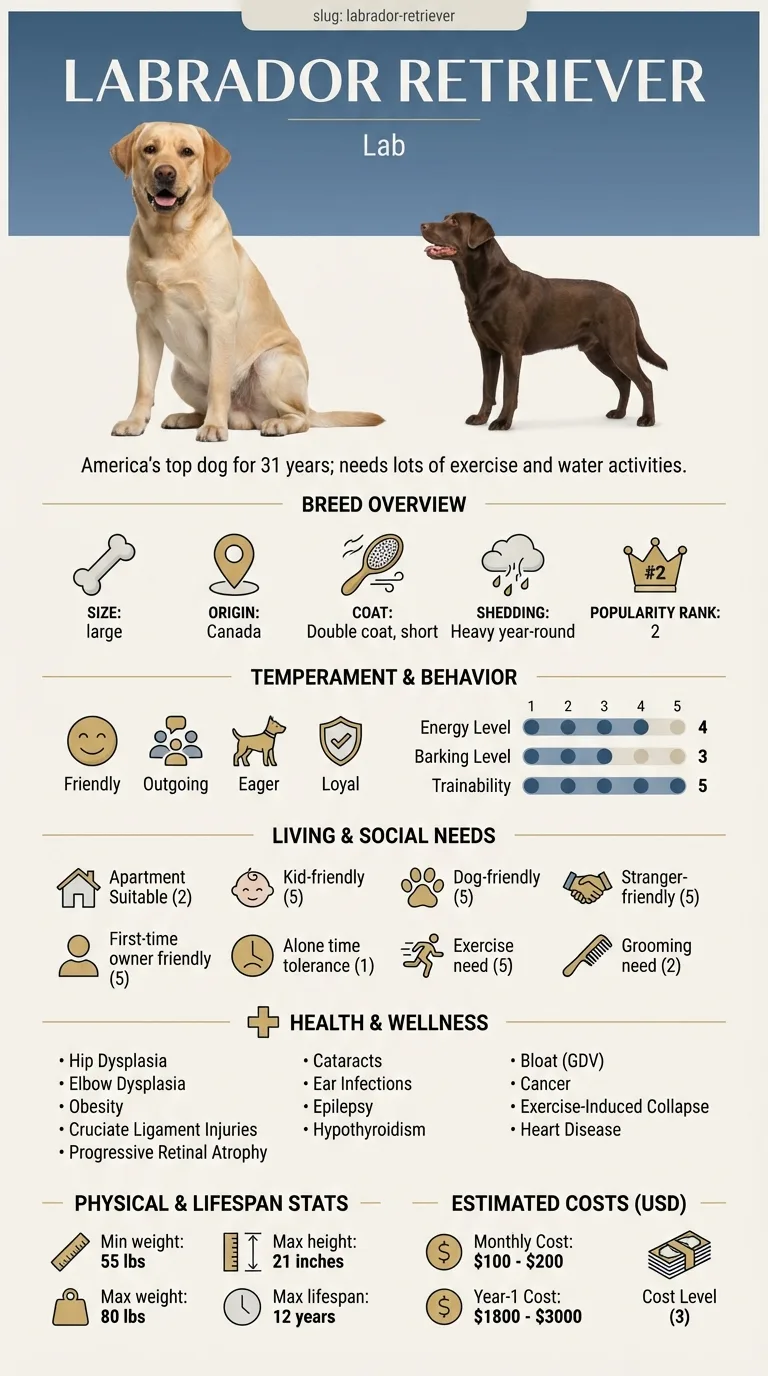
If you think your Lab has eye disorders, the plan is three steps: write down what you have seen and when it started, book a veterinary appointment rather than waiting for the next flare, and take video of the behaviour or symptom before you go — the thing you are worried about rarely happens in the consulting room. Screening in the parents covers hip dysplasia, elbow dysplasia, obesity.
What the vet visit should produce is a diagnosis and a written plan, not just reassurance: what is being ruled out, what the monitoring interval is, and which signs mean you come back sooner. Ask what the treatment costs across a year rather than per visit, because that is the number that decides whether you are managing this condition or reacting to it.
Between appointments, keep a short log — dates, what you saw, what changed. It is the single most useful thing an owner brings to a follow-up, and for eye disorders it is often what separates a clear pattern from a guess.
Cleo's owner first noticed her five-year-old Labrador hesitating at the bottom of the stairs during evening walks, something that seemed odd for a normally confident dog. A veterinary ophthalmologist exam confirmed early Progressive Retinal Atrophy, with night vision affected first as is typical for the condition. While there was no treatment to reverse it, catching it early let Cleo's owner adapt gradually: keeping furniture in consistent positions and adding nightlights along her usual paths. Two years later, with vision now significantly reduced even in daylight, Cleo navigates her familiar home and yard with remarkable confidence, and her owner credits the early diagnosis with giving them time to adjust gradually rather than facing a sudden, disorienting change.
Key takeaway: Knowing this breed's real, documented eye conditions helps owners recognize early signs and adapt proactively, rather than only reacting once vision loss is severe.
Progressive Retinal Atrophy (PRA) and cataracts are the two conditions specifically documented in this breed's health profile. Eyelid conformation issues like entropion or ectropion can also occur in individual dogs, though less consistently.
A genetic condition causing gradual degeneration of the retina's light-sensing cells, typically starting with night vision loss and progressing toward full blindness over months to years. There's no treatment that reverses it, but a genetic test identifies risk before symptoms appear.
Not in an individual dog once the genetic predisposition is present, but responsible breeding using genetic testing can avoid producing affected puppies, which is why testing breeding stock matters for this breed.
No, they're separate conditions affecting different eye structures, the lens for cataracts and the retina for PRA, though both are documented eye concerns for this breed and can occasionally occur in the same dog.
Entropion is an eyelid rolling inward, causing eyelashes to irritate the eye's surface; ectropion is an eyelid rolling outward, exposing the inner lid to irritation. Both can occur in individual Labradors and may need surgical correction if severe.
An annual eye exam is a reasonable baseline for most dogs, with breeding dogs typically undergoing more formal certification exams given the hereditary nature of PRA and some cataract forms.
Gradual in most cases, typically starting with night vision loss and progressing over months to years, though dogs often adapt remarkably well to gradual vision loss, especially in familiar environments.
Progressive Retinal Atrophy and cataracts are the two conditions specifically documented in this breed's health profile.
No, there's currently no treatment that reverses PRA, though a genetic test identifies risk before symptoms appear, which matters for breeding decisions.
Yes, in many cases, through surgical removal of the clouded lens, unlike PRA which has no direct treatment.
A basic veterinary eye exam is a modest cost, while a formal breeding certification exam by a veterinary ophthalmologist costs somewhat more.
It's a reasonable, low-cost step, especially useful if you're considering breeding or simply want early information about your dog's PRA risk status.
A one-page prep sheet for this condition: the signs, the questions to ask, what to get priced. Unlocks here.
You get: Vet visit prep sheet
No spam. One-click unsubscribe. See our privacy policy.
See a sample page before you decide.
Early access list
The free prep sheet covers the same-day warning signs, a symptom log and the questions to ask. We are considering a fuller kit that adds a cost worksheet for the usual tests and treatments (US price ranges with their sources) and a plain-English guide to ways of covering the bill. It is not built yet; this list tells us whether it is worth building.
One email, no spam, unsubscribe anytime. Information only, not veterinary advice.