Health
Where can I check a Labrador's hip score myself?
The OFA public database lets you search by registered name or certificate number to independently verify a breeder's claims.

Quick answer
Where can I check a Labrador's hip score myself?
The OFA public database lets you search by registered name or certificate number to independently verify a breeder's claims.
Decades of OFA hip evaluation submissions on Labradors give this breed one of the richer data sets in dog genetics — which is exactly why 'ask for the hip scores' is such standard advice for Lab puppy buyers specifically.
Prospective buyers comparing breeders who quote different numbers, and current owners trying to understand whether their dog's diagnosis is 'typical for the breed' or unusually severe.
This guide is not medical advice. If your dog shows pain, sudden behavior change, or worsening symptoms, consult a licensed veterinarian.
Some links may be affiliate links. We may earn a commission at no extra cost to you. We only suggest products we believe are helpful for dog owners.
Hip dysplasia prevalence data for Labrador Retrievers comes mainly from voluntary screening registries like OFA and PennHIP, which show meaningful representation of the condition in this breed's decades-long submission history. That data is a genuinely useful tool for evaluating a breeder's practices, though it comes from a self-selected sample of tested dogs rather than a random population survey, which matters when interpreting any specific number.
Labradors have one of the more extensive hip-screening data sets of any breed given decades of OFA submissions, and the condition is well enough represented that OFA or equivalent testing is considered standard practice among reputable Labrador breeders, distinguishing it from breeds where testing is far less routine.
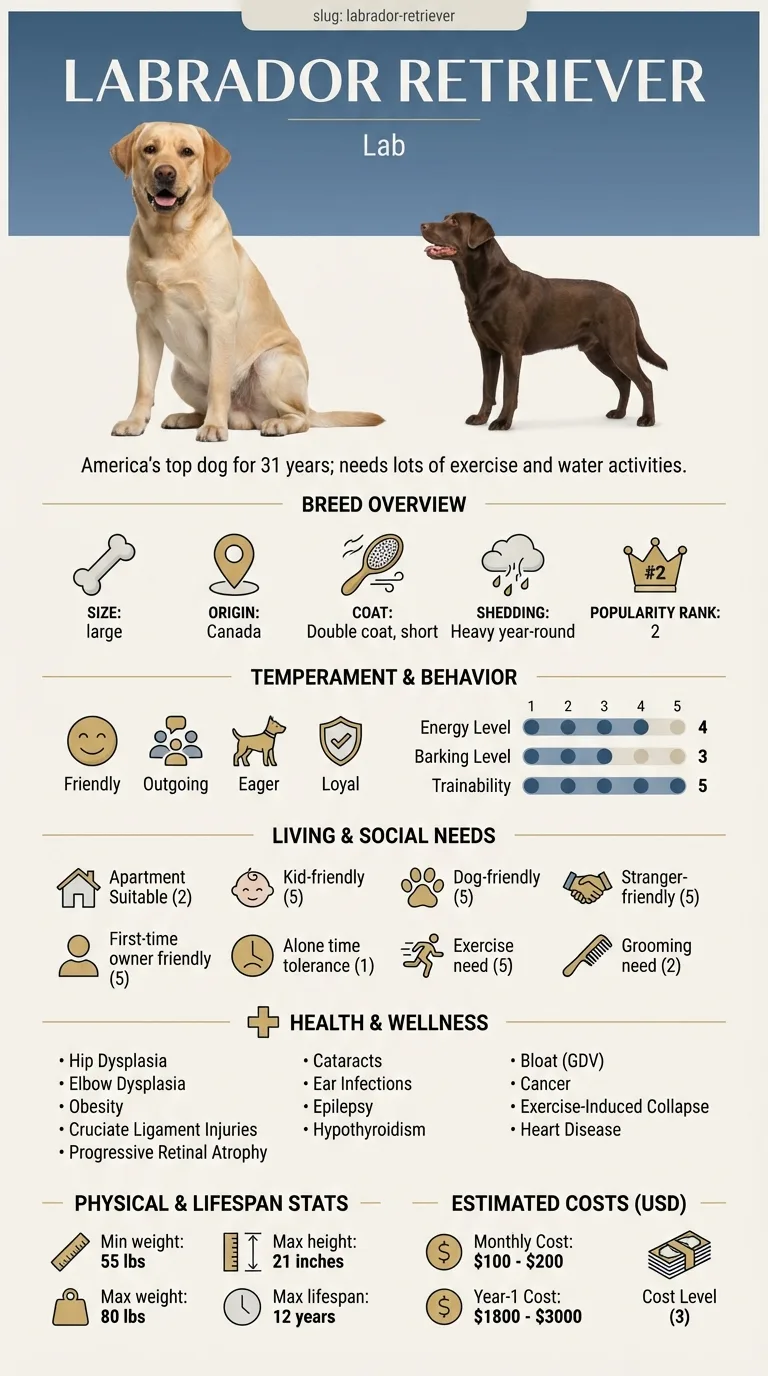
As a large, heavily built sporting breed at 55 to 80 pounds, Labradors carry documented genetic risk for hip joint conformation issues, which is exactly why the breed has such a long screening history — breeders and veterinary orthopedists have specifically tracked this condition in Labs for decades. This isn't unique to large breeds broadly, since some small breeds show meaningful hip dysplasia rates too, underscoring that genetics and joint shape, not size alone, drive the condition.
The main environmental factor affecting prevalence data itself, as opposed to individual dog risk, is testing culture — how consistently breeders in a given line or region submit dogs for screening. For an individual dog's actual risk, puppyhood growth rate and adult body weight remain the two biggest modifiable environmental factors layered on top of genetic risk.
Talk to your vet about a baseline hip evaluation if you're unsure of your dog's genetic background, or if you notice any gait changes, reluctance to jump, or stiffness after rest — these warrant investigation regardless of what any breed-level prevalence statistic suggests about your individual dog.
See all Labrador Retriever health problems, which breeds are prone to hip dysplasia prevalence, or the full Labrador Retriever breed guide for temperament, exercise needs and ownership costs.
Evaluating breeder screening data is a decision made before you even bring a puppy home — it's a one-time research task, though following up on your own dog's joint health is an ongoing, lifelong process regardless of parental scores.
Success looks like an informed decision: choosing a breeder with a documented multi-generation testing history, understanding that this reduces but doesn't eliminate risk, and following through with preventive puppyhood care regardless of the numbers you were shown.
Organizations like the Orthopedic Foundation for Animals (OFA) and PennHIP collect X-rays from dogs that are voluntarily submitted, usually by breeders screening potential breeding stock. That's an important caveat: this isn't a random sample of every Labrador in the world, it's a sample skewed toward dogs whose owners cared enough to test, which can push published rates in either direction depending on the breed's testing culture.
With that caveat in place, Labradors have one of the largest and longest-running submission histories of any breed, which makes the trend data more useful than a smaller sample would be, even if the raw percentage isn't a perfect population-wide estimate. What the decades of data consistently show is a large breed with meaningful hip dysplasia representation — enough that OFA hip certification became a near-standard expectation for reputable Labrador breeders long before it did for many other breeds.
This is genuinely different from breeds where the condition shows up despite a small body size, such as certain toy and small breeds where hip dysplasia isn't driven by heavy body weight the same way — a reminder that this condition is about joint conformation and genetics, not size alone.

Prevalence statistics are only useful if you know how to apply them to an individual breeding decision. Here's what a genuinely informed conversation with a breeder looks like.
If you think your Lab has hip dysplasia prevalence, the plan is three steps: write down what you have seen and when it started, book a veterinary appointment rather than waiting for the next flare, and take video of the behaviour or symptom before you go — the thing you are worried about rarely happens in the consulting room. Screening in the parents covers hip dysplasia, elbow dysplasia, obesity.
What the vet visit should produce is a diagnosis and a written plan, not just reassurance: what is being ruled out, what the monitoring interval is, and which signs mean you come back sooner. Ask what the treatment costs across a year rather than per visit, because that is the number that decides whether you are managing this condition or reacting to it.
Between appointments, keep a short log — dates, what you saw, what changed. It is the single most useful thing an owner brings to a follow-up, and for hip dysplasia prevalence it is often what separates a clear pattern from a guess.
Before buying her Lab puppy, Wren, Sam contacted three breeders and asked each for OFA certificate numbers on both parents. One breeder said the parents were 'hip tested and healthy' with no documentation offered. Another provided certificate numbers that, when Sam looked them up on OFA's public database, showed 'Fair' ratings rather than the 'Excellent' the breeder had implied. The third provided verifiable 'Good' and 'Excellent' ratings across three generations. Sam chose the third breeder. Wren is now four years old with no hip issues on her most recent exam, though Sam knows that isn't guaranteed by the paperwork alone — it's simply the best odds available going in.
Key takeaway: Prevalence and screening data don't predict any individual dog's outcome, but verifying the actual certificates rather than trusting a verbal claim is one of the few concrete steps a buyer can take to meaningfully improve the odds.
Labradors are well represented in hip dysplasia screening data, similarly to other large sporting and working breeds, but they're not uniquely the highest-risk breed. What sets Labs apart is how extensive and long-running the screening data is, not necessarily a uniquely elevated rate.
Hip dysplasia is driven by joint conformation and genetics, not purely body weight, which is why it appears in some small and compact breeds despite their lighter frame. It's a reminder that this is a structural, inherited condition rather than simply a consequence of being large.
No. It's a polygenic trait, meaning multiple genes contribute, so two well-scored parents can still produce an affected puppy, though the odds are meaningfully better than breeding from untested or poorly scored parents.
OFA grades a single static X-ray into categories like Excellent, Good, Fair, or dysplastic, typically at age two or later. PennHIP measures joint laxity directly using a specific technique and can be performed as early as four months, giving an earlier, more quantitative read.
Not necessarily — the data is a tool for choosing a responsible breeder who screens for it, not a reason to avoid the breed. Many Labs from health-tested lines live their entire lives with no hip issues at all.
OFA maintains a public online database searchable by registered name or number, which lets you independently verify a certificate rather than relying solely on what a breeder tells you.
Yes — breed-wide screening and selective breeding away from affected dogs has measurably improved outcomes in some lines over decades, which is part of why choosing a breeder who has tested multiple generations matters more than a single pair of scores.
The OFA public database lets you search by registered name or certificate number to independently verify a breeder's claims.
No — it improves the odds meaningfully, but hip dysplasia is polygenic, so even well-scored parents can still produce an affected puppy.
No — it also appears in some small breeds like French Bulldogs, since it's driven by joint conformation and genetics, not body weight alone.
OFA grades a single X-ray at age two or later; PennHIP directly measures joint laxity and can test as early as four months.
Not necessarily — it should push you toward a breeder who actively screens breeding stock, since untested lines carry meaningfully more risk.
A one-page prep sheet for this condition: the signs, the questions to ask, what to get priced. Unlocks here.
You get: Vet visit prep sheet
No spam. One-click unsubscribe. See our privacy policy.
Preview page 1 before you decide.