Health
What's a warning sign of a liver shunt in a puppy?
Disorientation or staring into space, especially after meals, combined with being smaller than littermates.

Quick answer
What's a warning sign of a liver shunt in a puppy?
Disorientation or staring into space, especially after meals, combined with being smaller than littermates.
A puppy that seems 'just a little off' after meals, disoriented or strange-acting for no obvious reason, is describing something that sounds vague until you learn it has a name and a specific surgical fix.
Owners of a small or underweight-for-age puppy showing unusual behavior after eating, working through a diagnostic process that can feel confusing until the pieces click into place.
This guide is not medical advice. If your dog shows pain, sudden behavior change, or worsening symptoms, consult a licensed veterinarian.
Some links may be affiliate links. We may earn a commission at no extra cost to you. We only suggest products we believe are helpful for dog owners.
A portosystemic liver shunt is an abnormal blood vessel, typically present from birth, that lets blood from the intestines bypass the liver's filtering function, leading to toxin buildup that particularly affects the brain and can impair growth. Affected puppies often show disorientation, especially after meals, and are frequently smaller than littermates, with surgical correction offering the best long-term outcome for most congenital cases.
Congenital liver shunts are relatively uncommon overall and aren't documented as a major widespread concern specifically in Labrador Retrievers the way they are in certain small breeds, though any individual puppy showing the characteristic symptom pattern warrants investigation regardless of breed.
Labradors don't carry a strongly documented breed-specific predisposition toward congenital liver shunts compared to certain small breeds where the condition is much more frequently discussed, making this a less breed-defining condition for Labs than several others on this list. When it does occur, the underlying vascular abnormality is present from birth regardless of breed.
There's no significant environmental trigger for the underlying congenital vessel abnormality itself, though diet composition — particularly protein content and timing of meals — directly affects how severe symptoms appear day to day once a shunt is present, since ammonia production from digesting protein is the main toxin driving symptoms.
Seek prompt veterinary evaluation for disorientation, staring spells, or unusual behavior especially tied to meal timing, and seek emergency care immediately for a seizure or sudden collapse, since these can indicate significant toxin buildup requiring urgent stabilization.
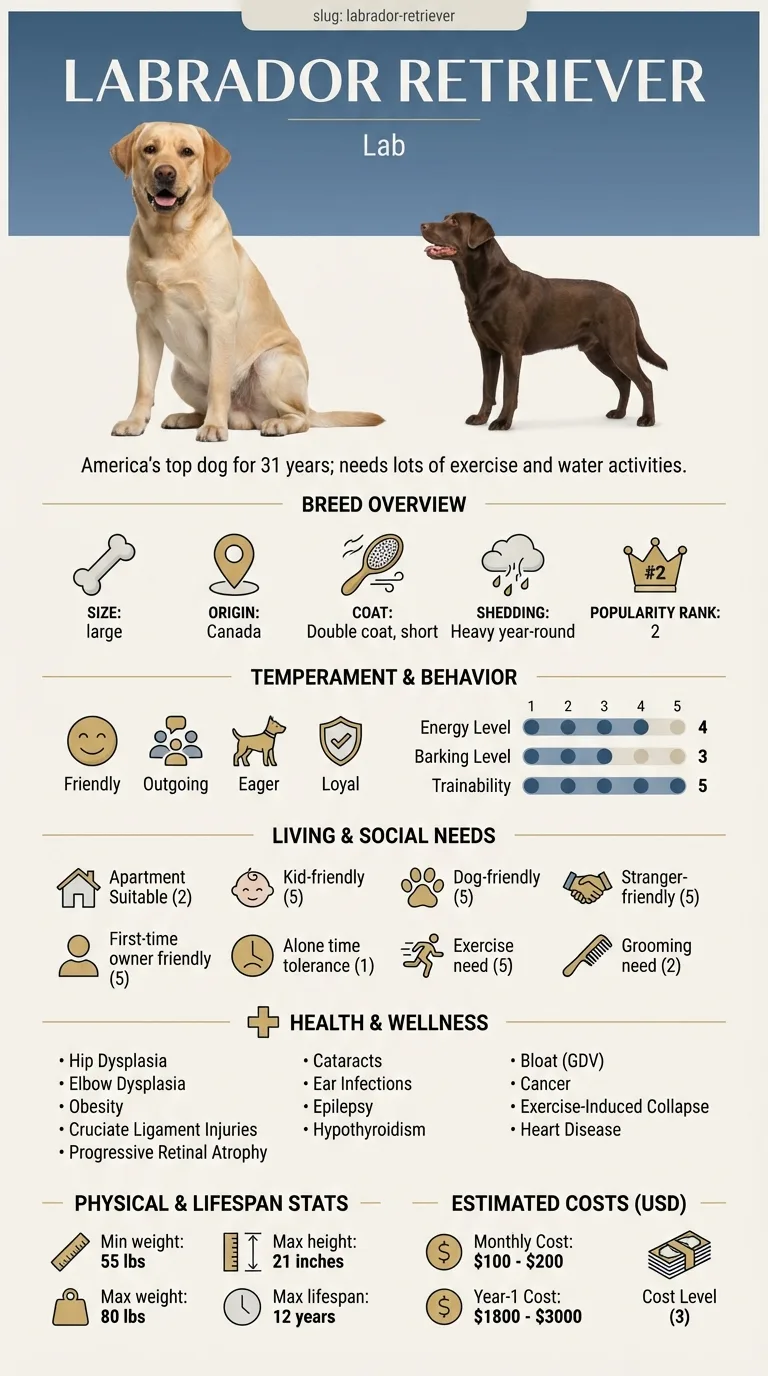
See all Labrador Retriever health problems, which breeds are prone to liver shunts, or the full Labrador Retriever breed guide for temperament, exercise needs and ownership costs.
Diagnosis typically involves an initial bloodwork visit followed by a specialist imaging appointment within a few weeks. Surgical correction is usually scheduled once the shunt is clearly mapped, with a recovery period of several weeks and follow-up bloodwork to confirm improved liver function.
Success for most surgically corrected congenital shunts means a puppy that goes on to grow and develop normally, with bile acid levels returning to normal range on follow-up testing — many affected dogs live entirely normal lives after successful treatment.
Normally, blood from the intestines travels through the portal vein directly to the liver, which filters out toxins, including ammonia produced during protein digestion, before that blood joins general circulation. A shunt is an abnormal vessel — present from birth in most cases (a congenital shunt) — that allows some or most of that blood to skip the liver entirely and go straight into general circulation.
The result is a buildup of unfiltered toxins, most notably ammonia, which particularly affects the brain and produces a set of symptoms collectively called hepatic encephalopathy: disorientation, staring into space, circling, or even seizures, often worse after a protein-rich meal when ammonia production spikes. Affected puppies are also frequently smaller than littermates, since the liver plays a broader role in growth and nutrient processing beyond just detoxification.
Diagnosis typically starts with bloodwork showing elevated bile acids, followed by imaging — ultrasound, CT angiography, or sometimes nuclear scintigraphy — to actually visualize the abnormal vessel and plan for surgical correction, which is the standard treatment for congenital shunts when the dog is a good surgical candidate.

No single sign confirms a shunt, but this specific cluster — especially tied to timing after meals — is what prompts vets to check bile acid levels.
If you think your Lab has liver shunts, the plan is three steps: write down what you have seen and when it started, book a veterinary appointment rather than waiting for the next flare, and take video of the behaviour or symptom before you go — the thing you are worried about rarely happens in the consulting room. Screening in the parents covers hip dysplasia, elbow dysplasia, obesity.
What the vet visit should produce is a diagnosis and a written plan, not just reassurance: what is being ruled out, what the monitoring interval is, and which signs mean you come back sooner. Ask what the treatment costs across a year rather than per visit, because that is the number that decides whether you are managing this condition or reacting to it.
Between appointments, keep a short log — dates, what you saw, what changed. It is the single most useful thing an owner brings to a follow-up, and for liver shunts it is often what separates a clear pattern from a guess.
Eight-week-old Labrador puppy Biscuit was noticeably smaller than her three littermates, and her new owner, Priya, noticed she'd occasionally stop mid-play and stare blankly at a wall for several seconds before seeming to snap out of it, usually not long after eating. A vet visit for a routine puppy check turned into a bloodwork workup once Priya described the pattern. Elevated bile acids led to an ultrasound confirming a single congenital shunt. Biscuit had surgical correction at four months old, and by six months her bile acid levels had normalized and she'd caught up significantly in size compared to her littermates.
Key takeaway: A puppy that's noticeably smaller than littermates combined with odd post-meal behavior is a specific enough pattern to mention directly to a vet — it's a recognizable presentation, not just a vague concern to wait out.
It's an abnormal blood vessel, usually present from birth, that lets blood from the intestines bypass the liver instead of being filtered through it, leading to toxin buildup that particularly affects the brain and can impair growth.
Disorientation, staring into space, poor growth compared to littermates, and sometimes seizures, especially after a protein-rich meal, are the classic symptoms. Poor recovery from a previous anesthesia event is also a common red flag.
Bloodwork showing elevated bile acids is usually the first clue, followed by imaging like ultrasound or CT angiography to actually visualize and locate the abnormal vessel before planning surgery.
Mild cases are sometimes managed medically with a low-protein diet and medication to reduce ammonia production, but surgical correction generally offers the best long-term outcome for congenital shunts in dogs healthy enough for the procedure.
Surgical correction, often performed at a specialty veterinary hospital given its complexity, commonly runs $4,000–$8,000 depending on the type of shunt and imaging required beforehand.
Congenital shunts, the type usually seen in young puppies, are believed to have a hereditary component in some lines, though it's not documented as a major widespread issue specifically in Labrador Retrievers the way it is in certain other breeds.
Many dogs go on to live completely normal lives after successful surgical correction, especially when diagnosed and treated while young, though some require ongoing dietary management even afterward.
Disorientation or staring into space, especially after meals, combined with being smaller than littermates.
Typically $4,000–$8,000 depending on shunt type and required imaging.
Sometimes with a low-protein diet and medication for mild cases, though surgery generally offers the best long-term outcome.
A bile acid blood test is usually the first screening step, followed by imaging to locate the abnormal vessel.
A seizure or severe disorientation episode warrants immediate veterinary care, though the underlying condition itself is typically diagnosed and scheduled for surgery rather than treated as a sudden emergency.
A one-page prep sheet for this condition: the signs, the questions to ask, what to get priced. Unlocks here.
You get: Vet visit prep sheet
No spam. One-click unsubscribe. See our privacy policy.
Preview page 1 before you decide.