Living
Which is friendlier with strangers?
The Labrador Retriever, rated Very high (5/5) against the Shar-Pei's Low (2/5).

Quick answer
Which is friendlier with strangers?
The Labrador Retriever, rated Very high (5/5) against the Shar-Pei's Low (2/5).
Chinese Shar-Pei or Labrador Retriever? On paper they differ most on exercise need, and on the scales Labrador Retriever is the heavier at 55–80 lbs. Here is how the two compare on everything that shapes an ordinary week.

This is for someone already down to Chinese Shar-Pei and Labrador Retriever and deciding between them. For this pair the decision usually turns on exercise need and good for first-time owners, so those are covered first and in most detail. Anyone choosing from a flat has a clear answer here: Chinese Shar-Pei rates 4/5 against 2/5. It is written for the decision rather than the breed history.
Between Chinese Shar-Pei and Labrador Retriever, exercise need is what separates them, and Chinese Shar-Pei is the lower-effort dog of the two to keep.
Choose Chinese Shar-Pei if you are in a flat or a smaller home, shedding is a problem in your house and your walking routine is modest.
Choose Labrador Retriever if this is your first dog, there are young children at home and you already have another dog.
| Feature | chinese shar pei | labrador retriever | Winner |
|---|---|---|---|
| Size class | medium | large | Equal |
| Weight | 45–60 lbs | 55–80 lbs | Equal |
| Height | 18–20 in | 21–24 in | Equal |
| Lifespan | 8–12 years | 10–12 years | labrador retriever |
| Exercise need | Low (2/5) | Very high (5/5) | chinese shar pei |
| Grooming need | Low (2/5) | Low (2/5) | Equal |
| Shedding | Low (2/5) | High (4/5) | chinese shar pei |
| Energy level | Low (2/5) | High (4/5) | Equal |
| Barking | Low (2/5) | Moderate (3/5) | chinese shar pei |
| Apartment suitability | High (4/5) | Low (2/5) | chinese shar pei |
| Good for first-time owners | Low (2/5) | Very high (5/5) | labrador retriever |
| Tolerates being alone | Moderate (3/5) | Very low (1/5) | chinese shar pei |
| Trainability | Low (2/5) | Very high (5/5) | labrador retriever |
| Good with kids | Moderate (3/5) | Very high (5/5) | labrador retriever |
| Good with other dogs | Low (2/5) | Very high (5/5) | labrador retriever |
| Friendly to strangers | Low (2/5) | Very high (5/5) | labrador retriever |
| Cost level | High (4/5) | Moderate (3/5) | labrador retriever |
| Coat | Short and harsh | Double coat, short | Equal |
| Origin | Various | Canada | Equal |
| Typical monthly cost | $100–$200 | $100–$200 | Equal |
| Typical first-year cost | $1,400–$2,900 | $1,800–$3,000 | Equal |
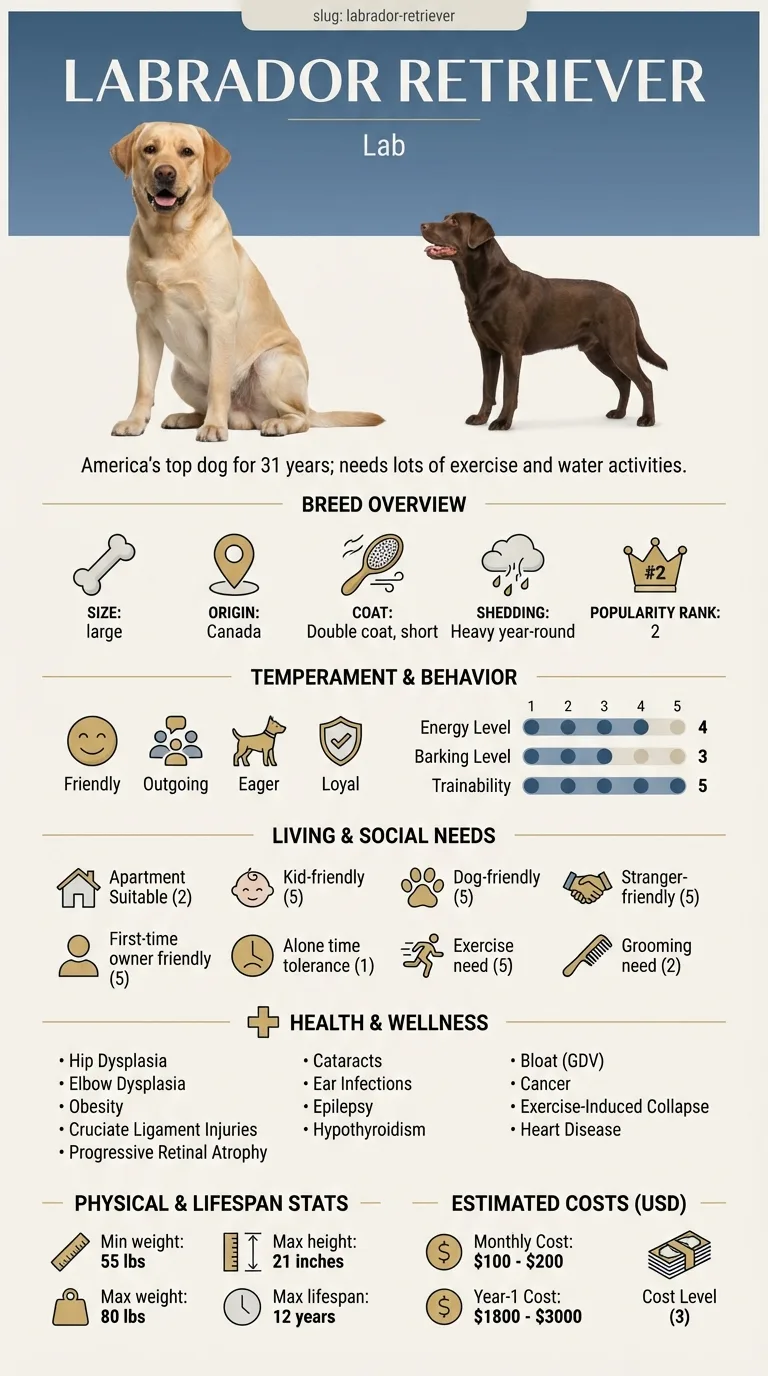
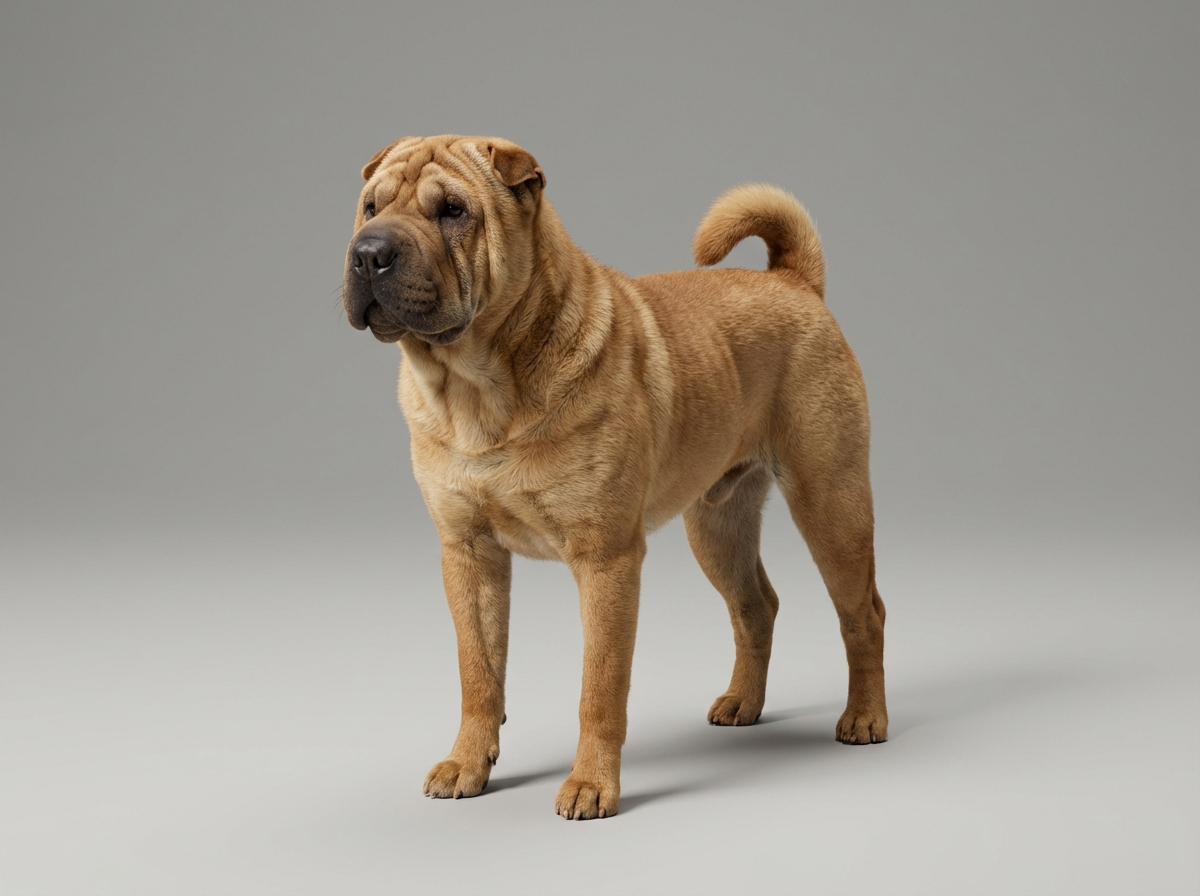
The Labrador Retriever outsizes the Shar-Pei clearly, 55-80 lbs and 21-24 inches against the Shar-Pei's 45-60 lbs and 18-20 inches, placing the Lab in the large class versus the Shar-Pei's medium. That said, the overlap at the edges -- a big Shar-Pei can weigh close to a small Lab -- means the gap is less extreme than the size-class labels alone suggest. The Labrador's smooth, athletic build and double coat give it a classic sporting-dog silhouette, while the Shar-Pei's dense, wrinkled frame stays visually distinct at any weight. Buyers should still expect the Lab to need meaningfully more space and a sturdier crate than the Shar-Pei.
The Labrador Retriever's Very high (5/5) exercise need reflects its Eager, Outgoing sporting heritage -- this is a breed built to retrieve, swim, and run for hours. The Shar-Pei's Low (2/5) rating sits at the far opposite end, and its Calm, Independent temperament means it won't push for the activity level a Lab craves. Labs left under-exercised are famously prone to weight gain and destructive boredom, a risk directly tied to the breed's own obesity listing among its health concerns, while the naturally lower-drive Shar-Pei faces no comparable exercise-related risk. This gap alone should steer most of the decision between these two breeds.
Grooming ties at Low (2/5) for both breeds, but shedding is a different story -- the Labrador's dense double coat rates High (4/5) against the Shar-Pei's Low (2/5), meaning Labs shed substantially more hair despite requiring similarly minimal brushing effort. That combination -- low grooming labor but high shed volume -- is common in double-coated retrievers and catches some new owners off guard, since easy to groom doesn't mean hair-free house. The Shar-Pei's short, harsh coat sheds less overall but adds its own specialized fold-cleaning routine that the smooth-shedding Lab never requires.
The Shar-Pei rates considerably better on apartment suitability, High (4/5) against the Labrador's Low (2/5), driven primarily by the Lab's Very high exercise needs rather than noise -- the Lab's Moderate (3/5) barking isn't far off the Shar-Pei's Low (2/5). The bigger contrast shows up in solitude tolerance: the Labrador rates Very low (1/5) for tolerating being alone, among the lowest scores in this dataset, reflecting its intensely Loyal, people-focused nature, while the Shar-Pei's Moderate (3/5) makes it considerably more self-sufficient during long workdays. A Lab left alone often in a small space is a tougher combination than its friendly reputation might suggest.
Both trainability and first-time-owner suitability heavily favor the Labrador Retriever, rated Very high (5/5) on each against the Shar-Pei's Low (2/5), making the Lab one of the most consistently beginner-friendly large breeds tracked on this site. Its Eager, Friendly temperament was effectively bred for exactly this kind of trainability, thriving on repetition and positive reinforcement. The Shar-Pei's Independent streak means training moves at a fundamentally slower pace and rewards patience rather than repetition-based methods. A first-time owner choosing the Lab over the Shar-Pei will almost certainly have an easier path through basic obedience and household manners.
The Labrador Retriever posts some of the strongest social scores in this entire comparison set: Very high (5/5) with kids, Very high (5/5) with other dogs, and Very high (5/5) with strangers, all decisively ahead of the Shar-Pei's Moderate (3/5), Low (2/5), and Low (2/5). Its Friendly, Outgoing, Loyal temperament makes it a dog that greets nearly everyone warmly, while the Shar-Pei's Reserved nature keeps it more selective about who earns its trust. For households with kids, other pets, or frequent visitors, the Labrador is about as close to a universally easy social fit as this comparison offers, a bar the Shar-Pei doesn't attempt to clear.
Lifespans land close, 10-12 years for the Labrador against 8-12 for the Shar-Pei, but the Lab carries the longest health list among all ten pairings in this batch -- thirteen conditions including hip and elbow dysplasia, obesity, cruciate ligament injuries, cancer, bloat, epilepsy, heart disease, and exercise-induced collapse. Two conditions, ear infections and hypothyroidism, appear on both breeds' lists, meaning owners of either dog should stay attentive to ear and thyroid health. The Shar-Pei's remaining conditions, skin fold dermatitis, entropion, and Familial Shar-Pei Fever, trace back specifically to its wrinkled structure and have no Labrador parallel.
The Labrador actually rates a lower general cost level than the Shar-Pei, Moderate (3/5) against High (4/5), even though their typical monthly costs tie at $100-$200 and their first-year figures sit fairly close -- $1,800-$3,000 for the Lab versus $1,400-$2,900 for the Shar-Pei. Much of the Lab's cost concentrates on food volume for its larger frame and preventive care given its long list of breed-associated conditions, particularly weight and joint management. The Shar-Pei's costs lean toward specialized skin-fold care and ear-infection treatment despite its smaller size, a reminder that overall cost level doesn't always track directly with body size.
Chinese Shar-Pei weighs 45–60 lbs and lives 8–12 years; Labrador Retriever weighs 55–80 lbs and lives 10–12 years. The two diverge most on exercise need, good for first-time owners and trainability and 7 other rated axes. Almost every rated axis separates them at least slightly. In the table, a "winner" means easier for an ordinary household — not better. Size, coat and origin are recorded without a verdict. Because both breeds are scored the same way, the gaps are reliable even where the absolute numbers are rough.

The Labrador Retriever, rated Very high (5/5) for first-time owners against the Shar-Pei's Low (2/5).
The Shar-Pei, rated Moderate (3/5) against the Labrador's Very low (1/5) -- Labs are prone to separation-related stress given their Loyal, people-oriented nature.
The Labrador Retriever, rated High (4/5) versus the Shar-Pei's Low (2/5), despite both breeds tying on overall grooming effort.
Labrador Retrievers, rated Very high (5/5) with other dogs against the Shar-Pei's Low (2/5).
The Labrador Retriever, with thirteen flagged conditions including cancer, bloat, and cruciate ligament injuries, compared to the Shar-Pei's five.
The Labrador rates a lower general cost level (Moderate vs High), though the two breeds' actual first-year dollar ranges are fairly close.
The Labrador Retriever by a wide margin, rated Very high (5/5) versus the Shar-Pei's Low (2/5).
The Labrador Retriever, rated Very high (5/5) against the Shar-Pei's Low (2/5).
The Labrador Retriever, rated Very high (5/5) versus the Shar-Pei's Low (2/5).
The Shar-Pei, rated High (4/5) on apartment suitability against the Labrador's Low (2/5).
The Shar-Pei, with Low (2/5) energy versus the Labrador's High (4/5).
Secure checkout on Stripe. We never see your card.
7-day money-back guarantee. Instant access.
Health information here is general and is not veterinary advice. If your dog shows pain, sudden behaviour change, or worsening symptoms, consult a licensed veterinarian.
Some links on this site are affiliate links. We may earn a commission at no extra cost to you, and we only suggest products we believe are helpful for dog owners.
We research and check what we publish, but we do not warrant that any figure, date, price, or statement is accurate, complete, or current, and we accept no liability for any loss, cost, injury, or other harm arising from the use of this site. Use it as one reference among several. You remain responsible for your own decisions and for your dog's care - confirm anything that matters with a licensed veterinarian or another qualified professional before you act on it. Full disclaimer.
Match your lifestyle to the right dog.
Take quizNot sure which breed is right for you? Take our 2-minute quiz to find out.
Take the quiz