Health
What's the single clearest sign of bloat?
A tight, visibly swollen abdomen paired with unproductive retching is the clearest combination; either sign alone still warrants urgent attention.

Quick answer
What's the single clearest sign of bloat?
A tight, visibly swollen abdomen paired with unproductive retching is the clearest combination; either sign alone still warrants urgent attention.
A distended, drum-tight belly and dry, unproductive retching are the two signs that should move you to the emergency vet immediately, with no waiting to see if it passes.
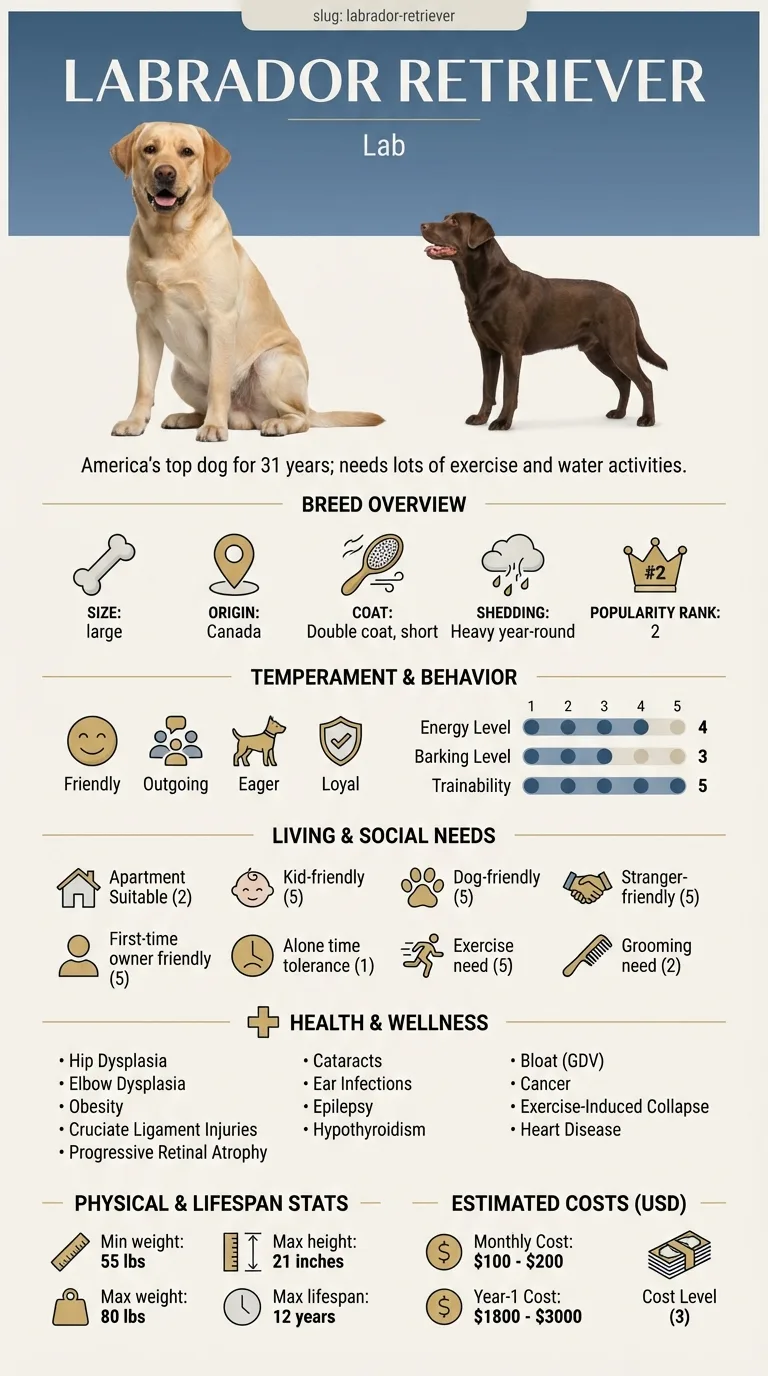
Every Labrador owner should know these signs, but it matters most for owners of large, deep-chested, adult dogs, and especially those who feed one large daily meal or have a dog that eats quickly.
This guide is not medical advice. If your dog shows pain, sudden behavior change, or worsening symptoms, consult a licensed veterinarian.
Some links may be affiliate links. We may earn a commission at no extra cost to you. We only suggest products we believe are helpful for dog owners.
We research and check what we publish, but we do not warrant that any figure, date, price, or statement is accurate, complete, or current, and we accept no liability for any loss, cost, injury, or other harm arising from the use of this site. Use it as one reference among several. You remain responsible for your own decisions and for your dog's care - confirm anything that matters with a licensed veterinarian or another qualified professional before you act on it. Full disclaimer.
Check this first
Once a stomach twists, it cuts off its own blood supply and begins to compromise the spleen and surrounding tissue almost immediately. There is no effective home treatment and no medication that resolves this; surgery is the only path to survival once volvulus has occurred. The gap between a dog that's retching but otherwise standing and one that's in true shock can be a matter of one to two hours, which is why "let's watch him for a bit" is the single most dangerous response an owner can have to these specific signs.
If any of these apply, call your vet or an emergency clinic now. The rest of this page is for the cases that are not an emergency.
Bloat, or gastric dilatation-volvulus, is a sudden, life-threatening emergency where a dog's stomach fills with gas and twists, cutting off its own blood supply. In Labrador Retrievers, a documented at-risk breed given their size and chest depth, recognizing the specific early signs, a distended abdomen and unproductive retching, within the first hour is the single most important factor in survival.
Bloat is specifically documented as a real risk for large, deep-chested breeds including Labrador Retrievers, making early symptom recognition genuinely essential knowledge rather than a low-probability worry to set aside.
Labrador Retrievers' size and chest depth place them among the breeds where bloat is a documented, genuine risk, distinct from smaller or more shallow-chested breeds where it's far less common.
Fast eating, large single meals, vigorous exercise too close to feeding time, and stressful mealtime environments where a dog gulps its food are the main environmental triggers that raise the odds of an episode occurring.
This is not a "talk to the vet this week" situation. The moment you see a distended abdomen combined with unproductive retching or clear distress, go to an emergency vet immediately, calling ahead if you can so they're ready when you arrive.
See all Labrador Retriever health problems, which breeds are prone to bloat gdv, or the full Labrador Retriever breed guide for temperament, exercise needs and ownership costs.
From first symptom to needing surgery can be as short as one to two hours. There is no "monitor overnight" version of this condition; the realistic timeline is measured in minutes to a couple of hours, not days.
Success is recognizing the signs immediately and being in an emergency vet's hands within the hour, since speed of recognition and response is the factor most within an owner's control and most tied to survival.
These are the specific signs that separate bloat from ordinary stomach upset, and they tend to appear together rather than one at a time:
If you think your Lab has bloat, the plan is three steps: write down what you have seen and when it started, book a veterinary appointment rather than waiting for the next flare, and take video of the behaviour or symptom before you go — the thing you are worried about rarely happens in the consulting room. Screening in the parents covers hip dysplasia, elbow dysplasia, obesity.
What the vet visit should produce is a diagnosis and a written plan, not just reassurance: what is being ruled out, what the monitoring interval is, and which signs mean you come back sooner. Ask what the treatment costs across a year rather than per visit, because that is the number that decides whether you are managing this condition or reacting to it.
Between appointments, keep a short log — dates, what you saw, what changed. It is the single most useful thing an owner brings to a follow-up, and for bloat it is often what separates a clear pattern from a guess.
Delta, a five-year-old Labrador, woke her owners at midnight pacing and unable to settle, drooling more than usual, and gagging without producing anything. Her owner, who had read about bloat signs specifically because Delta was a large, deep-chested breed, recognized the pattern immediately rather than assuming it was a minor stomach upset. They were at the emergency clinic within twenty minutes, and X-rays confirmed early-stage volvulus, caught before significant tissue damage had occurred. Delta went into surgery that night and recovered fully. Her owner credits knowing the exact signs in advance, rather than trying to figure them out in the moment, with the fast decision that likely saved her life.
Key takeaway: Knowing bloat's specific signs before you ever need them, and acting the instant you see them, is the single biggest factor an owner controls in this emergency.
A visibly swollen, tight abdomen and repeated unproductive retching, gagging without bringing anything up, are the two earliest and most reliable signs, often appearing together within the same short window.
It can start subtly, but the combination of a distended belly with dry retching specifically, rather than normal vomiting, is the key distinguishing feature that separates it from routine indigestion.
It can move from early signs to life-threatening shock within one to two hours. There's no safe amount of time to wait and see if symptoms resolve on their own.
Go to an emergency vet immediately, call ahead if possible so they can prepare, and don't attempt any home remedies, since there is nothing safe or effective to do outside a veterinary setting.
Without surgical intervention, bloat is very often fatal. With prompt treatment, especially when caught in the early stages before significant tissue damage, survival rates are considerably better.
Yes, simple gastric dilatation without volvulus (twisting) can occur and is less immediately dangerous, but it still needs urgent veterinary evaluation since it can progress to full volvulus at any point.
It has no fixed schedule, but cases are often reported in the hours after a large meal or vigorous activity, and frequently overnight, which is part of why every owner should know the signs cold rather than relying on daytime vet office hours.
A tight, visibly swollen abdomen paired with unproductive retching is the clearest combination; either sign alone still warrants urgent attention.
No. This is a same-hour emergency; waiting to see if symptoms resolve is the most common and most dangerous mistake owners make.
No, there is no safe or effective home treatment. Go directly to an emergency vet the moment you suspect it.
Not necessarily on its own, but classic bloat presents with visible distension; if retching and distress continue without that sign, it still warrants an urgent vet call.
Learn the specific combination of distended belly and dry retching now, before an emergency, so you recognize it instantly rather than trying to recall symptoms under pressure.
A one-page prep sheet for this condition: the signs, the questions to ask, what to get priced. Unlocks here.
You get: Vet visit prep sheet
No spam. One-click unsubscribe. See our privacy policy.
Preview page 1 before you decide.