Health
What autoimmune condition is most likely in a GSP?
Immune-mediated thyroiditis, which produces hypothyroidism. It is on the breed's documented health list and is highly treatable once found.

Quick answer
What autoimmune condition is most likely in a GSP?
Immune-mediated thyroiditis, which produces hypothyroidism. It is on the breed's documented health list and is highly treatable once found.
In this breed the most likely version is the quiet one. A GSP losing condition and enthusiasm over a season is a more realistic picture than a dog covered in lesions.
Owners of middle-aged pointers who have watched the dog become slower, heavier and less interested over several months with no obvious cause, and owners facing a sudden, frightening collapse with pale gums.
This guide is not medical advice. If your dog shows pain, sudden behavior change, or worsening symptoms, consult a licensed veterinarian.
Some links may be affiliate links. We may earn a commission at no extra cost to you. We only suggest products we believe are helpful for dog owners.
We research and check what we publish, but we do not warrant that any figure, date, price, or statement is accurate, complete, or current, and we accept no liability for any loss, cost, injury, or other harm arising from the use of this site. Use it as one reference among several. You remain responsible for your own decisions and for your dog's care - confirm anything that matters with a licensed veterinarian or another qualified professional before you act on it. Full disclaimer.
In autoimmune disease the immune system attacks the body's own tissue. The German Shorthaired Pointer's best-documented example is thyroid destruction leading to hypothyroidism, a slow condition that reads as ageing. The faster, more dangerous versions attack blood cells and present as sudden weakness with pale gums, which is an emergency.
Hypothyroidism, the usual endpoint of immune-mediated thyroiditis, is common enough to appear on the German Shorthaired Pointer's documented health list, and typically shows between about four and eight years of age. The blood-cell and joint forms are uncommon in any breed, and the classic autoimmune skin diseases are rare in GSPs.
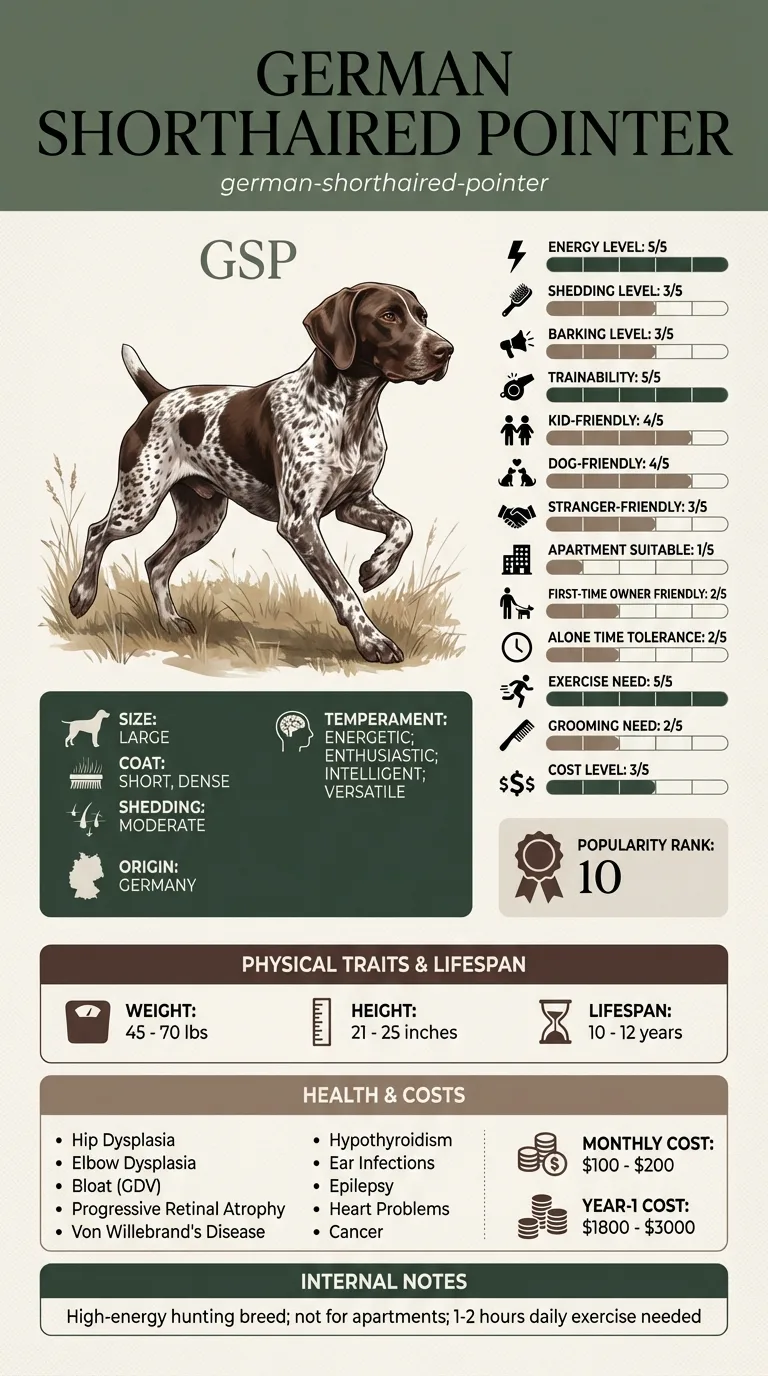
The German Shorthaired Pointer's inherited contribution is concentrated in the thyroid. Hypothyroidism sits on the breed's documented health list, and in dogs it is usually the result of the immune system destroying gland tissue over months or years. The breed's temperament shapes how it presents rather than whether it occurs: in a dog rated at the top of the scale for energy and exercise need, a fall in drive is a far louder signal than the same change would be in a placid breed, which is the one diagnostic advantage GSP owners have.
Nothing in a dog's environment reliably causes immune-mediated disease, and owners should be cautious of explanations that promise otherwise. What environment does influence is timing and detection: a working GSP's performance drop is noticed sooner than a pet's, tick-borne infections picked up in field cover can precede an immune flare and must be excluded, and dogs on immune-suppressing treatment need cleaner conditions and closer monitoring than they did before.
Book a blood panel for any GSP that has been slower, heavier or duller for more than a month with no explanation, and ask specifically that thyroid testing be included. Go to an emergency clinic immediately, without waiting for an appointment, for pale, white or yellow gums, sudden weakness or collapse, laboured breathing at rest, dark or orange-coloured urine, or pinpoint red spots and unexplained bruising on the gums and belly. Immune-mediated destruction of blood cells can go from a slightly off dog to a critical one inside a day, and it is one of the situations where hours genuinely matter.
See all German Shorthaired Pointer health problems, which breeds are prone to autoimmune diseases, or the full German Shorthaired Pointer breed guide for temperament, exercise needs and ownership costs.
Thyroid replacement usually shows a change in energy within four to six weeks, with coat improvement taking three to six months and dose adjustments guided by repeat blood tests. The blood-cell conditions are different in character: the crisis is resolved over days in hospital, then months of gradual medication reduction, with relapse a real possibility that needs watching for.
For thyroid disease, success is total: a dog back at full working capacity on a daily tablet, with a stable weight and a coat that has grown back in. For the immune-suppressed conditions, success is a dog in remission on the lowest medication dose that holds it, and an owner who recognises a relapse in its first day rather than its third.
Autoimmune disease is a family rather than a single condition. These are the versions a German Shorthaired Pointer owner is most likely to encounter, roughly in order of how often they turn up.
Immune-mediated thyroiditis is the most realistic autoimmune diagnosis in this breed, and it is missed constantly because none of its signs are alarming on their own. The gland is destroyed gradually, over months to years, and produces less and less hormone. The dog does not become ill. It becomes slower.
What owners describe is a dog that has gone off the pace, put on weight on the same food, grown a duller coat with thinning over the flanks and tail, and started seeking out warm places. In any other breed that reads as middle age. In a German Shorthaired Pointer, rated at the maximum for energy and exercise need, a dog that would rather not go out is genuinely abnormal, and that is the signal owners should not talk themselves out of.
The good news attached to this particular diagnosis is that it is one of the most treatable problems in veterinary medicine. Hormone replacement, monitored with periodic blood tests, restores most dogs to normal function. The damage to the gland does not reverse, but the consequences of it can be corrected almost entirely.

If you think your GSP has autoimmune diseases, the plan is three steps: write down what you have seen and when it started, book a veterinary appointment rather than waiting for the next flare, and take video of the behaviour or symptom before you go — the thing you are worried about rarely happens in the consulting room. Screening in the parents covers hip dysplasia, elbow dysplasia, bloat (gdv).
What the vet visit should produce is a diagnosis and a written plan, not just reassurance: what is being ruled out, what the monitoring interval is, and which signs mean you come back sooner. Ask what the treatment costs across a year rather than per visit, because that is the number that decides whether you are managing this condition or reacting to it.
Between appointments, keep a short log — dates, what you saw, what changed. It is the single most useful thing an owner brings to a follow-up, and for autoimmune diseases it is often what separates a clear pattern from a guess.
Wren was six, and her handler had spent an autumn making excuses. She was fine at the start of a morning and out of it by the second hour. She had gained four pounds without a change of food. Her coat had gone slightly harsh across the flanks. He put it down to age until a friend pointed out that six is not old for a breed that lives ten to twelve years. Her blood panel showed clear hypothyroidism, and the follow-up antibody test confirmed immune-mediated thyroiditis. She started daily hormone replacement with a recheck at eight weeks to fine-tune the dose. By midwinter she was working full mornings again. The four pounds came off over three months. Her coat took most of a year to come fully back, which her handler had not expected, but by the following season she was, in his words, the dog he had two years earlier.
Key takeaway: The loudest symptom was one nobody thinks to report. In a breed this driven, a dog choosing to stop is data, and it should not be filed under getting older until the bloodwork says so.
The breed's documented health list includes hypothyroidism, which is usually immune-mediated in dogs. Beyond that, GSPs are not flagged as an especially autoimmune-prone breed. Most autoimmune conditions occur across many breeds rather than clustering in this one.
A sustained drop in energy in a dog that is normally relentless. That single change, held for several weeks with no explanation, is worth a blood panel that includes thyroid testing. It is easier to investigate early than to explain away for a year.
By ruling out infection and cancer first, then by finding the specific fingerprint: hormone levels and antibodies for thyroid disease, blood films and cell counts for anaemia and platelet destruction, joint fluid sampling for joint disease. There is no single autoimmune test.
For thyroid disease, yes, but it is a daily tablet and periodic bloodwork rather than a burden. For the conditions treated by suppressing the immune system, many dogs are eventually tapered down, though some relapse and need long-term medication.
A well-controlled hypothyroid dog usually returns to full work, and owners often say the dog is better than it was for the year before diagnosis. Dogs on immune-suppressing treatment need their vet's guidance, since suppressed immunity and muddy fields are a poor combination.
No. Immune-mediated disease reflects an inherited tendency plus triggers nobody can identify reliably. Owners frequently blame a recent vaccine, a diet change or a stressful event, and there is rarely evidence for any of it.
Immune-mediated thyroiditis, which produces hypothyroidism. It is on the breed's documented health list and is highly treatable once found.
Pale or yellow gums with weakness and fast breathing. That suggests red cells being destroyed and needs an emergency clinic immediately.
Thyroid replacement is inexpensive with periodic monitoring bloods. Immune-suppressing treatment costs considerably more, especially in the first months of frequent rechecks.
An untreated hypothyroid dog often seems flat or unusually irritable. Most owners describe the old dog coming back within a couple of months of starting treatment.
A one-page prep sheet for this condition: the signs, the questions to ask, what to get priced. Unlocks here.
You get: Vet visit prep sheet
No spam. One-click unsubscribe. See our privacy policy.
Preview page 1 before you decide.