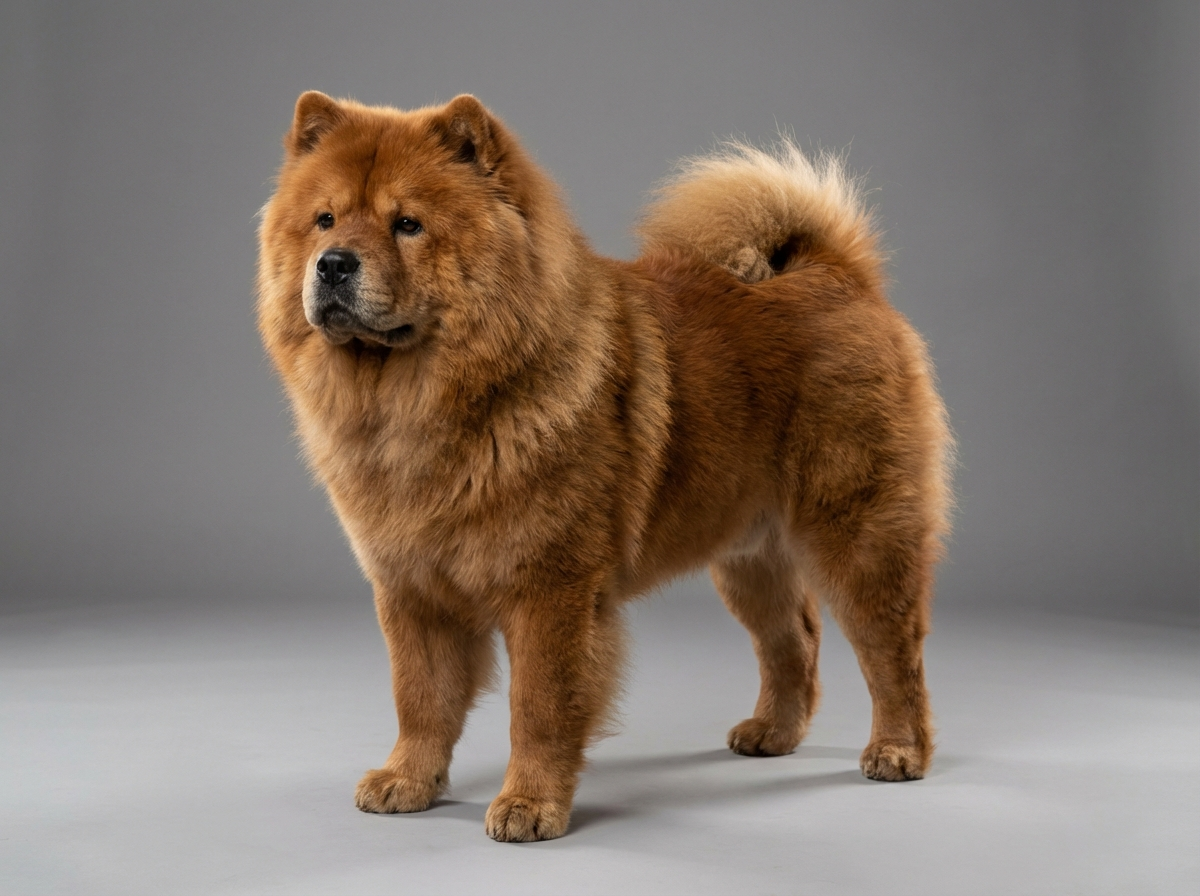
Health
Are mixed breed dogs genuinely healthier?
They carry fewer recessive single-gene diseases on average. They do not escape conformational problems, which is most of what affects Chow Chows.

Quick answer
Are mixed breed dogs genuinely healthier?
They carry fewer recessive single-gene diseases on average. They do not escape conformational problems, which is most of what affects Chow Chows.
Crossbreeding dilutes recessive disease. It does not dilute anatomy, and most of what troubles a Chow Chow is anatomy.
People deciding between a purebred Chow puppy and a Chow cross from a rescue, and owners of a mix trying to work out which breed's health list applies to their dog.
This guide is not medical advice. If your dog shows pain, sudden behavior change, or worsening symptoms, consult a licensed veterinarian.
Some links may be affiliate links. We may earn a commission at no extra cost to you. We only suggest products we believe are helpful for dog owners.
We research and check what we publish, but we do not warrant that any figure, date, price, or statement is accurate, complete, or current, and we accept no liability for any loss, cost, injury, or other harm arising from the use of this site. Use it as one reference among several. You remain responsible for your own decisions and for your dog's care - confirm anything that matters with a licensed veterinarian or another qualified professional before you act on it. Full disclaimer.
The purebred versus mixed debate is usually conducted with pooled statistics that describe no individual dog. The more useful framing separates two kinds of inherited risk: recessive single-gene diseases, which genuine outcrossing does dilute, and conformational traits, which pass to any offspring that inherits the shape. For the Chow Chow, the second category dominates.
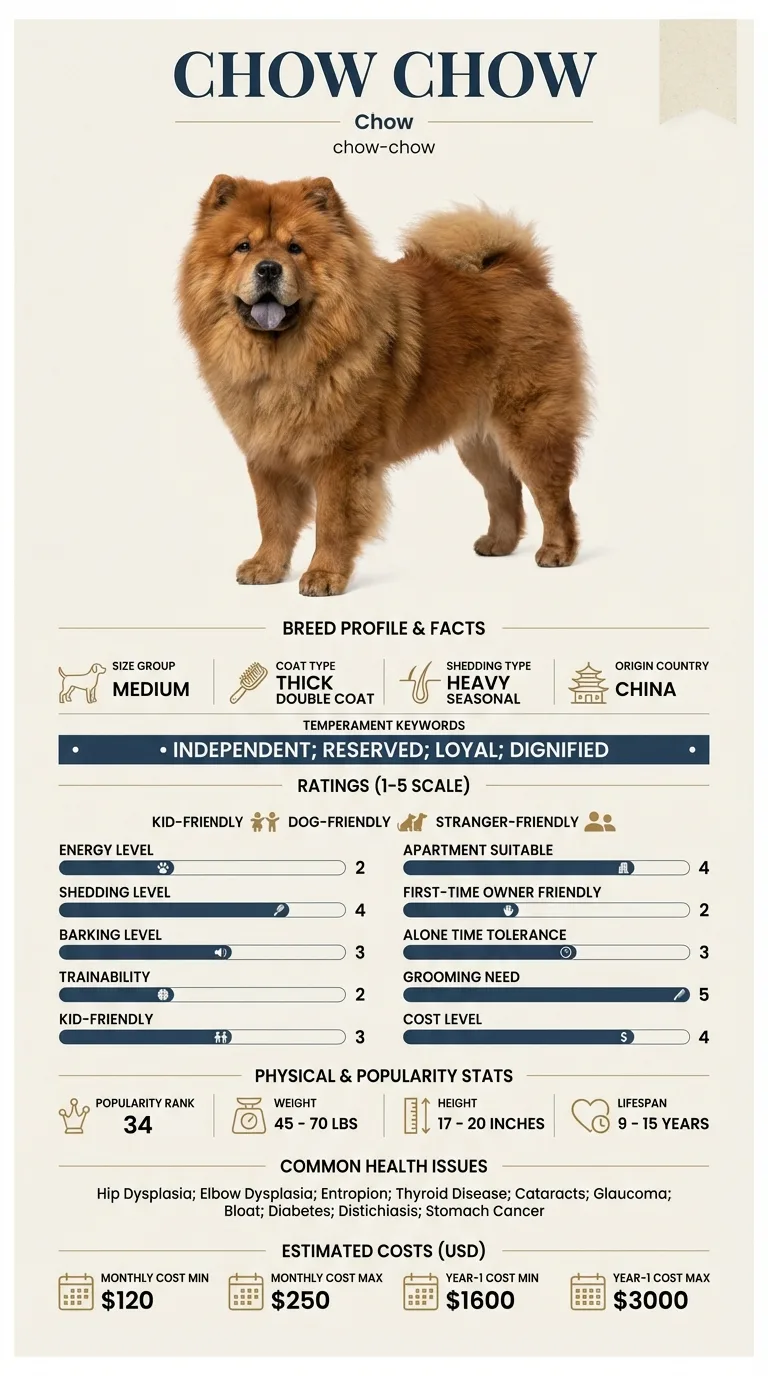
Of the ten documented Chow Chow health issues, the majority are either conformational or polygenic: hip dysplasia, elbow dysplasia, entropion, distichiasis, cataracts, glaucoma, thyroid disease, bloat, diabetes and stomach cancer. That composition is why crossbreeding offers less protection here than it would in a breed dominated by simple recessive conditions.
The Chow's problem profile is unusually structural, which is exactly what makes crossbreeding a weaker protection here. A broad, flat skull with a small deeply set eye produces entropion and distichiasis mechanically. A dense double coat and shortened muzzle produce heat intolerance thermodynamically. A heavily boned 45 to 70 pound body on a 17 to 20 inch frame loads the hips and elbows. None of those is a recessive gene waiting to be diluted; they are the dog's shape, and shape is inherited visibly. The temperament traits, rated 2 out of 5 for stranger friendliness and dog friendliness, are more variable in crosses but are certainly not guaranteed to disappear.
Where a dog comes from often matters more than what it is. A well-screened purebred from a breeder who tests hips, elbows, eyes and thyroid is a lower-risk proposition than an unscreened cross from a volume producer, and vice versa. Rescue introduces a different variable: unknown history, but an adult dog whose current joints, eyes and gait can be assessed directly. And in every case, the household's climate, flooring, feeding and veterinary routine influence outcomes at least as much as the pedigree does.
Nothing about this comparison is urgent, but two breed-derived warnings apply to any dog carrying Chow anatomy, whatever its pedigree. First, bloat: a swollen, hard abdomen with unproductive retching in a deep-chested dog is a surgical emergency measured in hours, and it is documented in this breed. Second, eyes: a suddenly painful, cloudy or enlarged eye needs same-day care, because glaucoma is documented and blinds within hours. Beyond those, book a normal appointment for persistent vomiting, unexplained weight loss or appetite change in an older dog, since stomach cancer is on the documented list and early investigation matters. Never assume a mixed dog is exempt from a breed's conformational problems.
See all Chow Chow health problems, which breeds are prone to purebred vs mixed breeds, or the full Chow Chow breed guide for temperament, exercise needs and ownership costs.
Screening a prospective purebred's parents takes days of correspondence. Assessing a rescue adult takes one veterinary appointment. Neither produces certainty, and the honest expectation is a better-informed choice rather than a guaranteed healthy dog.
Success is choosing a dog whose visible traits and documented screening you understand, and setting up a household suited to those traits. It is not selecting the category, purebred or mixed, that a statistic favoured.
The useful question is never purebred versus mixed in the abstract. It is which specific traits this individual dog inherited, and you can see most of them by looking at the dog.
Figures comparing cancer rates between purebred and mixed dogs circulate widely, often as a single ratio. Treat them carefully. Cancer risk varies enormously between breeds, so a pooled purebred average is a number that describes no actual breed: it blends high-risk breeds with low-risk ones into a figure that applies to neither. The same pooling problem applies on the mixed side, where a cross of two low-risk breeds and a cross of two high-risk breeds are counted together.
There is a further complication. Purebred dogs are, on average, more likely to be insured, more likely to see a vet regularly and more likely to have a diagnosis recorded rather than an unexplained decline. Better diagnosis produces higher recorded rates, which is a genuine confounder in almost every dataset of this kind.
What can be said with more confidence is breed-specific. Stomach cancer appears among the ten documented Chow Chow health issues, which is a meaningful piece of information about this breed rather than about purebreds in general. If you are weighing a Chow against a Chow cross, that specific fact is more useful than any pooled ratio, because you can act on it: know the signs, take chronic vomiting seriously, and do not assume an older dog off his food is simply ageing.

Bandit was advertised as a Chow crossed with a Labrador, adopted at nine months by Ottilie, who had chosen a mix specifically because she had read that crosses avoided breed health problems. He had a Labrador's build and weight and a coat somewhere between the two. What he had inherited from his Chow parent was the head. His skull was broad, his eyes sat deep beneath a heavy brow, and by eighteen months he had entropion on both lower lids requiring surgical correction. What he had genuinely escaped was the coat. Bandit swims, tolerates summer without difficulty, and takes twenty minutes to dry. Ottilie's conclusion, which she offers to anyone who asks, is that the cross gave her a completely different heat problem and exactly the same eye problem, and that nobody had told her which risks travel with shape.
Key takeaway: Crossbreeding shuffles the deck; it does not remove the cards. Look at which traits your particular dog actually inherited, because those are the risks you have bought.
On average, mixes carry a lower burden of recessive single-gene disease, which is a real advantage. They do not escape conditions driven by conformation, and a mix that inherited a Chow head, a Chow coat and a heavy build carries most of the risks that matter in this breed.
Any that follow from shape. Entropion and distichiasis follow the eyelid and skull, heat intolerance follows the coat and muzzle, and hip and elbow dysplasia follow build and growth. All four categories are on the breed's documented list and all four can cross.
Only if the parent breeds are genuinely unrelated and the crossing continues. A first cross between two distinct breeds gains genuine diversity. Breeding those crosses back to each other in a small closed population recreates the original problem within a few generations.
Yes, and it is arguably more useful than a pedigree. Hips and elbows can be radiographed, eyes can be examined by an ophthalmologist, and thyroid can be tested, all on any dog regardless of ancestry. Screening tells you about the individual, which is what you actually needed.
It appears among the ten documented Chow Chow health issues, which places it in the category of things worth knowing about. Practically that means taking chronic vomiting, weight loss and appetite change in an older Chow seriously rather than attributing them to age.
For a veterinary assessment of gait and eyes, a current weight, and any known history. Then look at the dog: the shape of the eyelids, the density of the coat and the way the hind end moves tell you more about its likely future than the breed label on the kennel card.
They carry fewer recessive single-gene diseases on average. They do not escape conformational problems, which is most of what affects Chow Chows.
If it inherited the dense double coat and shortened muzzle, yes. Heat tolerance follows the coat, not the pedigree.
Yes. Hips, elbows, eyes and thyroid can all be assessed on any dog. Screening the individual beats guessing from ancestry.
Stomach cancer is among the Chow Chow's ten documented health issues, which makes chronic vomiting or appetite change in an older dog worth investigating properly.
A one-page prep sheet for this condition: the signs, the questions to ask, what to get priced. Unlocks here.
You get: Vet visit prep sheet
No spam. One-click unsubscribe. See our privacy policy.
Preview page 1 before you decide.