Behavior
Which is the better overall choice?
For sheer practicality in a small space, the yorkie's size and trainability make it the easier dog. The chow suits someone specifically drawn to a bigger, more independent, lower-energy breed.

Quick answer
Which is the better overall choice?
For sheer practicality in a small space, the yorkie's size and trainability make it the easier dog. The chow suits someone specifically drawn to a bigger, more independent, lower-energy breed.
Chow Chow or Yorkshire Terrier? On paper they differ most on shedding, and on the scales Chow Chow is the heavier at 45–70 lbs. Here is how the two compare on everything that shapes an ordinary week.
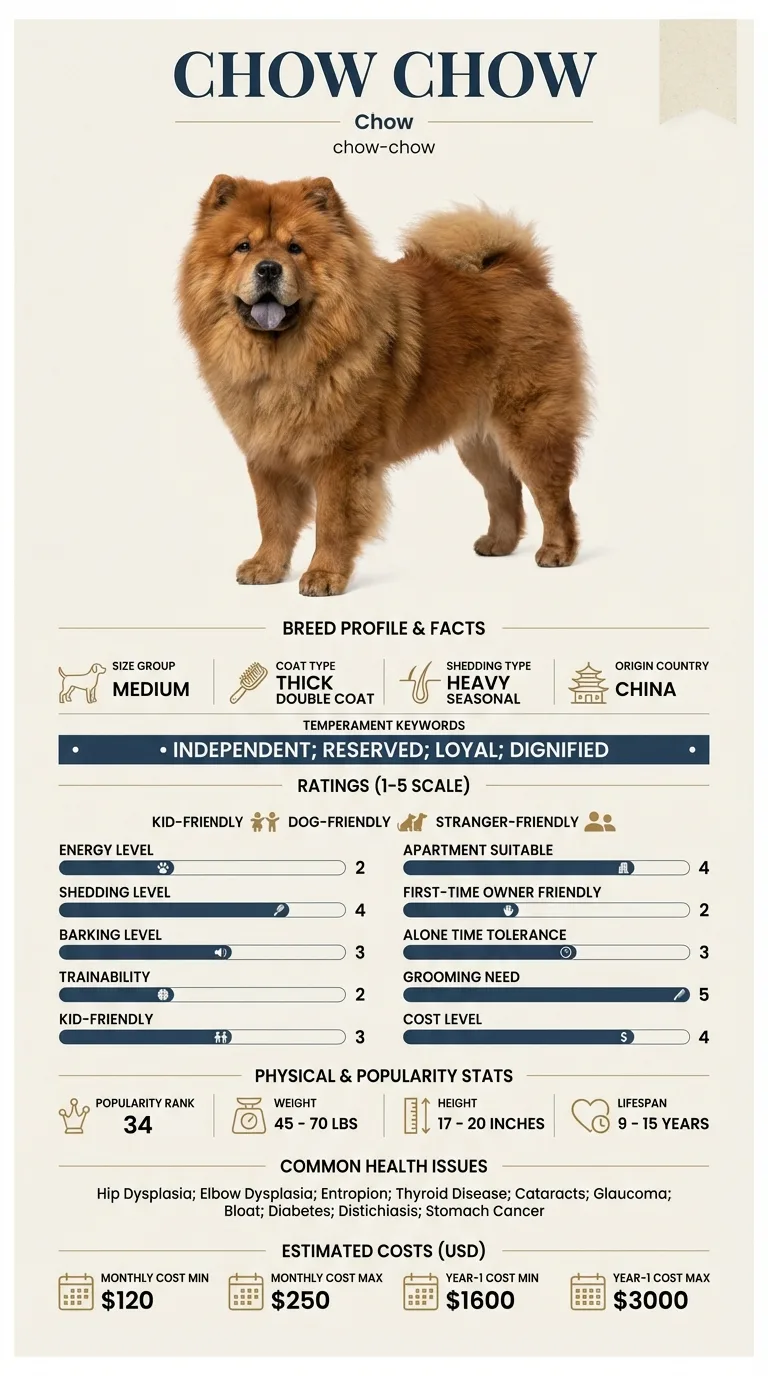
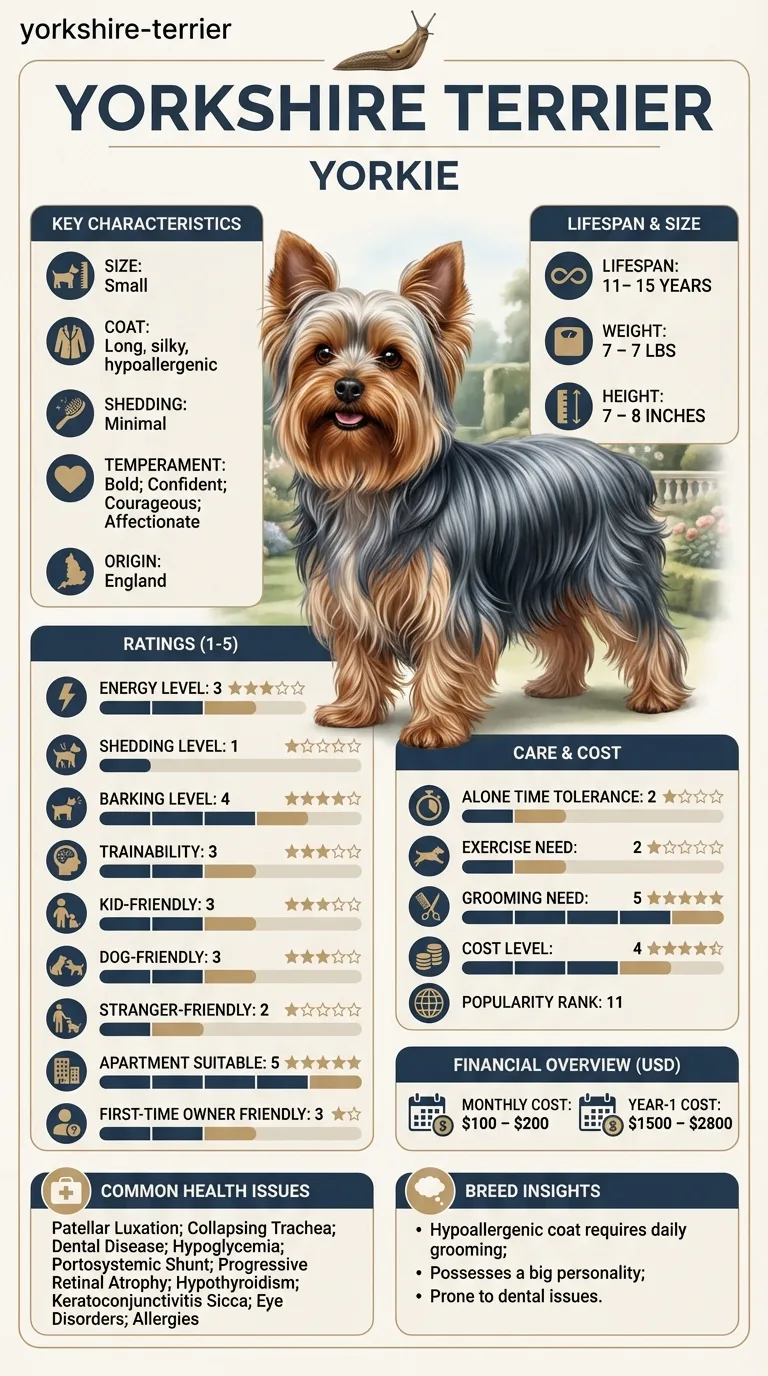
This is for someone already down to Chow Chow and Yorkshire Terrier and deciding between them. For this pair the decision usually turns on shedding, so those are covered first and in most detail. Anyone choosing from a flat has a clear answer here: Yorkshire Terrier rates 5/5 against 4/5. Breed history is left out; what follows is what you will actually live with.
Between Chow Chow and Yorkshire Terrier, shedding is what separates them, and Yorkshire Terrier is the lower-effort dog of the two to keep.
Choose Chow Chow if the dog will be alone during the working day.
Choose Yorkshire Terrier if you are in a flat or a smaller home, this is your first dog and shedding is a problem in your house.
| Feature | chow chow | yorkshire terrier | Winner |
|---|---|---|---|
| Size class | medium | small | Equal |
| Weight | 45–70 lbs | 4–7 lbs | Equal |
| Height | 17–20 in | 7–8 in | Equal |
| Lifespan | 9–15 years | 11–15 years | yorkshire terrier |
| Exercise need | Low (2/5) | Low (2/5) | Equal |
| Grooming need | Very high (5/5) | Very high (5/5) | Equal |
| Shedding | High (4/5) | Very low (1/5) | yorkshire terrier |
| Energy level | Low (2/5) | Moderate (3/5) | Equal |
| Barking | Moderate (3/5) | High (4/5) | chow chow |
| Apartment suitability | High (4/5) | Very high (5/5) | yorkshire terrier |
| Good for first-time owners | Low (2/5) | Moderate (3/5) | yorkshire terrier |
| Tolerates being alone | Moderate (3/5) | Low (2/5) | chow chow |
| Trainability | Low (2/5) | Moderate (3/5) | yorkshire terrier |
| Good with kids | Moderate (3/5) | Moderate (3/5) | Equal |
| Good with other dogs | Low (2/5) | Moderate (3/5) | yorkshire terrier |
| Friendly to strangers | Low (2/5) | Low (2/5) | Equal |
| Cost level | High (4/5) | High (4/5) | Equal |
| Coat | Thick double coat | Long, silky, hypoallergenic | Equal |
| Origin | China | England | Equal |
| Typical monthly cost | $120–$250 | $100–$190 | Equal |
| Typical first-year cost | $1,600–$3,000 | $1,400–$2,900 | Equal |
The size gap here is the most extreme in this entire batch: chow chow runs 45-70 lbs, Yorkshire terrier just 4-7 lbs -- a chow can outweigh a yorkie by ten times over. Height follows suit, 17-20 in against 7-8 in. Size class labels them medium and small, though "small" barely covers how tiny a yorkie actually is standing next to a chow.
Both rate low (2/5) on exercise need, a genuine tie, though the yorkie edges slightly higher on general energy level (moderate, 3/5, against the chow's low, 2/5) despite the exercise-need tie. Neither breed asks for serious daily activity; a short walk and some indoor play cover both. That extra spark of energy in the yorkie tends to show up as playfulness at home rather than a need to get outside and run.
Grooming need ties at very high (5/5) for both breeds, but the payoff is nowhere close. Yorkie sheds very low (1/5); chow sheds high (4/5). The yorkie's long, silky, often-called-hypoallergenic coat rewards regular brushing with almost no loose hair; the chow's dense double coat sheds regardless of how well you keep up with it. A yorkie's coat can even be left to grow long and silky show-style, which raises the grooming bar further still.
Yorkie rates very high (5/5) for apartment suitability against the chow's high (4/5), but it's also the louder dog -- high (4/5) barking against the chow's moderate (3/5) -- and tolerates being alone worse, low (2/5) versus moderate (3/5). Small-space living favors the yorkie on square footage, but a thin-walled apartment might favor the quieter, more self-sufficient chow instead, especially if your schedule leaves the dog home alone most weekdays.
Yorkie rates moderate (3/5) on trainability and moderate (3/5) for first-time owners; chow rates low (2/5) on both. Neither breed is an obedience star, but the yorkie's more workable temperament -- bold, confident, but ultimately affectionate -- gives a beginner a somewhat easier path than the chow's independence does. Short, food-motivated sessions tend to work better on the yorkie than the longer structured routines a chow generally tunes out.
This is one of the more even household-fit comparisons in the batch: both rate moderate (3/5) with kids and low (2/5) with strangers, a tie on both. The yorkie edges ahead with other dogs, moderate (3/5) against the chow's low (2/5), which tracks with the temperament data -- yorkie reads bold and confident, chow reads reserved and independent. Small children should still be supervised with a yorkie given its size, regardless of the temperament match.
Yorkie's lifespan tops out at 15 years with a higher floor too, 11-15 against the chow's 9-15. The two breeds don't overlap much on specific risks in this data: the chow's list centers on hip and elbow dysplasia, bloat and stomach cancer, while the yorkie's includes patellar luxation, collapsing trachea and portosystemic shunt -- small-breed-specific concerns the chow's list doesn't share.
Both rate high (4/5) on overall cost, a tie, but the dollar ranges favor the yorkie slightly -- $100-190 monthly against the chow's $120-250, and $1,400-2,900 in year one against $1,600-3,000. A smaller dog still eats and boards more cheaply even when both breeds demand comparable grooming attention. Professional grooming for a yorkie's coat can still add up quickly if you skip DIY maintenance between visits.
Chow Chow weighs 45–70 lbs and lives 9–15 years; Yorkshire Terrier weighs 4–7 lbs and lives 11–15 years. The two diverge most on shedding. They are level on cost level, exercise need and grooming need, so those cannot decide it. The comparison marks an easier option only where one exists. Facts like weight and country of origin are not scored. Both dogs are rated from the same dataset, which is what makes the numbers comparable with each other even though any individual dog sits somewhere inside its breed's range.

Dramatically bigger -- 45-70 lbs against just 4-7 lbs, close to a tenfold difference at the extremes. This is one of the largest size gaps you'll find in any breed comparison.
No, despite tying on grooming need (both very high, 5/5) -- the yorkie sheds very low (1/5) while the chow sheds high (4/5). Grooming effort and shedding output aren't the same thing here.
The chow chow -- moderate (3/5) barking against the yorkie's high (4/5). Yorkies have a reputation as vocal little dogs, and the data backs it up.
The yorkie is the better fit, rated moderate (3/5) for first-timers against the chow's low (2/5), with moderate (3/5) trainability against the chow's low (2/5).
The yorkie, modestly -- $100-190 a month against the chow's $120-250 -- even though both rate high (4/5) on overall cost due to grooming demands.
Not much directly, beyond a general thyroid-related concern (hypothyroidism for the yorkie, thyroid disease for the chow). The yorkie's risks lean toward small-breed issues like collapsing trachea and patellar luxation; the chow's lean toward bloat and joint dysplasia.
The yorkie edges ahead on the overall apartment score (very high, 5/5, versus high, 4/5), but it's also the louder, more alone-averse of the two -- worth weighing against the chow's quieter, more independent profile if noise is a concern.
For sheer practicality in a small space, the yorkie's size and trainability make it the easier dog. The chow suits someone specifically drawn to a bigger, more independent, lower-energy breed.
About $20-60 apart -- yorkie runs $100-190, chow $120-250, both driven mainly by grooming.
Both are low-key -- exercise need rates low (2/5) for each.
The yorkie, slightly -- up to 15 years with a higher floor (11 years) than the chow's wider 9-15 range.
Secure checkout on Stripe. We never see your card.
7-day money-back guarantee. Instant access.
Health information here is general and is not veterinary advice. If your dog shows pain, sudden behaviour change, or worsening symptoms, consult a licensed veterinarian.
Some links on this site are affiliate links. We may earn a commission at no extra cost to you, and we only suggest products we believe are helpful for dog owners.
We research and check what we publish, but we do not warrant that any figure, date, price, or statement is accurate, complete, or current, and we accept no liability for any loss, cost, injury, or other harm arising from the use of this site. Use it as one reference among several. You remain responsible for your own decisions and for your dog's care - confirm anything that matters with a licensed veterinarian or another qualified professional before you act on it. Full disclaimer.
Match your lifestyle to the right dog.
Take quizNot sure which breed is right for you? Take our 2-minute quiz to find out.
Take the quiz