Health
Why is arthritis hard to spot in this breed?
Because the Chow's normal gait is already short and stilted, so the usual stiff-walk clue is missing. Watch function and behaviour instead.

Quick answer
Why is arthritis hard to spot in this breed?
Because the Chow's normal gait is already short and stilted, so the usual stiff-walk clue is missing. Watch function and behaviour instead.
Most breeds tell you they are getting arthritic by developing a stiff, short-strided walk. The Chow Chow already walks that way. The breed's characteristic stilted rear gait is normal for the dog and abnormal for everything else, and that overlap is why owners routinely miss the first two years of joint pain.
Owners of middle-aged and older Chows, and owners of dogs whose weight has crept up. It is also a hard one for people who have owned the breed for years, because they know what a Chow walk looks like and are therefore the most likely to write off a genuine change as just how the breed moves.
This guide is not medical advice. If your dog shows pain, sudden behavior change, or worsening symptoms, consult a licensed veterinarian.
Some links may be affiliate links. We may earn a commission at no extra cost to you. We only suggest products we believe are helpful for dog owners.
We research and check what we publish, but we do not warrant that any figure, date, price, or statement is accurate, complete, or current, and we accept no liability for any loss, cost, injury, or other harm arising from the use of this site. Use it as one reference among several. You remain responsible for your own decisions and for your dog's care - confirm anything that matters with a licensed veterinarian or another qualified professional before you act on it. Full disclaimer.
Arthritis is the progressive loss of joint cartilage with associated pain, stiffness and reduced range of movement. In Chow Chows it most often develops secondary to hip or elbow dysplasia, both of which are documented in the breed, and it is typically identified late because the breed's naturally stilted gait masks the early changes owners are told to look for.
Degenerative joint disease is close to universal in older dogs of any breed, and in a breed carrying documented dysplasia in both the hip and the elbow it should be treated as expected rather than unlucky. What varies is not whether a Chow develops arthritic change, but at what age it starts limiting the dog's life.
Two documented conditions drive it directly. Hip dysplasia means the femoral head and socket do not fit properly, so contact pressure concentrates on a small area and wears it out. Elbow dysplasia describes several developmental abnormalities of the elbow joint that leave incongruent surfaces grinding against each other. Add the breed's straight-through rear conformation, which transmits concussion up the limb rather than absorbing it through flexion, and a solid body of forty-five to seventy pounds, and the mechanical bill comes due earlier than it would in a lighter, better-angulated dog.
Flooring matters more than most owners appreciate. Laminate, tile and polished boards force a dog with a stiff rear to make constant small stabilising efforts, and every slip is a jolt through a compromised joint. Stairs, particularly descending, load the elbows heavily. Sedentary indoor life without regular gentle movement allows the supporting muscle to waste, which leaves the joint doing more of the work. And because this breed's exercise need is genuinely low, it is easy for a Chow to become both underexercised and overweight without the owner noticing either.
Book an appointment for any lasting change in how the dog gets up, sits or manages stairs, for a new reluctance to be touched over the hips or shoulders, or for muscle wasting over one hind leg. Seek same-day help for a dog that is suddenly non-weight-bearing on one limb, for a leg that is hot and swollen, or for a dog that cries out on movement, since acute injury such as a ruptured ligament can happen on top of chronic arthritis and needs distinguishing from it. Never give a human anti-inflammatory to a dog - several are seriously toxic and they interact with prescribed veterinary medication.
See all Chow Chow health problems, which breeds are prone to arthritis, or the full Chow Chow breed guide for temperament, exercise needs and ownership costs.
Weight loss shows in comfort within six to twelve weeks. Environmental changes such as flooring and ramps help within days. Medication effects are usually assessable within two to four weeks. What none of it does is reverse the joint damage: arthritis is managed, and the aim is to flatten the slope of decline rather than to climb back up it.
A good outcome is a dog that still chooses to go for its walk, gets up without a long wind-up, and holds a stable weight, sustained over years rather than months. Expect gradual loss of range and the occasional flare after an unusually active day. Success is measured in how much of the dog's ordinary routine survives into old age, not in the absence of arthritis on an X-ray.
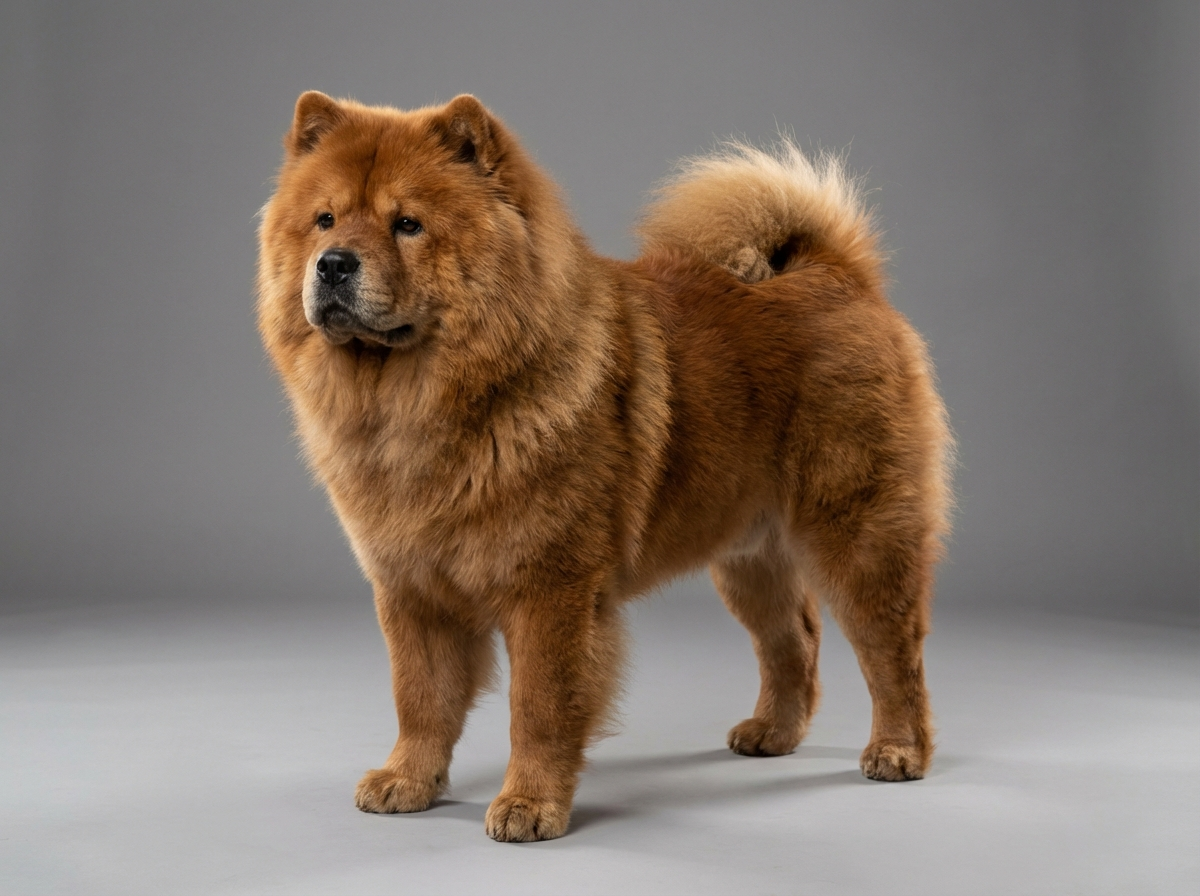
The Chow Chow moves with notably little bend through the rear, producing a short, stilted, almost mechanical stride that is a recognised feature of the breed rather than a fault. That gait means the rear legs absorb shock differently from a well-angulated dog, and it means the visual cue owners rely on - shortened stride, stiffness after rest - is already present at baseline.
So you need different markers. In this breed the reliable early signs of joint pain are almost all behavioural rather than gait-based. A dog that used to take the stairs and now waits at the bottom. A dog that has started choosing the floor over the sofa. A reluctance to sit squarely, or a sit that slides sideways onto one hip. Slowness in the last third of a walk rather than the first.
The temperament compounds it. Chows are independent and undemonstrative; a stoic breed does not limp theatrically or whine for sympathy. It just quietly does less. Owners often describe the dog as having gotten lazy, which is frequently the first symptom of pain being reported as a personality change.

Since gait comparison is unreliable in this breed, track function instead. These are the observations that change month to month and give you a real signal.
Tao was nine and his family had been saying for about a year that he had slowed down. He still ate well and still barked at the postman. He had simply stopped coming upstairs at night, and had started sleeping in the hallway instead of on his usual landing. His owner, Fiona, mentioned it in passing at a vaccination appointment. The vet watched Tao sit, and he lowered himself with his left hip swung out to the side. On the table he flinched when the hip was extended. X-rays showed advanced arthritic change in both hips on a background of dysplasia that had never been diagnosed. Tao was five pounds overweight, which on a dog his size was meaningful. Over four months Fiona brought that down, put runners along the tiled hallway, and started three short walks a day instead of one long one. He began coming upstairs again by the spring - not every night, but most.
Key takeaway: In this breed, slowing down is a clinical finding rather than a personality trait. Because a Chow's normal walk is already stiff and its temperament is already undemonstrative, the earliest evidence of arthritis is usually a list of things the dog has quietly stopped doing.
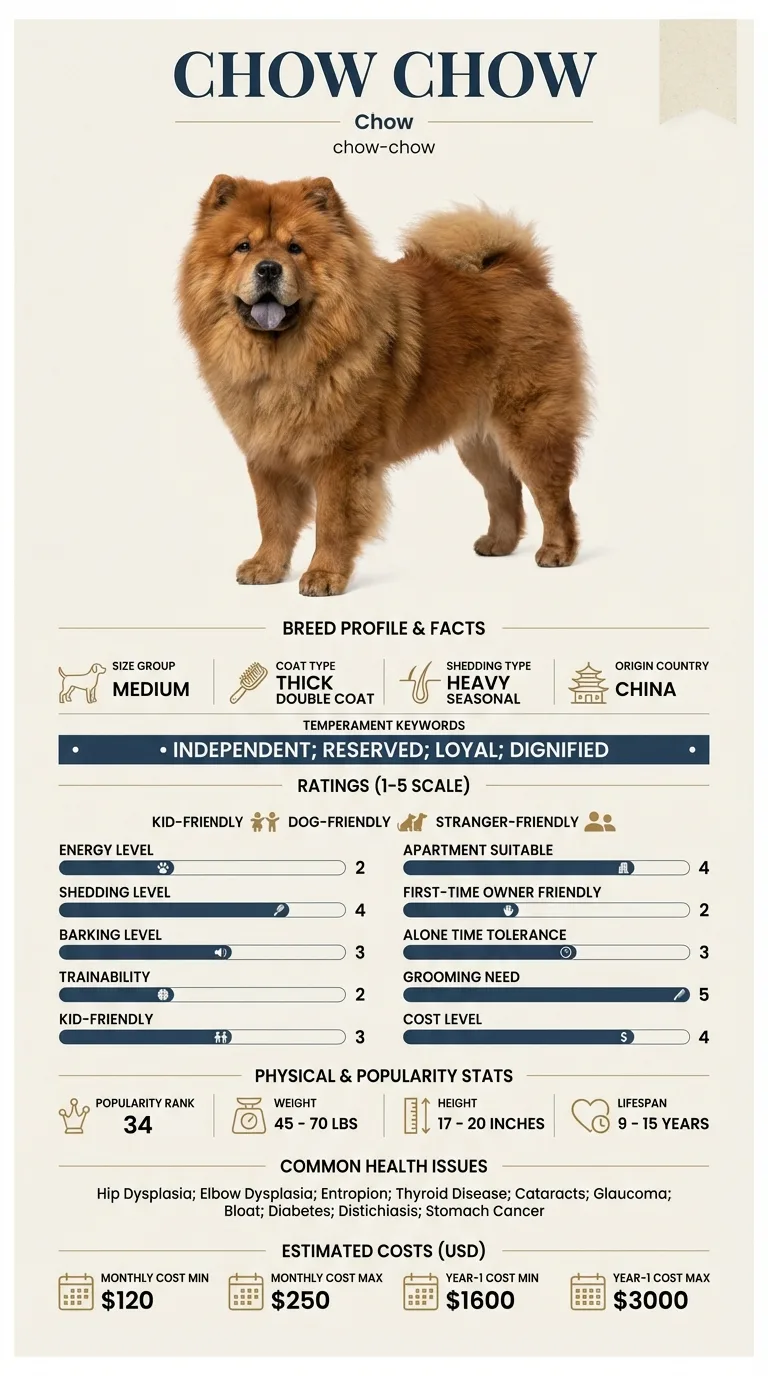
Radiographic change often precedes obvious signs by years. Owners commonly notice something around six to eight, but a dog with significant hip or elbow dysplasia may be uncomfortable considerably earlier. Given a typical lifespan of nine to fifteen years, that can mean a long stretch of life spent managing joints.
Not reliably at home, and it is frequently both. Elbow pain tends to show as shortened front reach and reluctance on descending stairs; hip pain shows in sitting, rising and jumping up. Imaging is what settles it, and it matters because the management differs.
It is the single most effective thing an owner controls. Reducing the load a damaged joint carries lowers pain without a prescription. It is also difficult in this breed, because a low exercise requirement means you cannot burn the weight off - it has to come out of the bowl.
Differently rather than more or less. Frequent short walks on level ground beat one long weekend outing, which is the pattern that most reliably causes flares. Controlled swimming suits some dogs, though a double coat takes a long time to dry and that has to be planned for.
The evidence is mixed and the effect, where it exists, is modest. They are not a substitute for weight control, appropriate exercise and veterinary pain management. Discuss any supplement with your vet rather than adding it independently, particularly if the dog is already on prescribed medication.
For some dogs with severe hip or elbow disease, yes, and it is a discussion worth having with an orthopaedic specialist rather than dismissing. For most older Chows the realistic path is long-term medical management, weight control and environmental adaptation.
Because the Chow's normal gait is already short and stilted, so the usual stiff-walk clue is missing. Watch function and behaviour instead.
Non-slip flooring on the routes the dog uses most. Hard smooth floors force constant micro-corrections that arthritic joints cannot afford.
Use the same scale monthly rather than judging by eye, and feel for ribs with flat hands. A double coat hides several pounds either way.
Ongoing pain medication, repeat check-ups and periodic imaging add up over years and are a major driver of this breed's high lifetime cost.
A one-page prep sheet for this condition: the signs, the questions to ask, what to get priced. Unlocks here.
You get: Vet visit prep sheet
No spam. One-click unsubscribe. See our privacy policy.
Preview page 1 before you decide.