Behavior
Which breed barks more?
The Jack Russell Terrier, rated Very high (5/5) versus the Bernese's Low (2/5).

Quick answer
Which breed barks more?
The Jack Russell Terrier, rated Very high (5/5) versus the Bernese's Low (2/5).
Bernese Mountain Dog or Jack Russell Terrier? On paper they differ most on barking, and on the scales Bernese Mountain Dog is the heavier at 70–115 lbs. Here is how the two compare on everything that shapes an ordinary week.
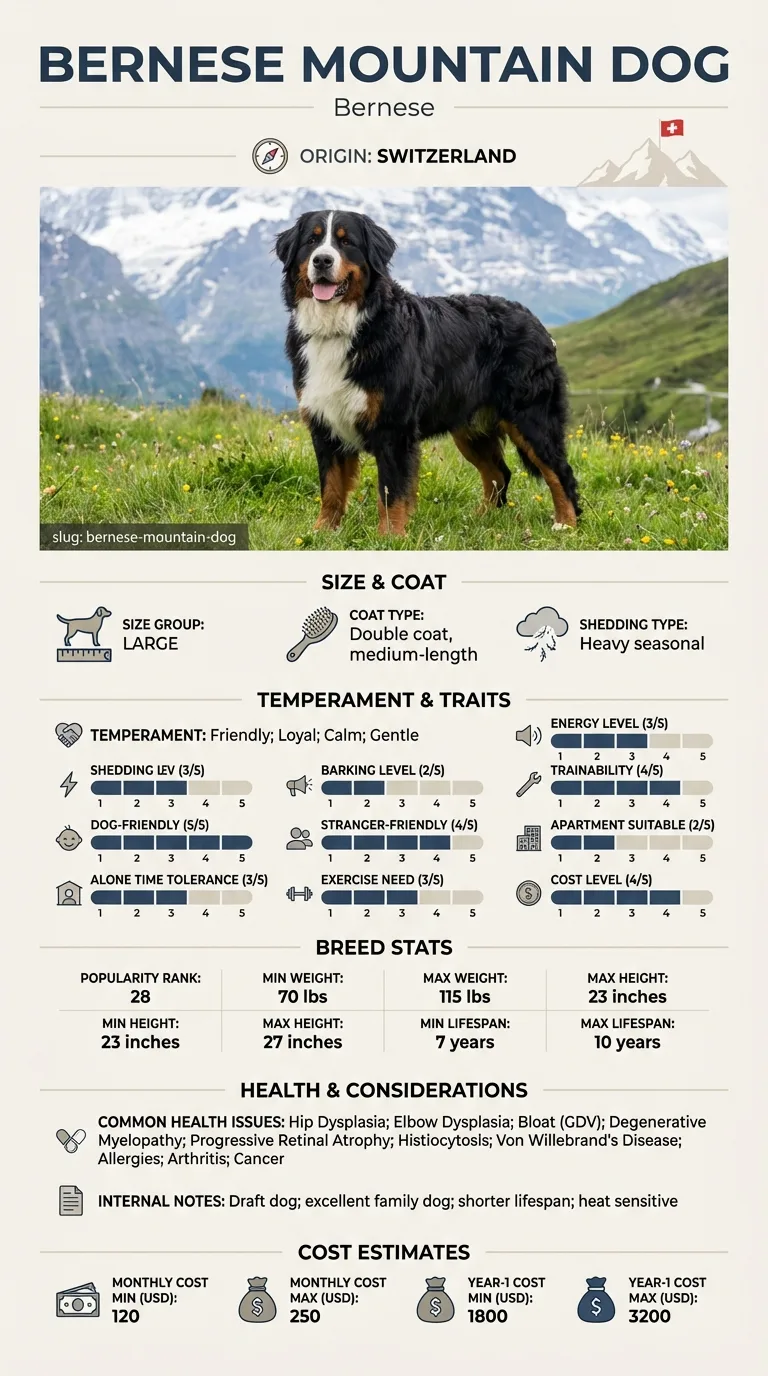
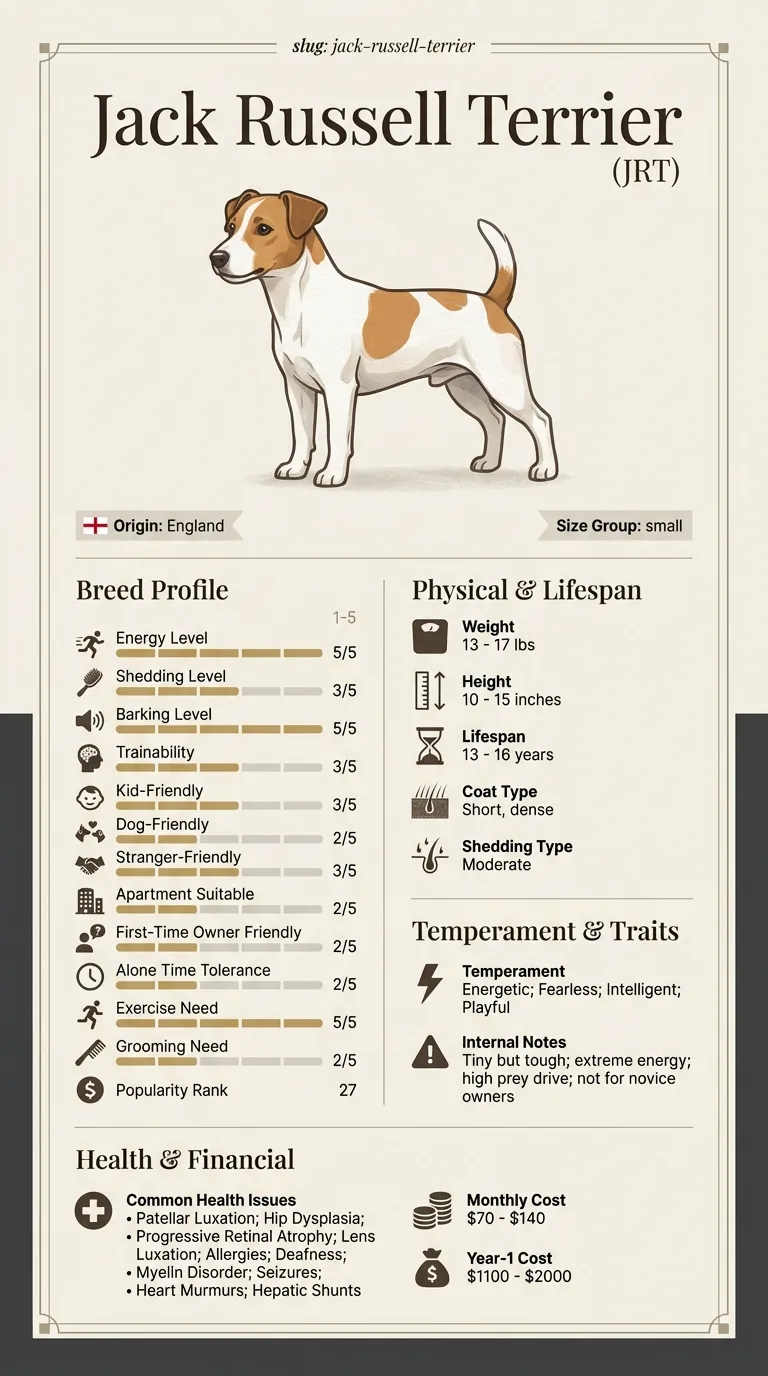
This is for someone already down to Bernese Mountain Dog and Jack Russell Terrier and deciding between them. For this pair the decision usually turns on barking and good with other dogs, so those are covered first and in most detail. Both rate 2/5 for flats, so housing does not settle this one. Breed history is left out; what follows is what you will actually live with.
Between Bernese Mountain Dog and Jack Russell Terrier, barking is what separates them, and Bernese Mountain Dog is the lower-effort dog of the two to keep.
Choose Bernese Mountain Dog if this is your first dog, your walking routine is modest and the dog will be alone during the working day.
Choose Jack Russell Terrier if you do not want a standing grooming appointment, shedding is a problem in your house and a smaller dog suits your car, your home or your back.
| Feature | bernese mountain dog | jack russell terrier | Winner |
|---|---|---|---|
| Size class | large | small | Equal |
| Weight | 70–115 lbs | 13–17 lbs | Equal |
| Height | 23–27 in | 10–15 in | Equal |
| Lifespan | 7–10 years | 13–16 years | jack russell terrier |
| Exercise need | Moderate (3/5) | Very high (5/5) | bernese mountain dog |
| Grooming need | Moderate (3/5) | Low (2/5) | jack russell terrier |
| Shedding | High (4/5) | Moderate (3/5) | jack russell terrier |
| Energy level | Moderate (3/5) | Very high (5/5) | Equal |
| Barking | Low (2/5) | Very high (5/5) | bernese mountain dog |
| Apartment suitability | Low (2/5) | Low (2/5) | Equal |
| Good for first-time owners | High (4/5) | Low (2/5) | bernese mountain dog |
| Tolerates being alone | Moderate (3/5) | Low (2/5) | bernese mountain dog |
| Trainability | High (4/5) | Moderate (3/5) | bernese mountain dog |
| Good with kids | Very high (5/5) | Moderate (3/5) | bernese mountain dog |
| Good with other dogs | Very high (5/5) | Low (2/5) | bernese mountain dog |
| Friendly to strangers | High (4/5) | Moderate (3/5) | bernese mountain dog |
| Cost level | High (4/5) | Low (2/5) | jack russell terrier |
| Coat | Double coat, medium-length | Short, dense | Equal |
| Origin | Switzerland | England | Equal |
| Typical monthly cost | $120–$250 | $70–$140 | Equal |
| Typical first-year cost | $1,800–$3,200 | $1,100–$2,000 | Equal |
Few comparisons on this site show a bigger size mismatch: a 70–115 lb Bernese Mountain Dog against a 13–17 lb Jack Russell Terrier, with height running 23–27 inches versus just 10–15. The Bernese can outweigh the Jack Russell by six or seven times at the extremes. Despite its tiny frame, the Jack Russell's short, dense coat covers a wiry, athletic body built for going to ground after vermin, giving it a fearless physicality that belies its size. The Bernese's heavy, thickly coated build couldn't be more different, a gentle giant next to a compact powerhouse.
The Jack Russell Terrier rates Very high (5/5) for both exercise need and energy level, matching or exceeding many large working breeds despite its small size, while the Bernese sits at a comfortable Moderate (3/5) on both counts. This tracks directly with temperament: Energetic, Fearless, and Playful describe a terrier bred to hunt and dig relentlessly, a drive that doesn't shrink just because the dog is small. Owners expecting a low-key companion because of the Jack Russell's size are often surprised by how much daily activity it actually demands compared to the much larger, calmer Bernese.
Grooming favors the Jack Russell at Low (2/5) against the Bernese's Moderate (3/5), and shedding follows suit, Moderate (3/5) versus High (4/5) for the Bernese. The Jack Russell's short, dense coat is genuinely low-maintenance, an occasional brush handles it, while the Bernese's double coat needs more regular attention to manage its heavier shedding, especially during seasonal coat blows. This is one of the few categories where the smaller dog is unambiguously the easier option, without any of the trade-offs seen in coat type comparisons with feathered or curly-coated breeds.
Both breeds tie at Low (2/5) for apartment suitability, the Bernese for its size and the Jack Russell for its Very high exercise need, small size doesn't guarantee apartment ease here. Barking is where they diverge sharply: Very high (5/5) for the Jack Russell against Low (2/5) for the Bernese, one of the largest gaps in this entire batch. A Jack Russell's Fearless, alert nature means it vocalizes readily at anything unusual, a real consideration for anyone in close-quarters housing. Tolerating time alone favors the Bernese, Moderate (3/5) versus Low (2/5) for the Jack Russell.
Trainability favors the Bernese, High (4/5) against Moderate (3/5) for the Jack Russell, whose Intelligent but famously independent-minded terrier streak means it learns fast but doesn't always choose to comply. First-time-owner suitability shows an even bigger gap, High (4/5) for the Bernese versus Low (2/5) for the Jack Russell, reflecting how much handling experience it takes to channel a small, Fearless, high-drive terrier's energy productively. The Bernese's Friendly, Loyal, Calm temperament makes it dramatically more forgiving for someone new to dog ownership than the feisty Jack Russell.
The Bernese leads decisively across every social category: Very high (5/5) with kids versus Moderate (3/5), Very high (5/5) with other dogs versus a notably Low (2/5) for the Jack Russell, and High (4/5) with strangers versus Moderate (3/5). That Low rating with other dogs is significant, Jack Russells have a well-documented history of dog-selectivity and prey drive that can make multi-dog households or dog parks genuinely risky without careful management. Families wanting the more broadly sociable, lower-conflict companion will find the Bernese the clearer choice on every household-fit metric measured here.
The lifespan gap is the largest in this entire batch: 13–16 years for the Jack Russell Terrier against just 7–10 for the Bernese Mountain Dog, meaning a Jack Russell puppy could plausibly outlive a Bernese by the better part of a decade. The Jack Russell's ten-item list includes Patellar Luxation, Lens Luxation, Deafness, Myelin Disorder, and Hepatic Shunts, a broader spread of orthopedic, sensory, and organ conditions than its small size might suggest. The Bernese's list stays anchored in Cancer and Bloat (GDV). Anyone weighing years of companionship heavily should note this gap is roughly double.
The Jack Russell is the clear budget option here: $70–$140 monthly and $1,100–$2,000 in year one, against the Bernese's $120–$250 and $1,800–$3,200, cost level rated Low (2/5) for the Jack Russell versus High (4/5) for the Bernese, the widest cost gap in this batch. Smaller size means less food and lower medication dosing, and the Jack Russell's Low grooming need avoids added grooming costs too. Given its much longer 13–16 year lifespan, the Jack Russell likely represents significantly lower total lifetime cost than the Bernese despite both requiring a real ongoing commitment.
Bernese Mountain Dog weighs 70–115 lbs and lives 7–10 years; Jack Russell Terrier weighs 13–17 lbs and lives 13–16 years. The two diverge most on barking, good with other dogs and exercise need and 4 other rated axes. Almost every rated axis separates them at least slightly. The comparison marks an easier option only where one exists. Facts like weight and country of origin are not scored. Both dogs are rated from the same dataset, which is what makes the numbers comparable with each other even though any individual dog sits somewhere inside its breed's range.

It's rated Very high (5/5) for barking versus the Bernese's Low (2/5), the widest barking gap in this batch, reflecting the Jack Russell's Fearless, alert terrier temperament bred to react to vermin and intruders.
Not especially — it rates Low (2/5) for good with other dogs, well below the Bernese's Very high (5/5), reflecting the breed's known prey drive and dog-selectivity.
Considerably longer — 13–16 years versus 7–10 for the Bernese Mountain Dog, a gap that can approach a decade.
The Jack Russell Terrier by a wide margin, at $1,100–$2,000 in year one versus $1,800–$3,200 for the Bernese, with a Low (2/5) cost level versus High (4/5).
Not typically — it rates Low (2/5) for first-time owners versus the Bernese's High (4/5), given its Very high energy and independent streak.
The Jack Russell Terrier, rated Low (2/5) versus the Bernese's Moderate (3/5), thanks to its short, dense, low-maintenance coat.
They rate Moderate (3/5), noticeably behind the Bernese's Very high (5/5), so supervision and careful introductions matter more with a Jack Russell around young children.
The Jack Russell Terrier, rated Very high (5/5) versus the Bernese's Low (2/5).
The Jack Russell Terrier, typically 13–16 years versus 7–10 for the Bernese.
The Jack Russell Terrier, at $1,100–$2,000 in year one versus $1,800–$3,200 for the Bernese.
The Bernese Mountain Dog, rated Very high (5/5) versus the Jack Russell's Low (2/5).
Secure checkout on Stripe. We never see your card.
7-day money-back guarantee. Instant access.
Health information here is general and is not veterinary advice. If your dog shows pain, sudden behaviour change, or worsening symptoms, consult a licensed veterinarian.
Some links on this site are affiliate links. We may earn a commission at no extra cost to you, and we only suggest products we believe are helpful for dog owners.
We research and check what we publish, but we do not warrant that any figure, date, price, or statement is accurate, complete, or current, and we accept no liability for any loss, cost, injury, or other harm arising from the use of this site. Use it as one reference among several. You remain responsible for your own decisions and for your dog's care - confirm anything that matters with a licensed veterinarian or another qualified professional before you act on it. Full disclaimer.
Match your lifestyle to the right dog.
Take quizNot sure which breed is right for you? Take our 2-minute quiz to find out.
Take the quiz