Health
How fast can a hot spot develop on a dog?
Within hours in some cases, since the dog's own licking and scratching actively spreads the irritation and infection once it starts.

Quick answer
How fast can a hot spot develop on a dog?
Within hours in some cases, since the dog's own licking and scratching actively spreads the irritation and infection once it starts.
A hot spot doesn't build gradually the way most skin problems do. It can go from unnoticed to raw and weeping in a matter of hours.
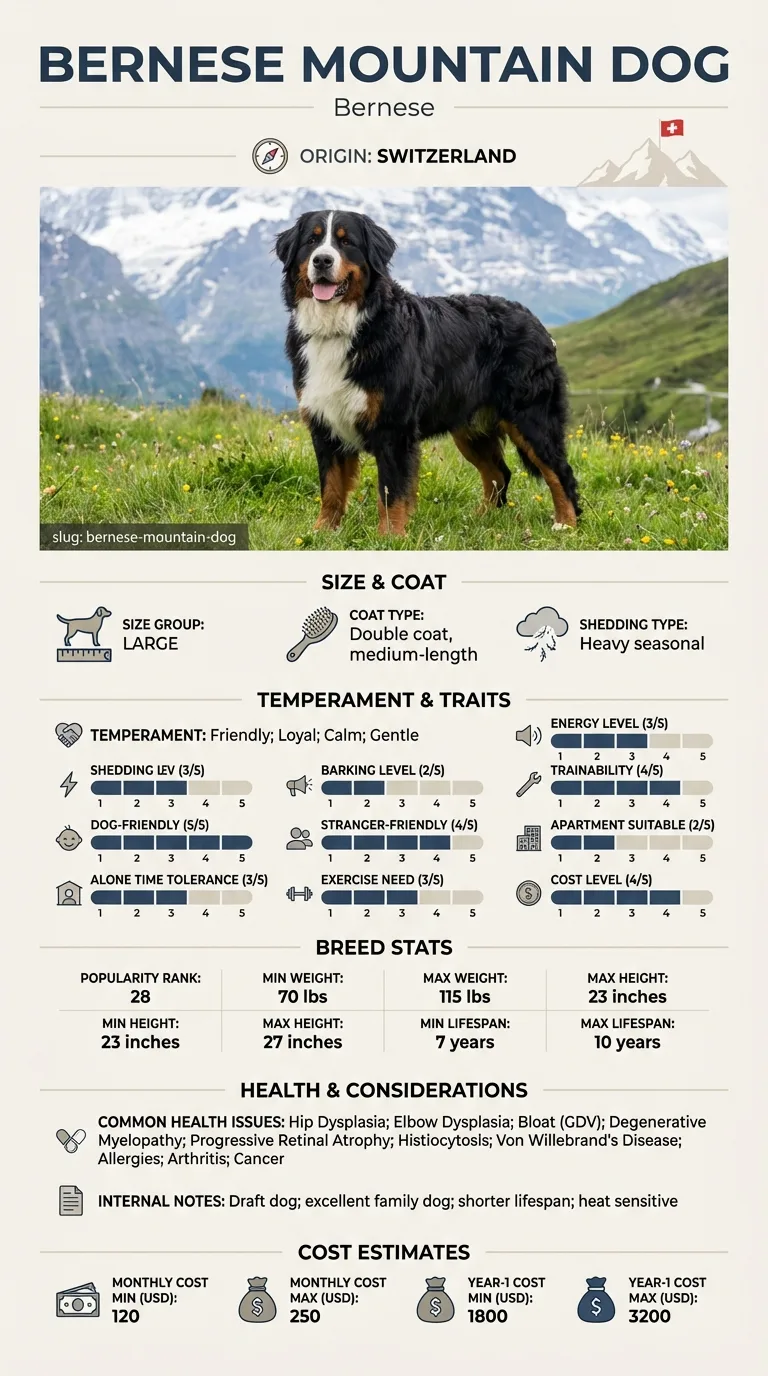
Owners of a Bernese that swims, gets caught in the rain, or carries mats in its heavy coat, especially during the heaviest shedding season when the undercoat traps moisture against the skin.
This guide is not medical advice. If your dog shows pain, sudden behavior change, or worsening symptoms, consult a licensed veterinarian.
Some links may be affiliate links. We may earn a commission at no extra cost to you. We only suggest products we believe are helpful for dog owners.
We research and check what we publish, but we do not warrant that any figure, date, price, or statement is accurate, complete, or current, and we accept no liability for any loss, cost, injury, or other harm arising from the use of this site. Use it as one reference among several. You remain responsible for your own decisions and for your dog's care - confirm anything that matters with a licensed veterinarian or another qualified professional before you act on it. Full disclaimer.
A hot spot is a fast-developing bacterial skin infection, also called acute moist dermatitis, that starts with local irritation and is rapidly worsened by the dog's own licking and scratching. Unlike this breed's slower, chronic allergic itch pattern, a hot spot can form within hours, and the dense double coat that hides it also traps the moisture that drives it.
Hot spots are a common presentation across heavily coated breeds generally, and this breed's dense double coat with heavy seasonal shedding puts it at meaningfully elevated practical risk compared with short-coated breeds, even though it is not on the formal documented health issue list the way hip dysplasia or bloat are.
The medium-length double coat with a heavy undercoat is the direct driver: it traps moisture and debris against the skin far more readily than a short, single coat would, and heavy seasonal shedding periods increase the chance of matting that concentrates this effect in one spot. The coat also makes early detection harder, since a small irritated area can be entirely hidden from view until it has already progressed.
Swimming, rain, and humid weather are the main environmental triggers, since all three leave the coat and underlying skin damp for longer than they would on a shorter-coated dog. Infrequent grooming that allows mats to form, and warm weather that encourages more time outdoors and more swimming, both raise practical risk during the months they're most relevant.
See your vet promptly for any area that looks red, moist, hairless or has an odour, since hot spots can worsen significantly within a day if untreated. Seek urgent care if the affected area is large, if your dog seems to be in significant pain, or if you notice fever, lethargy or reduced appetite alongside the skin lesion, since these can indicate a more extensive infection.
Because this breed's coat hides the skin so effectively, most of the mistakes here come from not looking closely enough, not from doing the wrong thing once a hot spot is found.
Start here: Bernese Mountain Dog Most Common Genetic Disorders
See all Bernese Mountain DOG health problems, which breeds are prone to skin infections, or the full Bernese Mountain DOG breed guide for temperament, exercise needs and ownership costs.
With prompt treatment, a hot spot typically starts improving within a few days and resolves within one to two weeks. Delayed treatment or repeated self-trauma from licking can extend this considerably.
Success is the affected area drying out, regrowing hair, and the dog no longer fixating on that spot. Longer-term success is fewer recurrences, achieved by addressing the underlying moisture and matting rather than only treating each episode as it appears.
A hot spot, known clinically as acute moist dermatitis, begins when bacteria that normally live harmlessly on the skin surface multiply rapidly in a small area of broken or irritated skin. What makes it different from the slower allergic itch cycle documented elsewhere for this breed is speed: instead of building over days or weeks, a hot spot can go from a small irritation to a raw, weeping, infected patch within hours, largely because the dog's own scratching and licking response actively spreads bacteria and breaks down more skin as it goes.
The dense double coat is the specific reason this breed is prone to the moisture side of the problem. Heavy seasonal shedding means loose undercoat can mat and trap debris and moisture against the skin underneath, and swimming, rain, or even heavy panting on a warm day leaves dampness sitting against skin that doesn't dry quickly through a thick coat the way it would on a short-haired dog. Bacteria thrive in that warm, damp, low-oxygen environment, and a mat sitting over one spot concentrates the risk in that exact location.
A hot spot typically starts as a small area of intense itch, and the dog's response, biting or scratching at it, is what turns a minor irritation into an open, infected sore. The affected area often looks red, moist and hairless once found, sometimes with a foul odour, and it can be surprisingly painful to the touch given how quickly it developed. Because it's frequently hidden under intact coat around it, owners often discover a hot spot by smell or by noticing their dog fixating on one spot, rather than by seeing it directly.
Treatment usually involves clipping the surrounding coat to expose the full extent of the affected skin, cleaning the area, and a short course of topical or oral antibiotics along with something to stop the itch-scratch cycle, since the dog will keep making it worse otherwise. Preventing recurrence means addressing the underlying moisture and matting rather than only treating each spot as it appears.

Sabine let her Berner Anton swim at the lake as usual on a humid Saturday and toweled him off before heading home. By evening he was gnawing frantically at one spot on his hip, and when she parted the coat she found a raw, wet patch the size of her palm that hadn't been there that morning. Her vet clipped the area, revealing it was larger under the coat than it looked, cleaned it, and sent her home with antibiotics and a cone. Sabine now checks Anton's skin by hand after every swim, not just his coat by eye, and hasn't had a repeat since she added a thorough dry-down to their after-swim routine.
Key takeaway: A heavy double coat can hide a skin infection until it's already significant. Checking the skin itself, not just how the coat looks, after anything that leaves your dog wet is what actually catches this early.
A hot spot, or acute moist dermatitis, is a fast-developing bacterial skin infection that starts with local irritation and is worsened rapidly by the dog's own licking and scratching. It can go from minor to raw and infected within hours.
The dense double coat and heavy seasonal shedding create conditions where moisture and debris can get trapped against the skin, especially under mats or after swimming, and bacteria multiply quickly in that warm, damp environment.
Allergic itch typically builds gradually and affects multiple areas over time, often alongside recurring ear infections. A hot spot is a single, fast-forming, localised infection that can appear within hours in one specific spot, often where moisture or a mat has been trapped.
Gently clip away coat around the area to expose it and let it air, and prevent further licking with a cone if possible. Full veterinary treatment, usually antibiotics and something to interrupt the itch-scratch cycle, is still needed to resolve it properly.
Regular grooming to prevent mats, thoroughly drying the coat after swimming or heavy rain, and checking under the coat periodically during heavy shedding season are the main preventive steps for this breed specifically.
A straightforward case seen early is a routine vet visit with a short course of medication. Cases that go unnoticed and spread further, or that recur repeatedly, cost more in cumulative visits and treatment.
No. The bacteria involved are normal skin residents that overgrow locally due to moisture and irritation; a hot spot is not something one dog catches from another.
Within hours in some cases, since the dog's own licking and scratching actively spreads the irritation and infection once it starts.
It traps moisture and debris against the skin, especially under mats or after swimming, creating a warm, damp environment where bacteria multiply quickly.
Part the coat regularly during heavy shedding season and after swimming, and pay attention if your dog fixates on licking or biting one particular spot.
Clipping the area to expose it, preventing further licking with a cone, and a short course of vet-prescribed antibiotics to address the infection directly.
A case caught early is usually a routine, modest vet visit. Cost rises mainly if it goes unnoticed under the coat and spreads further before treatment.
A one-page prep sheet for this condition: the signs, the questions to ask, what to get priced. Unlocks here.
You get: Vet visit prep sheet
No spam. One-click unsubscribe. See our privacy policy.
Preview page 1 before you decide.