Akita or Bichon Frise: Opposite Ends of the Dog World
Quick answer
Akita vs Bichon Frise: which should I choose?
The Bichon for almost any ordinary home — 5/5 for apartments, 4/5 for first-time owners, sociable, long-lived and small. Choose the Akita only if you specifically want a guardian breed and prefer a coat you rake to one you pay to clip.
An Akita can weigh nine times what a Bichon does and sheds at 5/5 against the Bichon's 1/5 — the widest shedding gap available on this site. But the Bichon needs professional grooming every four to six weeks for its whole life, and the Akita needs none at all. Neither coat is free.
This is for someone comparing two dogs at opposite extremes, usually because a specific constraint — a small home, an allergy, or a wish for a guardian — is driving the decision. It covers the coat economics honestly, the temperament gap, the health issues that matter for each, and what each really costs.
Quick verdict
The Bichon suits almost any home and costs its money at the groomer; the Akita suits a specific owner who wants a guardian and costs its money at the food bowl.
Choose akita if...
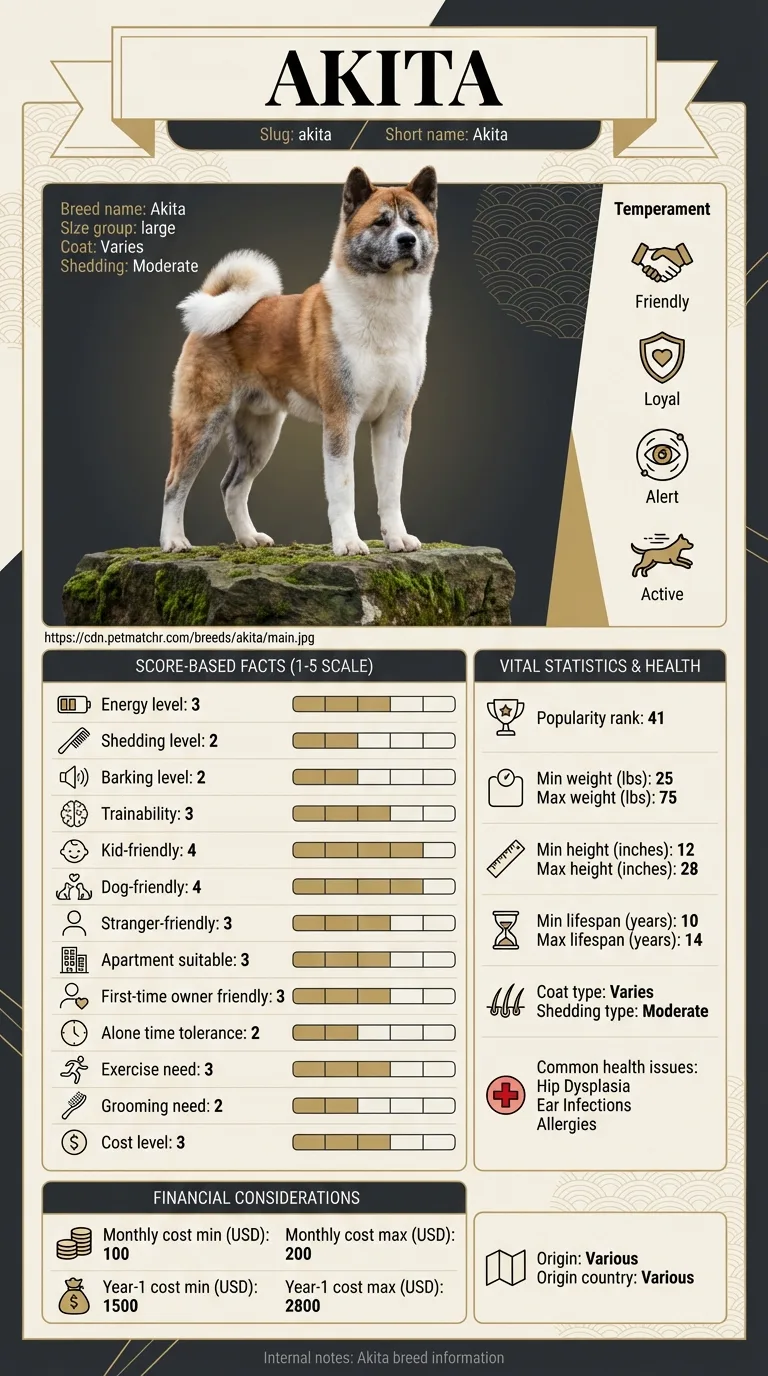
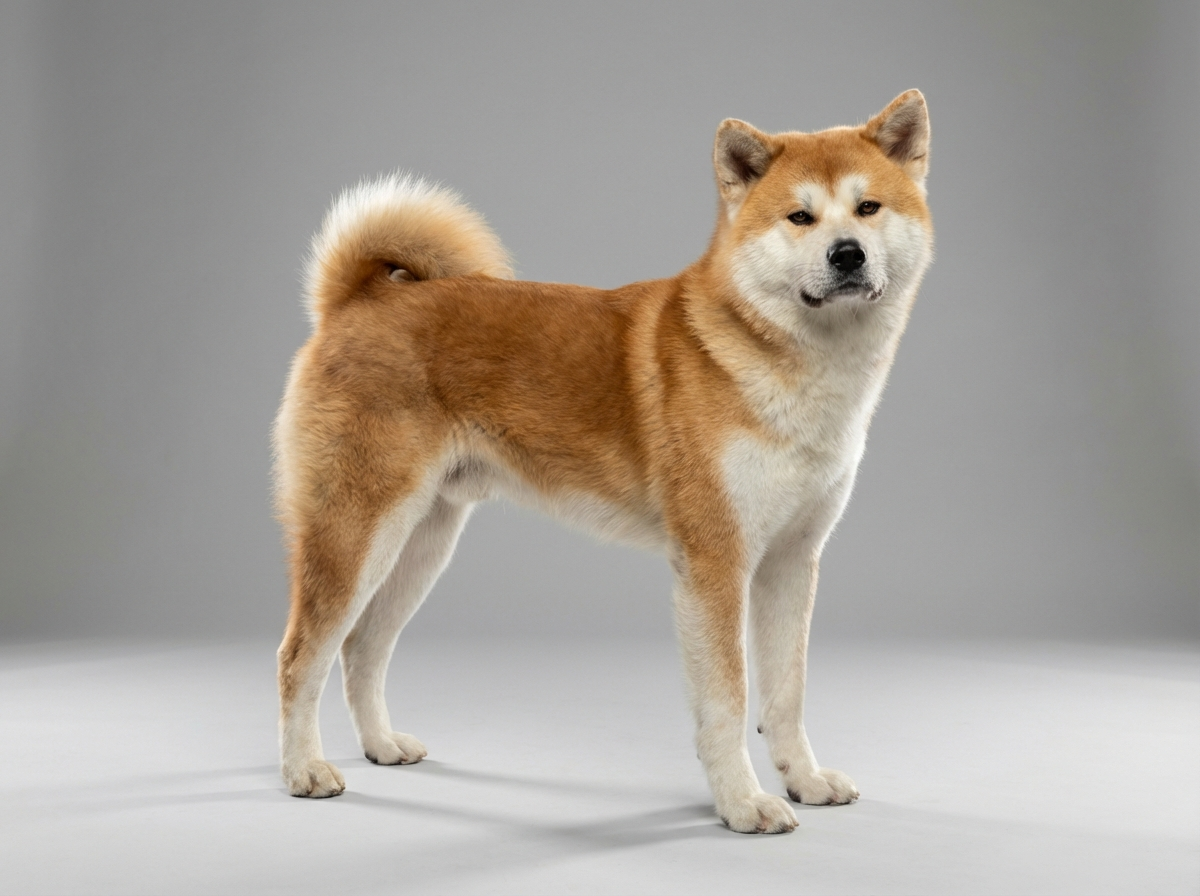
Choose the Akita if you want guardian instinct, a very quiet dog at 2/5 barking, and a coat that needs raking rather than clipping. You are accepting 1/5 first-time suitability, 2/5 with strangers and other dogs, 5/5 shedding, up to 130 pounds, and a shorter life at 10 to 13 years.
Choose bichon frise if...
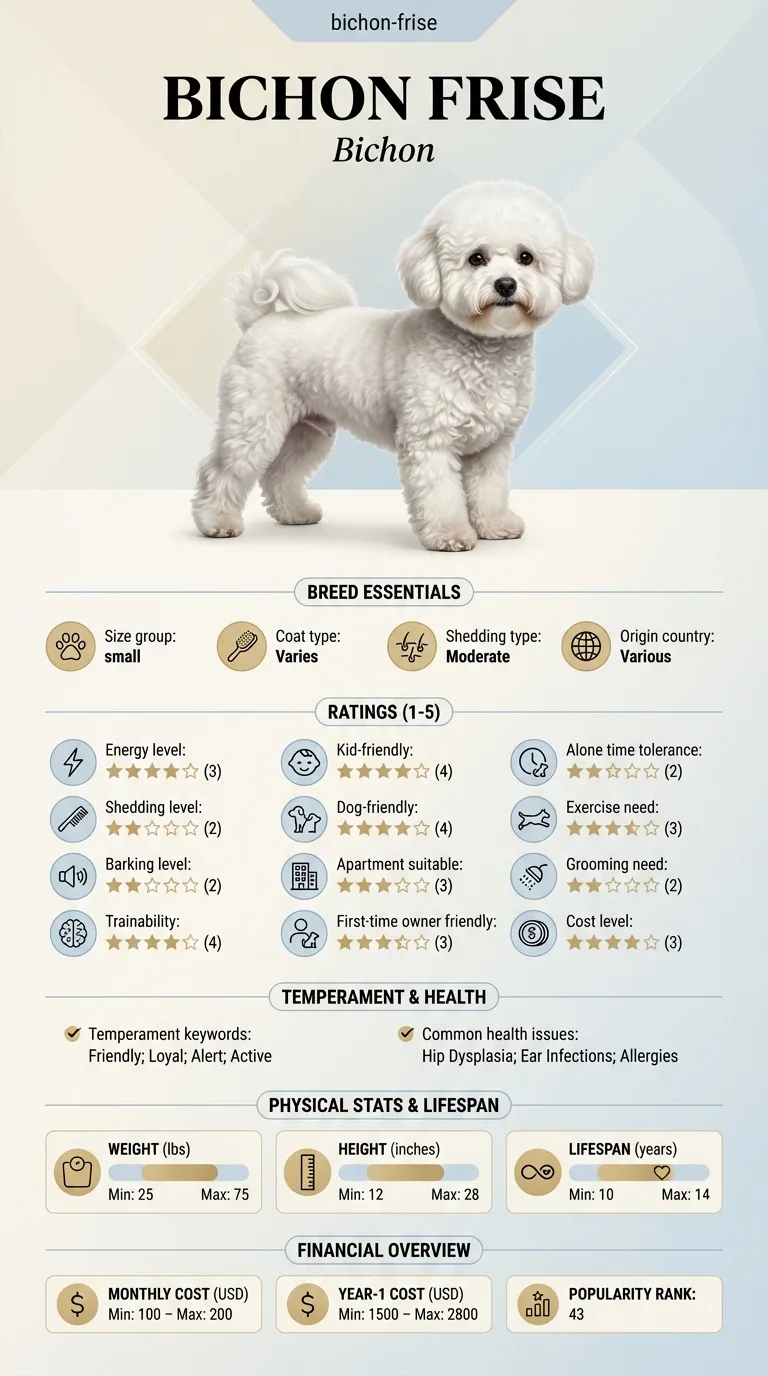
Choose the Bichon Frise if you want a small, sociable companion that fits anywhere: 5/5 for apartments, 4/5 with children, other dogs and strangers, 4/5 for first-time owners, and 14 to 15 years of life. Shedding is 1/5, the lowest here. Budget for grooming at 5/5 — clipping every four to six weeks, permanently.
Head-to-head comparison
Feature
akita
bichon frise
Winner
Weight
70–130 lbs
12–18 lbs
Equal
Height
24–28 in
9–12 in
Equal
Lifespan
10–13 years
14–15 years
bichon frise
Coat
Dense double coat
Curly, dense double coat
Equal
Grooming need
Moderate (3/5)
Very high (5/5)
akita
Shedding
Very high (5/5)
Very low (1/5)
bichon frise
Energy level
Moderate (3/5)
Moderate (3/5)
Equal
Exercise need
Moderate (3/5)
Low (2/5)
bichon frise
Trainability
Moderate (3/5)
Moderate (3/5)
Equal
Barking
Low (2/5)
Moderate (3/5)
akita
Good with kids
Moderate (3/5)
High (4/5)
bichon frise
Good with other dogs
Low (2/5)
High (4/5)
bichon frise
Friendly to strangers
Low (2/5)
High (4/5)
bichon frise
Apartment suitability
Low (2/5)
Very high (5/5)
bichon frise
Good for first-time owners
Very low (1/5)
High (4/5)
bichon frise
Tolerates being alone
Moderate (3/5)
Low (2/5)
akita
Typical monthly cost
$110–$240
$80–$150
bichon frise
Typical first-year cost
$1,700–$3,200
$1,100–$2,300
bichon frise
Deep dive
Two coats, two completely different bills
The Bichon has a curly, dense double coat that traps shed hair instead of dropping it. That is why shedding rates 1/5 — the lowest on this site — and why the breed is often suggested for people who react to dogs.
But hair that does not fall out keeps growing, and it mats. Grooming rates 5/5, the top of the scale, and it means what it says: brushing to the skin several times a week at home, plus a full professional groom every four to six weeks for the dog's entire fourteen-to-fifteen-year life. Skip it for a couple of months and you get a pelted coat that has to be clipped off short, which is uncomfortable for the dog and expensive to correct.
The Akita's dense double coat is the opposite arrangement. Shedding is 5/5 and twice a year it is genuinely startling — you will fill bin bags. But the tool is an undercoat rake and the cost is your time, not a standing appointment. Grooming rates 3/5. The coat must never be clipped, because it insulates against summer heat as well as winter cold.
So: the Bichon converts hair into a recurring bill. The Akita converts it into vacuuming. Neither is free, and the honest question is which currency you would rather pay in.
Twelve pounds against a hundred and thirty
This is not a subtle difference and it decides most of the practical rows.
A Bichon at 12 to 18 pounds and 9 to 12 inches fits into a flat, a car footwell, a carrier and most travel arrangements. It rates 5/5 for apartments. It can be picked up by anyone in the household. Its food, medication and boarding costs are all small, which is most of why it runs $80–$150 a month against the Akita's $110–$240.
An Akita at 70 to 130 pounds and 24 to 28 inches needs a large crate, a car with space, a two-person lift onto a vet table at the top end, and a household where someone can hold the lead if the dog decides otherwise. It rates 2/5 for apartments — it is quiet enough at 2/5 barking, but it is a very large animal in a small space.
On exercise the Bichon actually asks less, 2/5 against 3/5, though both are modest.
Companion breed against guardian breed
The Bichon was bred for one job: to be good company. It rates 4/5 with children, 4/5 with other dogs and 4/5 with strangers, and its described character — playful, curious, cheerful — is accurate. It is a sociable dog with no guarding instinct worth mentioning, and it rates 4/5 for first-time owners because very little about it is difficult.
Its one behavioural catch is separation. At 2/5 for time alone, the Bichon is a companion breed that genuinely wants company, and Bichons left alone all day are candidates for separation anxiety and for barking about it at 3/5. If the house is empty nine hours a day, plan for that.
The Akita rates 3/5, 2/5 and 2/5 on the same rows. It assesses visitors rather than greeting them, its dog intolerance is a real breed trait that often appears at around two years old, and it rates 1/5 for first-time owners. What it offers in exchange is a genuinely calm, near-silent presence and a guardian instinct that some owners specifically want.
Small-dog problems against large-dog ones
The two condition lists barely overlap, which is what you would expect at this size difference.
The Bichon's are classic small-companion problems: skin allergies, which are the breed's most common ongoing complaint; patellar luxation, where the kneecap slips; bladder stones, which the breed is genuinely prone to and which can become an emergency if they block; cataracts; and dental disease, which is near-universal in small dogs and is the reason daily tooth brushing matters more in a Bichon than in most breeds. Almost all of these are manageable and none of them is typically fatal, which is part of why the breed reaches 14 to 15 years.
The Akita's are large-dog and systemic: hip dysplasia, bloat as a deep-chested breed, and a heavy burden of autoimmune and endocrine disease including hypothyroidism and immune-mediated conditions affecting skin, eyes and blood. It also carries a known anaesthesia sensitivity worth flagging to any vet who has not treated the breed.
Bloat is the one to learn on sight for the Akita: unproductive retching, tight swollen abdomen, distress, and go now.
What each actually costs, and where
On the headline figures the Bichon is much cheaper: $80–$150 a month against $110–$240, and $1,100–$2,300 in year one against $1,700–$3,200.
But the composition matters. Most of the Akita's monthly cost is food and routine care for a very large dog, and it is predictable. A meaningful share of the Bichon's is the groomer every four to six weeks, and that share does not fall as the dog ages — if anything it rises, because an older dog is slower to groom.
Over a full life the Bichon is still the cheaper animal, helped by lower food and medication costs, but it is cheaper by less than the monthly figures suggest. Ring a local groomer for a small-breed full-groom price before choosing, and multiply by nine or ten a year for fourteen years. That number is the real price of the coat.
Akita vs Bichon Frise: the widest gaps on the site
Nine times the weight. Shedding at 5/5 against 1/5. Apartment suitability 2/5 against 5/5. First-time suitability 1/5 against 4/5. These are among the largest gaps any pairing here produces.
The rows where the Akita wins are narrow but real: grooming 3/5 against 5/5, barking 2/5 against 3/5, and time alone 3/5 against 2/5.
That grooming row is the one people misread, and it is worth the section below. A dog that sheds nothing is not a dog that costs nothing.
Akita or Bichon Frise: Opposite Ends of the Dog World - Akita vs Bichon Frise: the widest gaps on the site
Frequently asked questions
Do Bichon Frises really not shed?
They shed at 1/5, the lowest rating on this site, because the curly double coat traps loose hair rather than dropping it. That is not the same as low maintenance. Grooming rates 5/5: brushing to the skin several times a week plus a professional groom every four to six weeks for the dog's whole life. Miss it and the coat pelts and has to be clipped off.
Which is cheaper to keep?
The Bichon, at $80–$150 a month against the Akita's $110–$240, with first-year totals of $1,100–$2,300 against $1,700–$3,200. The composition differs though: the Akita's cost is mostly food for a large dog, while a large and permanent share of the Bichon's is professional grooming every four to six weeks.
Which lives longer?
The Bichon Frise, typically 14 to 15 years against the Akita's 10 to 13. Small dogs generally live longer, and the Bichon's health problems — allergies, luxating patellas, bladder stones, dental disease — tend to be manageable rather than life-limiting.
Can either live in an apartment?
The Bichon is one of the best apartment dogs here at 5/5, with a 2/5 exercise requirement and a small footprint. The Akita rates 2/5 — it is genuinely quiet at 2/5 barking, but a dog of up to 130 pounds is a lot of animal for a flat. The Bichon's caveat is that it tolerates being alone poorly at 2/5.
Which is better for a first-time owner?
The Bichon at 4/5 against the Akita's 1/5. Very little about the Bichon is difficult apart from the grooming commitment and its dislike of being alone. The Akita is a guardian breed whose instincts sharpen at maturity and which needs years of deliberate socialisation, and it is among the least beginner-suited breeds on this site.
What health problems should I expect from a Bichon?
Skin allergies are the most common ongoing complaint, followed by patellar luxation, bladder stones, cataracts and dental disease. Bladder stones in particular can become an emergency if they block, so straining to urinate needs a same-day vet. Daily tooth brushing matters more in this breed than in most.
Which is quieter?
The Akita, at 2/5 against the Bichon's 3/5, despite being up to nine times heavier. Akitas are famously near-silent. The Bichon's barking rises when it is left alone, which combines with its 2/5 alone-tolerance into the main risk for a flat with shared walls.
The Bichon for almost any ordinary home — 5/5 for apartments, 4/5 for first-time owners, sociable, long-lived and small. Choose the Akita only if you specifically want a guardian breed and prefer a coat you rake to one you pay to clip.
Living
Which sheds less?
The Bichon at 1/5 against the Akita's 5/5 — the widest shedding gap on this site. Grooming runs the other way, 5/5 against 3/5.
Costs
How much does each cost per month?
The Akita runs $110–$240 a month and the Bichon Frise $80–$150, with first-year totals of $1,700–$3,200 and $1,100–$2,300.
Behavior
Which can be left alone during the day?
The Akita at 3/5 against the Bichon's 2/5. The Bichon is a companion breed that wants company and is prone to separation problems in an empty house.
Related DogBreedCompass guides
Akita breed guide – The Akita profile covers guardian temperament, coat care and the socialisation window.
Bichon Frise breed guide – The Bichon profile covers grooming schedules and the skin and bladder issues in more detail.
Bichon Frise vs Poodle – The Poodle is the other curly non-shedding breed buyers compare, with the same clipping commitment.
Akita vs Alaskan Malamute – The Malamute is the large northern alternative to the Akita and is far more sociable.
Bichon Frise genetic disorders – The genetic-disorder page sets out the skin, knee and bladder issues a Bichon breeder should discuss.
Akita autoimmune diseases – Autoimmune disease is the Akita's most distinctive burden and the first question for a breeder.
Health information here is general and is not veterinary advice. If your dog shows pain, sudden behaviour change, or worsening symptoms, consult a licensed veterinarian.
Some links on this site are affiliate links. We may earn a commission at no extra cost to you, and we only suggest products we believe are helpful for dog owners.
We research and check what we publish, but we do not warrant that any figure, date, price, or statement is accurate, complete, or current, and we accept no liability for any loss, cost, injury, or other harm arising from the use of this site. Use it as one reference among several. You remain responsible for your own decisions and for your dog's care - confirm anything that matters with a licensed veterinarian or another qualified professional before you act on it. Full disclaimer.