Behavior
Bichon Frise or Jack Russell for an apartment?
Bichon Frise; the Jack Russell's high barking and low apartment suitability make it a tougher fit.

Quick answer
Bichon Frise or Jack Russell for an apartment?
Bichon Frise; the Jack Russell's high barking and low apartment suitability make it a tougher fit.
Bichon Frise or Jack Russell Terrier? On paper they differ most on exercise need, and on the scales Bichon Frise is the heavier at 12–18 lbs. Here is how the two compare on everything that shapes an ordinary week.
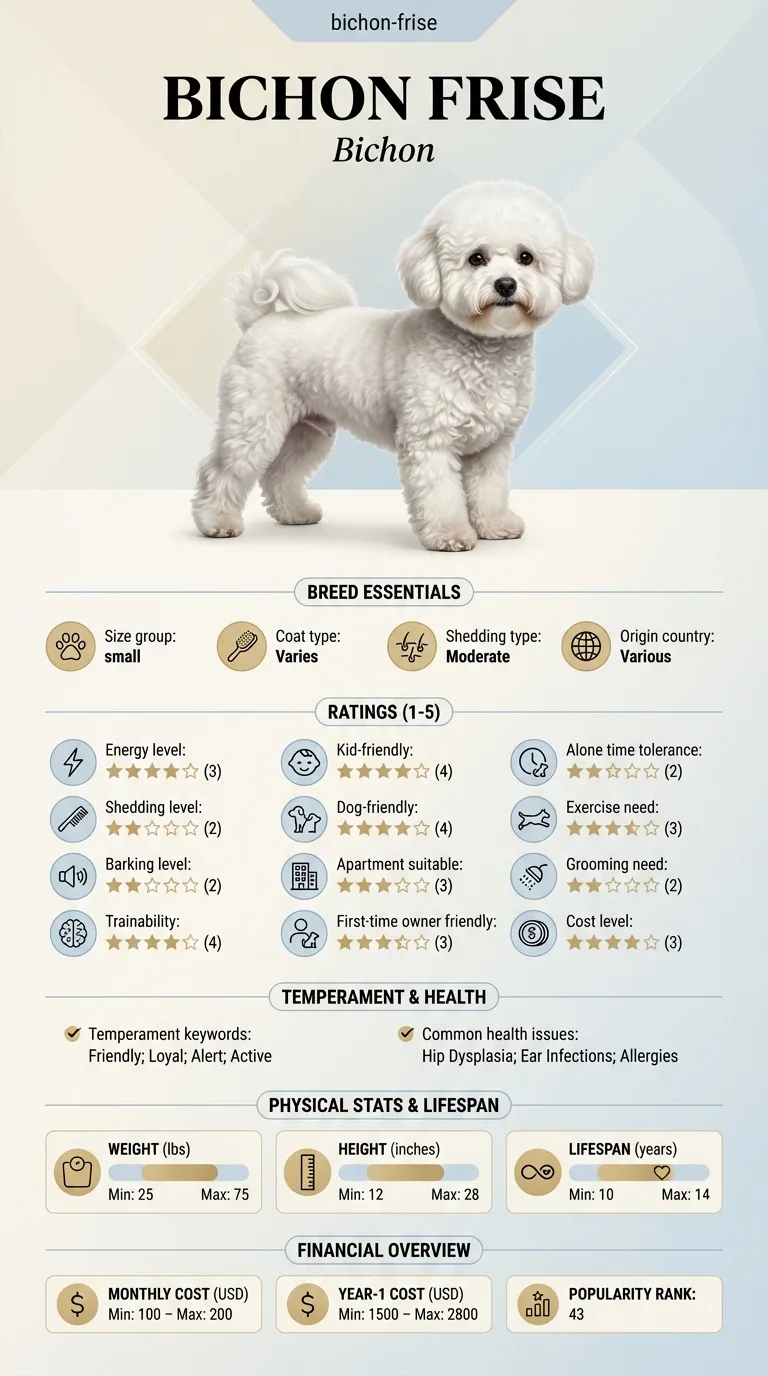
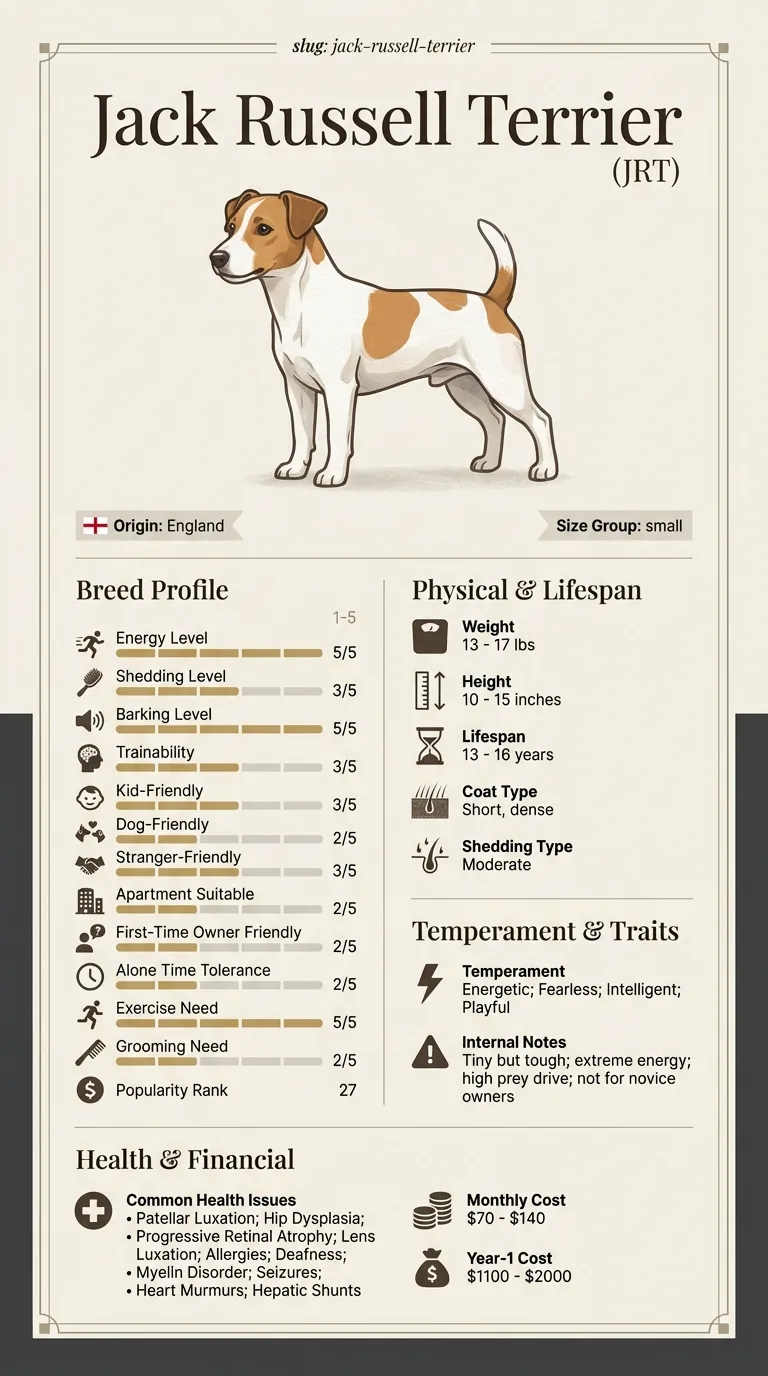
This is for someone already down to Bichon Frise and Jack Russell Terrier and deciding between them. For this pair the decision usually turns on exercise need and grooming need, so those are covered first and in most detail. Anyone choosing from a flat has a clear answer here: Bichon Frise rates 5/5 against 2/5. It is written for the decision rather than the breed history.
Between Bichon Frise and Jack Russell Terrier, exercise need is what separates them, and Bichon Frise is the lower-effort dog of the two to keep.
Choose Bichon Frise if you are in a flat or a smaller home, this is your first dog and shedding is a problem in your house.
Choose Jack Russell Terrier if you do not want a standing grooming appointment, you want a dog that can keep up with an active routine and you want a dog that is more watchful with visitors.
| Feature | bichon frise | jack russell terrier | Winner |
|---|---|---|---|
| Size class | small | small | Equal |
| Weight | 12–18 lbs | 13–17 lbs | Equal |
| Height | 9–12 in | 10–15 in | Equal |
| Lifespan | 14–15 years | 13–16 years | Equal |
| Exercise need | Low (2/5) | Very high (5/5) | bichon frise |
| Grooming need | Very high (5/5) | Low (2/5) | jack russell terrier |
| Shedding | Very low (1/5) | Moderate (3/5) | bichon frise |
| Energy level | Moderate (3/5) | Very high (5/5) | Equal |
| Barking | Moderate (3/5) | Very high (5/5) | bichon frise |
| Apartment suitability | Very high (5/5) | Low (2/5) | bichon frise |
| Good for first-time owners | High (4/5) | Low (2/5) | bichon frise |
| Tolerates being alone | Low (2/5) | Low (2/5) | Equal |
| Trainability | Moderate (3/5) | Moderate (3/5) | Equal |
| Good with kids | High (4/5) | Moderate (3/5) | bichon frise |
| Good with other dogs | High (4/5) | Low (2/5) | bichon frise |
| Friendly to strangers | High (4/5) | Moderate (3/5) | bichon frise |
| Cost level | Moderate (3/5) | Low (2/5) | jack russell terrier |
| Coat | Curly, dense double coat | Short, dense | Equal |
| Origin | Various | England | Equal |
| Typical monthly cost | $80–$150 | $70–$140 | Equal |
| Typical first-year cost | $1,100–$2,300 | $1,100–$2,000 | Equal |
Weight and height sit close between these two small breeds, 12-18 lbs and 9-12 inches for the Bichon versus 13-17 lbs and 10-15 inches for the Jack Russell Terrier, but the resemblance stops at the numbers. The Jack Russell carries a lean, wiry, athletic build shaped by generations of fox hunting and vermin work, while the Bichon's rounded, plush silhouette is purely a companion breed's frame. Don't let similar weight classes suggest similar dogs here: the Jack Russell's terrier heritage drives a completely different temperament and exercise profile than its size alone would imply.
The Jack Russell Terrier rates very high (5/5) on exercise need, tied with its energy level, a legacy of its working origins as a fast, tenacious hunting terrier bred to chase quarry to ground. The Bichon's low (2/5) exercise need and moderate (3/5) energy sit far below that. This is a genuine mismatch for anyone expecting small dog to mean low energy; a Jack Russell packed into a compact frame can out-exercise many larger breeds, and an under-stimulated one is notorious for digging, escaping, and general mischief that a bored Bichon simply doesn't produce.
Grooming flips sharply in the Jack Russell's favor: low (2/5) for its short, dense coat versus the Bichon's very high (5/5) demands from a curly double coat needing regular professional trims. Shedding tells the opposite story; the Jack Russell sheds at a moderate (3/5) level against the Bichon's very low (1/5). An owner drawn to minimal grooming appointments but tolerant of some hair on the furniture will find the Jack Russell far easier upkeep; someone prioritizing a low-shed home despite the grooming bills will still lean toward the Bichon.
The Bichon's very high (5/5) apartment suitability towers over the Jack Russell's low (2/5), and barking makes the gap starker still: the Jack Russell rates very high (5/5) on barking, the highest rating in this whole comparison, against the Bichon's moderate (3/5). Terriers were bred to alert loudly at burrows and vermin, and that instinct doesn't disappear indoors. Both breeds share a low (2/5) tolerance for being left alone, but a bored, alone Jack Russell in a small apartment is a genuine noise-complaint risk in a way a bored Bichon typically isn't.
Trainability actually ties at moderate (3/5) for both breeds, which may surprise anyone expecting the famously smart Jack Russell to score higher; its intelligence is real, but it's paired with independent, stubborn instincts that make consistent obedience work harder than raw intelligence alone would suggest. First-time-owner suitability tells the clearer story: the Bichon rates high (4/5) against the Jack Russell's low (2/5). A Jack Russell's high prey drive, high energy, and strong personality genuinely benefit from an owner who has handled a strong-willed dog before.
The Bichon outperforms the Jack Russell across every household category here: high (4/5) with kids versus moderate (3/5), high (4/5) with other dogs versus low (2/5), and high (4/5) friendliness to strangers versus moderate (3/5). The Jack Russell's low rating with other dogs deserves particular attention; this breed's terrier instincts can translate into scrappiness with unfamiliar dogs, especially same-sex pairings, and careful introductions matter more here than with most breeds on this site. Families prioritizing an easy multi-pet household will find the Bichon the more straightforward choice.
Lifespan ties closely, 14-15 years for the Bichon against 13-16 for the Jack Russell, both long-lived small breeds relative to larger dogs. Health lists diverge more: the Jack Russell's ten conditions include lens luxation, seizures, deafness, and hepatic shunts alongside patellar luxation and hip dysplasia, while the Bichon's five center on skin allergies, bladder stones, and dental disease. Lens luxation is a serious, breed-associated eye condition worth screening for specifically in Jack Russells. Bichon owners face a comparatively contained list, with dental and bladder health as the main ongoing concerns.
The Jack Russell is actually the cheaper breed to keep on paper: cost level rates low (2/5) versus the Bichon's moderate (3/5), with monthly costs of $70-140 against $80-150 and first-year totals of $1,100-2,000 versus $1,100-2,300. Its short coat needs no professional grooming, which keeps ongoing costs down despite its longer health-condition list. The Bichon's spending concentrates heavily in the grooming chair instead. For owners on a tight budget, the Jack Russell edges out as the more affordable choice, provided its exercise and training needs can genuinely be met.
Bichon Frise weighs 12–18 lbs and lives 14–15 years; Jack Russell Terrier weighs 13–17 lbs and lives 13–16 years. The two diverge most on exercise need, grooming need and apartment suitability and 5 other rated axes. They are level on tolerates being alone and trainability, so those cannot decide it. In the table, a "winner" means easier for an ordinary household — not better. Size, coat and origin are recorded without a verdict. Because both breeds are scored the same way, the gaps are reliable even where the absolute numbers are rough.

Not really; it rates low (2/5) on apartment suitability and very high (5/5) on barking, a combination that tends to create noise issues in close-quarters living. The Bichon Frise, rated very high (5/5) for apartments, is the better fit.
It's bred as a terrier to alert loudly at burrows and vermin, and that instinct carries into home life; it rates very high (5/5) on barking, the highest rating in this comparison, versus the Bichon's moderate (3/5).
Not especially; it rates low (2/5), well below the Bichon's high (4/5), and its terrier instincts can mean real scrappiness with unfamiliar dogs, particularly same-sex pairs.
The Jack Russell Terrier, at $1,100-2,000 in the first year versus $1,100-2,300 for the Bichon, mainly because its short coat needs no professional grooming.
A lot; it rates very high (5/5) on both exercise need and energy level, reflecting its history as a fast, tenacious hunting terrier. Without a serious daily outlet, expect digging, escaping, and destructive behavior.
It's rated low (2/5) for first-time owners, well below the Bichon's high (4/5); its strong prey drive and independent streak benefit from an owner experienced with strong-willed dogs.
Its ten-item list includes patellar luxation, hip dysplasia, lens luxation, deafness, seizures, and hepatic shunts; lens luxation in particular is a serious breed-associated eye condition worth screening for early.
Bichon Frise; the Jack Russell's high barking and low apartment suitability make it a tougher fit.
The Jack Russell Terrier, rated very high (5/5) versus the Bichon's moderate (3/5).
The Jack Russell Terrier, at roughly $1,100-2,000 in year one versus $1,100-2,300 for the Bichon.
The Jack Russell Terrier, rated very high (5/5) versus the Bichon's low (2/5).
Secure checkout on Stripe. We never see your card.
7-day money-back guarantee. Instant access.
Health information here is general and is not veterinary advice. If your dog shows pain, sudden behaviour change, or worsening symptoms, consult a licensed veterinarian.
Some links on this site are affiliate links. We may earn a commission at no extra cost to you, and we only suggest products we believe are helpful for dog owners.
We research and check what we publish, but we do not warrant that any figure, date, price, or statement is accurate, complete, or current, and we accept no liability for any loss, cost, injury, or other harm arising from the use of this site. Use it as one reference among several. You remain responsible for your own decisions and for your dog's care - confirm anything that matters with a licensed veterinarian or another qualified professional before you act on it. Full disclaimer.
Match your lifestyle to the right dog.
Take quizNot sure which breed is right for you? Take our 2-minute quiz to find out.
Take the quiz