Living
Which is better for apartments?
The Bichon Frise, rated Very high (5/5) versus the Cocker Spaniel's High (4/5).

Quick answer
Which is better for apartments?
The Bichon Frise, rated Very high (5/5) versus the Cocker Spaniel's High (4/5).
Bichon Frise or Cocker Spaniel? On paper they differ most on shedding, and on the scales Cocker Spaniel is the heavier at 20–30 lbs. Here is how the two compare on everything that shapes an ordinary week.
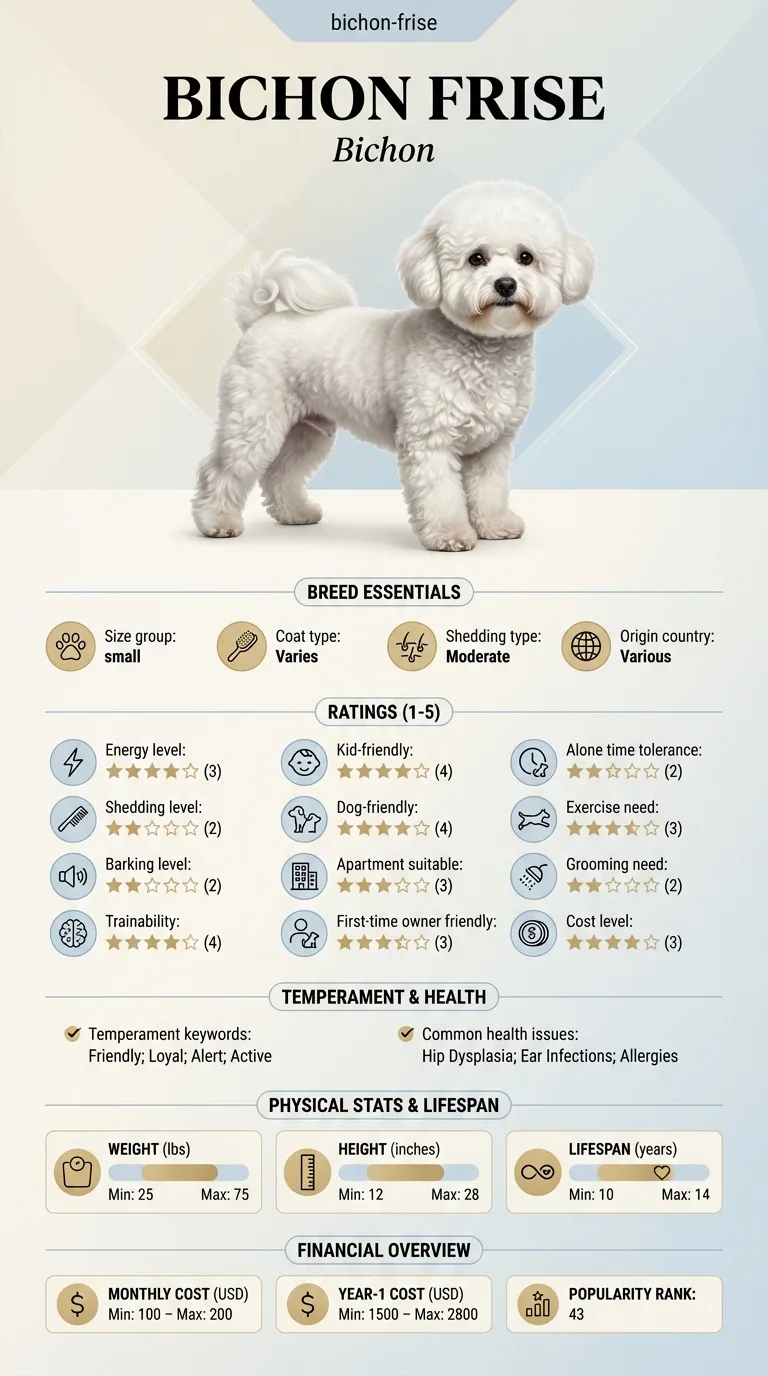
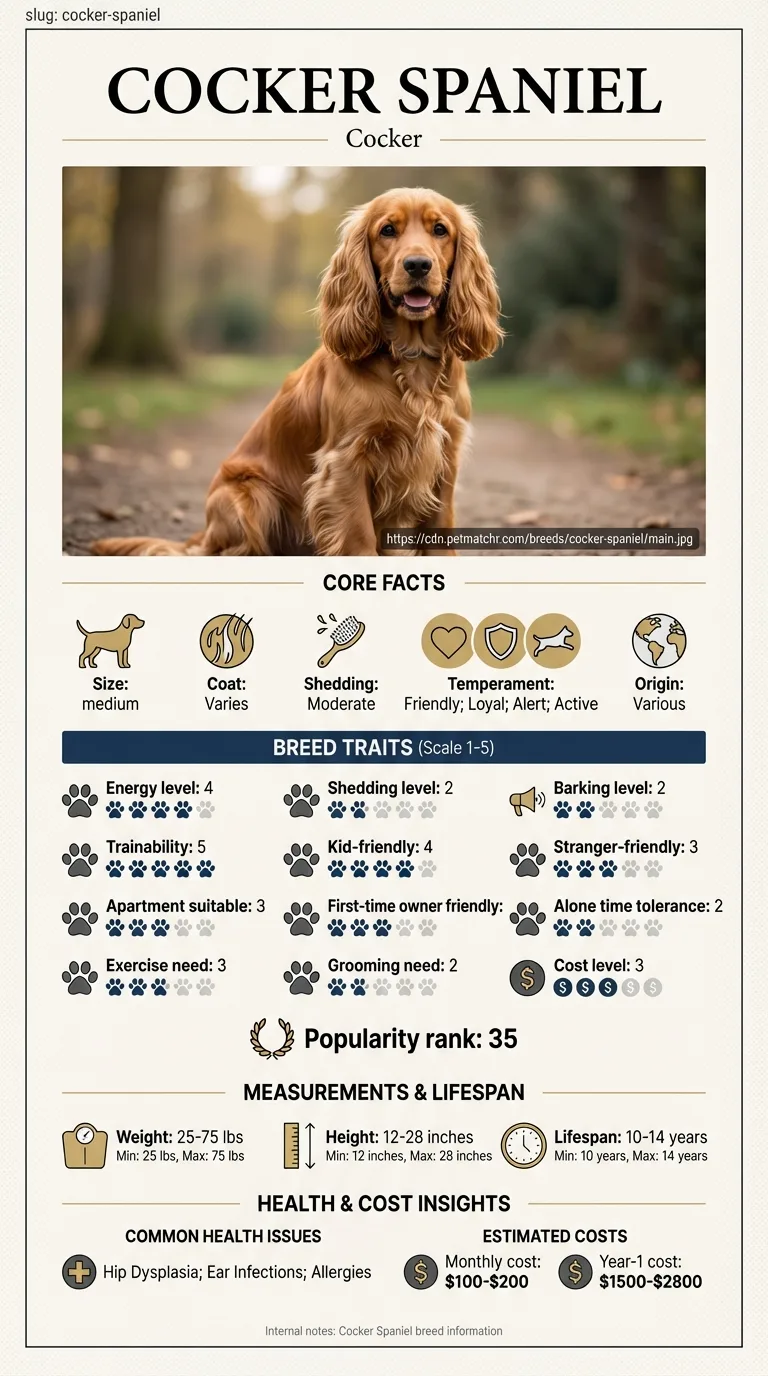
This is for someone already down to Bichon Frise and Cocker Spaniel and deciding between them. For this pair the decision usually turns on shedding, so those are covered first and in most detail. Anyone choosing from a flat has a clear answer here: Bichon Frise rates 5/5 against 4/5. It is written for the decision rather than the breed history.
Between Bichon Frise and Cocker Spaniel, shedding is what separates them, and Bichon Frise is the lower-effort dog of the two to keep.
Choose Bichon Frise if you are in a flat or a smaller home, shedding is a problem in your house and your walking routine is modest.
Choose Cocker Spaniel if there are young children at home, you want a dog that picks up training quickly and you want a dog that can keep up with an active routine.
| Feature | bichon frise | cocker spaniel | Winner |
|---|---|---|---|
| Size class | small | small | Equal |
| Weight | 12–18 lbs | 20–30 lbs | Equal |
| Height | 9–12 in | 13–16 in | Equal |
| Lifespan | 14–15 years | 10–14 years | bichon frise |
| Exercise need | Low (2/5) | Moderate (3/5) | bichon frise |
| Grooming need | Very high (5/5) | Very high (5/5) | Equal |
| Shedding | Very low (1/5) | Moderate (3/5) | bichon frise |
| Energy level | Moderate (3/5) | Moderate (3/5) | Equal |
| Barking | Moderate (3/5) | Moderate (3/5) | Equal |
| Apartment suitability | Very high (5/5) | High (4/5) | bichon frise |
| Good for first-time owners | High (4/5) | High (4/5) | Equal |
| Tolerates being alone | Low (2/5) | Low (2/5) | Equal |
| Trainability | Moderate (3/5) | High (4/5) | cocker spaniel |
| Good with kids | High (4/5) | Very high (5/5) | cocker spaniel |
| Good with other dogs | High (4/5) | High (4/5) | Equal |
| Friendly to strangers | High (4/5) | High (4/5) | Equal |
| Cost level | Moderate (3/5) | Moderate (3/5) | Equal |
| Coat | Curly, dense double coat | Silky and feathered | Equal |
| Origin | Various | Various | Equal |
| Typical monthly cost | $80–$150 | $80–$150 | Equal |
| Typical first-year cost | $1,100–$2,300 | $1,100–$2,300 | Equal |
Weight-wise these two aren't nearly as far apart as most Bichon comparisons: 12–18 lbs for the Bichon Frise against 20–30 lbs for the Cocker Spaniel, with height at 9–12 inches versus 13–16 inches. Both land squarely in the small size class, so neither dog will overwhelm a small home the way a medium or large breed might. The practical difference shows up more in proportion than mass — the Cocker's longer legs and deeper chest give it a sportier profile built for field work, while the Bichon's compact, rounded frame is closer to a classic toy-companion build. Either dog is easy to lift, easy to fit in a car, and easy to house in tight quarters.
The Cocker Spaniel needs more daily activity than the Bichon Frise — Moderate (3/5) exercise versus Low (2/5) — a real but modest gap given the Cocker's sporting-breed roots as a flushing spaniel. Energy level itself ties at Moderate (3/5) for both, so the difference isn't about how wound-up either dog is at rest, it's about how much structured output the Cocker's instincts want. A Cocker left under-exercised tends to get restless or destructive faster than a Bichon would, since the Bichon's exercise needs are genuinely modest rather than just tolerant of less. Daily walks work for both, but the Cocker benefits from added sniffing time or fetch that taps its retrieving drive.
Grooming need ties at Very high (5/5) for both breeds, which surprises people who assume a curly Bichon needs more upkeep than a silky-coated Cocker Spaniel — in practice both require frequent brushing, regular trims, and professional grooming visits to stay comfortable. Shedding is where they separate: Very low (1/5) for the Bichon against Moderate (3/5) for the Cocker, whose feathered coat sheds noticeably around the ears, legs, and belly even with regular care. The Cocker's long ears also need routine cleaning to prevent infections, an extra grooming task the Bichon doesn't carry. Anyone choosing based on hair around the house should lean Bichon; anyone choosing based on grooming time alone will find the workload comparable.
Both breeds score well for small-space living, though the Bichon Frise edges ahead at Very high (5/5) apartment suitability versus the Cocker Spaniel's High (4/5). Barking ties at Moderate (3/5), so neither is silent, and tolerating being alone ties too, both scoring Low (2/5) — meaning apartment dwellers with long workdays should plan for enrichment or midday breaks regardless of which breed they pick. The Cocker's slightly higher exercise need also means an apartment routine has to include enough outdoor activity to burn off its sporting instincts, or the pent-up energy tends to surface as restlessness indoors rather than as barking.
A gap opens here: the Cocker Spaniel rates High (4/5) on trainability against the Bichon Frise's Moderate (3/5), and its temperament keywords — gentle, merry, affectionate, eager to please — spell out exactly why. Cockers were bred to work closely with a handler in the field, and that eagerness to please carries straight into obedience work. Both breeds rate High (4/5) for first-time owners, so neither is a poor choice for a novice, but someone specifically wanting a dog that picks up commands fast and responds to positive reinforcement with real enthusiasm will likely find the Cocker Spaniel the more responsive student of the two.
The Cocker Spaniel edges out the Bichon Frise with kids, rating Very high (5/5) against High (4/5), while other-dog compatibility and friendliness to strangers tie at High (4/5) for both. That kid-friendly edge tracks with the Cocker's gentle, merry temperament — words that show up nowhere in more guarded breeds. Practically speaking, both dogs do well in busy, social households with children, visitors, and other pets, but a family specifically prioritizing an extra-gentle disposition around small kids has a slight data-backed reason to lean Cocker, while a family that values the Bichon's curious, cheerful energy loses very little by choosing it instead.
The Bichon Frise's 14–15 year lifespan runs longer than the Cocker Spaniel's 10–14 years, and the health lists diverge in focus rather than severity. Bichon concerns include skin allergies, patellar luxation, bladder stones, cataracts, and dental disease, while Cocker Spaniels face ear infections, cataracts, progressive retinal atrophy, hip dysplasia, and autoimmune hemolytic anemia. The Cocker's long, low-hanging ears are a direct line to its top health issue — ear infections are common enough in the breed that routine ear cleaning becomes a permanent part of ownership. Both breeds share a cataract risk, so regular eye checks are worthwhile no matter which one joins the household.
Cost lands identically here — Moderate (3/5) for both breeds, with matching $80–$150 monthly ranges and matching $1,100–$2,300 first-year estimates. That's a rare full tie in this comparison, and it reflects how closely matched these two are in size, coat maintenance, and general upkeep. The one budget line worth flagging separately is the Cocker's ears: routine cleaning supplies and the occasional vet visit for infection add a recurring cost that doesn't show up as clearly in the Bichon's ledger. Otherwise, food, grooming, and preventive care should land in a similar range for either dog, making cost close to a non-factor in this particular decision.
Bichon Frise weighs 12–18 lbs and lives 14–15 years; Cocker Spaniel weighs 20–30 lbs and lives 10–14 years. The two diverge most on shedding. They are level on tolerates being alone, barking and cost level, so those cannot decide it. In the table, a "winner" means easier for an ordinary household — not better. Size, coat and origin are recorded without a verdict. Because both breeds are scored the same way, the gaps are reliable even where the absolute numbers are rough.

Yes — Cocker Spaniels rate High (4/5) on trainability versus the Bichon Frise's Moderate (3/5), thanks to an eager-to-please temperament bred for close work with handlers.
The Cocker Spaniel sheds Moderate (3/5) compared with the Bichon Frise's Very low (1/5), even though both need Very high (5/5) grooming overall.
Slightly — Cocker Spaniels rate Very high (5/5) with kids versus the Bichon Frise's High (4/5), matching their gentle, merry temperament.
Almost exactly — both rate Moderate (3/5) on cost with identical $80–$150 monthly and $1,100–$2,300 first-year ranges, though Cocker ear care adds a small recurring expense.
The Cocker Spaniel needs Moderate (3/5) exercise versus the Bichon Frise's Low (2/5), reflecting its sporting-breed background.
Ear infections are the breed's most common issue, driven by its long, feathered ears, alongside cataracts, progressive retinal atrophy, hip dysplasia, and autoimmune hemolytic anemia.
The Bichon Frise, with a 14–15 year lifespan versus the Cocker Spaniel's 10–14 years.
The Bichon Frise, rated Very high (5/5) versus the Cocker Spaniel's High (4/5).
The Bichon Frise, at Low (2/5) versus the Cocker's Moderate (3/5).
The Cocker Spaniel, rated High (4/5) versus the Bichon's Moderate (3/5).
The Bichon Frise, rated Very low (1/5) versus the Cocker's Moderate (3/5).
Secure checkout on Stripe. We never see your card.
7-day money-back guarantee. Instant access.
Health information here is general and is not veterinary advice. If your dog shows pain, sudden behaviour change, or worsening symptoms, consult a licensed veterinarian.
Some links on this site are affiliate links. We may earn a commission at no extra cost to you, and we only suggest products we believe are helpful for dog owners.
We research and check what we publish, but we do not warrant that any figure, date, price, or statement is accurate, complete, or current, and we accept no liability for any loss, cost, injury, or other harm arising from the use of this site. Use it as one reference among several. You remain responsible for your own decisions and for your dog's care - confirm anything that matters with a licensed veterinarian or another qualified professional before you act on it. Full disclaimer.
Match your lifestyle to the right dog.
Take quizNot sure which breed is right for you? Take our 2-minute quiz to find out.
Take the quiz