Living
Bichon Frise or Havanese for apartment living?
Either works well; both rate very high (5/5) on apartment suitability.

Quick answer
Bichon Frise or Havanese for apartment living?
Either works well; both rate very high (5/5) on apartment suitability.
Bichon Frise or Havanese? On paper they differ most on grooming need, and on the scales Bichon Frise is the heavier at 12–18 lbs. Here is how the two compare on everything that shapes an ordinary week.
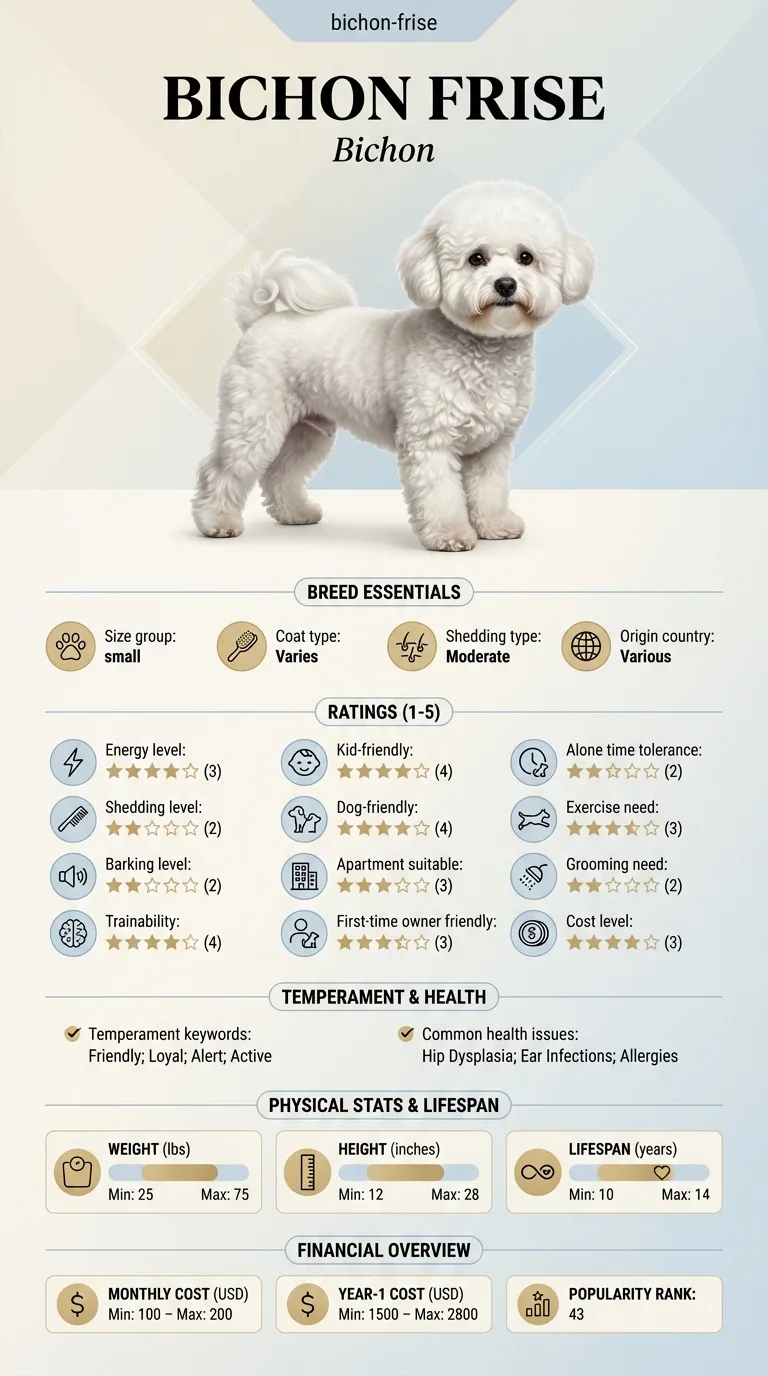
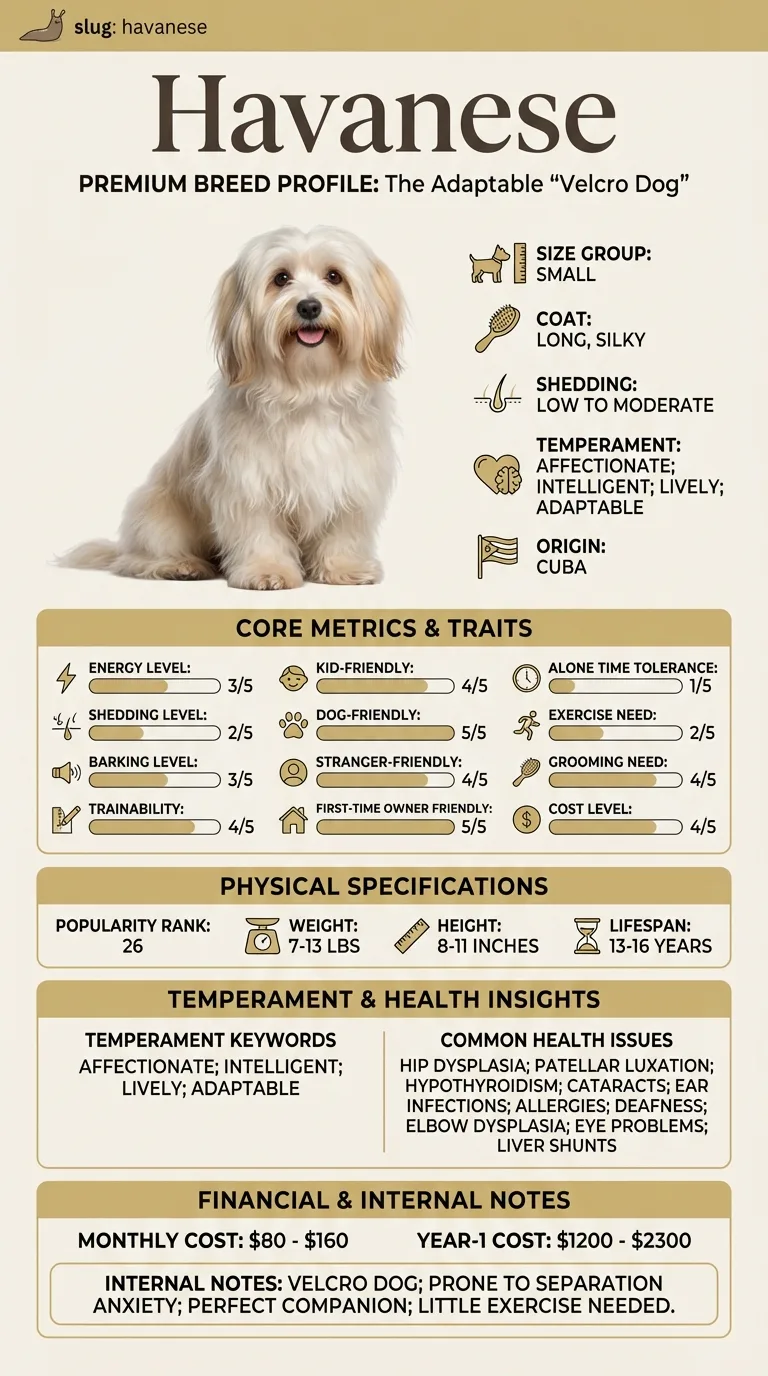
This is for someone already down to Bichon Frise and Havanese and deciding between them. Because the two are so evenly matched, the page works through every axis rather than leading with one. Both rate 5/5 for flats, so housing does not settle this one. There is no origin story here — only what changes about your week.
Between Bichon Frise and Havanese, they are closer than most pairings, and the choice comes down to temperament, and Havanese is the lower-effort dog of the two to keep.
Choose Bichon Frise if shedding is a problem in your house.
Choose Havanese if this is your first dog, you do not want a standing grooming appointment and you already have another dog.
| Feature | bichon frise | havanese | Winner |
|---|---|---|---|
| Size class | small | small | Equal |
| Weight | 12–18 lbs | 7–13 lbs | Equal |
| Height | 9–12 in | 8–11 in | Equal |
| Lifespan | 14–15 years | 13–16 years | Equal |
| Exercise need | Low (2/5) | Low (2/5) | Equal |
| Grooming need | Very high (5/5) | High (4/5) | havanese |
| Shedding | Very low (1/5) | Low (2/5) | bichon frise |
| Energy level | Moderate (3/5) | Moderate (3/5) | Equal |
| Barking | Moderate (3/5) | Moderate (3/5) | Equal |
| Apartment suitability | Very high (5/5) | Very high (5/5) | Equal |
| Good for first-time owners | High (4/5) | Very high (5/5) | havanese |
| Tolerates being alone | Low (2/5) | Very low (1/5) | bichon frise |
| Trainability | Moderate (3/5) | High (4/5) | havanese |
| Good with kids | High (4/5) | High (4/5) | Equal |
| Good with other dogs | High (4/5) | Very high (5/5) | havanese |
| Friendly to strangers | High (4/5) | High (4/5) | Equal |
| Cost level | Moderate (3/5) | High (4/5) | bichon frise |
| Coat | Curly, dense double coat | Long, silky | Equal |
| Origin | Various | Cuba | Equal |
| Typical monthly cost | $80–$150 | $80–$160 | Equal |
| Typical first-year cost | $1,100–$2,300 | $1,200–$2,300 | Equal |
Both breeds fall in the small size class, but the Havanese is noticeably lighter, 7-13 lbs against the Bichon Frise's 12-18 lbs, even though their heights sit close together at 8-11 inches versus 9-12 inches. In practice a Havanese often looks like a slightly more compact, leggier version of a Bichon rather than a dramatically different dog. This is one of the closer size matchups on this site, which means the deciding factors between these two breeds will come down to coat, temperament, and trainability rather than whether one dog can physically fit somewhere the other can't.
Exercise need ties at low (2/5) for both breeds, and energy level ties at moderate (3/5) as well; these two are genuinely similar in daily activity requirements, both content with modest walks and indoor play rather than demanding runs or hikes. Neither breed will push an owner toward a more active lifestyle than they already have. The practical difference shows up less in how much exercise each needs and more in style: Havanese are frequently described as especially playful and food-motivated during those lower-key activity sessions, which some owners find makes short training-and-play sessions more engaging than with other low-energy small breeds.
The Bichon Frise demands slightly more grooming, very high (5/5) versus the Havanese's still-substantial high (4/5), both needing frequent brushing to prevent matting in their long or curly coats. Shedding favors the Bichon marginally, very low (1/5) against the Havanese's low (2/5), a small but real difference for anyone with allergy sensitivities. Neither breed is a low-maintenance grooming choice; both will need either a skilled owner with clippers and a regular brushing routine or a standing appointment with a professional groomer every four to six weeks to avoid painful mats forming close to the skin.
Apartment suitability ties at very high (5/5) for both breeds, genuinely excellent options for compact living given their low exercise needs and small size. Barking also ties at moderate (3/5). The one meaningful gap is alone tolerance: the Havanese rates very low (1/5), even lower than the Bichon's already-low 2/5, reflecting a breed that was developed as a companion dog bred to stay close to its people and can struggle noticeably with solo time. Anyone working long hours from an office should think carefully before choosing either breed, but especially the Havanese.
The Havanese rates high (4/5) on trainability, a step above the Bichon's moderate (3/5), and edges ahead on first-time-owner suitability too at very high (5/5) versus the Bichon's high (4/5). Havanese were historically trained as circus and trick dogs in Cuba, and that heritage shows in how readily they take to training sessions; many owners find them quick to pick up tricks and commands beyond basic obedience. Both breeds remain solidly beginner-friendly overall, but someone specifically interested in trick training or dog sports may find the Havanese the more rewarding student.
Both breeds tie at high (4/5) with kids and at high (4/5) with strangers, so the family-friendliness comparison here is close to even. The Havanese pulls ahead with other dogs, rated very high (5/5) against the Bichon's high (4/5), suggesting a slightly easier fit in multi-dog households or dog parks. Given how similar these two breeds are across most household categories, choosing between them for a family setting will likely come down to smaller factors like individual breeder lines and personal preference rather than any single decisive trait in the data.
Lifespan ties closely, with the Bichon at 14-15 years and the Havanese at 13-16 years, both long-lived small breeds. Health profiles differ more: the Havanese's ten-item list includes deafness, liver shunts, and eye problems alongside more common conditions like hip dysplasia and hypothyroidism, while the Bichon's shorter five-item list centers on skin allergies, bladder stones, and dental disease. Liver shunts in particular are worth screening for in Havanese puppies, since they can be serious if undiagnosed. Bichon owners should stay ahead of dental disease and bladder stones with regular vet checkups instead.
Costs run close between these two small breeds: $80-150 monthly for the Bichon versus $80-160 for the Havanese, and first-year totals of $1,100-2,300 against $1,200-2,300, a near tie. The Havanese rates one notch higher on overall cost level, high (4/5) versus the Bichon's moderate (3/5), likely reflecting its longer health-condition list and the veterinary screening that comes with it. For budget-conscious owners choosing purely on cost, these two breeds land close enough together that other factors, trainability, alone tolerance, or simple personal preference, should probably decide it instead.
Bichon Frise weighs 12–18 lbs and lives 14–15 years; Havanese weighs 7–13 lbs and lives 13–16 years. No rated axis separates them by more than a single point, which makes this one of the closer pairings on the site. They are level on apartment suitability, barking and energy level, so those cannot decide it. Where the table declares a winner it means less work for the owner, nothing more; descriptive rows are left as ties on purpose. The value here is in the differences between the two columns; treat any single score as approximate.

Yes, somewhat; the Havanese typically weighs 7-13 lbs compared to the Bichon's 12-18 lbs, though their heights are close at 8-11 inches versus 9-12 inches.
Neither does well, but the Bichon is somewhat better, rated low (2/5) versus the Havanese's very low (1/5). Both breeds were bred as close companions and struggle with long solo hours.
The Havanese, rated high (4/5) versus the Bichon's moderate (3/5); its history as a Cuban circus and trick dog shows in how readily it learns.
Both are low-shed breeds, but the Bichon edges ahead at very low (1/5) versus the Havanese's low (2/5), a small difference that matters most for severe allergy sufferers.
The Havanese, rated very high (5/5) versus the Bichon's high (4/5), suggesting a slight edge for multi-dog households.
The Havanese's list includes hip dysplasia, patellar luxation, hypothyroidism, cataracts, deafness, and liver shunts, ten conditions total, worth discussing with a breeder about health testing.
Very close; first-year costs run $1,100-2,300 for the Bichon and $1,200-2,300 for the Havanese, making cost a near non-factor between these two.
Either works well; both rate very high (5/5) on apartment suitability.
The Havanese, rated high (4/5) versus the Bichon's moderate (3/5).
The Havanese, rated very low (1/5) versus the Bichon's low (2/5).
The Havanese, typically 7-13 lbs versus the Bichon's 12-18 lbs.
Secure checkout on Stripe. We never see your card.
7-day money-back guarantee. Instant access.
Health information here is general and is not veterinary advice. If your dog shows pain, sudden behaviour change, or worsening symptoms, consult a licensed veterinarian.
Some links on this site are affiliate links. We may earn a commission at no extra cost to you, and we only suggest products we believe are helpful for dog owners.
We research and check what we publish, but we do not warrant that any figure, date, price, or statement is accurate, complete, or current, and we accept no liability for any loss, cost, injury, or other harm arising from the use of this site. Use it as one reference among several. You remain responsible for your own decisions and for your dog's care - confirm anything that matters with a licensed veterinarian or another qualified professional before you act on it. Full disclaimer.
Match your lifestyle to the right dog.
Take quizNot sure which breed is right for you? Take our 2-minute quiz to find out.
Take the quiz