Behavior
Which needs more exercise?
The German Shepherd, rated Very high (5/5) versus the Bichon's Low (2/5).

Quick answer
Which needs more exercise?
The German Shepherd, rated Very high (5/5) versus the Bichon's Low (2/5).
Bichon Frise or German Shepherd? On paper they differ most on exercise need, and on the scales German Shepherd is the heavier at 50–90 lbs. Here is how the two compare on everything that shapes an ordinary week.
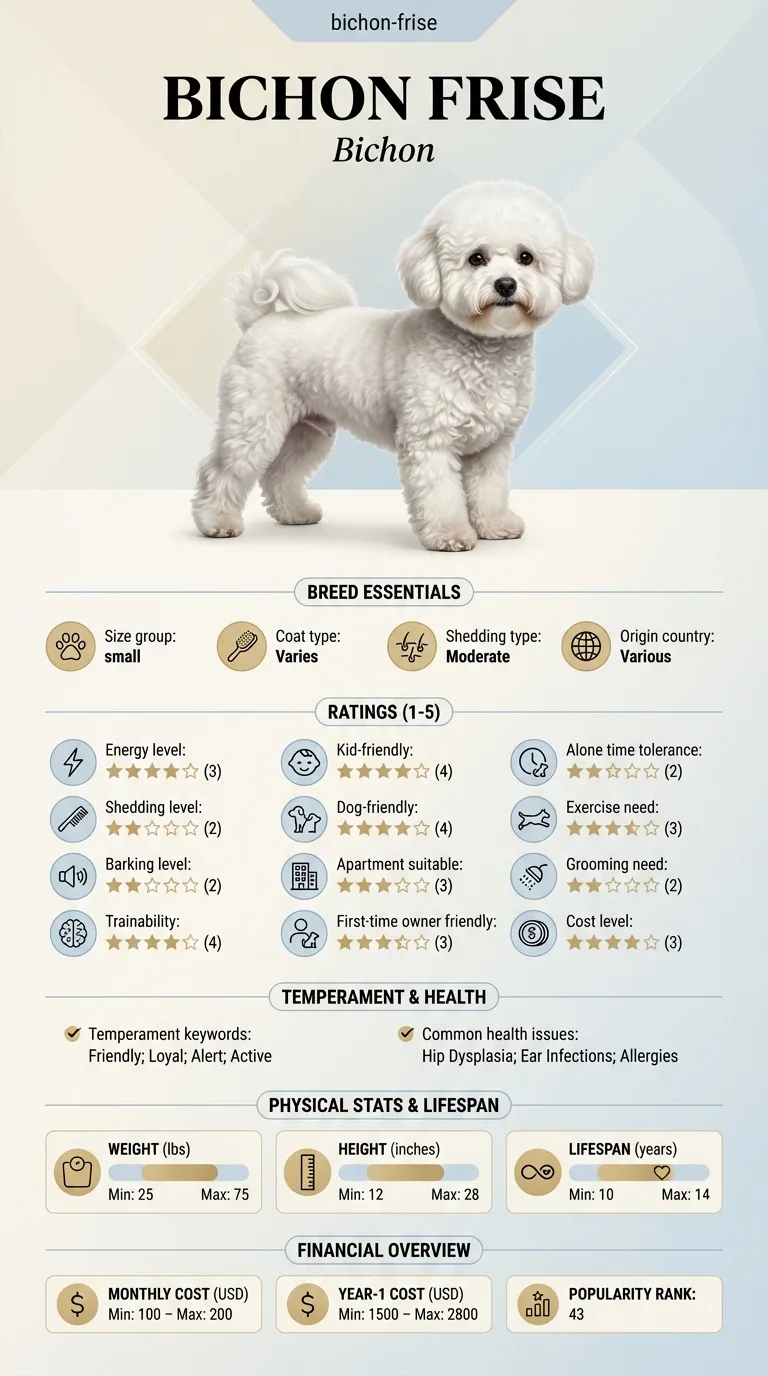
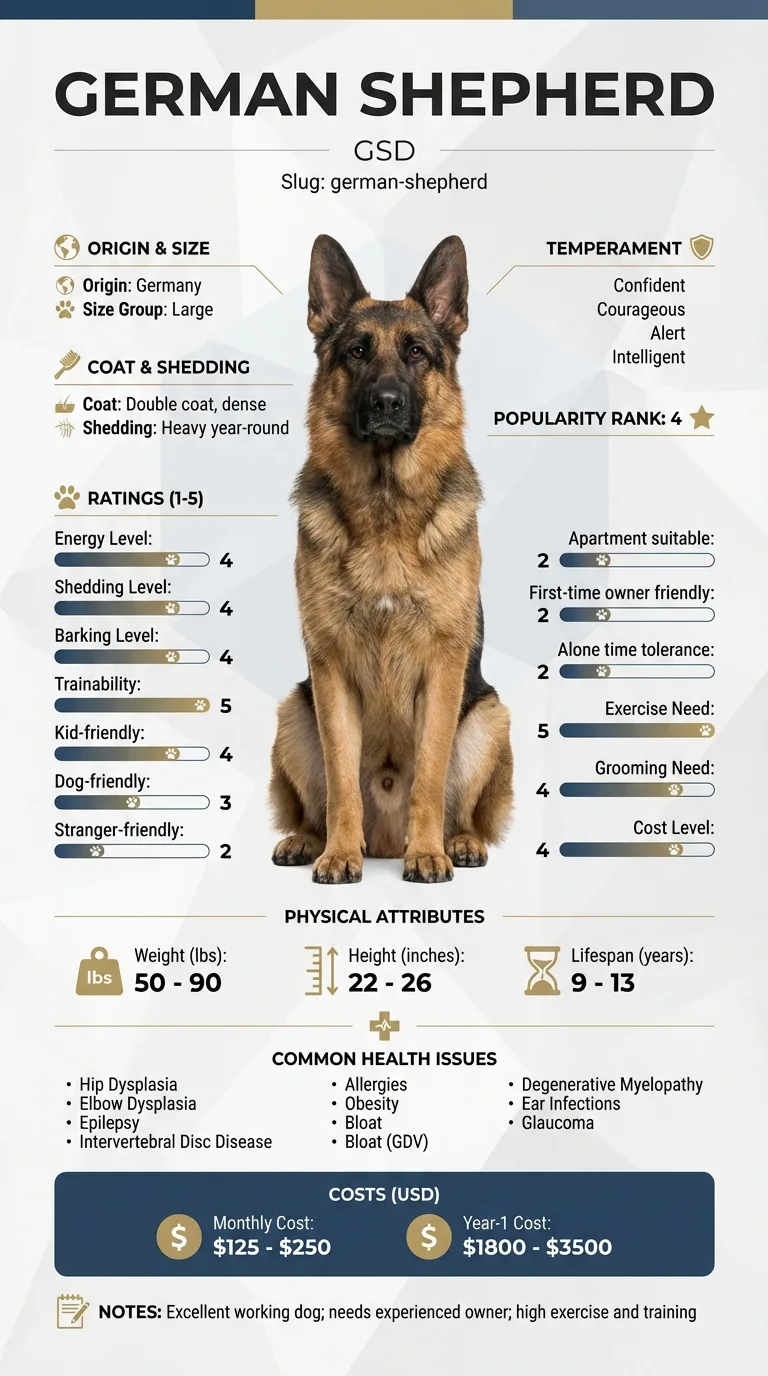
This is for someone already down to Bichon Frise and German Shepherd and deciding between them. For this pair the decision usually turns on exercise need and apartment suitability, so those are covered first and in most detail. Anyone choosing from a flat has a clear answer here: Bichon Frise rates 5/5 against 2/5. It is written for the decision rather than the breed history.
Between Bichon Frise and German Shepherd, exercise need is what separates them, and Bichon Frise is the lower-effort dog of the two to keep.
Choose Bichon Frise if you are in a flat or a smaller home, this is your first dog and shedding is a problem in your house.
Choose German Shepherd if you do not want a standing grooming appointment, you want a dog that picks up training quickly and you want a dog that can keep up with an active routine.
| Feature | bichon frise | german shepherd | Winner |
|---|---|---|---|
| Size class | small | large | Equal |
| Weight | 12–18 lbs | 50–90 lbs | Equal |
| Height | 9–12 in | 22–26 in | Equal |
| Lifespan | 14–15 years | 9–13 years | bichon frise |
| Exercise need | Low (2/5) | Very high (5/5) | bichon frise |
| Grooming need | Very high (5/5) | High (4/5) | german shepherd |
| Shedding | Very low (1/5) | High (4/5) | bichon frise |
| Energy level | Moderate (3/5) | High (4/5) | Equal |
| Barking | Moderate (3/5) | High (4/5) | bichon frise |
| Apartment suitability | Very high (5/5) | Low (2/5) | bichon frise |
| Good for first-time owners | High (4/5) | Low (2/5) | bichon frise |
| Tolerates being alone | Low (2/5) | Low (2/5) | Equal |
| Trainability | Moderate (3/5) | Very high (5/5) | german shepherd |
| Good with kids | High (4/5) | High (4/5) | Equal |
| Good with other dogs | High (4/5) | Moderate (3/5) | bichon frise |
| Friendly to strangers | High (4/5) | Low (2/5) | bichon frise |
| Cost level | Moderate (3/5) | High (4/5) | bichon frise |
| Coat | Curly, dense double coat | Double coat, dense | Equal |
| Origin | Various | Germany | Equal |
| Typical monthly cost | $80–$150 | $125–$250 | Equal |
| Typical first-year cost | $1,100–$2,300 | $1,800–$3,500 | Equal |
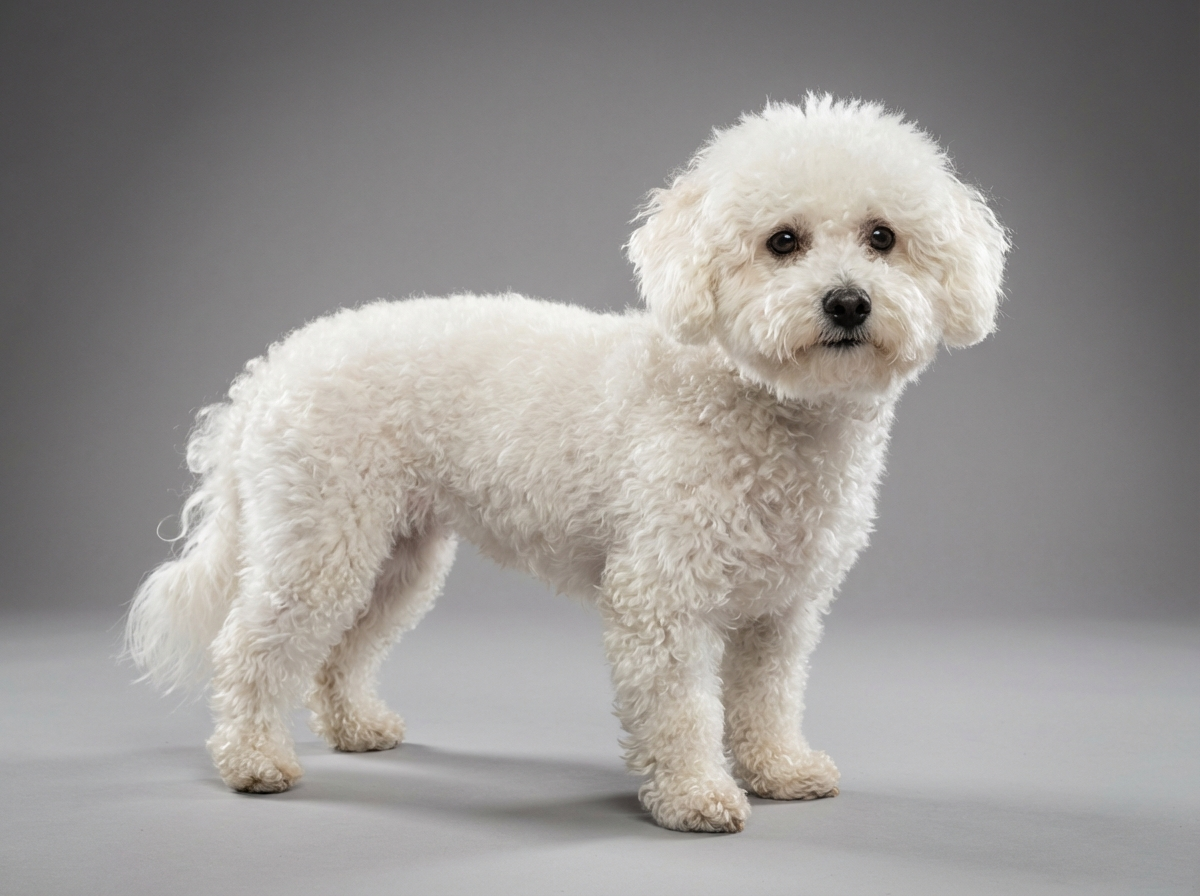
Scale sets this pairing apart immediately: the Bichon Frise at 12–18 lbs and 9–12 inches against the German Shepherd's imposing 50–90 lbs and 22–26 inches, a large working breed that can weigh five times more than the Bichon at its upper range. That's not a subtle difference — it changes the strength required to manage the dog physically, the size of home and yard needed, and even insurance considerations some landlords apply to large breeds. The Shepherd's muscular, athletic build reflects generations of herding and police-work breeding, standing in sharp contrast to the Bichon's small, plush-coated companion frame.
The German Shepherd needs dramatically more exercise than the Bichon Frise — Very high (5/5) versus Low (2/5) — and energy level follows the same pattern at High (4/5) against Moderate (3/5). Bred for demanding working roles in herding, police, and military service, the Shepherd needs real daily structure: long walks, training drills, or working-style tasks, not just casual yard time. A Bichon's modest needs sit at nearly the opposite end of the spectrum. Anyone drawn to the Shepherd's intelligence and loyalty should be honest about whether their schedule can actually deliver the physical and mental output this breed requires to stay balanced.
Grooming need rates High (4/5) for the German Shepherd, just under the Bichon Frise's Very high (5/5), so both breeds require regular, ongoing coat care rather than occasional attention. Shedding is where the real difference shows: High (4/5) for the Shepherd against Very low (1/5) for the Bichon, and Shepherd owners know this well — the breed's dense double coat sheds heavily year-round with seasonal blowouts that can feel constant without a regular brushing routine. The Bichon trades more frequent professional grooming appointments for a nearly hair-free home, while the Shepherd trades less professional grooming for significantly more vacuuming.
Apartment suitability heavily favors the Bichon Frise, Very high (5/5) against the German Shepherd's Low (2/5), a direct result of the Shepherd's size and Very high exercise needs colliding with limited space. Barking also favors the Bichon, Moderate (3/5) versus the Shepherd's High (4/5) — Shepherds are naturally alert and vocal watchdogs, which can be a liability in close-quarters apartment living with shared walls. Tolerance for being alone ties at Low (2/5) for both, so separation-related stress is a shared risk, but a Shepherd expressing that stress in a small space is a bigger practical problem given its size and bark volume.
The German Shepherd rates Very high (5/5) on trainability, well above the Bichon Frise's Moderate (3/5), and its temperament keywords — confident, courageous, alert, intelligent — explain its long history in working and service roles. But first-time-owner suitability flips sharply: Low (2/5) for the Shepherd versus High (4/5) for the Bichon. That combination of high intelligence and low first-time-owner suitability is a common pattern in working breeds — a Shepherd's trainability is real, but it needs an owner who can provide consistent structure and mental stimulation, or that same intelligence tends to find its own, less welcome outlets.
Both breeds tie at High (4/5) with kids, which counters the German Shepherd's occasionally intimidating reputation — properly raised and socialized, Shepherds are frequently devoted, protective family dogs. The Bichon Frise pulls ahead with other dogs, High (4/5) versus the Shepherd's Moderate (3/5), and with strangers, High (4/5) versus the Shepherd's Low (2/5), reflecting the Shepherd's natural wariness of unfamiliar people, a trait bred into it for guarding and protection work. Households that host frequently or live somewhere with a lot of foot traffic should plan for extra socialization work if choosing a Shepherd over the more universally welcoming Bichon.
Lifespan favors the Bichon Frise clearly, 14–15 years against the German Shepherd's 9–13 years, and the Shepherd's health list is both long and serious: hip dysplasia, elbow dysplasia, epilepsy, intervertebral disc disease, allergies, obesity, bloat (GDV), degenerative myelopathy, ear infections, and glaucoma. Hip and elbow dysplasia in particular are common enough in the breed that many buyers ask breeders for hip-score documentation before committing, and bloat is a genuine emergency risk in deep-chested large dogs like the Shepherd. The Bichon's five-item list — skin allergies, patellar luxation, bladder stones, cataracts, dental disease — is comparatively minor by contrast.
Cost level rates High (4/5) for the German Shepherd against Moderate (3/5) for the Bichon Frise, with monthly ranges of $125–$250 versus $80–$150 and first-year costs of $1,800–$3,500 versus $1,100–$2,300. Larger food volumes and weight-based medication dosing account for part of the gap, but the Shepherd's serious orthopedic and gastrointestinal risk list — hip dysplasia, bloat — is the bigger long-term budget factor, since both can mean significant veterinary bills. The Bichon's ongoing costs stay concentrated almost entirely in grooming, a more predictable expense than the Shepherd's larger health-risk profile.
Bichon Frise weighs 12–18 lbs and lives 14–15 years; German Shepherd weighs 50–90 lbs and lives 9–13 years. The two diverge most on exercise need, apartment suitability and shedding and 3 other rated axes. They are level on tolerates being alone and good with kids, so those cannot decide it. In the table, a "winner" means easier for an ordinary household — not better. Size, coat and origin are recorded without a verdict. Because both breeds are scored the same way, the gaps are reliable even where the absolute numbers are rough.

Not ideally — it rates Low (2/5) for first-time owners despite Very high (5/5) trainability, because that intelligence needs an experienced hand to channel well. The Bichon Frise, at High (4/5), is the easier starting point.
A great deal — it rates Very high (5/5) on exercise, versus the Bichon Frise's Low (2/5), reflecting its working-breed background in herding and police service.
Yes, when properly socialized — they tie the Bichon Frise at High (4/5) with kids.
Hip and elbow dysplasia are the most commonly flagged issues, alongside bloat (GDV), a genuine emergency risk in deep-chested large breeds.
The German Shepherd, rated High (4/5), versus the Bichon Frise's Very low (1/5).
The Bichon Frise, rated High (4/5), versus the German Shepherd's Low (2/5) — Shepherds are naturally more wary of unfamiliar people.
The German Shepherd, rated High (4/5) on cost versus the Bichon Frise's Moderate (3/5), driven by size and a more serious health-risk profile.
The German Shepherd, rated Very high (5/5) versus the Bichon's Low (2/5).
The German Shepherd, rated Very high (5/5) versus the Bichon's Moderate (3/5).
The Bichon Frise, rated Very high (5/5) versus the Shepherd's Low (2/5).
The Bichon Frise, rated Very low (1/5) versus the Shepherd's High (4/5).
Secure checkout on Stripe. We never see your card.
7-day money-back guarantee. Instant access.
Health information here is general and is not veterinary advice. If your dog shows pain, sudden behaviour change, or worsening symptoms, consult a licensed veterinarian.
Some links on this site are affiliate links. We may earn a commission at no extra cost to you, and we only suggest products we believe are helpful for dog owners.
We research and check what we publish, but we do not warrant that any figure, date, price, or statement is accurate, complete, or current, and we accept no liability for any loss, cost, injury, or other harm arising from the use of this site. Use it as one reference among several. You remain responsible for your own decisions and for your dog's care - confirm anything that matters with a licensed veterinarian or another qualified professional before you act on it. Full disclaimer.
Match your lifestyle to the right dog.
Take quizNot sure which breed is right for you? Take our 2-minute quiz to find out.
Take the quiz