Behavior
Which sheds less?
The Bichon Frise, rated Very low (1/5) versus the Dachshund's Low (2/5).

Quick answer
Which sheds less?
The Bichon Frise, rated Very low (1/5) versus the Dachshund's Low (2/5).
Bichon Frise or Dachshund? On paper they differ most on grooming need, and on the scales Dachshund is the heavier at 11–32 lbs. Here is how the two compare on everything that shapes an ordinary week.
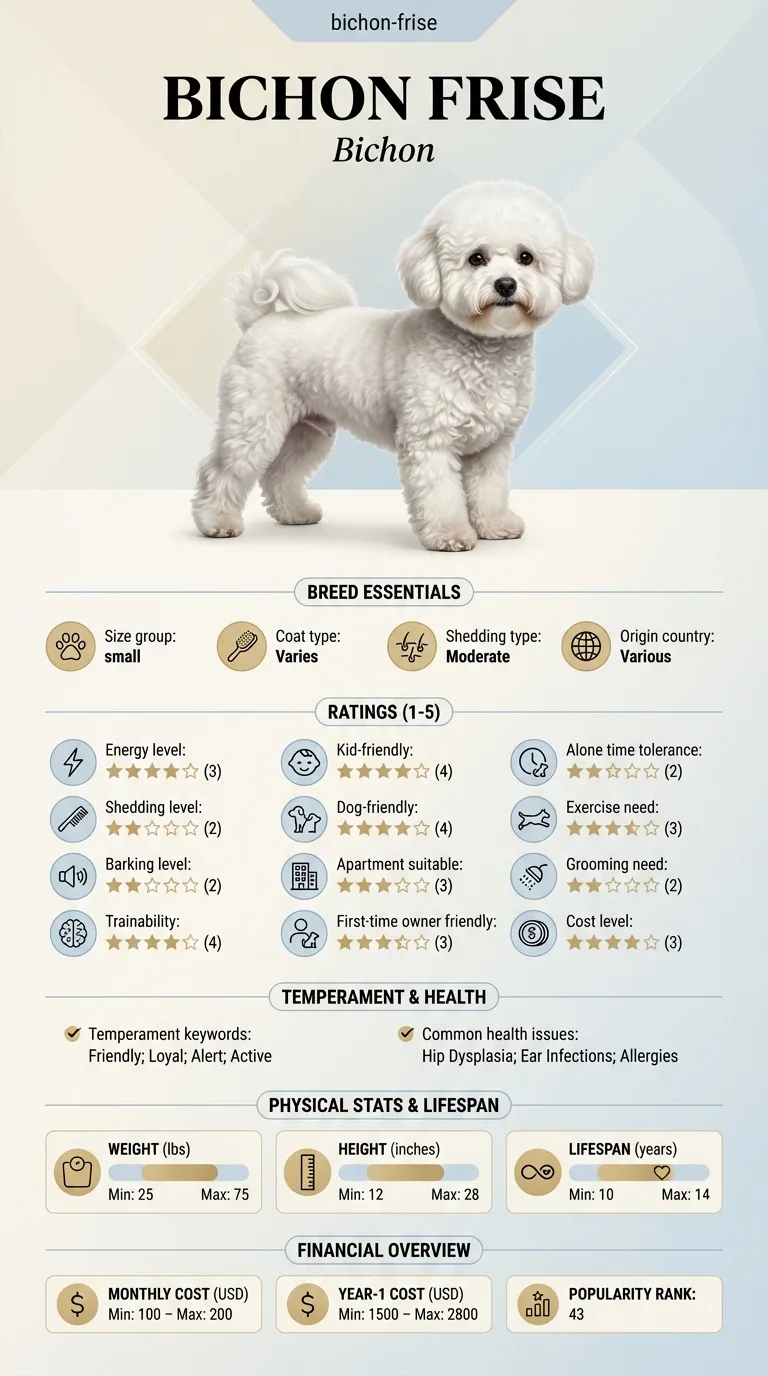
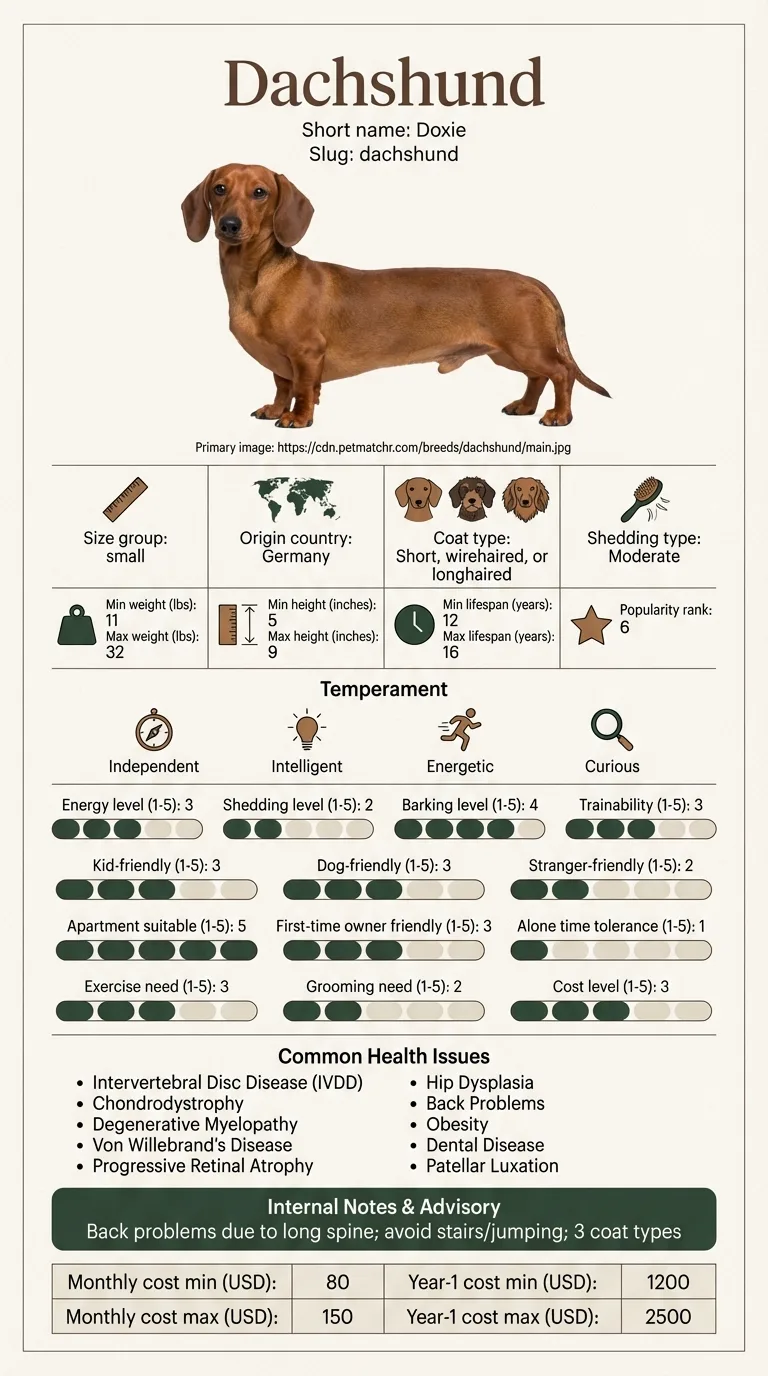
This is for someone already down to Bichon Frise and Dachshund and deciding between them. For this pair the decision usually turns on grooming need and friendly to strangers, so those are covered first and in most detail. Both rate 5/5 for flats, so housing does not settle this one. Breed history is left out; what follows is what you will actually live with.
Between Bichon Frise and Dachshund, grooming need is what separates them; neither is the lower-effort dog overall.
Choose Bichon Frise if this is your first dog, shedding is a problem in your house and your walking routine is modest.
Choose Dachshund if you do not want a standing grooming appointment, you want a dog that can keep up with an active routine and you want a dog that is more watchful with visitors.
| Feature | bichon frise | dachshund | Winner |
|---|---|---|---|
| Size class | small | small | Equal |
| Weight | 12–18 lbs | 11–32 lbs | Equal |
| Height | 9–12 in | 5–9 in | Equal |
| Lifespan | 14–15 years | 12–16 years | bichon frise |
| Exercise need | Low (2/5) | Moderate (3/5) | bichon frise |
| Grooming need | Very high (5/5) | Low (2/5) | dachshund |
| Shedding | Very low (1/5) | Low (2/5) | bichon frise |
| Energy level | Moderate (3/5) | Moderate (3/5) | Equal |
| Barking | Moderate (3/5) | High (4/5) | bichon frise |
| Apartment suitability | Very high (5/5) | Very high (5/5) | Equal |
| Good for first-time owners | High (4/5) | Moderate (3/5) | bichon frise |
| Tolerates being alone | Low (2/5) | Very low (1/5) | bichon frise |
| Trainability | Moderate (3/5) | Moderate (3/5) | Equal |
| Good with kids | High (4/5) | Moderate (3/5) | bichon frise |
| Good with other dogs | High (4/5) | Moderate (3/5) | bichon frise |
| Friendly to strangers | High (4/5) | Low (2/5) | bichon frise |
| Cost level | Moderate (3/5) | Moderate (3/5) | Equal |
| Coat | Curly, dense double coat | Short, wirehaired, or longhaired | Equal |
| Origin | Various | Germany | Equal |
| Typical monthly cost | $80–$150 | $80–$150 | Equal |
| Typical first-year cost | $1,100–$2,300 | $1,200–$2,500 | Equal |
Both breeds fall in the small size class, but the numbers hide some real variation: the Bichon Frise sits in a tight 12–18 lb, 9–12 inch range, while the Dachshund spans a much wider 11–32 lbs depending on whether it's a miniature or standard, standing just 5–9 inches tall. That low-slung, elongated Dachshund frame is a completely different build from the Bichon's compact, rounded silhouette — the Dachshund was bred to go down burrows after badgers, and its long spine and short legs are the direct result. Anyone comparing these two should note that "small" means something structurally different for each breed.
The Dachshund rates Moderate (3/5) on exercise need against the Bichon Frise's Low (2/5), a modest gap that belies the Dachshund's surprisingly high drive for its size — this is a hunting breed underneath the comical shape. Energy level ties at Moderate (3/5) for both, so neither dog is a couch potato, but the Dachshund's stronger prey drive means its energy often channels into digging, chasing, or burrowing behaviors that a Bichon simply doesn't show. Exercise for a Dachshund should also stay low-impact — no jumping off furniture — given the strain that puts on its long spine, a consideration the Bichon's build doesn't share.
Grooming flips dramatically here: the Bichon Frise needs Very high (5/5) grooming for its curly double coat, while the Dachshund needs only Low (2/5), whether it's smooth, wirehaired, or longhaired. Shedding tells a related story — Very low (1/5) for the Bichon against Low (2/5) for the Dachshund, meaning even the Dachshund's modest shedding still edges out the Bichon's near-zero baseline. For someone weighing time and money spent at the groomer, this is one of the largest gaps in the whole comparison: a Bichon typically needs professional grooming every four to six weeks, while a Dachshund's coat care is mostly a home routine with a brush and occasional bath.
Both breeds tie at Very high (5/5) apartment suitability, and both are genuinely well suited to compact living given their small size. Barking is where they split — the Dachshund rates High (4/5) against the Bichon's Moderate (3/5), and Dachshunds are famously vocal, alerting loudly to noises, strangers, or other dogs passing by, which can be a real issue in thin-walled apartment buildings. Alone-time tolerance is low for both, but the Dachshund's Very low (1/5) score is even lower than the Bichon's Low (2/5), making it the more prone of the two to separation anxiety and its associated barking or destructive behavior.
Trainability ties at Moderate (3/5) for both breeds, but first-time-owner suitability tips toward the Bichon Frise at High (4/5) versus the Dachshund's Moderate (3/5). The Dachshund's temperament — independent, intelligent, energetic, curious — is a combination that often translates to a strong-willed dog that thinks through commands rather than simply obeying them, a trait bred into it for solo underground hunting where waiting for instructions wasn't an option. New owners sometimes underestimate how much personality lives inside such a small dog; the Dachshund's cleverness is real, but so is its tendency to negotiate rather than comply.
The Bichon Frise outscores the Dachshund across every social category here: High (4/5) with kids versus Moderate (3/5), High (4/5) with other dogs versus Moderate (3/5), and High (4/5) with strangers versus Low (2/5). Dachshunds can be surprisingly territorial and wary of unfamiliar people and animals despite their small size, a trait that doesn't always match the "cute lap dog" image they project. Families with boisterous young kids should also weigh the Dachshund's fragile spine — rough handling carries real injury risk — something the sturdier, more universally sociable Bichon doesn't carry to the same degree.
Both breeds are relatively long-lived — 14–15 years for the Bichon Frise, 12–16 years for the Dachshund — but the Dachshund's health list is dominated by one defining risk: Intervertebral Disc Disease (IVDD), a direct consequence of its chondrodystrophy (the genetic dwarfism responsible for its short legs and long back). The rest of its list — degenerative myelopathy, Von Willebrand's disease, progressive retinal atrophy, hip dysplasia, back problems, obesity, dental disease, patellar luxation — reinforces how much spinal and joint health matters for this breed. The Bichon's shorter list of skin allergies, patellar luxation, bladder stones, cataracts, and dental disease is comparatively milder and less structurally determined.
Cost level ties at Moderate (3/5), and the monthly ranges match exactly at $80–$150, though first-year costs run slightly higher for the Dachshund at $1,200–$2,500 versus the Bichon's $1,100–$2,300. The real budget variable for Dachshund owners isn't routine cost, though — it's the possibility of IVDD-related veterinary care, which can mean expensive imaging and even spinal surgery if a disc ruptures. Bichon owners face steadier, more predictable grooming expenses instead. Both are manageable on a moderate budget, but a Dachshund owner should keep some financial cushion specifically earmarked for back-related emergencies.
Bichon Frise weighs 12–18 lbs and lives 14–15 years; Dachshund weighs 11–32 lbs and lives 12–16 years. The two diverge most on grooming need and friendly to strangers. They are level on apartment suitability, cost level and energy level, so those cannot decide it. The comparison marks an easier option only where one exists. Facts like weight and country of origin are not scored. Both dogs are rated from the same dataset, which is what makes the numbers comparable with each other even though any individual dog sits somewhere inside its breed's range.

Yes — Intervertebral Disc Disease (IVDD) is the breed's defining health risk, a consequence of the chondrodystrophy that gives Dachshunds their long spine and short legs. Owners are advised to limit jumping and use ramps.
The Dachshund by a wide margin — Low (2/5) versus the Bichon Frise's Very high (5/5), since the Bichon's curly coat needs regular professional trims.
Yes — they rate Very high (5/5) for apartment suitability, tied with the Bichon Frise, though their High (4/5) barking tendency is worth considering with close neighbors.
The Bichon Frise, rated High (4/5) versus the Dachshund's Low (2/5) — Dachshunds tend toward wariness of unfamiliar people.
The Dachshund has a slightly higher ceiling at 12–16 years versus the Bichon Frise's 14–15 years, though both are long-lived small breeds.
It's workable but rated only Moderate (3/5) for first-time owners, versus the Bichon Frise's High (4/5), due to the Dachshund's independent, strong-willed streak.
Neither does well, but the Bichon Frise's Low (2/5) still edges out the Dachshund's Very low (1/5).
The Bichon Frise, rated Very low (1/5) versus the Dachshund's Low (2/5).
The Dachshund, rated High (4/5) versus the Bichon's Moderate (3/5).
The Dachshund, rated Low (2/5) versus the Bichon's Very high (5/5).
The Bichon Frise, rated High (4/5) versus the Dachshund's Low (2/5).
Secure checkout on Stripe. We never see your card.
7-day money-back guarantee. Instant access.
Health information here is general and is not veterinary advice. If your dog shows pain, sudden behaviour change, or worsening symptoms, consult a licensed veterinarian.
Some links on this site are affiliate links. We may earn a commission at no extra cost to you, and we only suggest products we believe are helpful for dog owners.
We research and check what we publish, but we do not warrant that any figure, date, price, or statement is accurate, complete, or current, and we accept no liability for any loss, cost, injury, or other harm arising from the use of this site. Use it as one reference among several. You remain responsible for your own decisions and for your dog's care - confirm anything that matters with a licensed veterinarian or another qualified professional before you act on it. Full disclaimer.
Match your lifestyle to the right dog.
Take quizNot sure which breed is right for you? Take our 2-minute quiz to find out.
Take the quiz