Health
What is the first sign of bloat?
Repeated attempts to vomit that bring up nothing. If your dog is retching unproductively and pacing, go to an emergency hospital.

Quick answer
What is the first sign of bloat?
Repeated attempts to vomit that bring up nothing. If your dog is retching unproductively and pacing, go to an emergency hospital.
Bloat kills faster than almost anything else a healthy dog can develop. The risk to a Shetland Sheepdog is low, but the cost of not recognising it is total, which is an unusual combination worth thinking about clearly.
Owners who have read that bloat is a giant breed problem and want to know whether that lets a 20 pound dog off the hook. People whose Sheltie has a swollen belly right now and are trying to decide about the drive. Anyone budgeting for the kind of emergency that arrives without warning.
This guide is not medical advice. If your dog shows pain, sudden behavior change, or worsening symptoms, consult a licensed veterinarian.
Some links may be affiliate links. We may earn a commission at no extra cost to you. We only suggest products we believe are helpful for dog owners.
We research and check what we publish, but we do not warrant that any figure, date, price, or statement is accurate, complete, or current, and we accept no liability for any loss, cost, injury, or other harm arising from the use of this site. Use it as one reference among several. You remain responsible for your own decisions and for your dog's care - confirm anything that matters with a licensed veterinarian or another qualified professional before you act on it. Full disclaimer.
GDV is the sudden distension and rotation of the stomach, and it is one of the few genuine surgical emergencies in dogs where delay is measured in minutes rather than days. It affects deep-chested breeds far more than compact ones, and the Shetland Sheepdog is well outside the classic risk profile. The reason it belongs in a Sheltie owner's knowledge anyway is that it is unrecoverable if missed and highly survivable if caught.
Rare in this breed. Published risk data consistently places small, compactly built dogs at the bottom of the incidence range, and bloat does not feature among the five conditions documented for the Shetland Sheepdog. A veterinary practice may see several GDV cases a year across its whole caseload, and very few of them will be dogs of this size.
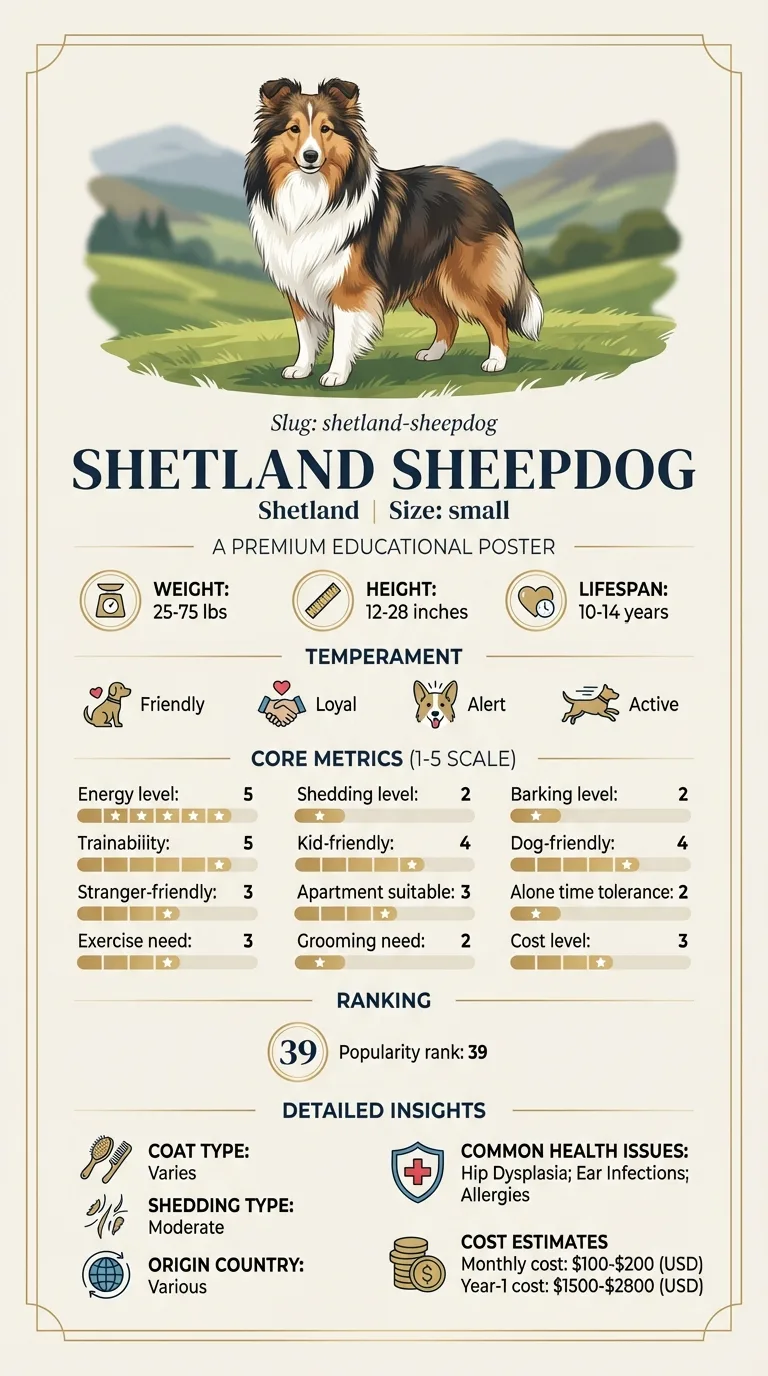
The main determinant is thoracic conformation, and here the Shetland Sheepdog is protected rather than predisposed. At 13 to 16 inches tall and 15 to 25 pounds, with a chest of moderate depth relative to its width, there is comparatively little room for the stomach to swing and rotate on its ligamentous attachments. Nothing in the breed's documented health profile points towards gastric disease. The one indirect breed factor worth noting is behavioural: a bright, food-motivated herding dog that gulps meals in seconds is swallowing air, and rapid eating is a modifiable risk in any breed.
Feeding pattern is the main lever available to owners. One enormous daily meal, competitive eating alongside another dog, and eating straight after or before hard exercise all raise risk in the breeds that get GDV. Stress is a repeatedly identified factor, so kennelling, travel and significant household upheaval are periods to feed conservatively. Very large volumes of water taken at once after strenuous exercise on a hot day contribute in the same way.
This is one of the few conditions where you should not phone first if phoning costs you time. Drive to the nearest open veterinary hospital immediately if your dog is retching repeatedly without producing anything, is pacing and unable to settle, is drooling heavily, has a visibly or palpably distended abdomen, or has collapsed with pale gums. Call from the road so they can prepare. Do not give food, water or any medication on the way, and do not attempt to make the dog vomit. For a dog with a mildly swollen belly who is otherwise bright, eating and passing stool normally, book a same-day appointment rather than an emergency visit, since there are many less dramatic causes.
See all Shetland Sheepdog health problems, which breeds are prone to bloat gastric dilatation volvulusgdv, or the full Shetland Sheepdog breed guide for temperament, exercise needs and ownership costs.
There is no timeline for management, because there is no management. A dog with GDV either reaches surgery within a few hours or does not survive. Post-operative dogs typically stay in hospital two to four days and are back to normal activity in three to four weeks.
For an owner of this breed, success is never needing any of this. Realistically it means feeding sensibly, knowing the retching sign well enough to act without hesitation, and having a financial plan for an emergency that arrives with no notice.
Bloat has a characteristic sequence, and knowing the order is more useful than knowing the list. The earliest sign in most dogs happens before the abdomen looks obviously wrong.
Risk of GDV tracks chest shape rather than body weight. Dogs with deep, narrow chests give the stomach room to swing on its attachments, and the classic cases are Great Danes, Weimaraners, Standard Poodles and Setters. A Shetland Sheepdog stands 13 to 16 inches with a chest that is moderately deep but nothing like those proportions, and bloat is not on the breed's documented condition list. Statistically this is a low-risk breed.
Low risk is not the same as no risk, and the reason to learn the signs anyway is the arithmetic of consequence. Treated promptly, a GDV dog often survives. Untreated, it is close to uniformly fatal within hours. There is no home treatment, no wait-and-see, and no over-the-counter product that helps.
Cost is worth confronting before it is urgent. Emergency stabilisation, decompression, surgery to untwist and secure the stomach, and several days of intensive monitoring commonly runs into thousands of dollars. For a breed whose ordinary running costs sit around eighty to a hundred and fifty dollars a month, that is an unbridgeable gap for most households unless it was planned for. Insurance taken out while a dog is young and well, or a dedicated emergency fund, is the mechanism that turns an impossible decision into a difficult one.
If your dog does reach surgery, mention the breed at admission. The Shetland Sheepdog carries a documented MDR1 drug sensitivity, and an anesthetic team benefits from knowing that before they premedicate, not after.

If you think your Shetland has bloat (gastric dilatation-volvulus/gdv), the plan is three steps: write down what you have seen and when it started, book a veterinary appointment rather than waiting for the next flare, and take video of the behaviour or symptom before you go — the thing you are worried about rarely happens in the consulting room. Screening in the parents covers collie eye anomaly, mdr1 drug sensitivity, dermatomyositis.
What the vet visit should produce is a diagnosis and a written plan, not just reassurance: what is being ruled out, what the monitoring interval is, and which signs mean you come back sooner. Ask what the treatment costs across a year rather than per visit, because that is the number that decides whether you are managing this condition or reacting to it.
Between appointments, keep a short log — dates, what you saw, what changed. It is the single most useful thing an owner brings to a follow-up, and for bloat (gastric dilatation-volvulus/gdv) it is often what separates a clear pattern from a guess.
Rowan was an eight year old Sheltie whose owner Beatrice found him pacing at half past eleven at night, retching without bringing anything up. She pushed her hands into the coat behind his ribs and found the abdomen unusually firm. Everything she had read about bloat concerned Great Danes, but the retching matched exactly, so she drove to the emergency hospital. Rowan did not have GDV. He had eaten roughly a third of a loaf of bread from the kitchen counter and had a stomach full of swelling dough. He was treated, kept overnight and went home fine. The vet's comment stuck with Beatrice: she had been right to come, because the signs she acted on were the correct ones and the only way to know which cause it was, was to look.
Key takeaway: You are not expected to diagnose bloat. You are expected to recognise unproductive retching and drive. A false alarm is a good outcome.
It is possible but uncommon. Risk rises steeply with chest depth and body size, and Shelties sit at the low end of both. The breed does not appear on the documented risk lists, which is genuinely reassuring rather than a technicality.
The retching is the tell. A dog with an upset stomach vomits and produces something. A dog with GDV heaves repeatedly and brings up nothing but froth, while becoming increasingly restless and distressed. That combination is a drive-now situation.
No. Never induce vomiting in a suspected bloat, and give nothing by mouth. The stomach is sealed, so anything you add makes the pressure worse. Get in the car and phone the hospital from the road.
Raised feeding was once recommended and the evidence has since gone the other way, with some studies associating raised bowls with higher risk in large breeds. It is not a protective measure worth relying on for any dog.
A surgical procedure tacking the stomach wall to the body wall so it cannot rotate. It is routinely offered alongside spays in high-risk giant breeds. For a Sheltie it is not standard practice, and it is a conversation to have with your vet rather than to request by default.
Usually none at all. Most dogs are entirely normal until the episode begins, which is why recognition matters more than surveillance. Repeated milder episodes of a bloated belly, however, do deserve investigation.
The early signs are set out in the sections above, and they are the reason to book a veterinary appointment rather than wait. Bloat (gastric Dilatation-volvulus/gdv) in Shetlands is diagnosed by a vet, not from a symptom list, and the sooner it is on record the more options remain open.
The early signs are set out in the sections above, and they are the reason to book a veterinary appointment rather than wait. Bloat (Gastric Dilatation-Volvulus/GDV) in Shetland Sheepdogs is diagnosed by a vet, not from a symptom list, and the sooner it is on record the more options remain open.
Repeated attempts to vomit that bring up nothing. If your dog is retching unproductively and pacing, go to an emergency hospital.
Low risk. It is a deep-chested large breed condition and is not on this breed's documented health profile, but the signs are still worth knowing.
Commonly thousands of dollars once stabilisation, surgery and intensive care are included, vastly beyond a Sheltie's ordinary monthly budget.
You will feel it before you see it. Press flat hands behind the ribs and tap. A drum-like sound over a tight abdomen is significant.
Vigorous activity soon after a large meal is a commonly cited risk factor. A quiet hour after feeding is sensible for any dog and costs nothing.
A one-page prep sheet for this condition: the signs, the questions to ask, what to get priced. Unlocks here.
You get: Vet visit prep sheet
No spam. One-click unsubscribe. See our privacy policy.
Preview page 1 before you decide.