Health
Do Shetland Sheepdogs get dilated cardiomyopathy?
Rarely. It is a disease of large and giant breeds and does not appear on this breed's documented health profile.

Quick answer
Do Shetland Sheepdogs get dilated cardiomyopathy?
Rarely. It is a disease of large and giant breeds and does not appear on this breed's documented health profile.
Dilated cardiomyopathy has a very specific address in the dog world: Dobermanns, Great Danes, Irish Wolfhounds, Boxers. A 20 pound herding dog is not on the list, and claims that it is the leading heart disease of this breed do not hold up.
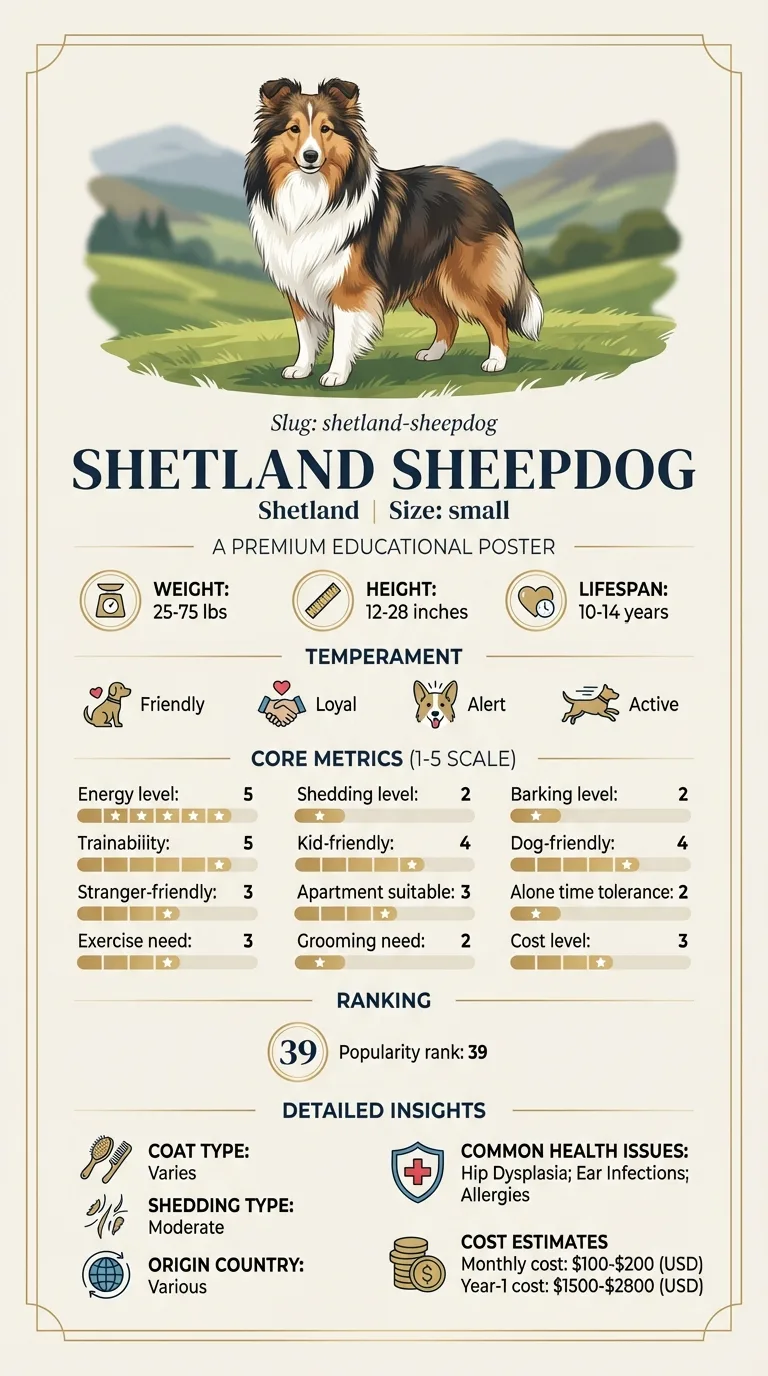
Owners told at a first vaccination that their puppy has a heart murmur. People who have read that DCM is the leading cardiac disease in Shelties and want to know whether that is true. Anyone deciding whether to proceed with a puppy who has a murmur.
This guide is not medical advice. If your dog shows pain, sudden behavior change, or worsening symptoms, consult a licensed veterinarian.
Some links may be affiliate links. We may earn a commission at no extra cost to you. We only suggest products we believe are helpful for dog owners.
We research and check what we publish, but we do not warrant that any figure, date, price, or statement is accurate, complete, or current, and we accept no liability for any loss, cost, injury, or other harm arising from the use of this site. Use it as one reference among several. You remain responsible for your own decisions and for your dog's care - confirm anything that matters with a licensed veterinarian or another qualified professional before you act on it. Full disclaimer.
Dilated cardiomyopathy is the progressive enlargement and weakening of the heart's main pumping chamber, ending in heart failure and, in some breeds, sudden death. Its distribution across breeds is unusually predictable, concentrating in large and giant dogs with identified genetic lines. For Shetland Sheepdog owners the practically relevant heart topic is not DCM at all but the murmur heard at a puppy examination, which requires a completely different response.
DCM is rare in dogs of this size and is not documented for the Shetland Sheepdog. Congenital heart defects, by contrast, occur across all breeds at a low but real rate and are the reason puppies are examined with a stethoscope before they leave for their new homes. Innocent puppy murmurs are common and harmless. The realistic expectation for a Sheltie owner is one of those two findings, not a cardiomyopathy diagnosis.
Body size is the dominant predictor and it works strongly in this breed's favour. At 15 to 25 pounds the Shetland Sheepdog sits in the group where age-related valve degeneration, not muscle disease, is the expected cardiac path. The breed's five documented conditions concern eyes, drug metabolism, skin and muscle, thyroid function and the kneecap, with no cardiac entry at all. Hypothyroidism is the one genuine indirect link, since low thyroid hormone reduces heart rate and contractility and can produce an appearance of poor cardiac performance that resolves entirely on thyroid treatment.
For congenital defects nothing in the environment is causal; the structure formed as it formed before birth. For acquired disease the environmental contributions are the familiar ones: excess body weight loading the heart, heat stress in a heavily double-coated dog making summer exercise disproportionately demanding, and diet composition, which remains under investigation following reports linking pulse-heavy grain-free foods to dilated heart changes across a range of breeds.
Seek urgent care for a puppy or adult with blue or grey gums, laboured breathing at rest, fainting or collapse, since these indicate the heart is not maintaining circulation and need immediate assessment. Book a prompt appointment for a puppy who tires far sooner than her littermates, who is not growing at the expected rate, or who coughs. Attend the scheduled recheck for any murmur heard at a puppy examination, and ask specifically for referral for an echocardiogram if a murmur is loud, if it persists beyond about five months, or if the puppy has any symptoms at all. Do not accept indefinite monitoring of an unexplained persistent murmur in a young dog.
See all Shetland Sheepdog health problems, which breeds are prone to dilated cardiomyopathy dcm, or the full Shetland Sheepdog breed guide for temperament, exercise needs and ownership costs.
An innocent puppy murmur typically resolves by four to five months and is confirmed gone at a recheck. A congenital defect is identified by echocardiogram in a single appointment, with treatment timing depending on the defect. Where DCM is diagnosed in any breed, it is managed with medication indefinitely and monitored every few months.
For most Sheltie owners success is a recheck at five months confirming the murmur has gone, and no further cardiac involvement for a decade. Where a real defect exists, success is identifying it early enough that the treatable ones get treated rather than discovered when the dog is already failing.
Murmurs in young puppies fall broadly into two groups. Innocent, or physiological, murmurs are soft, low grade, heard best over a small area, and they typically disappear by around four or five months as the puppy grows and the circulation matures. They are common, they mean nothing, and no treatment is needed. A vet who hears one will usually recommend rechecking at the next vaccination or by five months rather than acting immediately.
Congenital murmurs are the other group: structural defects present from birth. Some involve a valve that did not form correctly, some involve a hole between chambers, some involve a vessel that should have closed at birth and did not. These do not resolve with age. Several are treatable, and one in particular has an excellent outcome if it is corrected early and a poor one if it is missed, which is precisely why a persistent murmur in a young dog should be investigated rather than watched indefinitely.
Distinguishing the two by stethoscope alone is unreliable. Loud murmurs, murmurs still present at five months, murmurs in a puppy who tires more easily than her littermates, or murmurs in a puppy who is not growing well should be assessed by echocardiogram rather than monitored. That scan is what identifies the defect and determines whether anything can be done.
There is a practical breed note attached to any cardiac procedure. Correcting a congenital defect involves anesthesia, and the Shetland Sheepdog carries a documented MDR1 drug sensitivity. Testing the genotype early in a puppy with a known heart finding costs very little and removes an unknown from a plan that may need to move quickly.
DCM risk scales with body mass in a way that makes the breed lists remarkably consistent. These are the reasons that pattern holds.

Fyfe was nine weeks old when his first vaccination appointment turned up a soft murmur. The vet described it as probably innocent and asked to hear him again at his second vaccination and then at five months. His owner Sinead very nearly skipped the five month visit, because he was a boisterous, entirely normal puppy who never tired on a walk. She went anyway. The murmur was gone. What she took from the experience was less about Fyfe and more about the process: the vet explained that the whole reason for the five month appointment is the small number of puppies whose murmur is still there, because those are the ones where finding a treatable defect early changes the outcome. Sinead had also had his MDR1 tested at the same time and he carried two normal copies, which the practice recorded.
Key takeaway: The recheck exists for the puppies whose murmur does not disappear. Going when yours has is how the system finds the ones where it has not.
No, and that claim appears frequently online without support. No cardiac condition is documented for this breed at all, and the age-related disease small dogs actually develop is degeneration of the heart valves rather than disease of the muscle.
Not immediately, but do follow it up. Many puppy murmurs are innocent and disappear by four or five months. Book the recheck rather than skipping it, and ask for an echocardiogram if the murmur is still there at five months or is loud.
That is a conversation to have with your vet and the breeder together, once you know what the murmur actually is. An innocent murmur is not a defect. A significant congenital defect is a different matter and a good breeder will want to know regardless.
Some can, and outcomes for certain defects corrected early are excellent. Others are managed with medication. The determining factor is what the defect is, which is what the echocardiogram establishes, so the scan is the decision point rather than an optional extra.
Tiring far sooner than littermates, poor growth, a blue or grey tinge to the gums with exercise, fainting, coughing, or a rapid resting breathing rate. Any of those in a puppy with a known murmur warrants prompt reassessment.
It is not a documented feature of the Shetland Sheepdog. The breeds where sudden death is a recognised concern are those with inherited muscle and rhythm diseases, which is a group this breed does not belong to.
Rarely. It is a disease of large and giant breeds and does not appear on this breed's documented health profile.
Innocent ones usually disappear by four or five months. A murmur still present after that should be scanned rather than monitored.
Age-related degeneration of the heart valves, typically appearing in the second half of life rather than muscle disease.
Whether the litter was examined by a vet before leaving, whether any murmurs were noted, and what happened at the recheck.
A specialist scan is a several hundred dollar one-off cost, meaningful against a breed budget of eighty to a hundred and fifty dollars a month.
A one-page prep sheet for this condition: the signs, the questions to ask, what to get priced. Unlocks here.
You get: Vet visit prep sheet
No spam. One-click unsubscribe. See our privacy policy.
Preview page 1 before you decide.