Health
Is ARVC a Shetland Sheepdog disease?
No. It is characterised in Boxers and some other large breeds and does not appear on this breed's documented health profile.

Quick answer
Is ARVC a Shetland Sheepdog disease?
No. It is characterised in Boxers and some other large breeds and does not appear on this breed's documented health profile.
Before you worry about ARVC, it is worth knowing that this disease has a strong breed address and the Shetland Sheepdog is not at it. That does not make a fainting Sheltie less urgent.
Owners whose Sheltie has collapsed once and who have gone looking for a name for it. People who have read about sudden cardiac death in dogs and want to know whether their breed is on that list. Anyone told their dog has an irregular rhythm and now needs to know what happens next.
This guide is not medical advice. If your dog shows pain, sudden behavior change, or worsening symptoms, consult a licensed veterinarian.
Some links may be affiliate links. We may earn a commission at no extra cost to you. We only suggest products we believe are helpful for dog owners.
We research and check what we publish, but we do not warrant that any figure, date, price, or statement is accurate, complete, or current, and we accept no liability for any loss, cost, injury, or other harm arising from the use of this site. Use it as one reference among several. You remain responsible for your own decisions and for your dog's care - confirm anything that matters with a licensed veterinarian or another qualified professional before you act on it. Full disclaimer.
ARVC replaces working heart muscle with fat and scar tissue, creating an electrically unstable ventricle that fires off runs of abnormal beats. Dogs with it may faint, tire easily or, in the worst cases, die suddenly. It has a defined breed distribution centred on the Boxer, and the Shetland Sheepdog is not part of it. For Sheltie owners the value of this page is knowing what a collapse should actually prompt you to do.
Vanishingly rare as a diagnosis in Shetland Sheepdogs, and absent from the breed's documented condition list. Collapse itself is not rare in dogs generally, and the honest reading of a fainting Sheltie is that the cause is more likely to be a rhythm disturbance from another origin, a neurological event, or a drop in blood pressure from something outside the heart entirely.
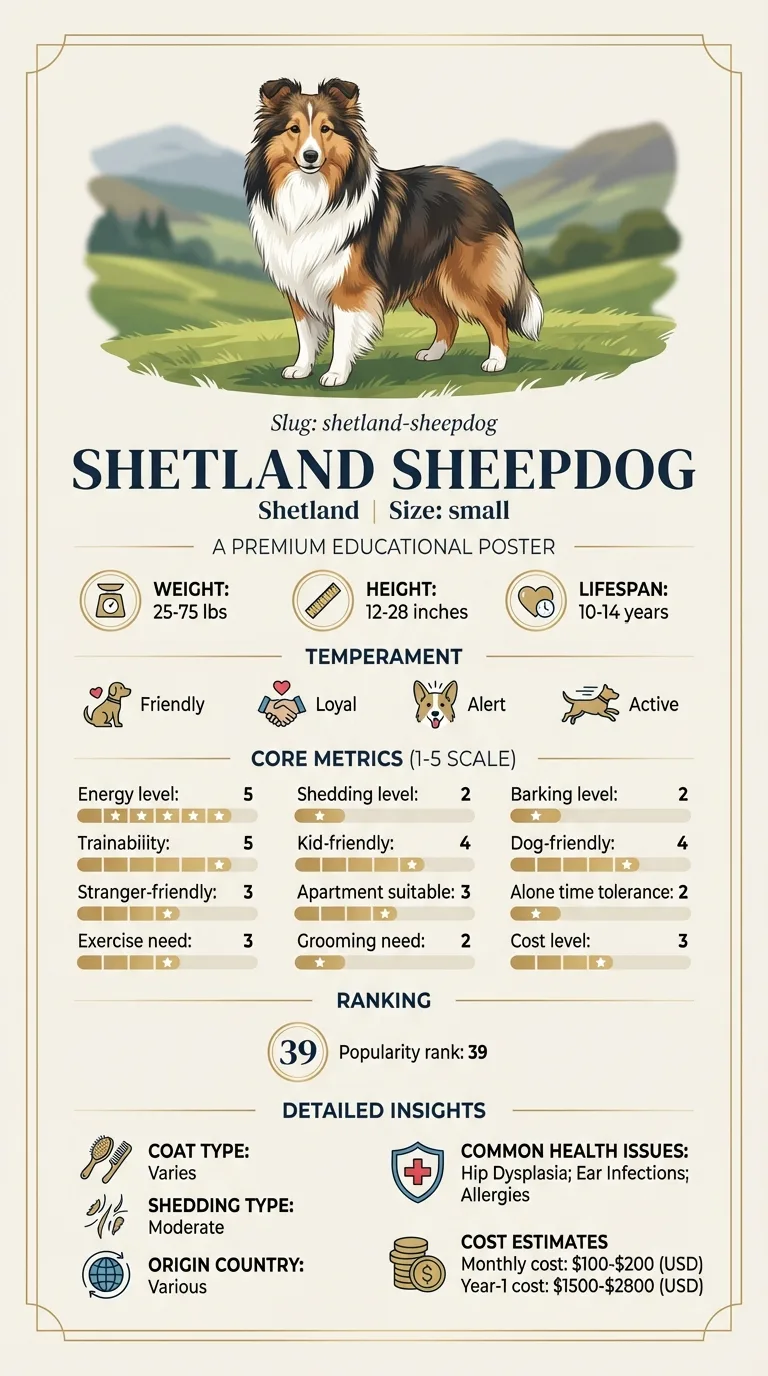
There is no known Shetland Sheepdog driver for ARVC specifically. The breed's documented cardiac relevance is indirect and runs through hypothyroidism, which alters heart rate and can contribute to exercise intolerance. At 15 to 25 pounds and with a typical lifespan of 12 to 14 years, Shelties reach an age where age-related valve disease becomes worth screening for, and that is a far more likely explanation for a murmur than a cardiomyopathy of the ARVC type.
Environment does not cause cardiomyopathy, but it shapes when problems become visible. A dog worked hard in agility or on long hill walks will show exercise-related collapse earlier than a dog who pootles round the block. Heat compounds it, because a long, dense double coat makes thermoregulation harder and an overheated dog can look cardiac when the real issue is temperature. Excess weight also loads a small heart unnecessarily.
Any collapse or fainting episode is worth a veterinary appointment even if the dog seems perfectly normal an hour later. Go immediately for a dog who collapses repeatedly in a short period, who has pale or blue-tinged gums, who has laboured breathing, who has a swollen abdomen, or who does not fully return to normal after an episode. Those are emergency signs and belong in a hospital that night. Ask for an urgent appointment rather than a routine one if your dog is coughing at rest, is unusually tired on ordinary walks, or is breathing faster than normal while asleep, because those three together suggest the heart is struggling.
See all Shetland Sheepdog health problems, which breeds are prone to arrhythmogenic right ventricular cardiomyopathy arvc, or the full Shetland Sheepdog breed guide for temperament, exercise needs and ownership costs.
Reaching a diagnosis usually takes two to six weeks, since it often involves a Holter recording, an ultrasound and bloodwork booked at different times. Rhythm problems that are found are managed rather than cured, with medication adjusted over months against repeat monitoring.
For most Shelties, success is a set of normal results and a documented explanation for the episode. Where a real rhythm disturbance is found, success is a dog with a stable heart rate on treatment who exercises comfortably and does not faint.
This distinction decides which specialist your dog needs, and owners are the only witnesses. What you notice in the first ten seconds matters more than anything measured later.
When a Shetland Sheepdog does turn out to have an arrhythmia, the underlying cause is generally something other than ARVC. Rhythm disturbances arise from valve disease, from congenital defects present since birth, from systemic illness affecting electrolytes, from pain and from thyroid disease. Hypothyroidism is one of the five conditions documented in this breed, and low thyroid hormone can slow the heart and alter its behaviour, which is one concrete reason a cardiac workup in a Sheltie usually includes bloodwork.
The diagnostic path is fairly standard whatever the suspicion. A stethoscope catches a murmur or an irregular beat. An electrocardiogram records the rhythm at that moment. Because arrhythmias are intermittent by nature, a normal in-clinic trace proves very little, so a Holter monitor worn at home for twenty four hours is often the tool that actually finds the problem. An ultrasound scan then shows whether the muscle and valves are structurally abnormal.
There is a breed detail worth flagging before any of this happens. Some cardiac procedures and the sedation used for imaging bring the Sheltie's documented MDR1 drug sensitivity into play. If your dog is heading for a cardiology referral, get the genotype tested first so the specialist is not making drug choices around an unknown.

Tarn was a five year old Sheltie who dropped mid-run at a flyball practice, was up within four seconds, and finished the session as though nothing had happened. His owner Callum assumed he had tripped. It happened again a fortnight later. The in-clinic electrocardiogram was completely normal, which Callum found more unsettling than reassuring. A twenty four hour Holter recorded three short runs of very fast beats, both while Tarn was excited about a delivery van. Bloodwork also showed underactive thyroid function. He was treated for the thyroid, monitored, and re-recorded three months later with a considerably calmer trace. Callum kept him in flyball but stopped running him in hot weather.
Key takeaway: A normal trace in clinic rules out almost nothing. If the episodes are real, ask about wearing a monitor at home.
There is no documented predisposition. The Shetland Sheepdog's recorded health conditions are Collie Eye Anomaly, MDR1 drug sensitivity, dermatomyositis, hypothyroidism and patellar luxation. ARVC is principally a Boxer disease with recognition in some other large breeds.
A single genuine faint always deserves investigation, whatever the breed. Losing consciousness means the brain briefly lost its blood supply, and that is worth understanding rather than waiting to see whether it repeats.
Film the next episode if there is one. A ten second phone video of how the dog collapses and recovers is more diagnostically useful than a page of description, and it often settles the faint-or-seizure question immediately.
Yes. Electrode sites are clipped, which on a heavily coated breed means small bald patches that take a few months to fill in. It is worth it, because intermittent arrhythmias are easily missed on a short in-clinic recording.
Until a cause is known, ask your vet rather than deciding yourself. Shelties have an exercise need rated four out of five and hate being under-exercised, but if collapse follows exertion then flat-out running is exactly what you want to avoid meanwhile.
It is not a documented feature of the Shetland Sheepdog. That said, any dog with an unexplained collapse should be assessed, because the reassurance is only worth having once someone has actually listened to the heart.
No. It is characterised in Boxers and some other large breeds and does not appear on this breed's documented health profile.
A Holter monitor worn at home for twenty four hours. A single clinic electrocardiogram often misses rhythms that come and go.
Say what the dog was doing beforehand, whether she stiffened or went limp, how long it lasted, and how quickly she was normal afterwards.
Specialist imaging and monitoring sit far outside the breed's ordinary monthly running cost, which is why insurance taken out before symptoms appear matters.
Pause high-intensity work until your vet has assessed the heart, and replace it with scentwork or trick training to keep a bright dog occupied.
A one-page prep sheet for this condition: the signs, the questions to ask, what to get priced. Unlocks here.
You get: Vet visit prep sheet
No spam. One-click unsubscribe. See our privacy policy.
Preview page 1 before you decide.