Health
What decides whether a dog can get stomach torsion?
Chest shape, mainly. Deep narrow chests give the stomach room to rotate. Compact builds like a Sheltie's largely do not.

Quick answer
What decides whether a dog can get stomach torsion?
Chest shape, mainly. Deep narrow chests give the stomach room to rotate. Compact builds like a Sheltie's largely do not.
The dangerous part of bloat is not the gas. It is the twist. Understanding why a stomach rotates explains why some dogs are built for this disaster and others, including this breed, largely are not.
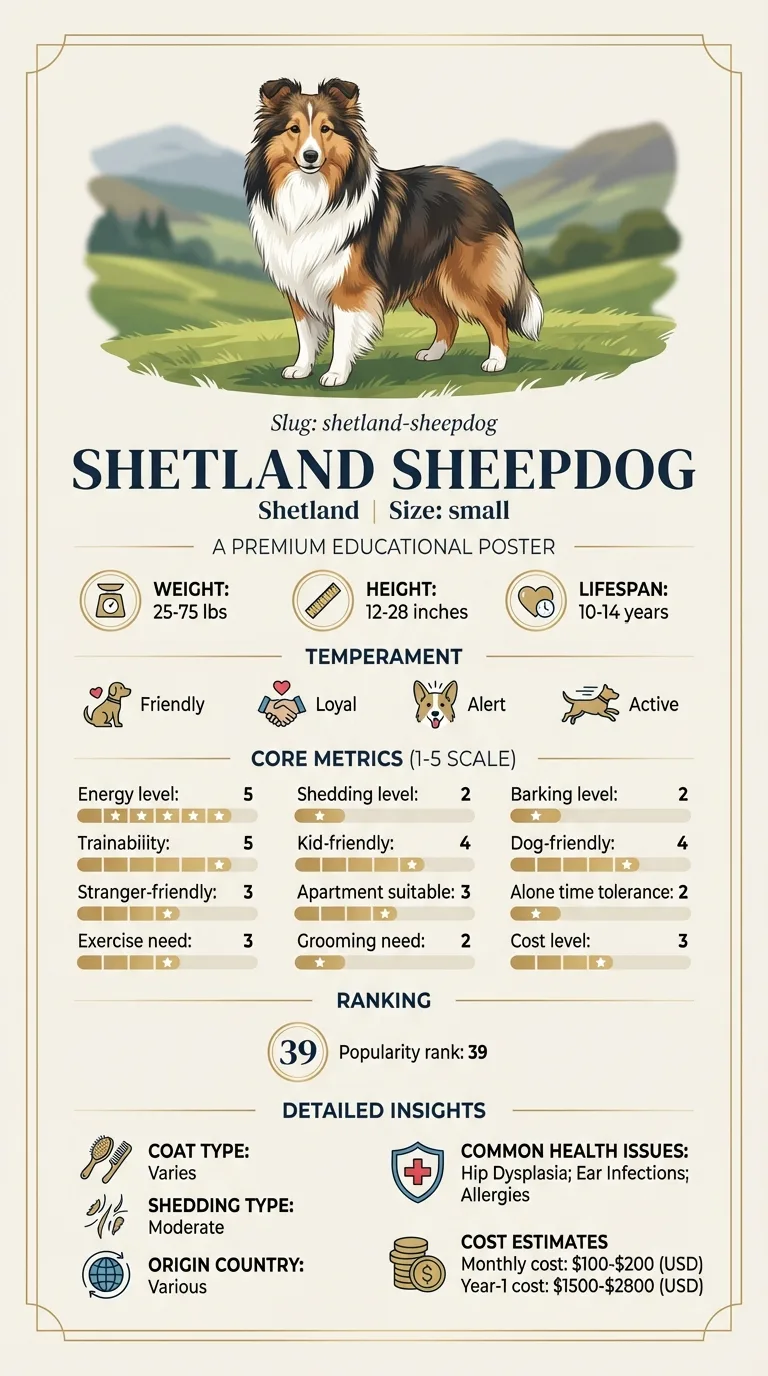
Owners setting up feeding routines for a new Sheltie puppy. People with a multi-dog household where meals are competitive and fast. Anyone who has owned a large breed before and is recalibrating what precautions actually apply here.
This guide is not medical advice. If your dog shows pain, sudden behavior change, or worsening symptoms, consult a licensed veterinarian.
Some links may be affiliate links. We may earn a commission at no extra cost to you. We only suggest products we believe are helpful for dog owners.
We research and check what we publish, but we do not warrant that any figure, date, price, or statement is accurate, complete, or current, and we accept no liability for any loss, cost, injury, or other harm arising from the use of this site. Use it as one reference among several. You remain responsible for your own decisions and for your dog's care - confirm anything that matters with a licensed veterinarian or another qualified professional before you act on it. Full disclaimer.
Stomach torsion is the rotation of a gas-distended stomach around its own long axis, sealing both openings and cutting off its own blood supply. Everything dangerous about bloat follows from that single mechanical event. Because rotation requires physical space, breeds with deep narrow chests dominate the case records and compact breeds like the Shetland Sheepdog appear rarely. Prevention is therefore mostly about not creating the distension in the first place.
Genuinely uncommon in dogs of this size and absent from the Shetland Sheepdog's documented health profile, which lists eye, drug sensitivity, skin-muscle, thyroid and kneecap conditions. Lifetime risk in giant deep-chested breeds is measured in double-digit percentages. For a compact 20 pound herding dog it is a rare event, and the prevention measures on this page are cheap insurance rather than urgent necessities.
Conformation is the dominant factor and it works in this breed's favour. The Shetland Sheepdog's chest depth to width ratio and its small abdominal volume leave little room for a distended stomach to swing. Body weight of 15 to 25 pounds keeps the organ itself small. What the breed does bring is a temperament that experiences stress readily, reflected in ratings of two out of five for tolerating time alone and two out of five for ease with strangers, and stress is a repeatedly identified association in the torsion literature. Food motivation in a trainable working breed also produces very fast eaters.
Household routine determines almost all of the modifiable risk. Competitive feeding in a multi-dog home accelerates eating dramatically. Free feeding a large bowl invites a single enormous meal. Exercising a dog straight after eating, or letting a hot, panting dog drink an entire bowl in one go, both increase gastric distension. Unstable routines, boarding kennels and periods of household upheaval have all been linked to increased incidence across breeds.
Prevention questions belong in an ordinary consultation, ideally at a puppy check or annual visit, where you can ask about meal sizes and whether anything about your dog's build gives your vet pause. Seek urgent same-day help for a dog with a persistently swollen abdomen, repeated episodes of a bloated belly after meals, or unexplained abdominal discomfort, since recurrent distension can point to a partial or intermittent problem that will not fix itself. Go to an emergency hospital immediately, without delay, for a dog retching without producing anything, pacing and unable to settle, drooling heavily, or with a tight drum-like abdomen. Do not offer food or water on the way.
See all Shetland Sheepdog health problems, which breeds are prone to bloat gdv, or the full Shetland Sheepdog breed guide for temperament, exercise needs and ownership costs.
Feeding changes take effect immediately, and most dogs adapt to split meals and a slow feeder within a week. Building a reliable post-meal settle takes two to four weeks of short daily sessions. There is nothing here that needs months.
A dog who eats a measured meal over several minutes rather than seconds, settles quietly afterwards, and maintains a stable weight within the 15 to 25 pound range. The prevention is invisible by design, and the absence of an emergency is the whole point.
None of these are Sheltie-specific medical interventions. They are sensible defaults for any dog, and they happen to remove most of the modifiable risk that torsion research has identified.
The strongest single predictor of torsion risk is the ratio between the depth of the chest and its width. A deep, narrow chest creates a tall vertical space where a gas-filled stomach has leverage to swing. A broad, shallower chest hems it in. This is why the incidence tables are dominated by Great Danes, Irish Setters, Standard Poodles and Weimaraners, and why the same tables run almost empty at the small, compactly built end.
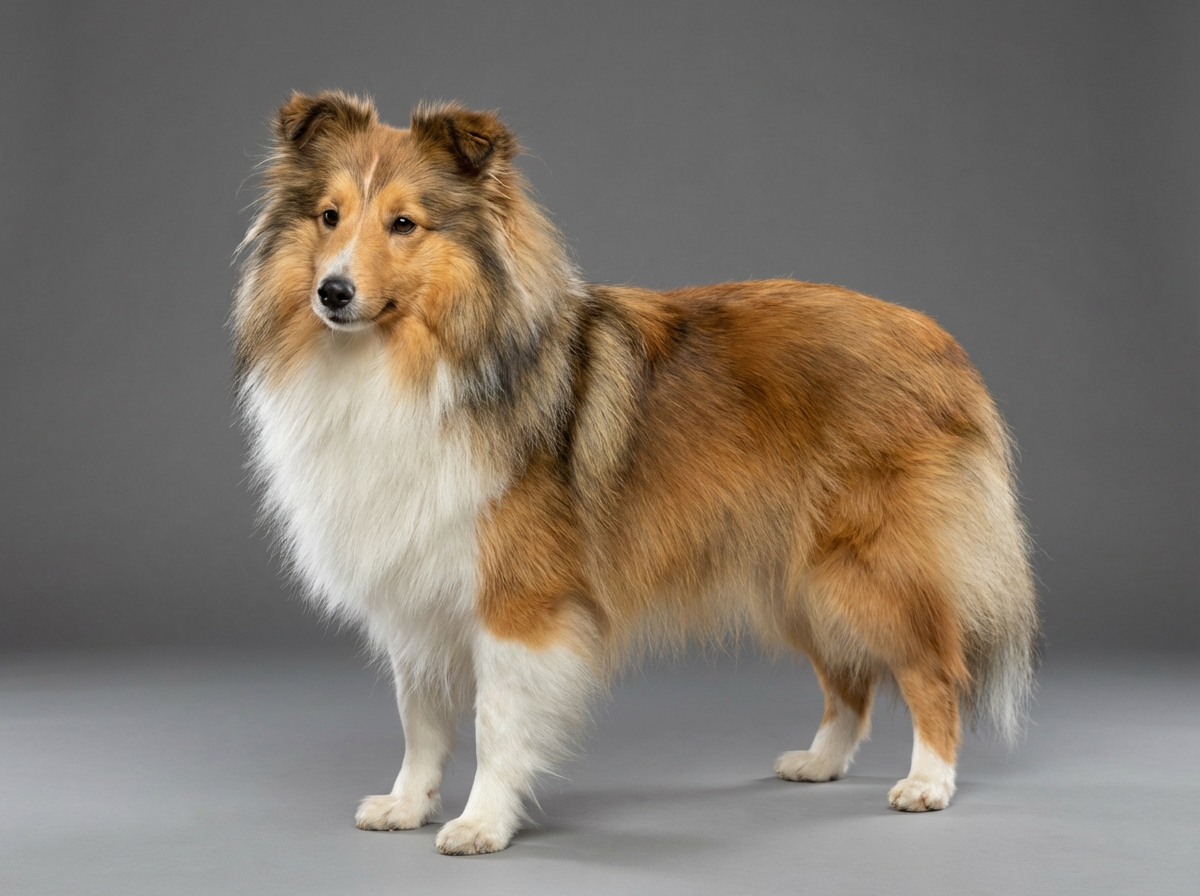
A Shetland Sheepdog stands 13 to 16 inches at the shoulder and weighs 15 to 25 pounds. The chest has reasonable depth for a working herding dog but nothing approaching the proportions that create the problem, and total abdominal volume is small. Gastric torsion is not among the five conditions documented for this breed. Owners who have previously kept a large breed and carry that anxiety forward can genuinely relax the level of vigilance, without abandoning it altogether.
Related risk factors that do transfer are age and temperament. Incidence rises in older dogs in every breed studied, as the ligaments supporting the stomach stretch. And anxious, easily stressed dogs appear at higher rates in the data than placid ones. Shetland Sheepdogs are rated two out of five for tolerance of being left alone and two out of five for confidence with strangers, so this is a breed that experiences stress readily. That is one more reason a predictable routine is worth maintaining, though it is a far weaker factor than conformation.
One planning note. If your dog ever does need emergency abdominal surgery for any reason, the Shetland Sheepdog's documented MDR1 drug sensitivity is relevant to the anesthetic plan. Having a tested genotype in the file removes a variable from a situation that will already have too many.

If you think your Shetland has bloat, the plan is three steps: write down what you have seen and when it started, book a veterinary appointment rather than waiting for the next flare, and take video of the behaviour or symptom before you go — the thing you are worried about rarely happens in the consulting room. Screening in the parents covers collie eye anomaly, mdr1 drug sensitivity, dermatomyositis.
What the vet visit should produce is a diagnosis and a written plan, not just reassurance: what is being ruled out, what the monitoring interval is, and which signs mean you come back sooner. Ask what the treatment costs across a year rather than per visit, because that is the number that decides whether you are managing this condition or reacting to it.
Between appointments, keep a short log — dates, what you saw, what changed. It is the single most useful thing an owner brings to a follow-up, and for bloat it is often what separates a clear pattern from a guess.
Isla was a young Sheltie sharing a kitchen with Bruno, a considerably larger and considerably greedier crossbreed. Their owner Marek fed them side by side and had grown used to both bowls being empty within twenty seconds. Isla burped constantly after meals and twice brought food straight back up. Marek's vet was not worried about torsion given her build, but pointed out that a dog eating that fast was swallowing a great deal of air, and that competition was the reason. The fix was mundane: Bruno now eats in the utility room, Isla eats in the kitchen from a slow feeder, and both get a settle on their mats afterwards. Her meals take four minutes instead of twenty seconds and the burping stopped within a fortnight.
Key takeaway: Fast eating is almost always about competition, not appetite. Separate the bowls before you buy anything.
The rotation itself is sudden. Some dogs have a period of gas build-up beforehand, which is why an early-caught case may be simple distension without torsion, but once it turns, the deterioration is rapid.
It is not standard practice for this breed. Prophylactic gastropexy is offered routinely to giant and deep-chested breeds where lifetime risk is substantial. Raise it with your vet if there is a specific reason, but do not expect it to be recommended by default.
Studies have looked at diet composition and particle size with inconsistent results. What holds up more reliably is eating speed and meal size, both of which you control regardless of what is in the bowl.
Not by itself. Frequent burping usually reflects a fast eater swallowing air and is worth addressing with a slow feeder. What matters is a dog who cannot burp or vomit despite trying, because that is the sealed stomach.
The association appears repeatedly in the research, though the mechanism is not settled. For a breed that scores low on alone-time tolerance it is a reasonable argument for consistency in feeding times and household routine, rather than a cause for alarm.
Both are worth spacing out. The commonly recommended pattern is to let a dog settle for a while before eating and for an hour or so afterwards, which is easy to build into a normal day.
The early signs are set out in the sections above, and they are the reason to book a veterinary appointment rather than wait. Bloat in Shetlands is diagnosed by a vet, not from a symptom list, and the sooner it is on record the more options remain open.
The early signs are set out in the sections above, and they are the reason to book a veterinary appointment rather than wait. Bloat in Shetland Sheepdogs is diagnosed by a vet, not from a symptom list, and the sooner it is on record the more options remain open.
Chest shape, mainly. Deep narrow chests give the stomach room to rotate. Compact builds like a Sheltie's largely do not.
Two or three measured meals a day from a slow feeder, with a calm hour after eating. Simple and effective.
Yes, incidence rises with age in every breed studied, as the ligaments supporting the stomach lose tension.
For a fast-eating dog, yes. It is inexpensive relative to the breed's eighty to a hundred and fifty dollar monthly running cost and doubles as enrichment.
Somewhat. Hand-feeding portions and scatter feeding both slow a gulper, and a breed rated five out of five for trainability adapts quickly.
A one-page prep sheet for this condition: the signs, the questions to ask, what to get priced. Unlocks here.
You get: Vet visit prep sheet
No spam. One-click unsubscribe. See our privacy policy.
Preview page 1 before you decide.